
ABSTRACTING Introduction n n Abstracts written to decrease
ABSTRACTING

Introduction n n Abstracts – written to decrease the time and effort it takes to search the overwhelming output from research and scholarship around the world Exponential research publications – Difficulty to keep track of it – users need not want to read everything – they want some specific information that relate to their current activity Abstract helps them to decide among the bulk Satisfy users needs for both current and exhaustive retrospective information
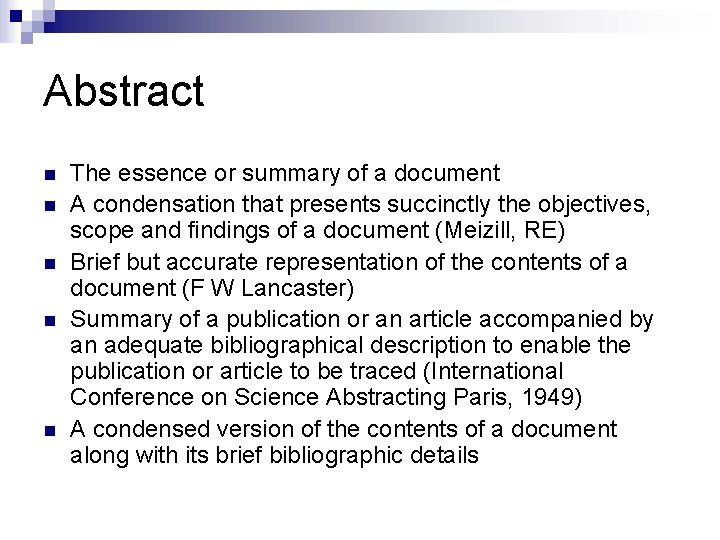
Abstract n n n The essence or summary of a document A condensation that presents succinctly the objectives, scope and findings of a document (Meizill, RE) Brief but accurate representation of the contents of a document (F W Lancaster) Summary of a publication or an article accompanied by an adequate bibliographical description to enable the publication or article to be traced (International Conference on Science Abstracting Paris, 1949) A condensed version of the contents of a document along with its brief bibliographic details
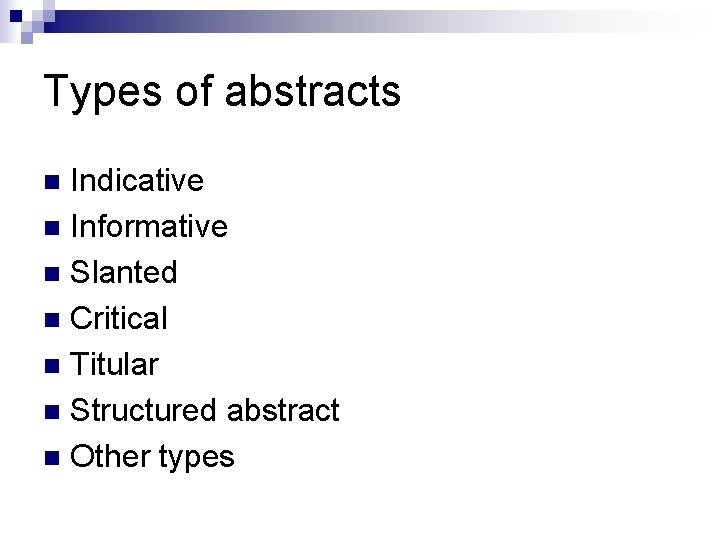
Types of abstracts Indicative n Informative n Slanted n Critical n Titular n Structured abstract n Other types n
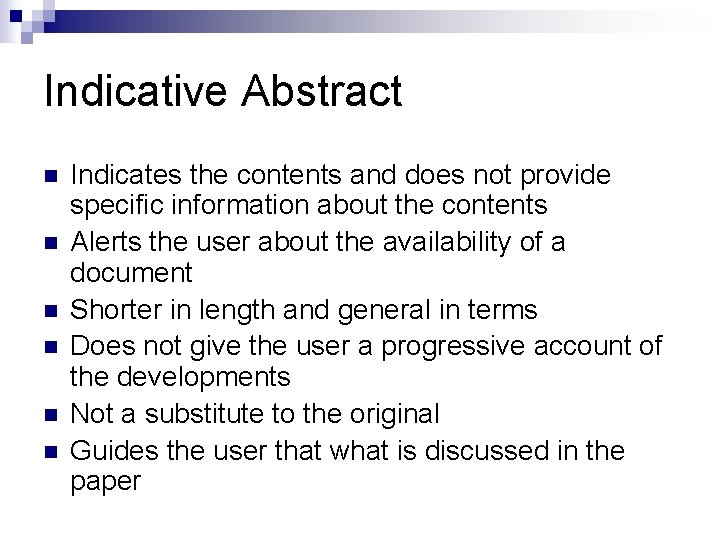
Indicative Abstract n n n Indicates the contents and does not provide specific information about the contents Alerts the user about the availability of a document Shorter in length and general in terms Does not give the user a progressive account of the developments Not a substitute to the original Guides the user that what is discussed in the paper
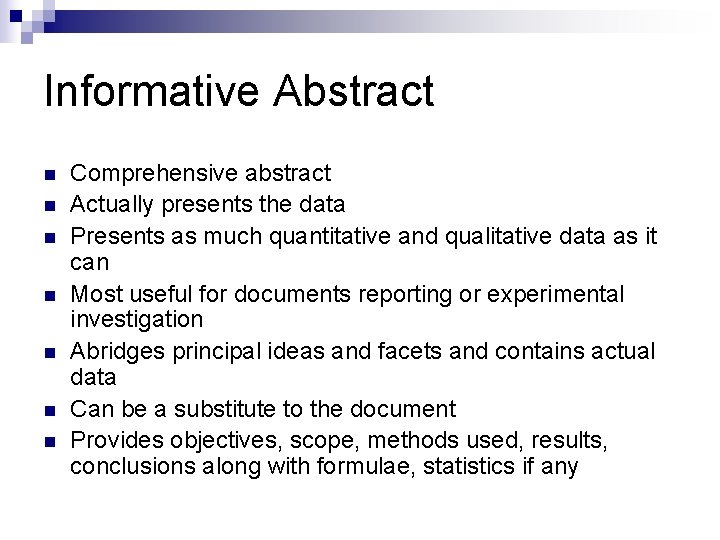
Informative Abstract n n n n Comprehensive abstract Actually presents the data Presents as much quantitative and qualitative data as it can Most useful for documents reporting or experimental investigation Abridges principal ideas and facets and contains actual data Can be a substitute to the document Provides objectives, scope, methods used, results, conclusions along with formulae, statistics if any
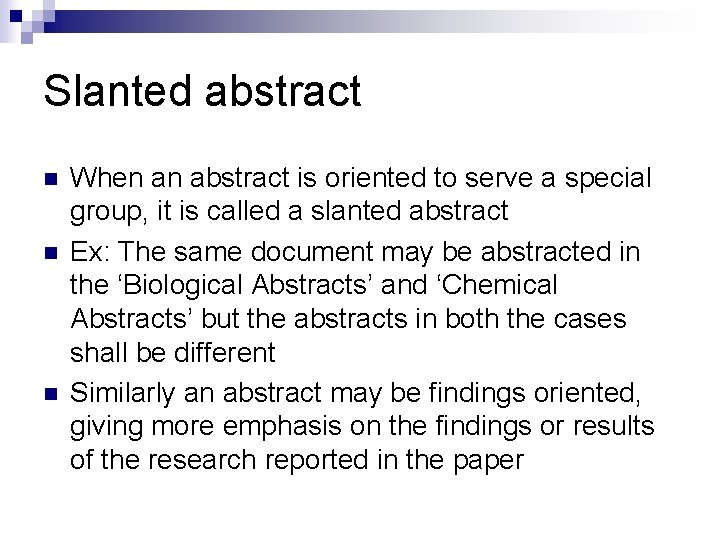
Slanted abstract n n n When an abstract is oriented to serve a special group, it is called a slanted abstract Ex: The same document may be abstracted in the ‘Biological Abstracts’ and ‘Chemical Abstracts’ but the abstracts in both the cases shall be different Similarly an abstract may be findings oriented, giving more emphasis on the findings or results of the research reported in the paper
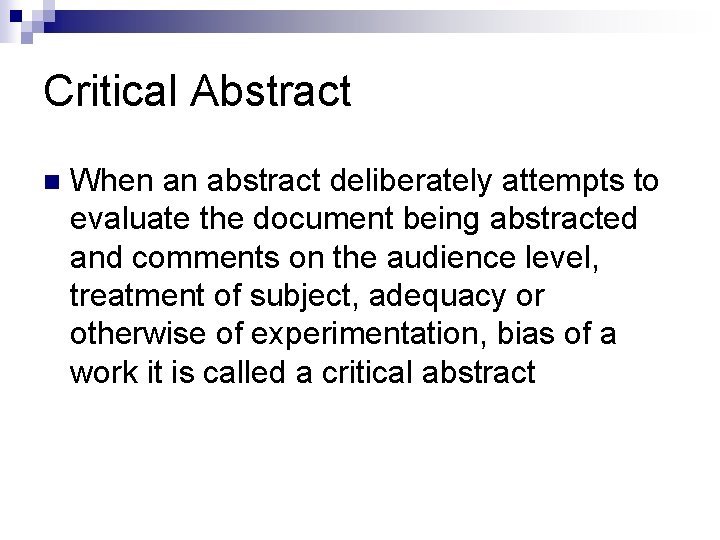
Critical Abstract n When an abstract deliberately attempts to evaluate the document being abstracted and comments on the audience level, treatment of subject, adequacy or otherwise of experimentation, bias of a work it is called a critical abstract
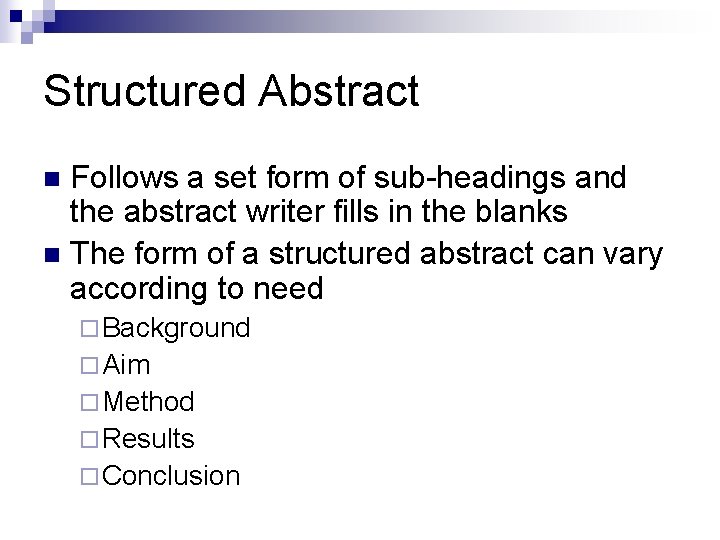
Structured Abstract Follows a set form of sub-headings and the abstract writer fills in the blanks n The form of a structured abstract can vary according to need n ¨ Background ¨ Aim ¨ Method ¨ Results ¨ Conclusion
Other types n n n n n Author abstract Specialist’s abstract Abstrctor’s abstract Article abstract Patents abstract Abstract of standards Abstract of Bibliography Graphic abstract Telegraphic abstract Numerical abstract
Purpose of abstract n n n n Facilitate selection (filtered access) Saves time Substituting the article itself Useful in illuminating the content of items written in languages unfamiliar to a particular reader Useful tool for current awareness Helps the indexer in identifying central subject matter of the item as rapidly as possible Facilitates the identification of pertinent items and by providing access to stored items (Computer based information retrieval)
Qualities of an abstract n n Brief, precise and objective Brevity should not be at the cost of essential information As regards precision the abstract should be free from the subjective judgment of the abstractor Language of an abstract should be simple, straight and intelligible
Elements of abstract n Good abstract should include all or most of the following ¨ Purpose ¨ Scope ¨ Methodology ¨ Data ¨ Results ¨ Conclusions ¨ Additional information
Parts of an abstract Citation or Bibliographical information n Abstract proper n Name of the abstractor n
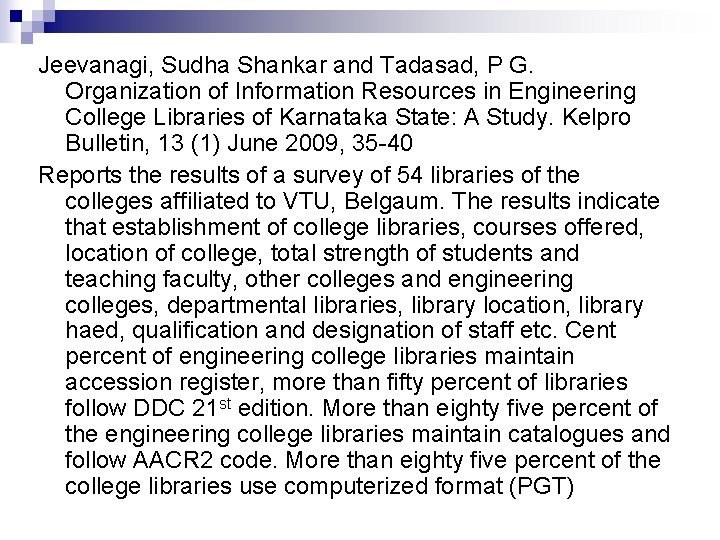
Jeevanagi, Sudha Shankar and Tadasad, P G. Organization of Information Resources in Engineering College Libraries of Karnataka State: A Study. Kelpro Bulletin, 13 (1) June 2009, 35 -40 Reports the results of a survey of 54 libraries of the colleges affiliated to VTU, Belgaum. The results indicate that establishment of college libraries, courses offered, location of college, total strength of students and teaching faculty, other colleges and engineering colleges, departmental libraries, library location, library haed, qualification and designation of staff etc. Cent percent of engineering college libraries maintain accession register, more than fifty percent of libraries follow DDC 21 st edition. More than eighty five percent of the engineering college libraries maintain catalogues and follow AACR 2 code. More than eighty five percent of the college libraries use computerized format (PGT)
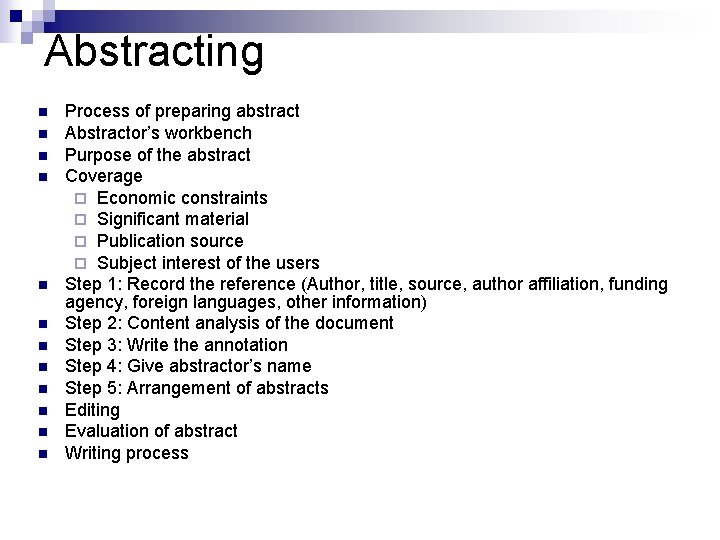
Abstracting n n n Process of preparing abstract Abstractor’s workbench Purpose of the abstract Coverage ¨ Economic constraints ¨ Significant material ¨ Publication source ¨ Subject interest of the users Step 1: Record the reference (Author, title, source, author affiliation, funding agency, foreign languages, other information) Step 2: Content analysis of the document Step 3: Write the annotation Step 4: Give abstractor’s name Step 5: Arrangement of abstracts Editing Evaluation of abstract Writing process
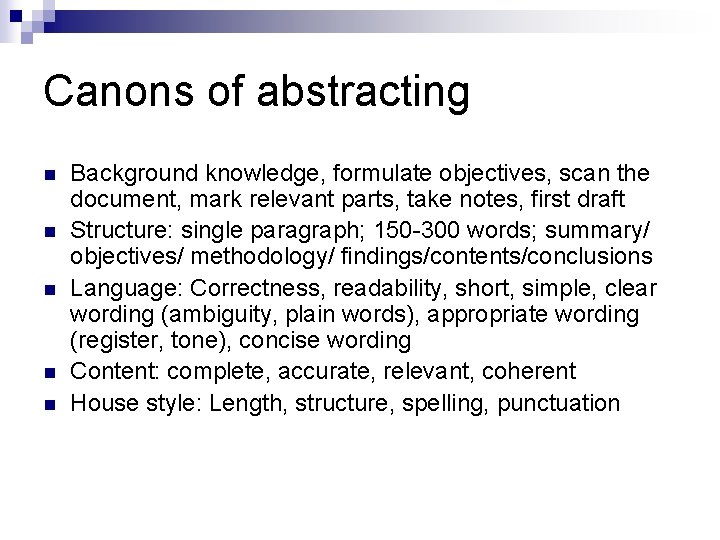
Canons of abstracting n n n Background knowledge, formulate objectives, scan the document, mark relevant parts, take notes, first draft Structure: single paragraph; 150 -300 words; summary/ objectives/ methodology/ findings/contents/conclusions Language: Correctness, readability, short, simple, clear wording (ambiguity, plain words), appropriate wording (register, tone), concise wording Content: complete, accurate, relevant, coherent House style: Length, structure, spelling, punctuation

THANK YOU
- Slides: 18