
Abstract Writing Process UCLan Boot Camp Mahmood Shah
Abstract Writing Process UCLan Boot Camp Mahmood Shah

What Is an Abstract? A brief, written explanation of the research project, consisting of a succinct description of the project’s purpose, the procedures followed, the data collected, and the conclusions reached. A clear and simple summary statement of the main points of the experiment A self-contained statement that must make sense all by itself.
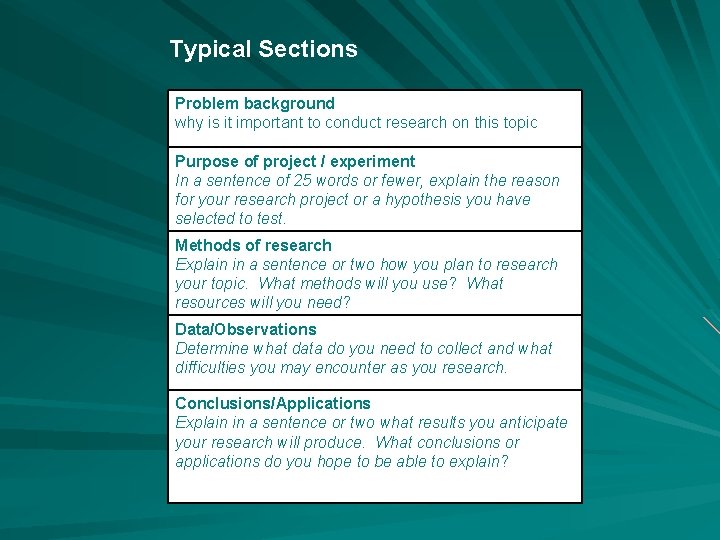
Typical Sections Problem background why is it important to conduct research on this topic Purpose of project / experiment In a sentence of 25 words or fewer, explain the reason for your research project or a hypothesis you have selected to test. Methods of research Explain in a sentence or two how you plan to research your topic. What methods will you use? What resources will you need? Data/Observations Determine what data do you need to collect and what difficulties you may encounter as you research. Conclusions/Applications Explain in a sentence or two what results you anticipate your research will produce. What conclusions or applications do you hope to be able to explain?

Explanation of Parts Introduction to the problem (1 -3 sentences) Aim of the research Purpose of the Experiment An introductory statement of the reason for investigating the topic of the project. A statement of the problem or hypothesis being studied. Procedures Used A summarization of the key points and an overview of how the investigation was conducted. An abstract does not give details about the materials used unless it greatly influenced the procedure or had to be developed to do the investigation. An abstract should only include procedures done by the student. Work done by a mentor (such as surgical procedures) or work done prior to student involvement must not be included. Observation/Data/Results This section should provide key results that lead directly to the conclusions you have drawn. It should not give too many details about the results nor include tables or graphs. Conclusions from the investigation should be described briefly. The summary paragraph should reflect on the process and possibly state some applications and extensions of the investigation. An abstract does not include a bibliography unless specifically required by your local fair. The Intel ISEF requires the bibliography as part of the research plan to be provided on Form 1 A.

Writing and Revising Tips Simply put, the style of an abstract should always be declarative not discursive. Emphasize these aspects: purpose (hypothesis), methods, scope, results, conclusions, and recommendations Omit details and discussions Use the past tense to describe (However, where appropriate use active verbs rather than passive verbs. ) Use short sentences, but vary sentence structure. Use complete sentences (Do not abbreviate by omitting articles or other small words in order to save space. ) Avoid jargon Use appropriate scientific language Use concise syntax Use correct spelling, grammar, and punctuation
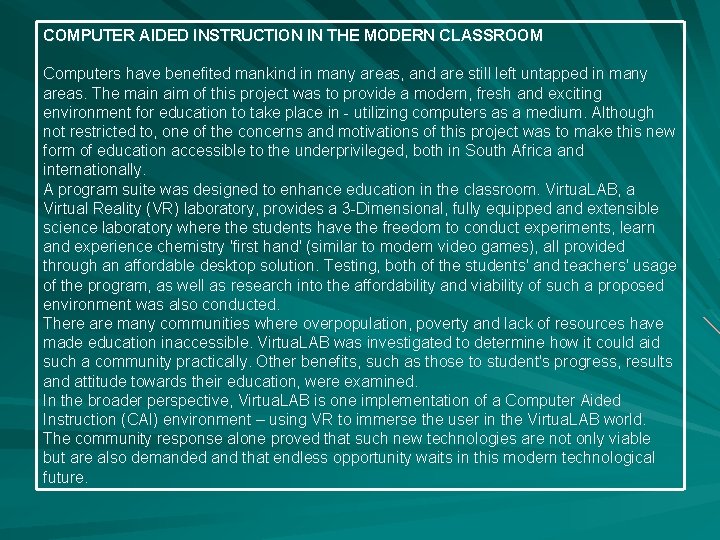
COMPUTER AIDED INSTRUCTION IN THE MODERN CLASSROOM Computers have benefited mankind in many areas, and are still left untapped in many areas. The main aim of this project was to provide a modern, fresh and exciting environment for education to take place in - utilizing computers as a medium. Although not restricted to, one of the concerns and motivations of this project was to make this new form of education accessible to the underprivileged, both in South Africa and internationally. A program suite was designed to enhance education in the classroom. Virtua. LAB, a Virtual Reality (VR) laboratory, provides a 3 -Dimensional, fully equipped and extensible science laboratory where the students have the freedom to conduct experiments, learn and experience chemistry 'first hand' (similar to modern video games), all provided through an affordable desktop solution. Testing, both of the students' and teachers' usage of the program, as well as research into the affordability and viability of such a proposed environment was also conducted. There are many communities where overpopulation, poverty and lack of resources have made education inaccessible. Virtua. LAB was investigated to determine how it could aid such a community practically. Other benefits, such as those to student's progress, results and attitude towards their education, were examined. In the broader perspective, Virtua. LAB is one implementation of a Computer Aided Instruction (CAI) environment – using VR to immerse the user in the Virtua. LAB world. The community response alone proved that such new technologies are not only viable but are also demanded and that endless opportunity waits in this modern technological future.
- Slides: 6