
Abstract writing An abstract must be a fully
Abstract writing An abstract must be a fully self-contained, capsule description of the paper. It must make sense all by itself
An Abstract…. . n Condense the whole paper into miniature form. A sentence or two summarizing each of the IMRAD sections should suffice. No new information, no supporting material, limited details, just the essential message that explains what you did and found out. Write this section last of all.
When do people write abstracts? n when submitting articles to journals, especially online journals n when applying for research grants n when writing a book proposal n when completing the Ph. D. dissertation or MA thesis n when writing a proposal for a conference paper n when writing a proposal for a book chapter
Types of abstracts Descriptive abstracts o A descriptive abstract indicates the type of information found in the work. It makes no judgments about the work, nor does it provide results or conclusions of the research. It may include the purpose, methods, and scope of the research. o Some people consider it an outline of the work, rather than a summary. o Descriptive abstracts are usually very short— 100 words or less.
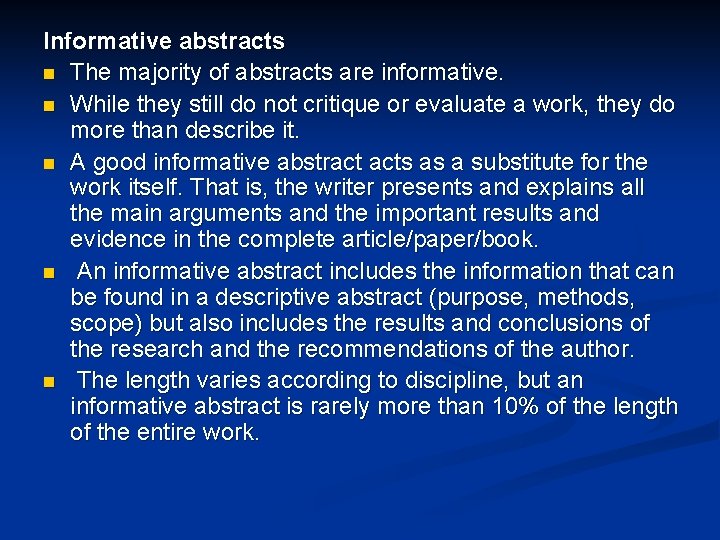
Informative abstracts n The majority of abstracts are informative. n While they still do not critique or evaluate a work, they do more than describe it. n A good informative abstract acts as a substitute for the work itself. That is, the writer presents and explains all the main arguments and the important results and evidence in the complete article/paper/book. n An informative abstract includes the information that can be found in a descriptive abstract (purpose, methods, scope) but also includes the results and conclusions of the research and the recommendations of the author. n The length varies according to discipline, but an informative abstract is rarely more than 10% of the length of the entire work.
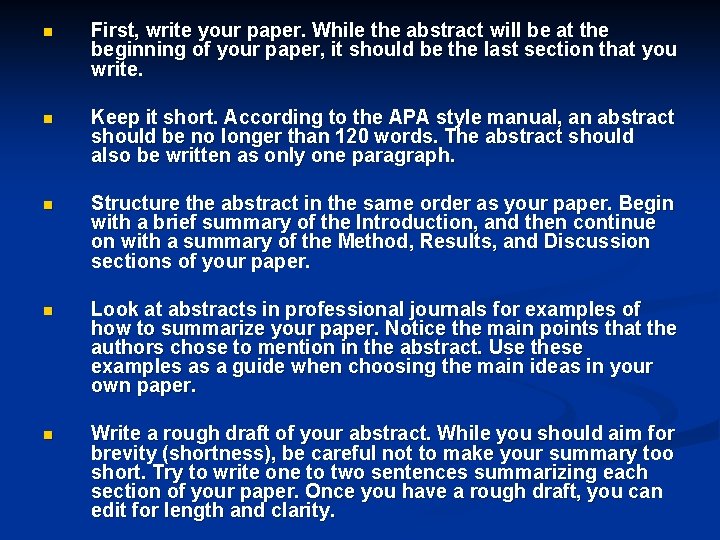
n First, write your paper. While the abstract will be at the beginning of your paper, it should be the last section that you write. n Keep it short. According to the APA style manual, an abstract should be no longer than 120 words. The abstract should also be written as only one paragraph. n Structure the abstract in the same order as your paper. Begin with a brief summary of the Introduction, and then continue on with a summary of the Method, Results, and Discussion sections of your paper. n Look at abstracts in professional journals for examples of how to summarize your paper. Notice the main points that the authors chose to mention in the abstract. Use these examples as a guide when choosing the main ideas in your own paper. n Write a rough draft of your abstract. While you should aim for brevity (shortness), be careful not to make your summary too short. Try to write one to two sentences summarizing each section of your paper. Once you have a rough draft, you can edit for length and clarity.
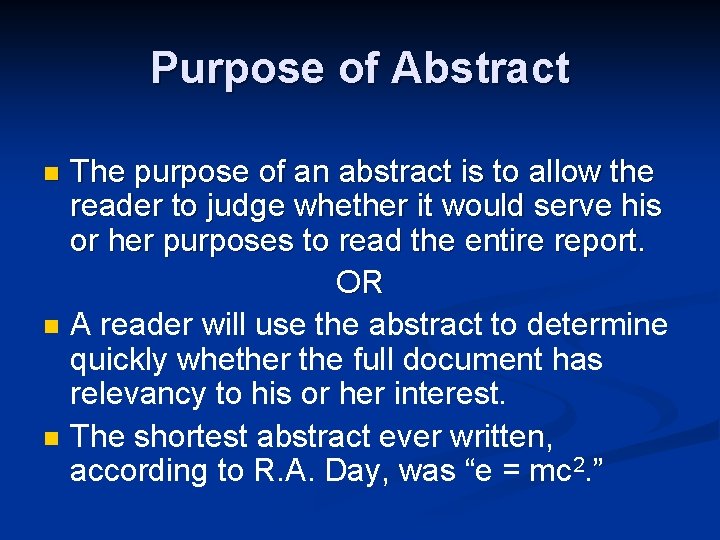
Purpose of Abstract n n n The purpose of an abstract is to allow the reader to judge whether it would serve his or her purposes to read the entire report. OR A reader will use the abstract to determine quickly whether the full document has relevancy to his or her interest. The shortest abstract ever written, according to R. A. Day, was “e = mc 2. ”
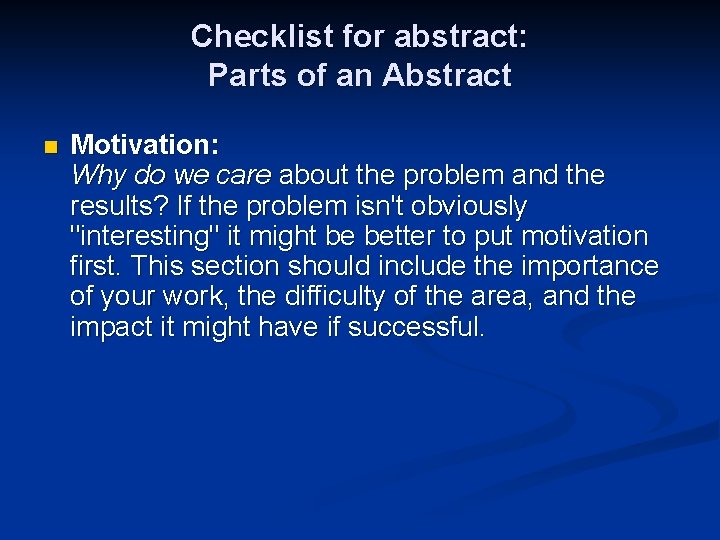
Checklist for abstract: Parts of an Abstract n Motivation: Why do we care about the problem and the results? If the problem isn't obviously "interesting" it might be better to put motivation first. This section should include the importance of your work, the difficulty of the area, and the impact it might have if successful.
n Problem statement: What problem are you trying to solve? What is the scope of your work (a generalized approach, or for a specific situation showing the importance of problem).
n Approach: How did you go about solving or making progress on the problem? . What important variables (parameters) did you control, ignore, or measure?
Results: What's the answer? n Specifically, most good computer architecture papers conclude that something is so many percent faster, cheaper, smaller, or otherwise better than something else. n Put the result there, in numbers. Avoid vague, hand-waving results such as "very", "small", or "significant. ” n
n Conclusions: Ø What are the implications of your answer? Is it going to change the world ? Be a significant "win", be a nice hack (a pointing mark), or simply serve as a road sign indicating that this path is a waste of time (all of the previous results are useful). Are your results general, potentially generalizable, or specific to a particular case? Any major restrictions or limitations on the results should be stated, if only by using "weasel -words" such as "might", "could", "may", and "seem". Ø Ø Ø
Other Considerations n Meet the word count limitation. If your abstract runs too long, either it will be rejected or someone will get it down to size. Your purposes will be better served by doing the difficult task of cutting yourself, rather than leaving it to someone else who might be more interested in meeting size restrictions than in representing your efforts in the best possible manner. An abstract word limit of 150 to 200 words is common.
n n Some publications request "keywords". These have two purposes. However, they are also used to assign papers to review committees or editors, which can be extremely important to your fate. So make sure that the keywords you pick should represent the content of paper clearly (for example, if there is a list of conference topics, use your chosen topic area as one of the keyword ORDERD FORM (tuples ).
These are the basic components of an abstract in any discipline: n 1) Motivation/problem statement: Why do we care about the problem? What practical, scientific, theoretical or artistic gap is your research filling? n 2) Methods/procedure/approach: What did you actually do to get your results? (e. g. analyzed 3 novels, completed a series of 5 oil paintings, interviewed 17 students) n 3) Results/findings/product: As a result of completing the above procedure, what did you learn/invent/create? n 4) Conclusion/implications: What are the larger implications of your findings, especially for
Stylistic Considerations: n n The abstract should be one paragraph and should not exceed the word limit. Edit it closely to be sure it meets the Four C's of abstract writing: Complete — it covers the major parts of the project. Concise — it contains no excess wordiness or unnecessary information. Clear — it is readable, well organized, and not too jargon-laden. Cohesive — it flows smoothly between the parts.
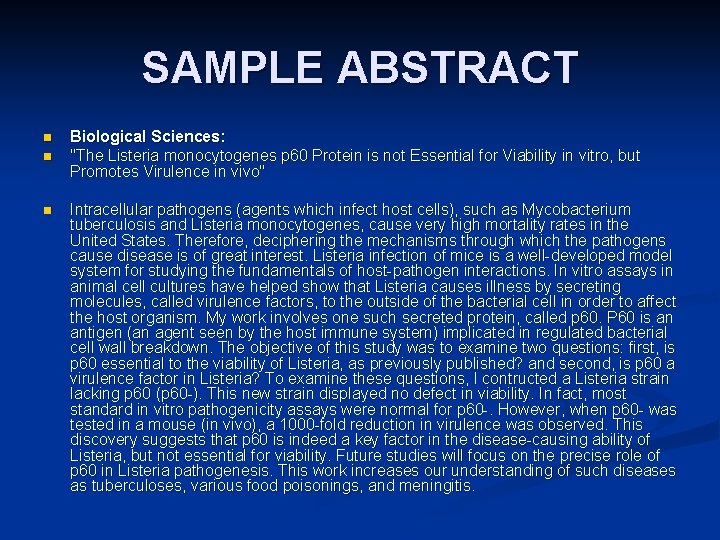
SAMPLE ABSTRACT n n n Biological Sciences: "The Listeria monocytogenes p 60 Protein is not Essential for Viability in vitro, but Promotes Virulence in vivo" Intracellular pathogens (agents which infect host cells), such as Mycobacterium tuberculosis and Listeria monocytogenes, cause very high mortality rates in the United States. Therefore, deciphering the mechanisms through which the pathogens cause disease is of great interest. Listeria infection of mice is a well-developed model system for studying the fundamentals of host-pathogen interactions. In vitro assays in animal cell cultures have helped show that Listeria causes illness by secreting molecules, called virulence factors, to the outside of the bacterial cell in order to affect the host organism. My work involves one such secreted protein, called p 60. P 60 is an antigen (an agent seen by the host immune system) implicated in regulated bacterial cell wall breakdown. The objective of this study was to examine two questions: first, is p 60 essential to the viability of Listeria, as previously published? and second, is p 60 a virulence factor in Listeria? To examine these questions, I contructed a Listeria strain lacking p 60 (p 60 -). This new strain displayed no defect in viability. In fact, most standard in vitro pathogenicity assays were normal for p 60 -. However, when p 60 - was tested in a mouse (in vivo), a 1000 -fold reduction in virulence was observed. This discovery suggests that p 60 is indeed a key factor in the disease-causing ability of Listeria, but not essential for viability. Future studies will focus on the precise role of p 60 in Listeria pathogenesis. This work increases our understanding of such diseases as tuberculoses, various food poisonings, and meningitis.
Further Reading n Michaelson, Herbert, How to Write & Publish Engineering Papers and Reports, Oryx Press, 1990. Chapter 6 discusses abstracts. n Cremmins, Edward, The Art of Abstracting 2 nd Edition, Info Resources Press, April 1996. This is an entire book about abstracting, written primarily for professional abstractors.
- Slides: 18