
ABSTRACT Virtual Reality Exposure Therapy is a growing
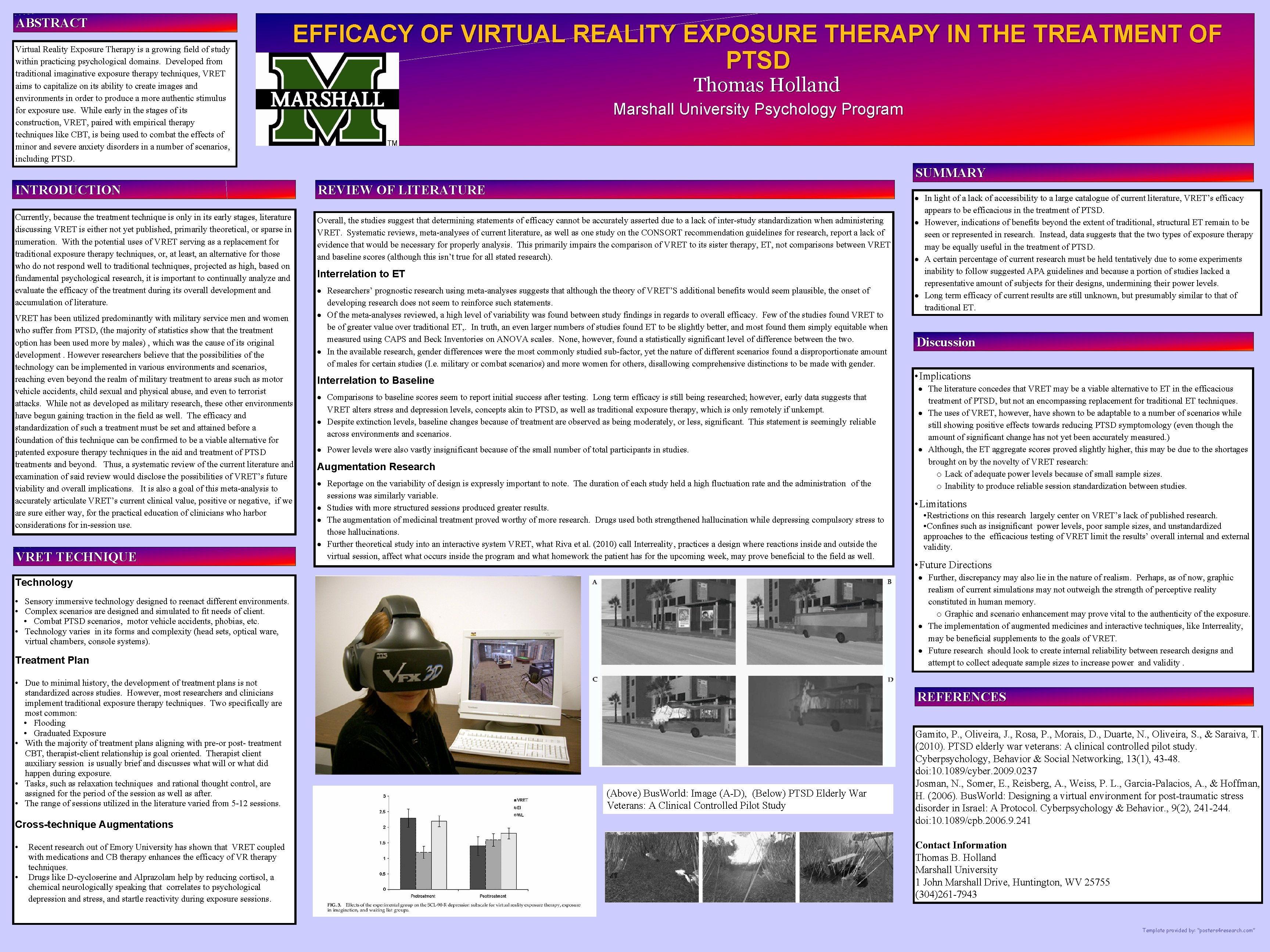
ABSTRACT Virtual Reality Exposure Therapy is a growing field of study within practicing psychological domains. Developed from traditional imaginative exposure therapy techniques, VRET aims to capitalize on its ability to create images and environments in order to produce a more authentic stimulus for exposure use. While early in the stages of its construction, VRET, paired with empirical therapy techniques like CBT, is being used to combat the effects of minor and severe anxiety disorders in a number of scenarios, including PTSD. EFFICACY OF VIRTUAL REALITY EXPOSURE THERAPY IN THE TREATMENT OF PTSD Logo Here Thomas Holland Marshall University Psychology Program SUMMARY INTRODUCTION REVIEW OF LITERATURE Currently, because the treatment technique is only in its early stages, literature discussing VRET is either not yet published, primarily theoretical, or sparse in numeration. With the potential uses of VRET serving as a replacement for traditional exposure therapy techniques, or, at least, an alternative for those who do not respond well to traditional techniques, projected as high, based on fundamental psychological research, it is important to continually analyze and evaluate the efficacy of the treatment during its overall development and accumulation of literature. Overall, the studies suggest that determining statements of efficacy cannot be accurately asserted due to a lack of inter-study standardization when administering VRET. Systematic reviews, meta-analyses of current literature, as well as one study on the CONSORT recommendation guidelines for research, report a lack of evidence that would be necessary for properly analysis. This primarily impairs the comparison of VRET to its sister therapy, ET, not comparisons between VRET and baseline scores (although this isn’t true for all stated research). VRET has been utilized predominantly with military service men and women who suffer from PTSD, (the majority of statistics show that the treatment option has been used more by males) , which was the cause of its original development. However researchers believe that the possibilities of the technology can be implemented in various environments and scenarios, reaching even beyond the realm of military treatment to areas such as motor vehicle accidents, child sexual and physical abuse, and even to terrorist attacks. While not as developed as military research, these other environments have begun gaining traction in the field as well. The efficacy and standardization of such a treatment must be set and attained before a foundation of this technique can be confirmed to be a viable alternative for patented exposure therapy techniques in the aid and treatment of PTSD treatments and beyond. Thus, a systematic review of the current literature and examination of said review would disclose the possibilities of VRET’s future viability and overall implications. It is also a goal of this meta-analysis to accurately articulate VRET’s current clinical value, positive or negative, if we are sure either way, for the practical education of clinicians who harbor considerations for in-session use. VRET TECHNIQUE Interrelation to ET Researchers’ prognostic research using meta-analyses suggests that although theory of VRET’S additional benefits would seem plausible, the onset of developing research does not seem to reinforce such statements. Of the meta-analyses reviewed, a high level of variability was found between study findings in regards to overall efficacy. Few of the studies found VRET to be of greater value over traditional ET, . In truth, an even larger numbers of studies found ET to be slightly better, and most found them simply equitable when measured using CAPS and Beck Inventories on ANOVA scales. None, however, found a statistically significant level of difference between the two. In the available research, gender differences were the most commonly studied sub-factor, yet the nature of different scenarios found a disproportionate amount of males for certain studies (I. e. military or combat scenarios) and more women for others, disallowing comprehensive distinctions to be made with gender. Comparisons to baseline scores seem to report initial success after testing. Long term efficacy is still being researched; however, early data suggests that VRET alters stress and depression levels, concepts akin to PTSD, as well as traditional exposure therapy, which is only remotely if unkempt. Despite extinction levels, baseline changes because of treatment are observed as being moderately, or less, significant. This statement is seemingly reliable across environments and scenarios. Power levels were also vastly insignificant because of the small number of total participants in studies. Augmentation Research Reportage on the variability of design is expressly important to note. The duration of each study held a high fluctuation rate and the administration of the sessions was similarly variable. Studies with more structured sessions produced greater results. The augmentation of medicinal treatment proved worthy of more research. Drugs used both strengthened hallucination while depressing compulsory stress to those hallucinations. Further theoretical study into an interactive system VRET, what Riva et al. (2010) call Interreality, practices a design where reactions inside and outside the virtual session, affect what occurs inside the program and what homework the patient has for the upcoming week, may prove beneficial to the field as well. Treatment Plan • • Recent research out of Emory University has shown that VRET coupled with medications and CB therapy enhances the efficacy of VR therapy techniques. Drugs like D-cycloserine and Alprazolam help by reducing cortisol, a chemical neurologically speaking that correlates to psychological depression and stress, and startle reactivity during exposure sessions. The literature concedes that VRET may be a viable alternative to ET in the efficacious treatment of PTSD, but not an encompassing replacement for traditional ET techniques. The uses of VRET, however, have shown to be adaptable to a number of scenarios while still showing positive effects towards reducing PTSD symptomology (even though the amount of significant change has not yet been accurately measured. ) Although, the ET aggregate scores proved slightly higher, this may be due to the shortages brought on by the novelty of VRET research: o Lack of adequate power levels because of small sample sizes. o Inability to produce reliable session standardization between studies. • Limitations • Restrictions on this research largely center on VRET’s lack of published research. • Confines such as insignificant power levels, poor sample sizes, and unstandardized approaches to the efficacious testing of VRET limit the results’ overall internal and external validity. • Future Directions Further, discrepancy may also lie in the nature of realism. Perhaps, as of now, graphic realism of current simulations may not outweigh the strength of perceptive reality constituted in human memory. o Graphic and scenario enhancement may prove vital to the authenticity of the exposure. The implementation of augmented medicines and interactive techniques, like Interreality, may be beneficial supplements to the goals of VRET. Future research should look to create internal reliability between research designs and attempt to collect adequate sample sizes to increase power and validity. • Sensory immersive technology designed to reenact different environments. • Complex scenarios are designed and simulated to fit needs of client. • Combat PTSD scenarios, motor vehicle accidents, phobias, etc. • Technology varies in its forms and complexity (head sets, optical ware, virtual chambers, console systems). Cross-technique Augmentations Discussion • Implications Interrelation to Baseline Technology • Due to minimal history, the development of treatment plans is not standardized across studies. However, most researchers and clinicians implement traditional exposure therapy techniques. Two specifically are most common: • Flooding • Graduated Exposure • With the majority of treatment plans aligning with pre-or post- treatment CBT, therapist-client relationship is goal oriented. Therapist client auxiliary session is usually brief and discusses what will or what did happen during exposure. • Tasks, such as relaxation techniques and rational thought control, are assigned for the period of the session as well as after. • The range of sessions utilized in the literature varied from 5 -12 sessions. In light of a lack of accessibility to a large catalogue of current literature, VRET’s efficacy appears to be efficacious in the treatment of PTSD. However, indications of benefits beyond the extent of traditional, structural ET remain to be seen or represented in research. Instead, data suggests that the two types of exposure therapy may be equally useful in the treatment of PTSD. A certain percentage of current research must be held tentatively due to some experiments inability to follow suggested APA guidelines and because a portion of studies lacked a representative amount of subjects for their designs, undermining their power levels. Long term efficacy of current results are still unknown, but presumably similar to that of traditional ET. REFERENCES (Above) Bus. World: Image (A-D), (Below) PTSD Elderly War Veterans: A Clinical Controlled Pilot Study Gamito, P. , Oliveira, J. , Rosa, P. , Morais, D. , Duarte, N. , Oliveira, S. , & Saraiva, T. (2010). PTSD elderly war veterans: A clinical controlled pilot study. Cyberpsychology, Behavior & Social Networking, 13(1), 43 -48. doi: 10. 1089/cyber. 2009. 0237 Josman, N. , Somer, E. , Reisberg, A. , Weiss, P. L. , Garcia-Palacios, A. , & Hoffman, H. (2006). Bus. World: Designing a virtual environment for post-traumatic stress disorder in Israel: A Protocol. Cyberpsychology & Behavior. , 9(2), 241 -244. doi: 10. 1089/cpb. 2006. 9. 241 Contact Information Thomas B. Holland Marshall University 1 John Marshall Drive, Huntington, WV 25755 (304)261 -7943 Template provided by: “posters 4 research. com”
- Slides: 1