
ABSTRACT TITLE Author Names Author Affiliations Abstract Methods
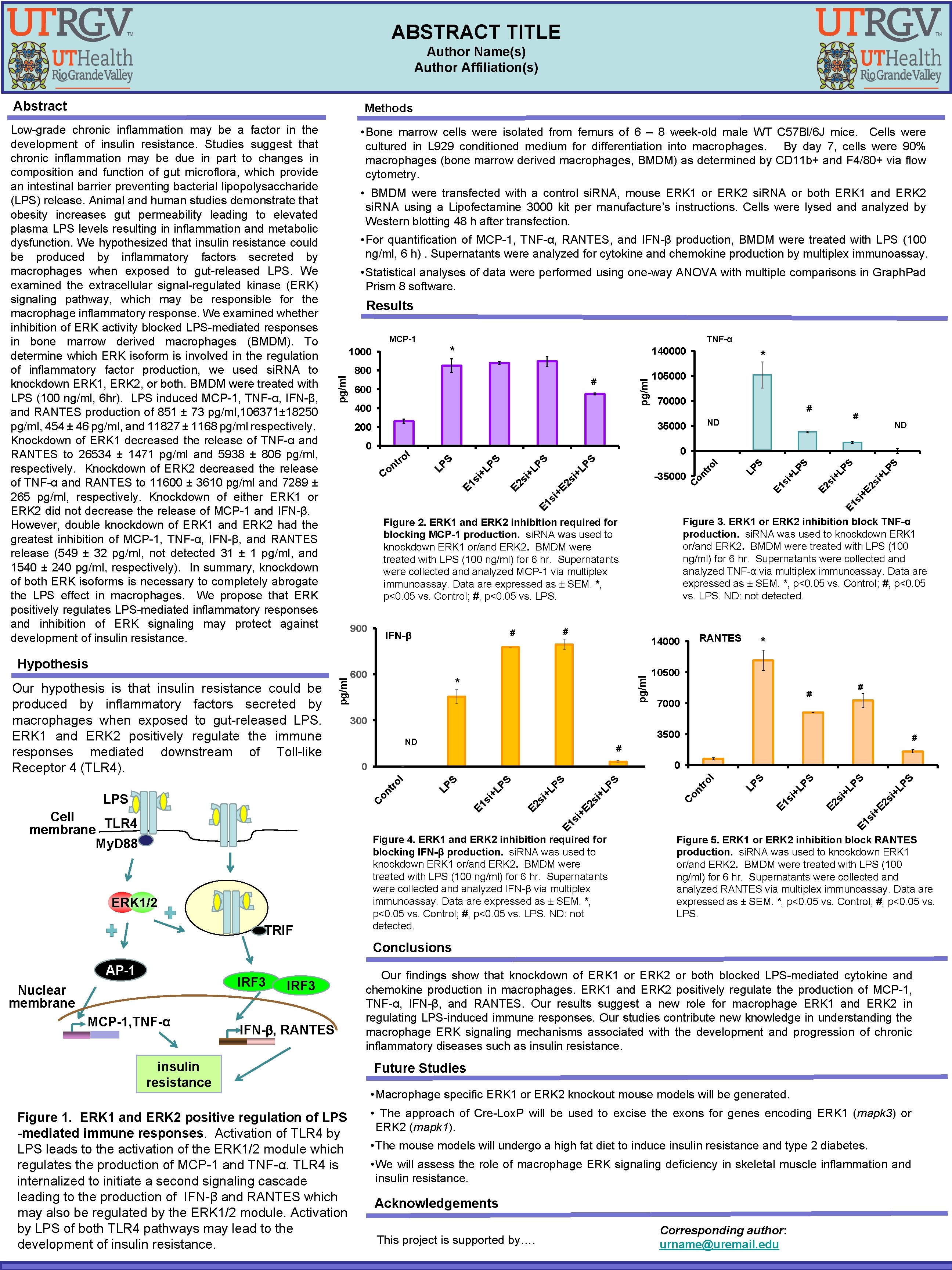
ABSTRACT TITLE Author Name(s) Author Affiliation(s) Abstract Methods • Bone marrow cells were isolated from femurs of 6 – 8 week-old male WT C 57 Bl/6 J mice. Cells were cultured in L 929 conditioned medium for differentiation into macrophages. By day 7, cells were 90% macrophages (bone marrow derived macrophages, BMDM) as determined by CD 11 b+ and F 4/80+ via flow cytometry. • BMDM were transfected with a control si. RNA, mouse ERK 1 or ERK 2 si. RNA or both ERK 1 and ERK 2 si. RNA using a Lipofectamine 3000 kit per manufacture’s instructions. Cells were lysed analyzed by Western blotting 48 h after transfection. • For quantification of MCP-1, TNF-α, RANTES, and IFN-β production, BMDM were treated with LPS (100 ng/ml, 6 h). Supernatants were analyzed for cytokine and chemokine production by multiplex immunoassay. • Statistical analyses of data were performed using one-way ANOVA with multiple comparisons in Graph. Pad Prism 8 software. Results MCP-1 140000 800 600 pg/ml # 400 * 105000 70000 # 600 pg/ml 10500 # 7000 # # LP S PS i+ +L si +E 2 s si E 1 Figure 4. ERK 1 and ERK 2 inhibition required for blocking IFN-β production. si. RNA was used to knockdown ERK 1 or/and ERK 2. BMDM were treated with LPS (100 ng/ml) for 6 hr. Supernatants were collected analyzed IFN-β via multiplex immunoassay. Data are expressed as ± SEM. *, p<0. 05 vs. Control; #, p<0. 05 vs. LPS. ND: not detected. E 2 E 1 si +L PS S LP tr on i+ 2 s si +E C LP S PS +L si E 2 E 1 si +L PS S LP ol 0 0 tr TRIF # 3500 ND on ERK 1/2 i+ * 300 C Cell TLR 4 membrane My. D 88 RANTES 14000 * ol pg/ml LPS # # IFN-β 2 s +E si E 1 s Figure 3. ERK 1 or ERK 2 inhibition block TNF-α production. si. RNA was used to knockdown ERK 1 or/and ERK 2. BMDM were treated with LPS (100 ng/ml) for 6 hr. Supernatants were collected analyzed TNF-α via multiplex immunoassay. Data are expressed as ± SEM. *, p<0. 05 vs. Control; #, p<0. 05 vs. LPS. ND: not detected. Figure 2. ERK 1 and ERK 2 inhibition required for blocking MCP-1 production. si. RNA was used to knockdown ERK 1 or/and ERK 2. BMDM were treated with LPS (100 ng/ml) for 6 hr. Supernatants were collected analyzed MCP-1 via multiplex immunoassay. Data are expressed as ± SEM. *, p<0. 05 vs. Control; #, p<0. 05 vs. LPS. 900 LP S PS +L si E 1 E 2 si +L PS S on tr C i+ E E 2 s 2 s i+ -35000 LP ol LP S i+ LP S E 1 s i+ Co ND 0 S Ve h r t n ol LP 0 # ND 35000 200 Hypothesis Our hypothesis is that insulin resistance could be produced by inflammatory factors secreted by macrophages when exposed to gut-released LPS. ERK 1 and ERK 2 positively regulate the immune responses mediated downstream of Toll-like Receptor 4 (TLR 4). TNF-α * 1000 pg/ml Low-grade chronic inflammation may be a factor in the development of insulin resistance. Studies suggest that chronic inflammation may be due in part to changes in composition and function of gut microflora, which provide an intestinal barrier preventing bacterial lipopolysaccharide (LPS) release. Animal and human studies demonstrate that obesity increases gut permeability leading to elevated plasma LPS levels resulting in inflammation and metabolic dysfunction. We hypothesized that insulin resistance could be produced by inflammatory factors secreted by macrophages when exposed to gut-released LPS. We examined the extracellular signal-regulated kinase (ERK) signaling pathway, which may be responsible for the macrophage inflammatory response. We examined whether inhibition of ERK activity blocked LPS-mediated responses in bone marrow derived macrophages (BMDM). To determine which ERK isoform is involved in the regulation of inflammatory factor production, we used si. RNA to knockdown ERK 1, ERK 2, or both. BMDM were treated with LPS (100 ng/ml, 6 hr). LPS induced MCP-1, TNF-α, IFN-β, and RANTES production of 851 ± 73 pg/ml, 106371± 18250 pg/ml, 454 ± 46 pg/ml, and 11827 ± 1168 pg/ml respectively. Knockdown of ERK 1 decreased the release of TNF-α and RANTES to 26534 ± 1471 pg/ml and 5938 ± 806 pg/ml, respectively. Knockdown of ERK 2 decreased the release of TNF-α and RANTES to 11600 ± 3610 pg/ml and 7289 ± 265 pg/ml, respectively. Knockdown of either ERK 1 or ERK 2 did not decrease the release of MCP-1 and IFN-β. However, double knockdown of ERK 1 and ERK 2 had the greatest inhibition of MCP-1, TNF-α, IFN-β, and RANTES release (549 ± 32 pg/ml, not detected 31 ± 1 pg/ml, and 1540 ± 240 pg/ml, respectively). In summary, knockdown of both ERK isoforms is necessary to completely abrogate the LPS effect in macrophages. We propose that ERK positively regulates LPS-mediated inflammatory responses and inhibition of ERK signaling may protect against development of insulin resistance. Figure 5. ERK 1 or ERK 2 inhibition block RANTES production. si. RNA was used to knockdown ERK 1 or/and ERK 2. BMDM were treated with LPS (100 ng/ml) for 6 hr. Supernatants were collected analyzed RANTES via multiplex immunoassay. Data are expressed as ± SEM. *, p<0. 05 vs. Control; #, p<0. 05 vs. LPS. Conclusions AP-1 IRF 3 Nuclear membrane MCP-1, TNF-α IRF 3 IFN- , RANTES insulin resistance Figure 1. ERK 1 and ERK 2 positive regulation of LPS -mediated immune responses. Activation of TLR 4 by LPS leads to the activation of the ERK 1/2 module which regulates the production of MCP-1 and TNF-α. TLR 4 is internalized to initiate a second signaling cascade leading to the production of IFN-β and RANTES which may also be regulated by the ERK 1/2 module. Activation by LPS of both TLR 4 pathways may lead to the development of insulin resistance. Our findings show that knockdown of ERK 1 or ERK 2 or both blocked LPS-mediated cytokine and chemokine production in macrophages. ERK 1 and ERK 2 positively regulate the production of MCP-1, TNF-α, IFN-β, and RANTES. Our results suggest a new role for macrophage ERK 1 and ERK 2 in regulating LPS-induced immune responses. Our studies contribute new knowledge in understanding the macrophage ERK signaling mechanisms associated with the development and progression of chronic inflammatory diseases such as insulin resistance. Future Studies • Macrophage specific ERK 1 or ERK 2 knockout mouse models will be generated. • The approach of Cre-Lox. P will be used to excise the exons for genes encoding ERK 1 (mapk 3) or ERK 2 (mapk 1). • The mouse models will undergo a high fat diet to induce insulin resistance and type 2 diabetes. • We will assess the role of macrophage ERK signaling deficiency in skeletal muscle inflammation and insulin resistance. Acknowledgements This project is supported by…. Corresponding author: urname@uremail. edu
- Slides: 1