
Abstract The American Dream Steps Towards Dystopia as
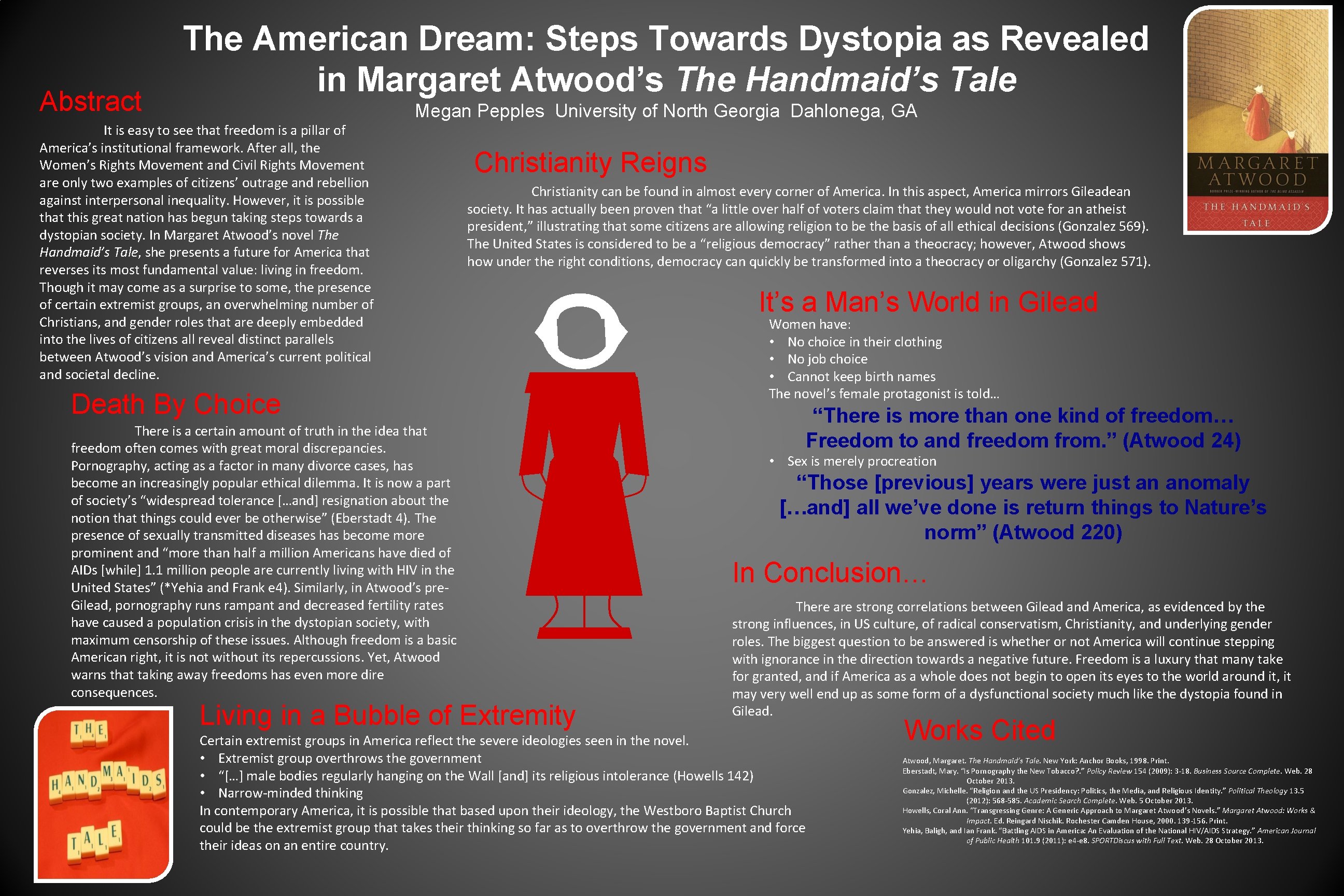
Abstract The American Dream: Steps Towards Dystopia as Revealed in Margaret Atwood’s The Handmaid’s Tale It is easy to see that freedom is a pillar of America’s institutional framework. After all, the Women’s Rights Movement and Civil Rights Movement are only two examples of citizens’ outrage and rebellion against interpersonal inequality. However, it is possible that this great nation has begun taking steps towards a dystopian society. In Margaret Atwood’s novel The Handmaid’s Tale, she presents a future for America that reverses its most fundamental value: living in freedom. Though it may come as a surprise to some, the presence of certain extremist groups, an overwhelming number of Christians, and gender roles that are deeply embedded into the lives of citizens all reveal distinct parallels between Atwood’s vision and America’s current political and societal decline. Megan Pepples University of North Georgia Dahlonega, GA Christianity Reigns Christianity can be found in almost every corner of America. In this aspect, America mirrors Gileadean society. It has actually been proven that “a little over half of voters claim that they would not vote for an atheist president, ” illustrating that some citizens are allowing religion to be the basis of all ethical decisions (Gonzalez 569). The United States is considered to be a “religious democracy” rather than a theocracy; however, Atwood shows how under the right conditions, democracy can quickly be transformed into a theocracy or oligarchy (Gonzalez 571). Death By Choice There is a certain amount of truth in the idea that freedom often comes with great moral discrepancies. Pornography, acting as a factor in many divorce cases, has become an increasingly popular ethical dilemma. It is now a part of society’s “widespread tolerance […and] resignation about the notion that things could ever be otherwise” (Eberstadt 4). The presence of sexually transmitted diseases has become more prominent and “more than half a million Americans have died of AIDs [while] 1. 1 million people are currently living with HIV in the United States” (*Yehia and Frank e 4). Similarly, in Atwood’s pre. Gilead, pornography runs rampant and decreased fertility rates have caused a population crisis in the dystopian society, with maximum censorship of these issues. Although freedom is a basic American right, it is not without its repercussions. Yet, Atwood warns that taking away freedoms has even more dire consequences. Living in a Bubble of Extremity It’s a Man’s World in Gilead Women have: • No choice in their clothing • No job choice • Cannot keep birth names The novel’s female protagonist is told… “There is more than one kind of freedom… Freedom to and freedom from. ” (Atwood 24) • Sex is merely procreation “Those [previous] years were just an anomaly […and] all we’ve done is return things to Nature’s norm” (Atwood 220) In Conclusion… There are strong correlations between Gilead and America, as evidenced by the strong influences, in US culture, of radical conservatism, Christianity, and underlying gender roles. The biggest question to be answered is whether or not America will continue stepping with ignorance in the direction towards a negative future. Freedom is a luxury that many take for granted, and if America as a whole does not begin to open its eyes to the world around it, it may very well end up as some form of a dysfunctional society much like the dystopia found in Gilead. Certain extremist groups in America reflect the severe ideologies seen in the novel. • Extremist group overthrows the government • “[…] male bodies regularly hanging on the Wall [and] its religious intolerance (Howells 142) • Narrow-minded thinking In contemporary America, it is possible that based upon their ideology, the Westboro Baptist Church could be the extremist group that takes their thinking so far as to overthrow the government and force their ideas on an entire country. Works Cited Atwood, Margaret. The Handmaid’s Tale. New York: Anchor Books, 1998. Print. Eberstadt, Mary. “Is Pornography the New Tobacco? . ” Policy Review 154 (2009): 3 -18. Business Source Complete. Web. 28 October 2013. Gonzalez, Michelle. “Religion and the US Presidency: Politics, the Media, and Religious Identity. ” Political Theology 13. 5 (2012): 568 -585. Academic Search Complete. Web. 5 October 2013. Howells, Coral Ann. “Transgressing Genre: A Generic Approach to Margaret Atwood’s Novels. ” Margaret Atwood: Works & Impact. Ed. Reingard Nischik. Rochester Camden House, 2000. 139 -156. Print. Yehia, Baligh, and Ian Frank. “Battling AIDS in America: An Evaluation of the National HIV/AIDS Strategy. ” American Journal of Public Health 101. 9 (2011): e 4 -e 8. SPORTDiscus with Full Text. Web. 28 October 2013.
- Slides: 1