
Abstract Impact of Crime Shows on Criminal Justice
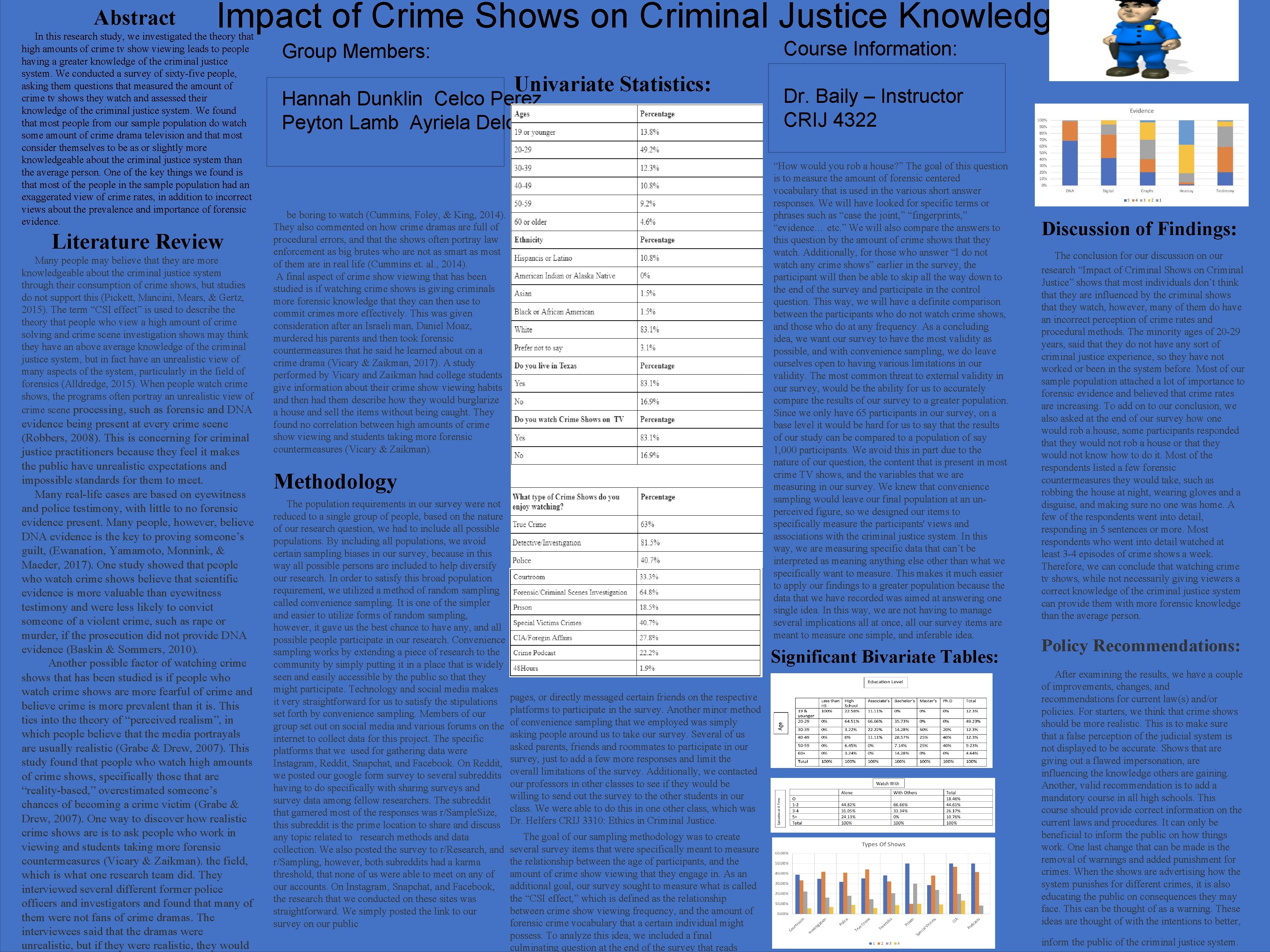
Abstract Impact of Crime Shows on Criminal Justice Knowledge In this research study, we investigated theory that high amounts of crime tv show viewing leads to people having a greater knowledge of the criminal justice system. We conducted a survey of sixty-five people, asking them questions that measured the amount of crime tv shows they watch and assessed their knowledge of the criminal justice system. We found that most people from our sample population do watch some amount of crime drama television and that most consider themselves to be as or slightly more knowledgeable about the criminal justice system than the average person. One of the key things we found is that most of the people in the sample population had an exaggerated view of crime rates, in addition to incorrect views about the prevalence and importance of forensic evidence. Literature Review Many people may believe that they are more knowledgeable about the criminal justice system through their consumption of crime shows, but studies do not support this (Pickett, Mancini, Mears, & Gertz, 2015). The term “CSI effect” is used to describe theory that people who view a high amount of crime solving and crime scene investigation shows may think they have an above average knowledge of the criminal justice system, but in fact have an unrealistic view of many aspects of the system, particularly in the field of forensics (Alldredge, 2015). When people watch crime shows, the programs often portray an unrealistic view of crime scene processing, such as forensic and DNA evidence being present at every crime scene (Robbers, 2008). This is concerning for criminal justice practitioners because they feel it makes the public have unrealistic expectations and impossible standards for them to meet. Many real-life cases are based on eyewitness and police testimony, with little to no forensic evidence present. Many people, however, believe DNA evidence is the key to proving someone’s guilt, (Ewanation, Yamamoto, Monnink, & Maeder, 2017). One study showed that people who watch crime shows believe that scientific evidence is more valuable than eyewitness testimony and were less likely to convict someone of a violent crime, such as rape or murder, if the prosecution did not provide DNA evidence (Baskin & Sommers, 2010). Another possible factor of watching crime shows that has been studied is if people who watch crime shows are more fearful of crime and believe crime is more prevalent than it is. This ties into theory of “perceived realism”, in which people believe that the media portrayals are usually realistic (Grabe & Drew, 2007). This study found that people who watch high amounts of crime shows, specifically those that are “reality-based, ” overestimated someone’s chances of becoming a crime victim (Grabe & Drew, 2007). One way to discover how realistic crime shows are is to ask people who work in viewing and students taking more forensic countermeasures (Vicary & Zaikman). the field, which is what one research team did. They interviewed several different former police officers and investigators and found that many of them were not fans of crime dramas. The interviewees said that the dramas were unrealistic, but if they were realistic, they would Course Information: Group Members: Univariate Statistics: Hannah Dunklin Celco Perez Peyton Lamb Ayriela Delong “How would you rob a house? ” The goal of this question is to measure the amount of forensic centered vocabulary that is used in the various short answer responses. We will have looked for specific terms or phrases such as “case the joint, ” “fingerprints, ” “evidence… etc. ” We will also compare the answers to this question by the amount of crime shows that they watch. Additionally, for those who answer “I do not watch any crime shows” earlier in the survey, the participant will then be able to skip all the way down to the end of the survey and participate in the control question. This way, we will have a definite comparison between the participants who do not watch crime shows, and those who do at any frequency. As a concluding idea, we want our survey to have the most validity as possible, and with convenience sampling, we do leave ourselves open to having various limitations in our validity. The most common threat to external validity in our survey, would be the ability for us to accurately compare the results of our survey to a greater population. Since we only have 65 participants in our survey, on a base level it would be hard for us to say that the results of our study can be compared to a population of say 1, 000 participants. We avoid this in part due to the nature of our question, the content that is present in most crime TV shows, and the variables that we are measuring in our survey. We knew that convenience sampling would leave our final population at an unperceived figure, so we designed our items to specifically measure the participants' views and associations with the criminal justice system. In this way, we are measuring specific data that can’t be interpreted as meaning anything else other than what we specifically want to measure. This makes it much easier to apply our findings to a greater population because the data that we have recorded was aimed at answering one single idea. In this way, we are not having to manage several implications all at once, all our survey items are meant to measure one simple, and inferable idea. be boring to watch (Cummins, Foley, & King, 2014). They also commented on how crime dramas are full of procedural errors, and that the shows often portray law enforcement as big brutes who are not as smart as most of them are in real life (Cummins et. al. , 2014). A final aspect of crime show viewing that has been studied is if watching crime shows is giving criminals more forensic knowledge that they can then use to commit crimes more effectively. This was given consideration after an Israeli man, Daniel Moaz, murdered his parents and then took forensic countermeasures that he said he learned about on a crime drama (Vicary & Zaikman, 2017). A study performed by Vicary and Zaikman had college students give information about their crime show viewing habits and then had them describe how they would burglarize a house and sell the items without being caught. They found no correlation between high amounts of crime show viewing and students taking more forensic countermeasures (Vicary & Zaikman). Methodology The population requirements in our survey were not reduced to a single group of people, based on the nature of our research question, we had to include all possible populations. By including all populations, we avoid certain sampling biases in our survey, because in this way all possible persons are included to help diversify our research. In order to satisfy this broad population requirement, we utilized a method of random sampling called convenience sampling. It is one of the simpler and easier to utilize forms of random sampling, however, it gave us the best chance to have any, and all possible people participate in our research. Convenience sampling works by extending a piece of research to the community by simply putting it in a place that is widely seen and easily accessible by the public so that they might participate. Technology and social media makes it very straightforward for us to satisfy the stipulations set forth by convenience sampling. Members of our group set out on social media and various forums on the internet to collect data for this project. The specific platforms that we used for gathering data were Instagram, Reddit, Snapchat, and Facebook. On Reddit, we posted our google form survey to several subreddits having to do specifically with sharing surveys and survey data among fellow researchers. The subreddit that garnered most of the responses was r/Sample. Size, this subreddit is the prime location to share and discuss any topic related to research methods and data collection. We also posted the survey to r/Research, and r/Sampling, however, both subreddits had a karma threshold, that none of us were able to meet on any of our accounts. On Instagram, Snapchat, and Facebook, the research that we conducted on these sites was straightforward. We simply posted the link to our survey on our public Dr. Baily – Instructor CRIJ 4322 Significant Bivariate Tables: pages, or directly messaged certain friends on the respective platforms to participate in the survey. Another minor method of convenience sampling that we employed was simply asking people around us to take our survey. Several of us asked parents, friends and roommates to participate in our survey, just to add a few more responses and limit the overall limitations of the survey. Additionally, we contacted our professors in other classes to see if they would be willing to send out the survey to the other students in our class. We were able to do this in one other class, which was Dr. Helfers CRIJ 3310: Ethics in Criminal Justice. The goal of our sampling methodology was to create several survey items that were specifically meant to measure the relationship between the age of participants, and the amount of crime show viewing that they engage in. As an additional goal, our survey sought to measure what is called the “CSI effect, ” which is defined as the relationship between crime show viewing frequency, and the amount of forensic crime vocabulary that a certain individual might possess. To analyze this idea, we included a final culminating question at the end of the survey that reads Discussion of Findings: The conclusion for our discussion on our research “Impact of Criminal Shows on Criminal Justice” shows that most individuals don’t think that they are influenced by the criminal shows that they watch, however, many of them do have an incorrect perception of crime rates and procedural methods. The minority ages of 20 -29 years, said that they do not have any sort of criminal justice experience, so they have not worked or been in the system before. Most of our sample population attached a lot of importance to forensic evidence and believed that crime rates are increasing. To add on to our conclusion, we also asked at the end of our survey how one would rob a house, some participants responded that they would not rob a house or that they would not know how to do it. Most of the respondents listed a few forensic countermeasures they would take, such as robbing the house at night, wearing gloves and a disguise, and making sure no one was home. A few of the respondents went into detail, responding in 5 sentences or more. Most respondents who went into detail watched at least 3 -4 episodes of crime shows a week. Therefore, we can conclude that watching crime tv shows, while not necessarily giving viewers a correct knowledge of the criminal justice system can provide them with more forensic knowledge than the average person. Policy Recommendations: After examining the results, we have a couple of improvements, changes, and recommendations for current law(s) and/or policies. For starters, we think that crime shows should be more realistic. This is to make sure that a false perception of the judicial system is not displayed to be accurate. Shows that are giving out a flawed impersonation, are influencing the knowledge others are gaining. Another, valid recommendation is to add a mandatory course in all high schools. This course should provide correct information on the current laws and procedures. It can only be beneficial to inform the public on how things work. One last change that can be made is the removal of warnings and added punishment for crimes. When the shows are advertising how the system punishes for different crimes, it is also educating the public on consequences they may face. This can be thought of as a warning. These ideas are thought of with the intentions to better, inform the public of the criminal justice system.
- Slides: 1