
Abstract Design and Methods Results Introduction C Day
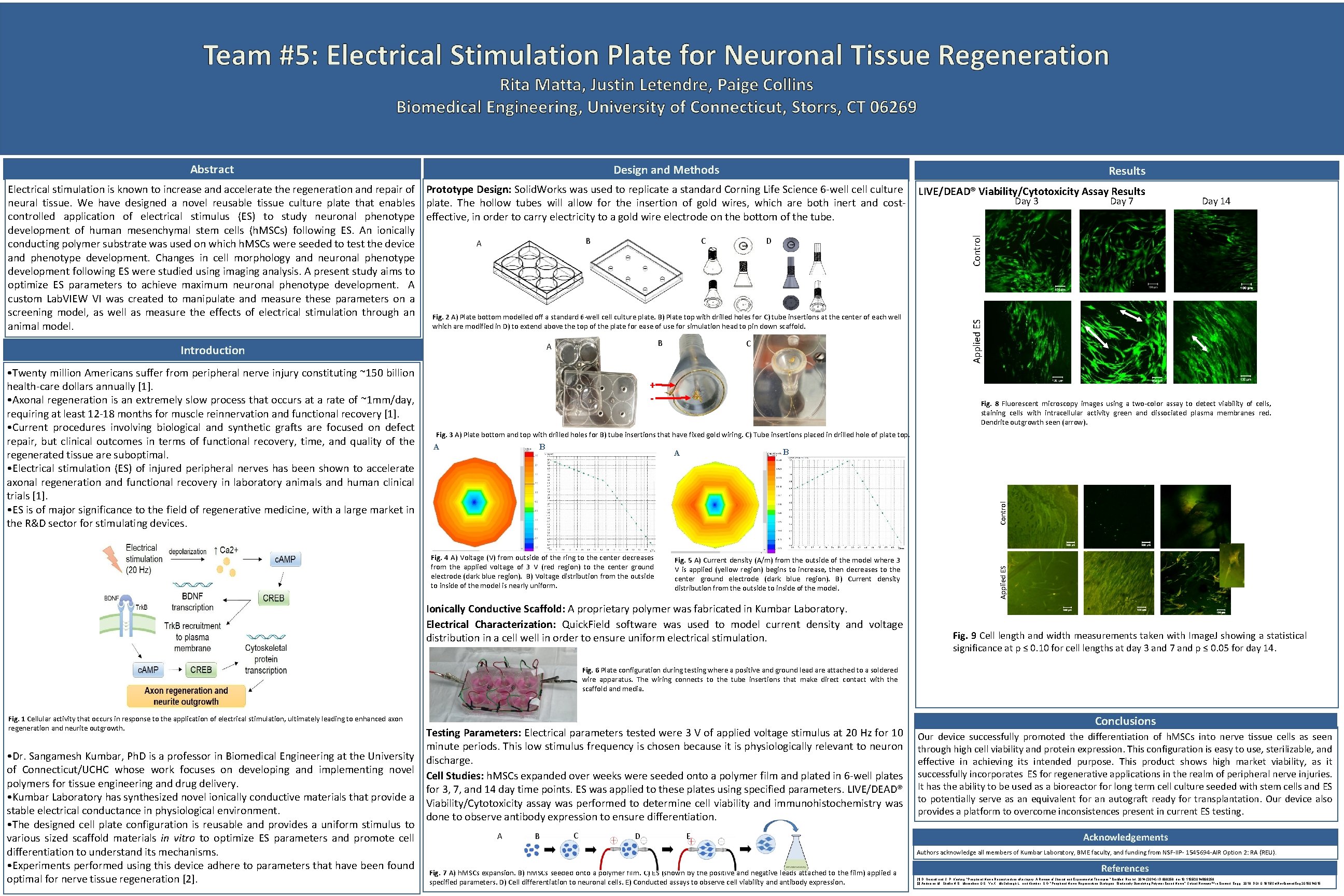
Abstract Design and Methods Results Introduction C + - Day 7 Day 14 Control Day 3 Fig. 8 Fluorescent microscopy images using a two-color assay to detect viability of cells, staining cells with intracellular activity green and dissociated plasma membranes red. Dendrite outgrowth seen (arrow). Fig. 3 A) Plate bottom and top with drilled holes for B) tube insertions that have fixed gold wiring. C) Tube insertions placed in drilled hole of plate top. B B A Control A Fig. 4 A) Voltage (V) from outside of the ring to the center decreases from the applied voltage of 3 V (red region) to the center ground electrode (dark blue region). B) Voltage distribution from the outside to inside of the model is nearly uniform. Fig. 5 A) Current density (A/m) from the outside of the model where 3 V is applied (yellow region) begins to increase, then decreases to the center ground electrode (dark blue region). B) Current density distribution from the outside to inside of the model. Ionically Conductive Scaffold: A proprietary polymer was fabricated in Kumbar Laboratory. Electrical Characterization: Quick. Field software was used to model current density and voltage distribution in a cell well in order to ensure uniform electrical stimulation. Applied ES • Twenty million Americans suffer from peripheral nerve injury constituting ~150 billion health-care dollars annually [1]. • Axonal regeneration is an extremely slow process that occurs at a rate of ~1 mm/day, requiring at least 12 -18 months for muscle reinnervation and functional recovery [1]. • Current procedures involving biological and synthetic grafts are focused on defect repair, but clinical outcomes in terms of functional recovery, time, and quality of the regenerated tissue are suboptimal. • Electrical stimulation (ES) of injured peripheral nerves has been shown to accelerate axonal regeneration and functional recovery in laboratory animals and human clinical trials [1]. • ES is of major significance to the field of regenerative medicine, with a large market in the R&D sector for stimulating devices. B A LIVE/DEAD® Viability/Cytotoxicity Assay Results Applied ES Electrical stimulation is known to increase and accelerate the regeneration and repair of Prototype Design: Solid. Works was used to replicate a standard Corning Life Science 6 -well culture neural tissue. We have designed a novel reusable tissue culture plate that enables plate. The hollow tubes will allow for the insertion of gold wires, which are both inert and costcontrolled application of electrical stimulus (ES) to study neuronal phenotype effective, in order to carry electricity to a gold wire electrode on the bottom of the tube. development of human mesenchymal stem cells (h. MSCs) following ES. An ionically B C D A conducting polymer substrate was used on which h. MSCs were seeded to test the device and phenotype development. Changes in cell morphology and neuronal phenotype development following ES were studied using imaging analysis. A present study aims to optimize ES parameters to achieve maximum neuronal phenotype development. A custom Lab. VIEW VI was created to manipulate and measure these parameters on a screening model, as well as measure the effects of electrical stimulation through an Fig. 2 A) Plate bottom modelled off a standard 6 -well culture plate. B) Plate top with drilled holes for C) tube insertions at the center of each well which are modified in D) to extend above the top of the plate for ease of use for simulation head to pin down scaffold. animal model. Fig. 9 Cell length and width measurements taken with Image. J showing a statistical significance at p ≤ 0. 10 for cell lengths at day 3 and 7 and p ≤ 0. 05 for day 14. Fig. 6 Plate configuration during testing where a positive and ground lead are attached to a soldered wire apparatus. The wiring connects to the tube insertions that make direct contact with the scaffold and media. Fig. 1 Cellular activity that occurs in response to the application of electrical stimulation, ultimately leading to enhanced axon regeneration and neurite outgrowth. • Dr. Sangamesh Kumbar, Ph. D is a professor in Biomedical Engineering at the University of Connecticut/UCHC whose work focuses on developing and implementing novel polymers for tissue engineering and drug delivery. • Kumbar Laboratory has synthesized novel ionically conductive materials that provide a stable electrical conductance in physiological environment. • The designed cell plate configuration is reusable and provides a uniform stimulus to various sized scaffold materials in vitro to optimize ES parameters and promote cell differentiation to understand its mechanisms. • Experiments performed using this device adhere to parameters that have been found optimal for nerve tissue regeneration [2]. Testing Parameters: Electrical parameters tested were 3 V of applied voltage stimulus at 20 Hz for 10 minute periods. This low stimulus frequency is chosen because it is physiologically relevant to neuron discharge. Cell Studies: h. MSCs expanded over weeks were seeded onto a polymer film and plated in 6 -well plates for 3, 7, and 14 day time points. ES was applied to these plates using specified parameters. LIVE/DEAD® Viability/Cytotoxicity assay was performed to determine cell viability and immunohistochemistry was done to observe antibody expression to ensure differentiation. A B C D E Conclusions Our device successfully promoted the differentiation of h. MSCs into nerve tissue cells as seen through high cell viability and protein expression. This configuration is easy to use, sterilizable, and effective in achieving its intended purpose. This product shows high market viability, as it successfully incorporates ES for regenerative applications in the realm of peripheral nerve injuries. It has the ability to be used as a bioreactor for long term cell culture seeded with stem cells and ES to potentially serve as an equivalent for an autograft ready for transplantation. Our device also provides a platform to overcome inconsistences present in current ES testing. Acknowledgements Authors acknowledge all members of Kumbar Laboratory, BME faculty, and funding from NSF-IIP- 1545694 -AIR Option 2: RA (REU). Fig. 7 A) h. MSCs expansion. B) h. MSCs seeded onto a polymer film. C) ES (shown by the positive and negative leads attached to the film) applied a specified parameters. D) Cell differentiation to neuronal cells. E) Conducted assays to observe cell viability and antibody expression. References [1] D. Grinsell and C. P. Keating, “Peripheral Nerve Reconstruction after Injury: A Review of Clinical and Experimental Therapies, ” Bio. Med. Res. Int, 2014 (2014), ID 698256, doi: 10. 1155/2014/698256. [2] Anderson M. , Shelke N. B. , Manoukian O. S. , Yu X. , Mc. Cullough L. , and Kumbar, S. G. “Peripheral Nerve Regeneration Strategies: Electrically Stimulating Polymer Based Nerve”. Critical Reviews™ in Biomed. Engg. , 2016, DOI: 0. 1615/Crit. Rev. Biomed. Eng. 2015014015.
- Slides: 1