
Abstract Data Types I and ObjectOriented Programming Jordi
Abstract Data Types (I) (and Object-Oriented Programming) Jordi Cortadella and Jordi Petit Department of Computer Science
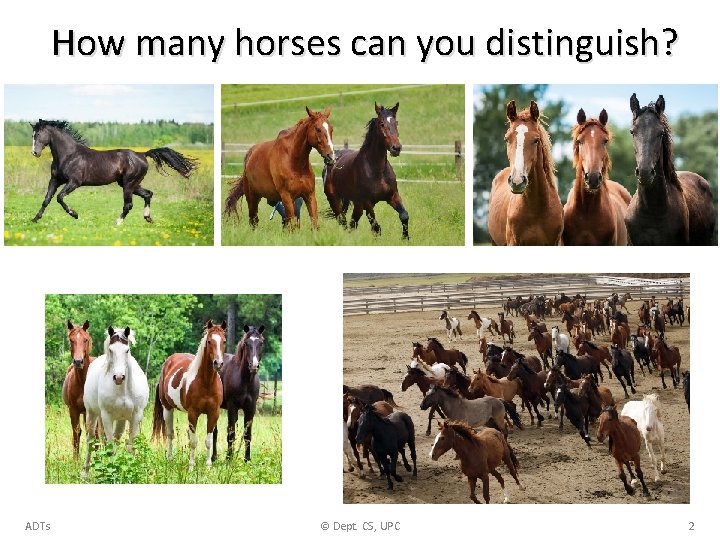
How many horses can you distinguish? ADTs © Dept. CS, UPC 2
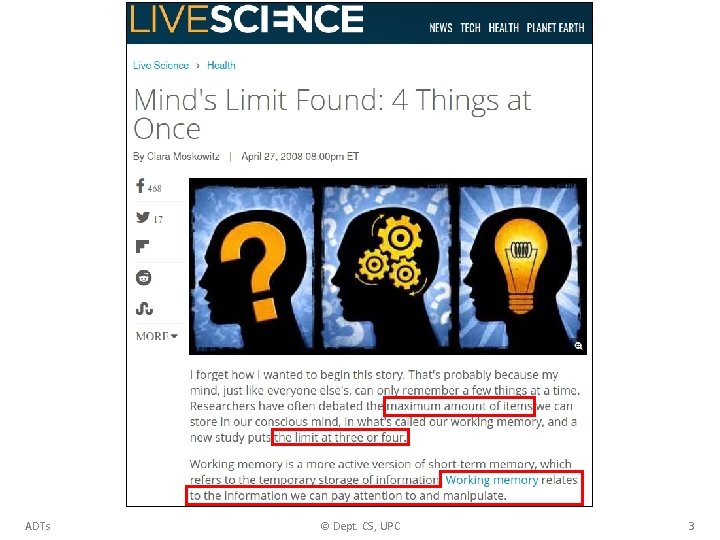
ADTs © Dept. CS, UPC 3
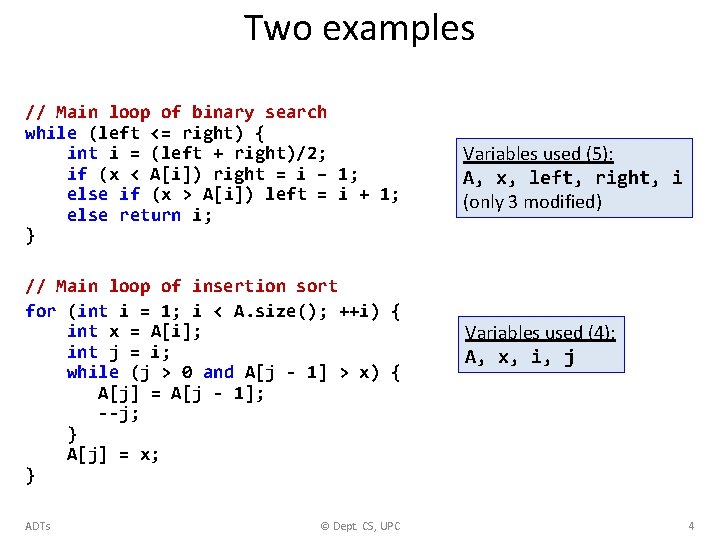
Two examples // Main loop of binary search while (left <= right) { int i = (left + right)/2; if (x < A[i]) right = i – 1; else if (x > A[i]) left = i + 1; else return i; } // Main loop of insertion sort for (int i = 1; i < A. size(); ++i) { int x = A[i]; int j = i; while (j > 0 and A[j - 1] > x) { A[j] = A[j - 1]; --j; } A[j] = x; } ADTs © Dept. CS, UPC Variables used (5): A, x, left, right, i (only 3 modified) Variables used (4): A, x, i, j 4
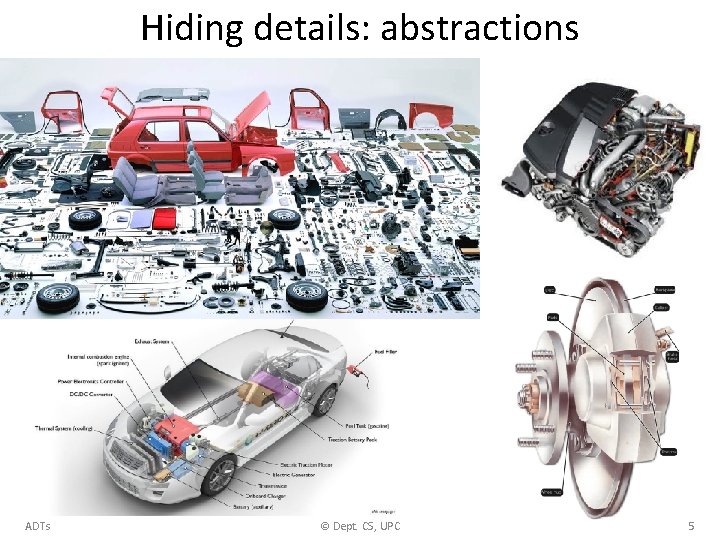
Hiding details: abstractions ADTs © Dept. CS, UPC 5
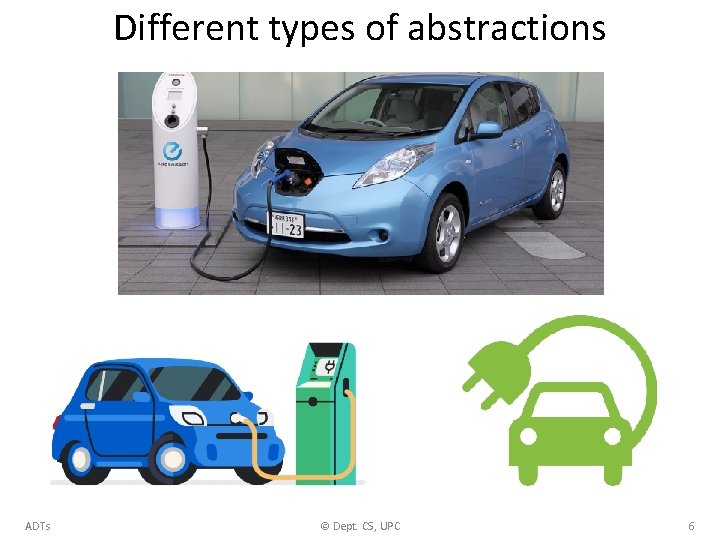
Different types of abstractions ADTs © Dept. CS, UPC 6
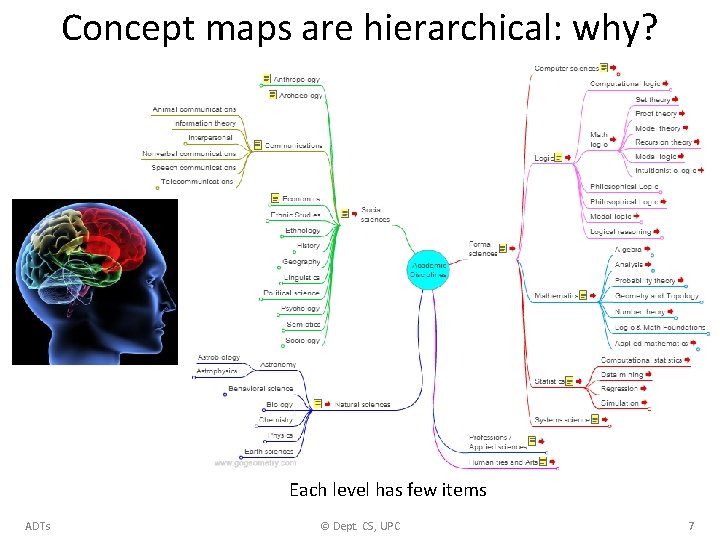
Concept maps are hierarchical: why? Each level has few items ADTs © Dept. CS, UPC 7
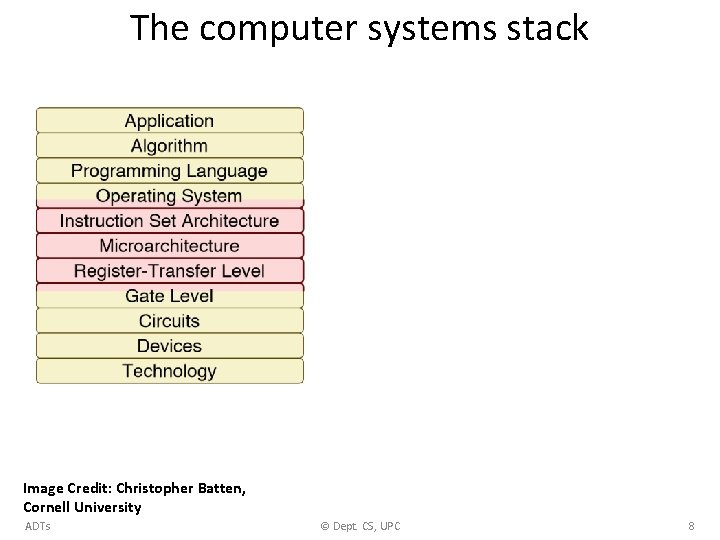
The computer systems stack Image Credit: Christopher Batten, Cornell University ADTs © Dept. CS, UPC 8
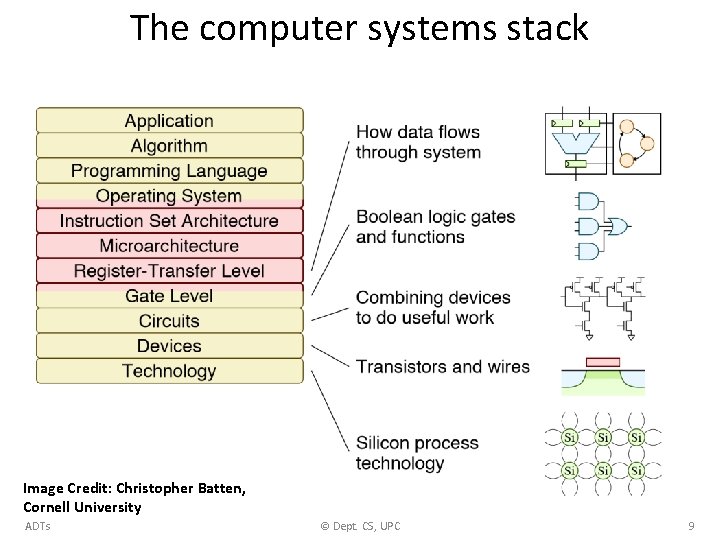
The computer systems stack Image Credit: Christopher Batten, Cornell University ADTs © Dept. CS, UPC 9
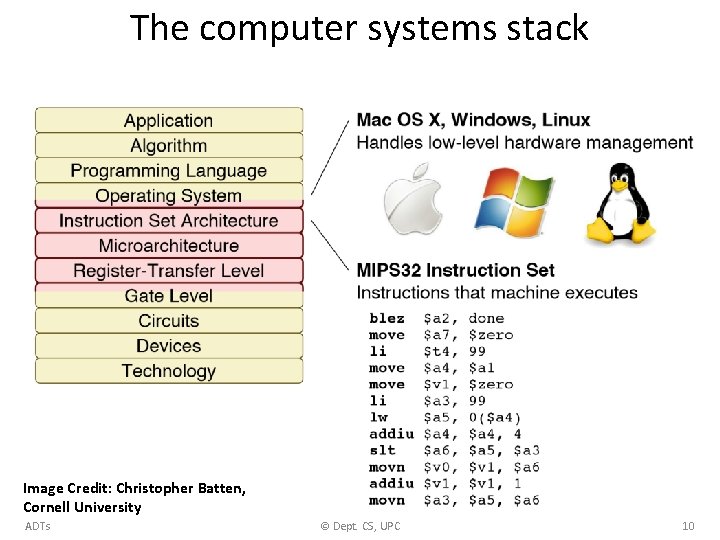
The computer systems stack Image Credit: Christopher Batten, Cornell University ADTs © Dept. CS, UPC 10
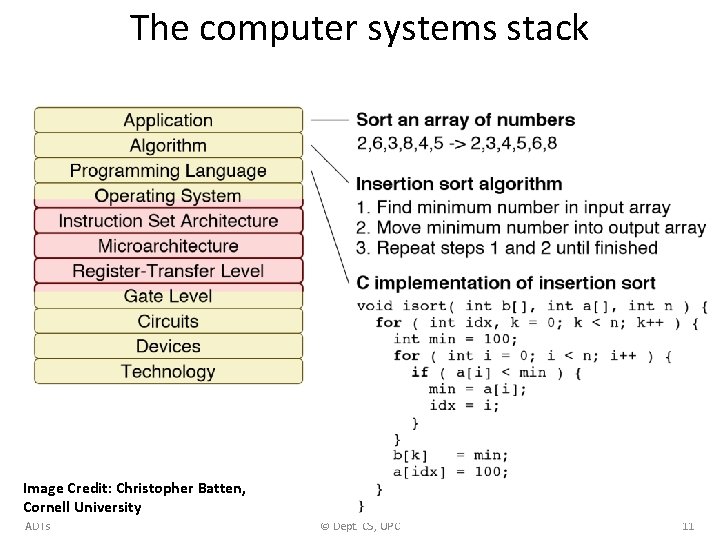
The computer systems stack Image Credit: Christopher Batten, Cornell University ADTs © Dept. CS, UPC 11
Our challenge • We need to design large systems and reason about complex algorithms. • Our working memory can only manipulate 4 things at once. • We need to interact with computers using programming languages. • Solution: abstraction – Abstract reasoning. – Programming languages that support abstraction. • We already use a certain level of abstraction: functions. But it is not sufficient. We need much more. ADTs © Dept. CS, UPC 12
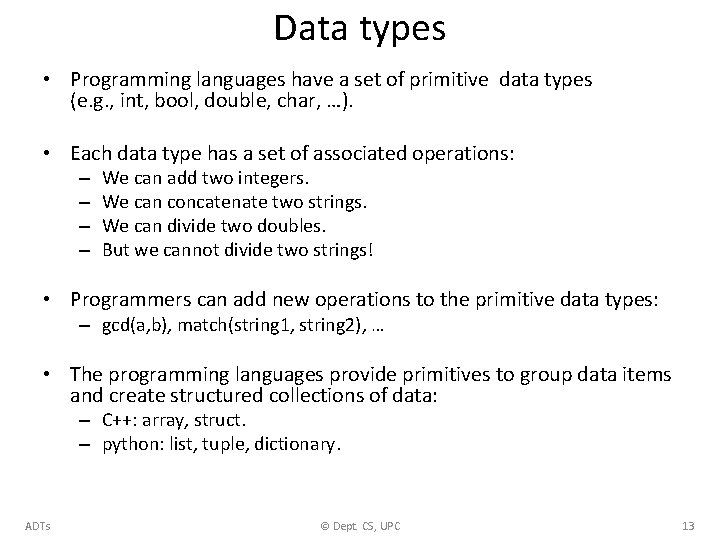
Data types • Programming languages have a set of primitive data types (e. g. , int, bool, double, char, …). • Each data type has a set of associated operations: – – We can add two integers. We can concatenate two strings. We can divide two doubles. But we cannot divide two strings! • Programmers can add new operations to the primitive data types: – gcd(a, b), match(string 1, string 2), … • The programming languages provide primitives to group data items and create structured collections of data: – C++: array, struct. – python: list, tuple, dictionary. ADTs © Dept. CS, UPC 13
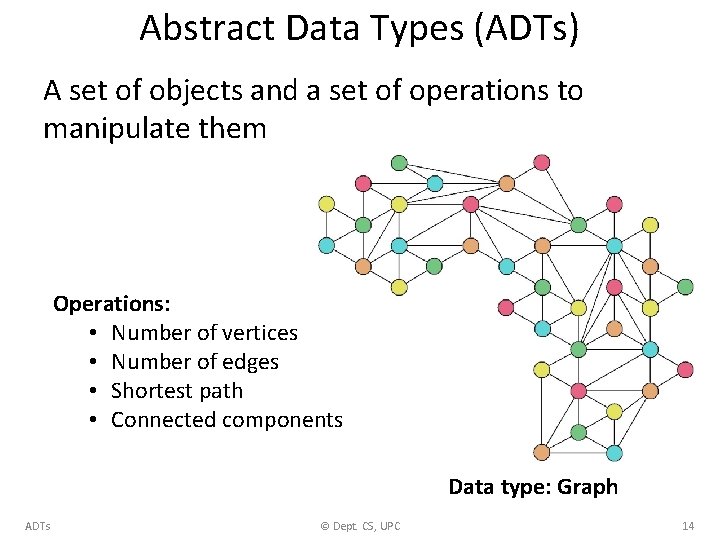
Abstract Data Types (ADTs) A set of objects and a set of operations to manipulate them Operations: • Number of vertices • Number of edges • Shortest path • Connected components Data type: Graph ADTs © Dept. CS, UPC 14
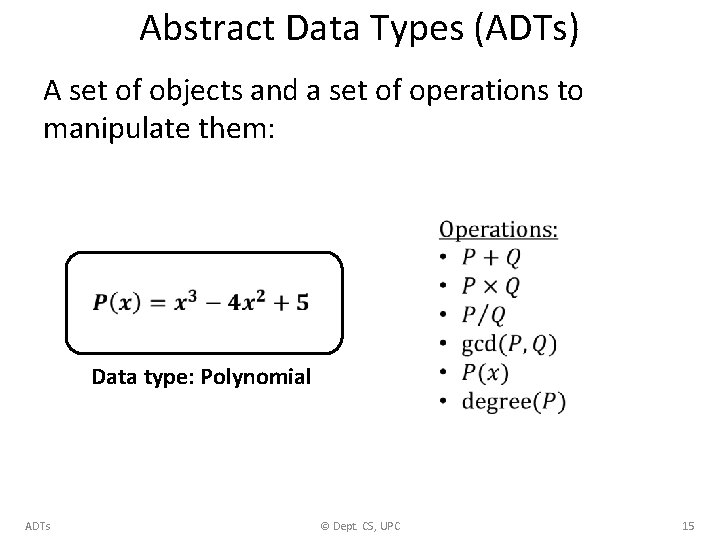
Abstract Data Types (ADTs) A set of objects and a set of operations to manipulate them: Data type: Polynomial ADTs © Dept. CS, UPC 15
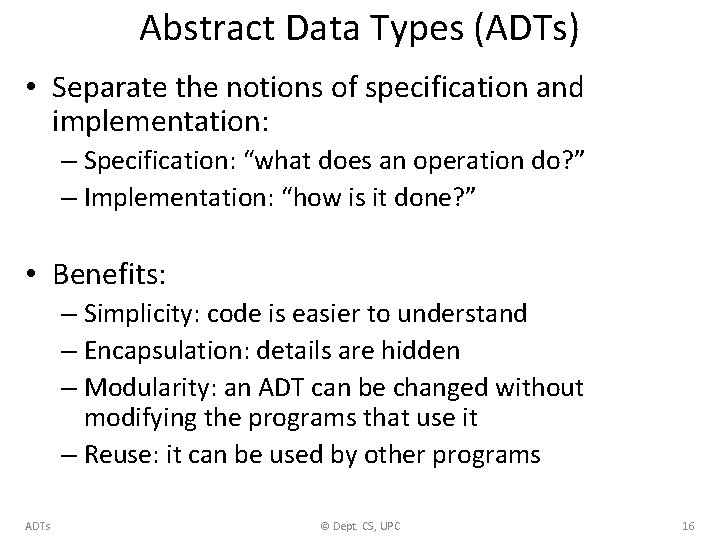
Abstract Data Types (ADTs) • Separate the notions of specification and implementation: – Specification: “what does an operation do? ” – Implementation: “how is it done? ” • Benefits: – Simplicity: code is easier to understand – Encapsulation: details are hidden – Modularity: an ADT can be changed without modifying the programs that use it – Reuse: it can be used by other programs ADTs © Dept. CS, UPC 16
Abstract Data Types (ADTs) • An ADT has two parts: – Public or external: abstract view of the data and operations (methods) that the user can use. – Private or internal: the actual implementation of the data structures and operations. • Operations: – Creation/Destruction – Access – Modification ADTs © Dept. CS, UPC 17
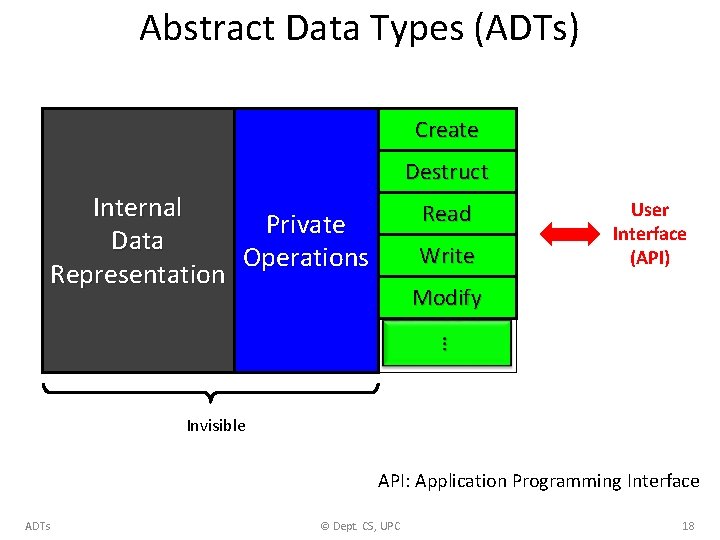
Abstract Data Types (ADTs) Create Destruct Internal Private Data Operations Representation Read Write User Interface (API) Modify Invisible API: Application Programming Interface ADTs © Dept. CS, UPC 18
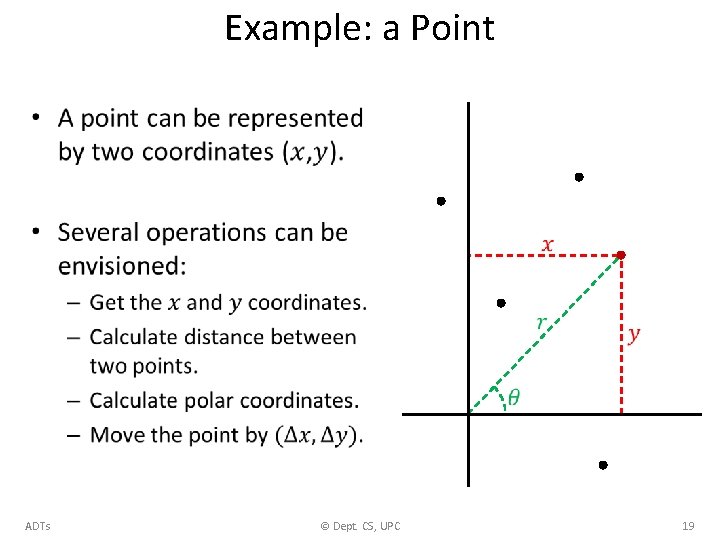
Example: a Point • ADTs © Dept. CS, UPC 19
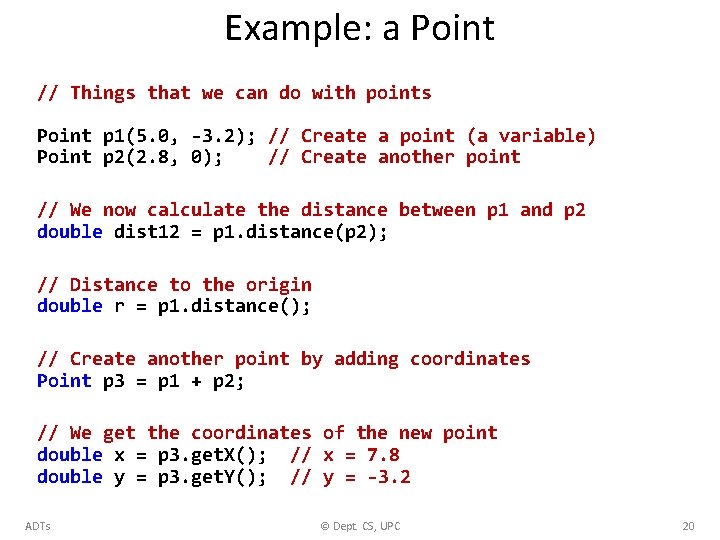
Example: a Point // Things that we can do with points Point p 1(5. 0, -3. 2); // Create a point (a variable) Point p 2(2. 8, 0); // Create another point // We now calculate the distance between p 1 and p 2 double dist 12 = p 1. distance(p 2); // Distance to the origin double r = p 1. distance(); // Create another point by adding coordinates Point p 3 = p 1 + p 2; // We get the coordinates of the new point double x = p 3. get. X(); // x = 7. 8 double y = p 3. get. Y(); // y = -3. 2 ADTs © Dept. CS, UPC 20
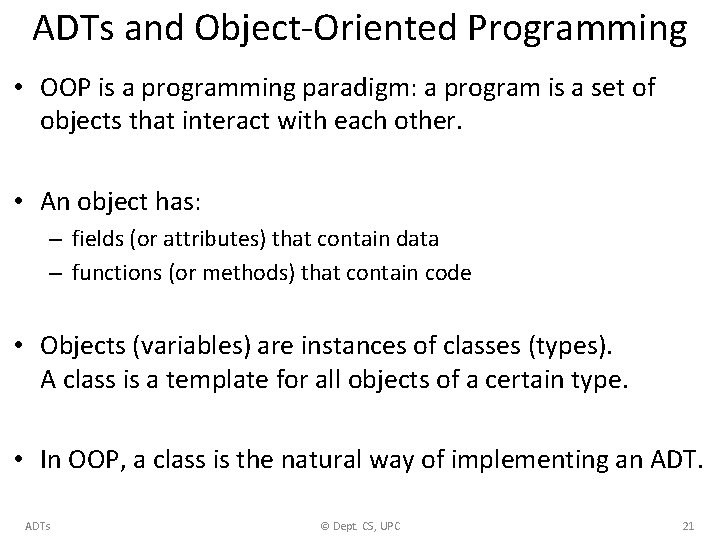
ADTs and Object-Oriented Programming • OOP is a programming paradigm: a program is a set of objects that interact with each other. • An object has: – fields (or attributes) that contain data – functions (or methods) that contain code • Objects (variables) are instances of classes (types). A class is a template for all objects of a certain type. • In OOP, a class is the natural way of implementing an ADTs © Dept. CS, UPC 21
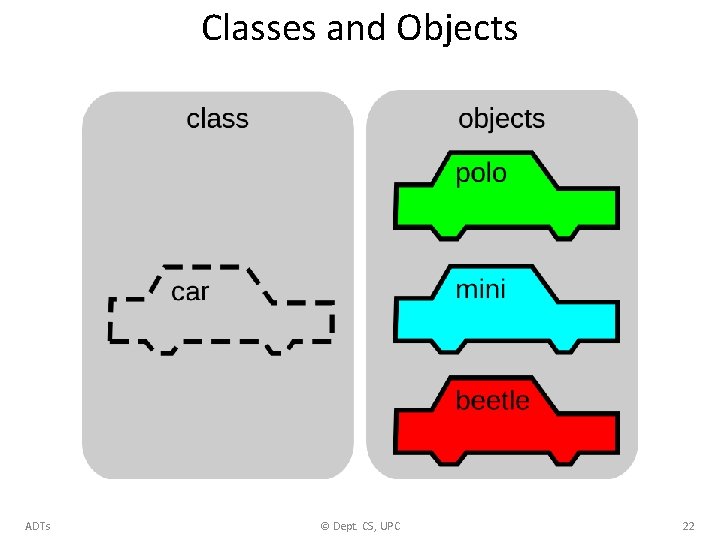
Classes and Objects ADTs © Dept. CS, UPC 22
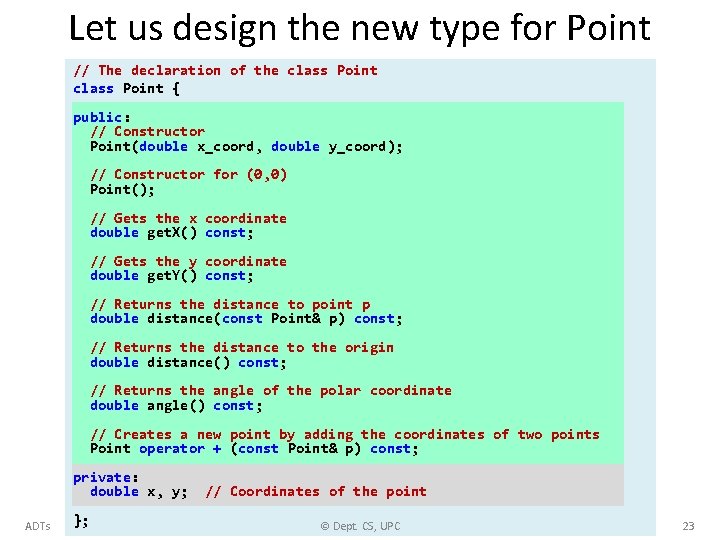
Let us design the new type for Point // The declaration of the class Point { public: // Constructor Point(double x_coord, double y_coord); // Constructor for (0, 0) Point(); // Gets the x coordinate double get. X() const; // Gets the y coordinate double get. Y() const; // Returns the distance to point p double distance(const Point& p) const; // Returns the distance to the origin double distance() const; // Returns the angle of the polar coordinate double angle() const; // Creates a new point by adding the coordinates of two points Point operator + (const Point& p) const; private: double x, y; ADTs }; // Coordinates of the point © Dept. CS, UPC 23
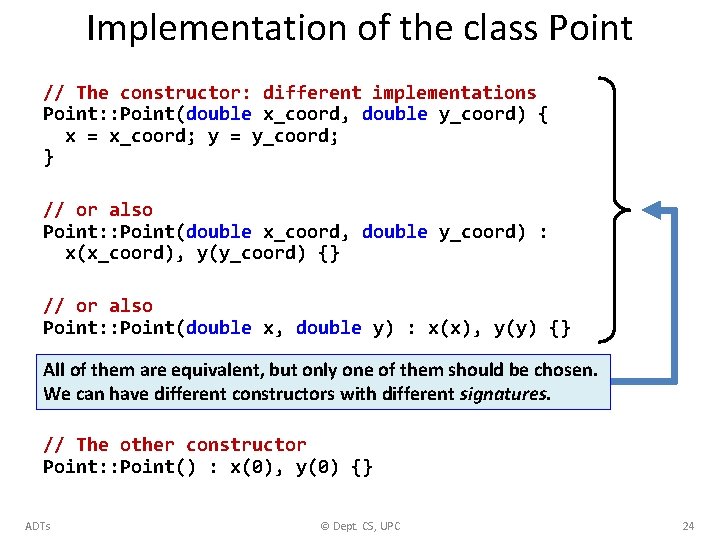
Implementation of the class Point // The constructor: different implementations Point: : Point(double x_coord, double y_coord) { x = x_coord; y = y_coord; } // or also Point: : Point(double x_coord, double y_coord) : x(x_coord), y(y_coord) {} // or also Point: : Point(double x, double y) : x(x), y(y) {} All of them are equivalent, but only one of them should be chosen. We can have different constructors with different signatures. // The other constructor Point: : Point() : x(0), y(0) {} ADTs © Dept. CS, UPC 24
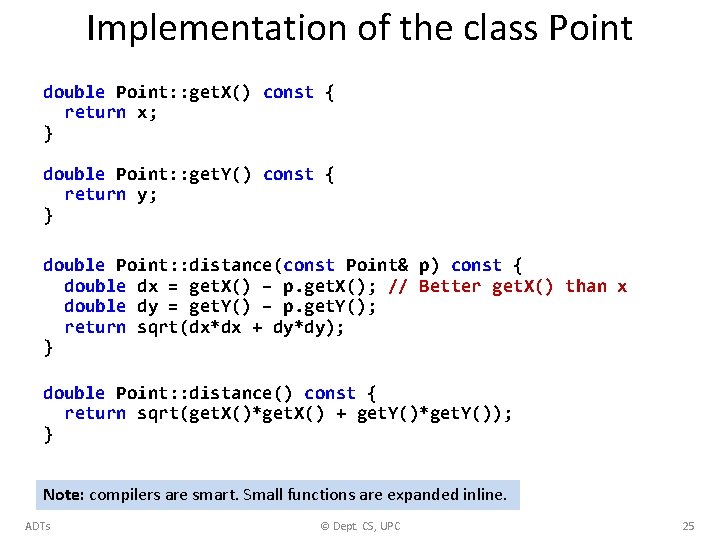
Implementation of the class Point double Point: : get. X() const { return x; } double Point: : get. Y() const { return y; } double Point: : distance(const Point& p) const { double dx = get. X() – p. get. X(); // Better get. X() than x double dy = get. Y() – p. get. Y(); return sqrt(dx*dx + dy*dy); } double Point: : distance() const { return sqrt(get. X()*get. X() + get. Y()*get. Y()); } Note: compilers are smart. Small functions are expanded inline. ADTs © Dept. CS, UPC 25
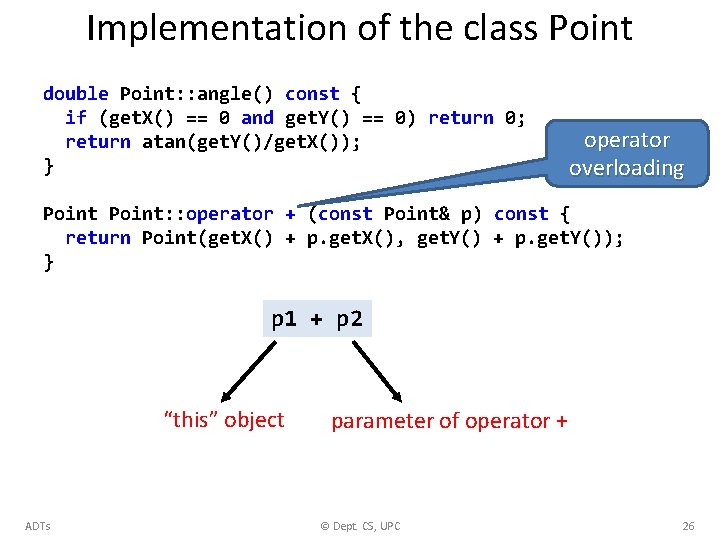
Implementation of the class Point double Point: : angle() const { if (get. X() == 0 and get. Y() == 0) return 0; return atan(get. Y()/get. X()); } operator overloading Point: : operator + (const Point& p) const { return Point(get. X() + p. get. X(), get. Y() + p. get. Y()); } p 1 + p 2 “this” object ADTs parameter of operator + © Dept. CS, UPC 26
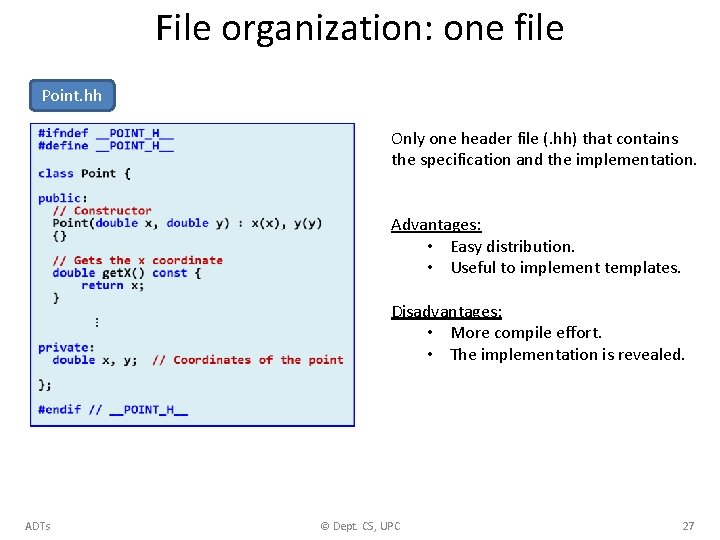
File organization: one file Point. hh Only one header file (. hh) that contains the specification and the implementation. Advantages: • Easy distribution. • Useful to implement templates. Disadvantages: • More compile effort. • The implementation is revealed. ADTs © Dept. CS, UPC 27
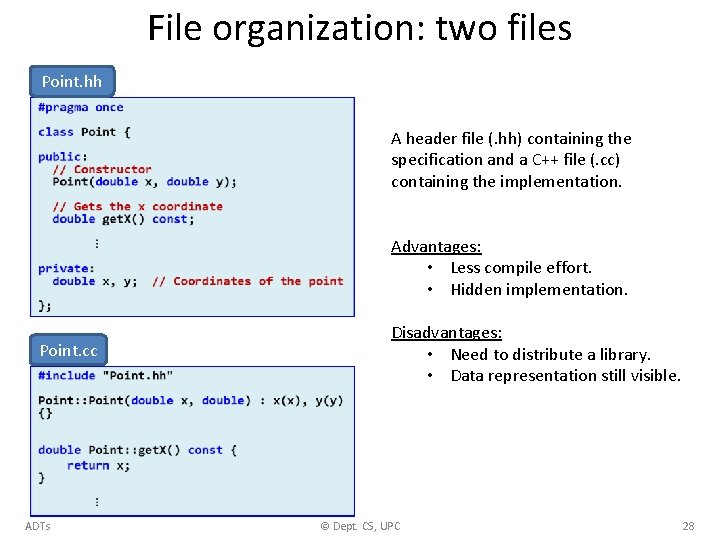
File organization: two files Point. hh A header file (. hh) containing the specification and a C++ file (. cc) containing the implementation. Advantages: • Less compile effort. • Hidden implementation. Point. cc ADTs Disadvantages: • Need to distribute a library. • Data representation still visible. © Dept. CS, UPC 28
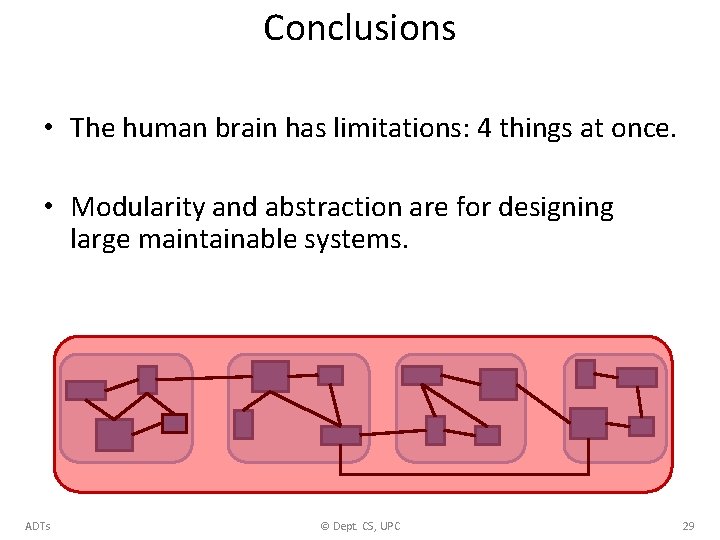
Conclusions • The human brain has limitations: 4 things at once. • Modularity and abstraction are for designing large maintainable systems. ADTs © Dept. CS, UPC 29
- Slides: 29