
Abstract Classes Interfaces Definitions abstract methods Methods that
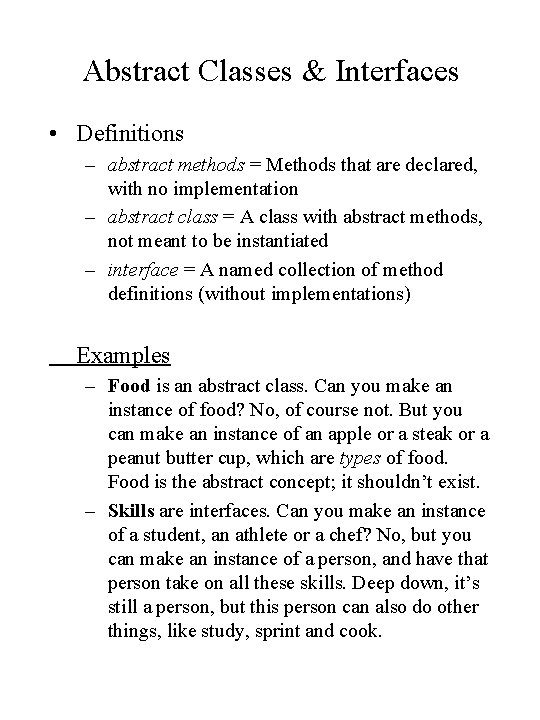
Abstract Classes & Interfaces • Definitions – abstract methods = Methods that are declared, with no implementation – abstract class = A class with abstract methods, not meant to be instantiated – interface = A named collection of method definitions (without implementations) Examples – Food is an abstract class. Can you make an instance of food? No, of course not. But you can make an instance of an apple or a steak or a peanut butter cup, which are types of food. Food is the abstract concept; it shouldn’t exist. – Skills are interfaces. Can you make an instance of a student, an athlete or a chef? No, but you can make an instance of a person, and have that person take on all these skills. Deep down, it’s still a person, but this person can also do other things, like study, sprint and cook.

Abstract Classes & Interfaces • Q: So what’s the difference between an interface and an abstract class? • A: – An interface cannot implement any methods, whereas an abstract class can – A class can implement many interfaces but can have only one superclass (abstract or not) – An interface is not part of the class hierarchy. Unrelated classes can implement the same interface • Syntax: – abstract class: public class Apple extends Food { … } – interface: public class Person implements Student, Athlete, Chef { … }
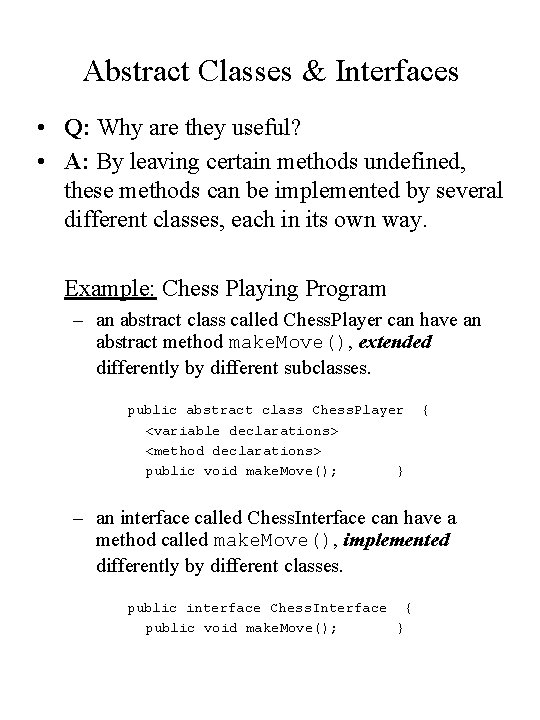
Abstract Classes & Interfaces • Q: Why are they useful? • A: By leaving certain methods undefined, these methods can be implemented by several different classes, each in its own way. Example: Chess Playing Program – an abstract class called Chess. Player can have an abstract method make. Move(), extended differently by different subclasses. public abstract class Chess. Player <variable declarations> <method declarations> public void make. Move(); } { – an interface called Chess. Interface can have a method called make. Move(), implemented differently by different classes. public interface Chess. Interface { public void make. Move(); }
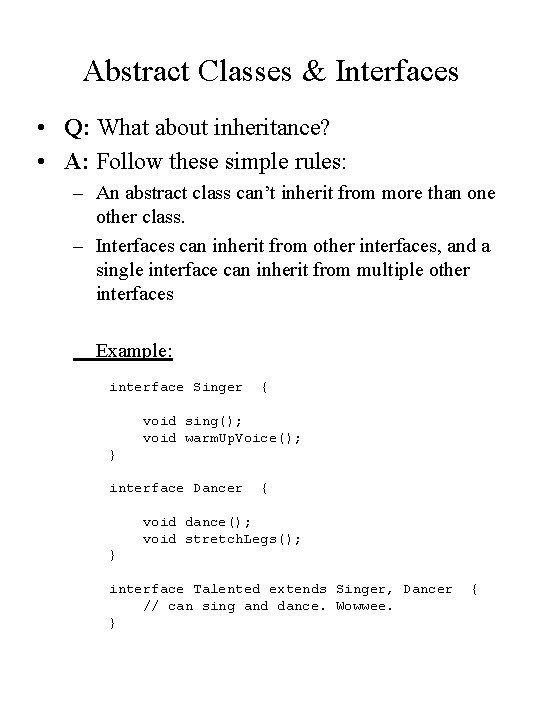
Abstract Classes & Interfaces • Q: What about inheritance? • A: Follow these simple rules: – An abstract class can’t inherit from more than one other class. – Interfaces can inherit from other interfaces, and a single interface can inherit from multiple other interfaces Example: interface Singer { void sing(); void warm. Up. Voice(); } interface Dancer { void dance(); void stretch. Legs(); } interface Talented extends Singer, Dancer // can sing and dance. Wowwee. } {

Abstract Classes & Interfaces • Q: Where else can interfaces be used? • A: You can pass an interface as a parameter or assign a class to an interface variable, just like you would to an abstract class. Example: Food my. Lunch = new Sandwich(); Food my. Snack = new Apple(); Student steve = new Person(); //assuming that Person implements Student – If Person has methods eat(Food f) and teach(Student s), the following is possible: Person bob = new Person(); steve. teach(bob); steve. eat(my. Lunch); System. out. println(“Yum. ”);
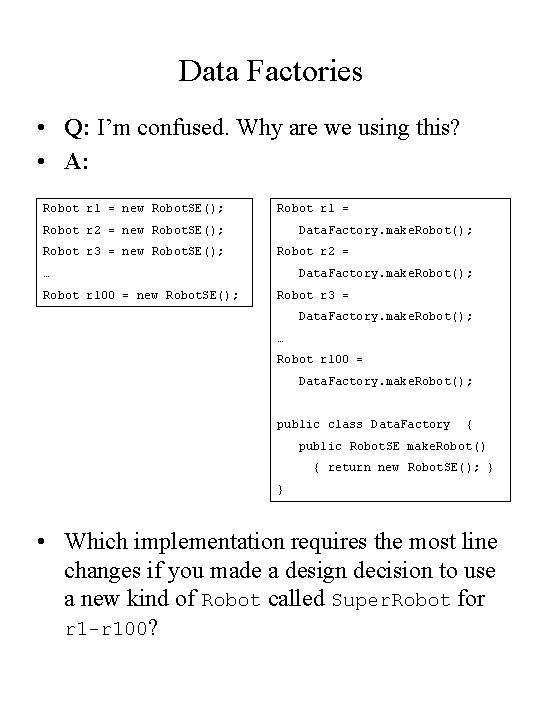
Data Factories • Q: I’m confused. Why are we using this? • A: Robot r 1 = new Robot. SE(); Robot r 1 = Robot r 2 = new Robot. SE(); Robot r 3 = new Robot. SE(); Data. Factory. make. Robot(); Robot r 2 = … Robot r 100 = new Robot. SE(); Data. Factory. make. Robot(); Robot r 3 = Data. Factory. make. Robot(); … Robot r 100 = Data. Factory. make. Robot(); public class Data. Factory { public Robot. SE make. Robot() { return new Robot. SE(); } } • Which implementation requires the most line changes if you made a design decision to use a new kind of Robot called Super. Robot for r 1 -r 100?
- Slides: 6