
Abstinence Contraception Abstinence is the decision to refrain
Abstinence & Contraception
Abstinence is the decision to refrain from sexual activity. It is the ONLY 100% effective way to prevent pregnancy and the transmission of STDs. It has no medical side effects and is free. No prescription is needed. This decision isn’t difficult to make, but is proven challenging to continue to make and practice if one allows themselves to be put in compromising situations. There a few simple things a person can practice to continue being abstinent…
Abstinence Healthy intimate relationships require honest communication and should include communication about sex. This commitment should be explained to a boyfriend or girlfriend for them to respect and understand. Avoid risky situations and refuse sexual advances – remove yourself from situations you don’t want to be in and practice refusal skills. Reevaluate your relationship if your partner does not respect your decision. The impaired judgement and inhibition that alcohol and other drug use causes may increase the possibility of engaging in sexual activity.
Contraception If CONCEPTION means: the action of conceiving a child or of a child being conceived. Then CONTRAception means: the deliberate use of artificial methods or other techniques to prevent pregnancy as a consequence of sexual intercourse. Contraception methods can be placed into one of the following categories: Natural Barrier Hormonal Chemical Surgical
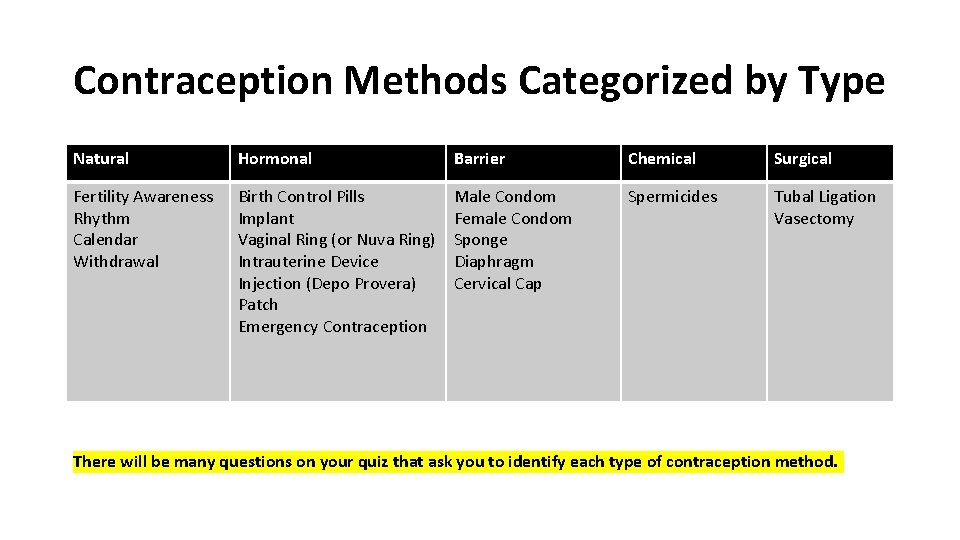
Contraception Methods Categorized by Type Natural Hormonal Barrier Chemical Surgical Fertility Awareness Rhythm Calendar Withdrawal Birth Control Pills Implant Vaginal Ring (or Nuva Ring) Intrauterine Device Injection (Depo Provera) Patch Emergency Contraception Male Condom Female Condom Sponge Diaphragm Cervical Cap Spermicides Tubal Ligation Vasectomy There will be many questions on your quiz that ask you to identify each type of contraception method.
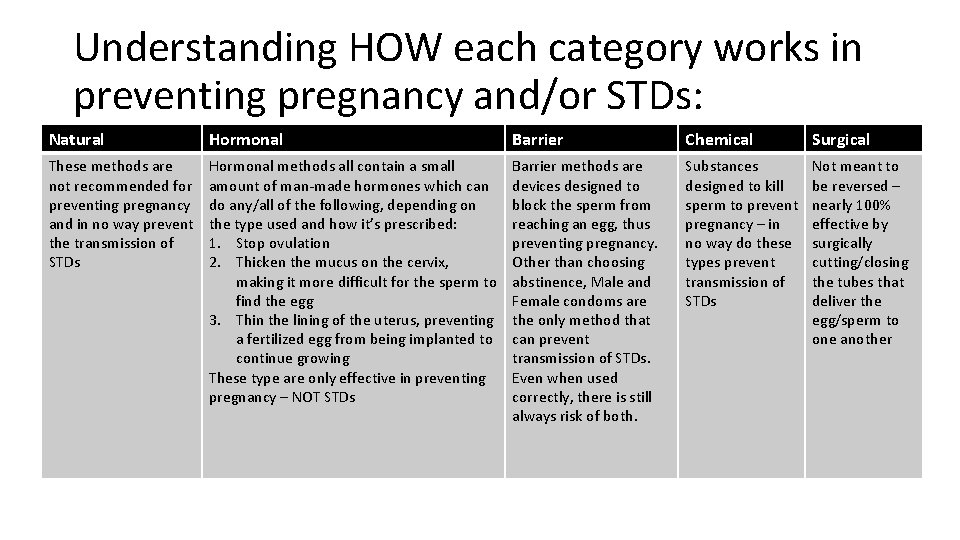
Understanding HOW each category works in preventing pregnancy and/or STDs: Natural Hormonal Barrier Chemical Surgical These methods are not recommended for preventing pregnancy and in no way prevent the transmission of STDs Hormonal methods all contain a small amount of man-made hormones which can do any/all of the following, depending on the type used and how it’s prescribed: 1. Stop ovulation 2. Thicken the mucus on the cervix, making it more difficult for the sperm to find the egg 3. Thin the lining of the uterus, preventing a fertilized egg from being implanted to continue growing These type are only effective in preventing pregnancy – NOT STDs Barrier methods are devices designed to block the sperm from reaching an egg, thus preventing pregnancy. Other than choosing abstinence, Male and Female condoms are the only method that can prevent transmission of STDs. Even when used correctly, there is still always risk of both. Substances designed to kill sperm to prevent pregnancy – in no way do these types prevent transmission of STDs Not meant to be reversed – nearly 100% effective by surgically cutting/closing the tubes that deliver the egg/sperm to one another
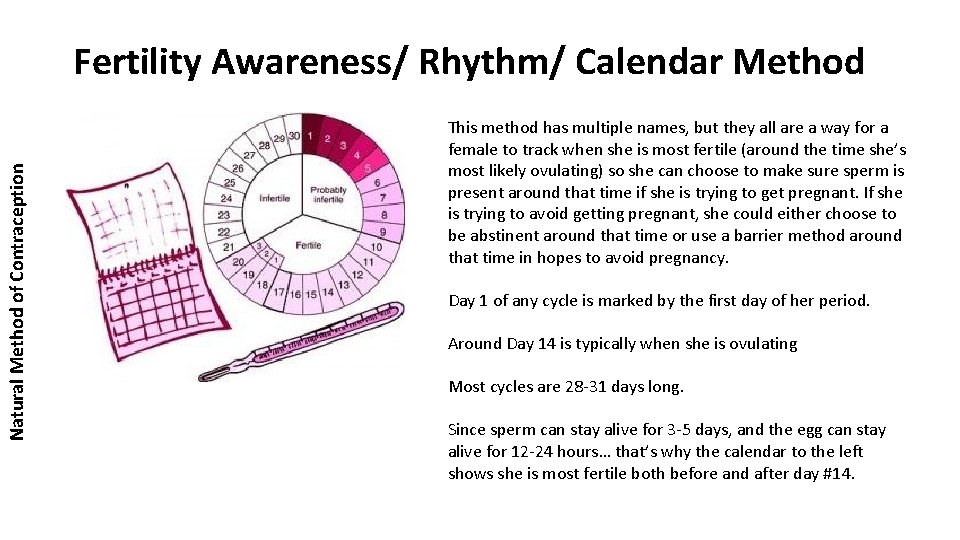
Natural Method of Contraception Fertility Awareness/ Rhythm/ Calendar Method This method has multiple names, but they all are a way for a female to track when she is most fertile (around the time she’s most likely ovulating) so she can choose to make sure sperm is present around that time if she is trying to get pregnant. If she is trying to avoid getting pregnant, she could either choose to be abstinent around that time or use a barrier method around that time in hopes to avoid pregnancy. Day 1 of any cycle is marked by the first day of her period. Around Day 14 is typically when she is ovulating Most cycles are 28 -31 days long. Since sperm can stay alive for 3 -5 days, and the egg can stay alive for 12 -24 hours… that’s why the calendar to the left shows she is most fertile both before and after day #14.
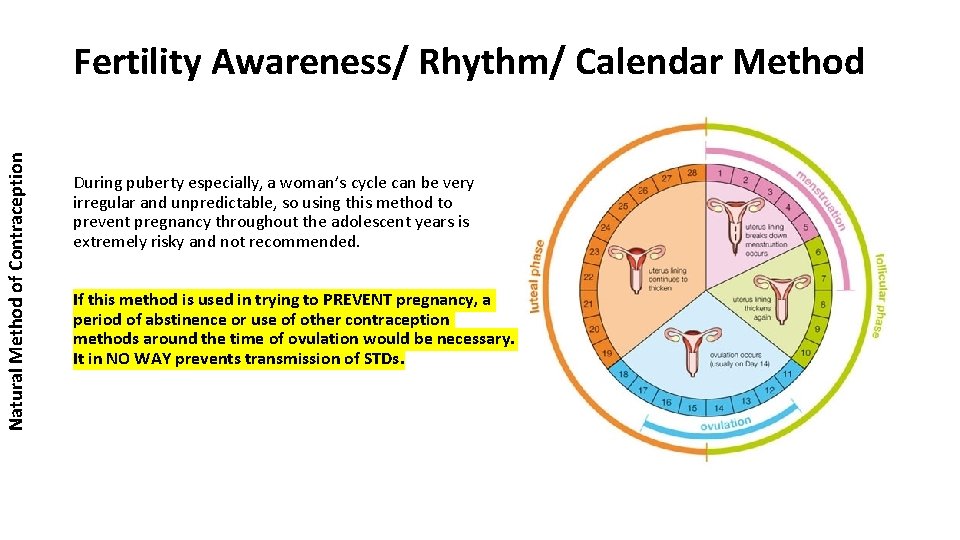
Natural Method of Contraception Fertility Awareness/ Rhythm/ Calendar Method During puberty especially, a woman’s cycle can be very irregular and unpredictable, so using this method to prevent pregnancy throughout the adolescent years is extremely risky and not recommended. If this method is used in trying to PREVENT pregnancy, a period of abstinence or use of other contraception methods around the time of ovulation would be necessary. It in NO WAY prevents transmission of STDs.

Natural Method of Contraception Withdrawal Method Withdrawal, or pulling out is a very commonly used contraception method. A man using this method will pull his penis out of the vagina before ejaculating. This may keep sperm out of the vagina and reduce the chance of pregnancy. However, this is NOT an effective method of birth control for several reasons: 1. It is difficult to time correctly and requires self-control. 2. It is not always easy for a man to withdrawal during intense sexual excitement. 3. Before ejaculation, it is common for fluid containing sperm to leak from the penis. This pre-ejaculation fluid may also contain sperm, which can cause pregnancy
Surgical Methods of Contraception Surgical Methods for Sterilization methods are surgical procedures that are performed by a medical doctor to prevent the sperm and ova from uniting to form a fertilized egg. Reversing these procedures is difficult and often unsuccessful, so it’s important for the individual to be certain they don’t want any, or they don’t want any more children. Female procedure: Tubal Ligation – fallopian tubes are cut/closed Male procedure: Vasectomy – vas deferens are cut/closed
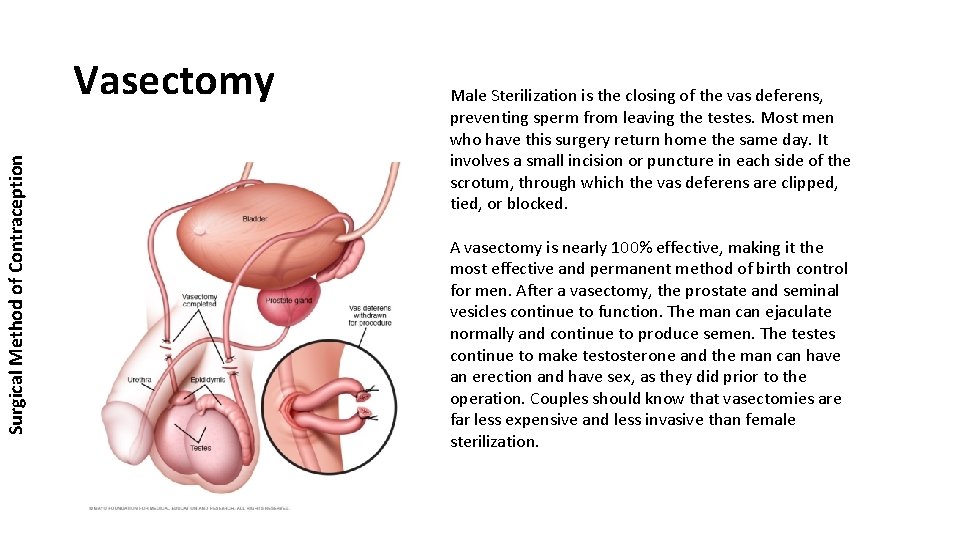
Surgical Method of Contraception Vasectomy Male Sterilization is the closing of the vas deferens, preventing sperm from leaving the testes. Most men who have this surgery return home the same day. It involves a small incision or puncture in each side of the scrotum, through which the vas deferens are clipped, tied, or blocked. A vasectomy is nearly 100% effective, making it the most effective and permanent method of birth control for men. After a vasectomy, the prostate and seminal vesicles continue to function. The man can ejaculate normally and continue to produce semen. The testes continue to make testosterone and the man can have an erection and have sex, as they did prior to the operation. Couples should know that vasectomies are far less expensive and less invasive than female sterilization.
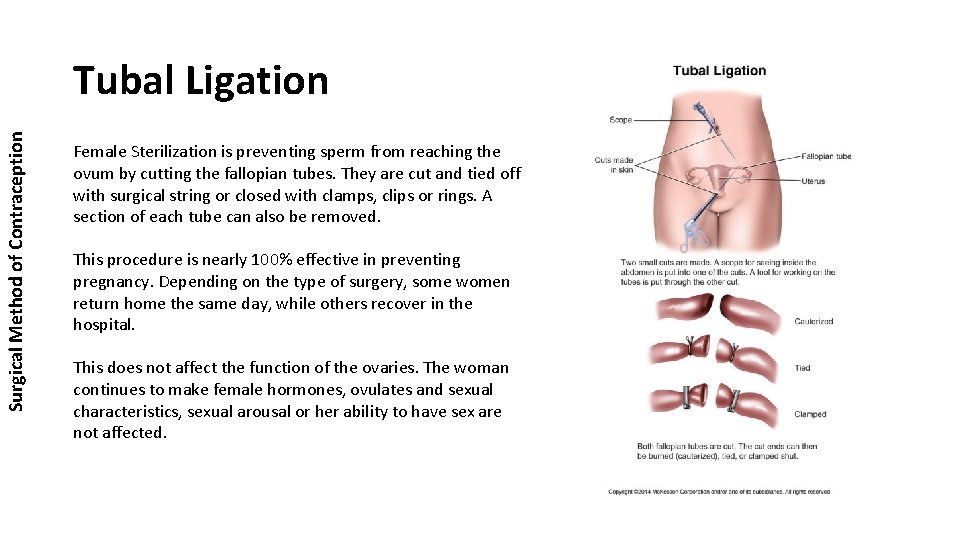
Surgical Method of Contraception Tubal Ligation Female Sterilization is preventing sperm from reaching the ovum by cutting the fallopian tubes. They are cut and tied off with surgical string or closed with clamps, clips or rings. A section of each tube can also be removed. This procedure is nearly 100% effective in preventing pregnancy. Depending on the type of surgery, some women return home the same day, while others recover in the hospital. This does not affect the function of the ovaries. The woman continues to make female hormones, ovulates and sexual characteristics, sexual arousal or her ability to have sex are not affected.
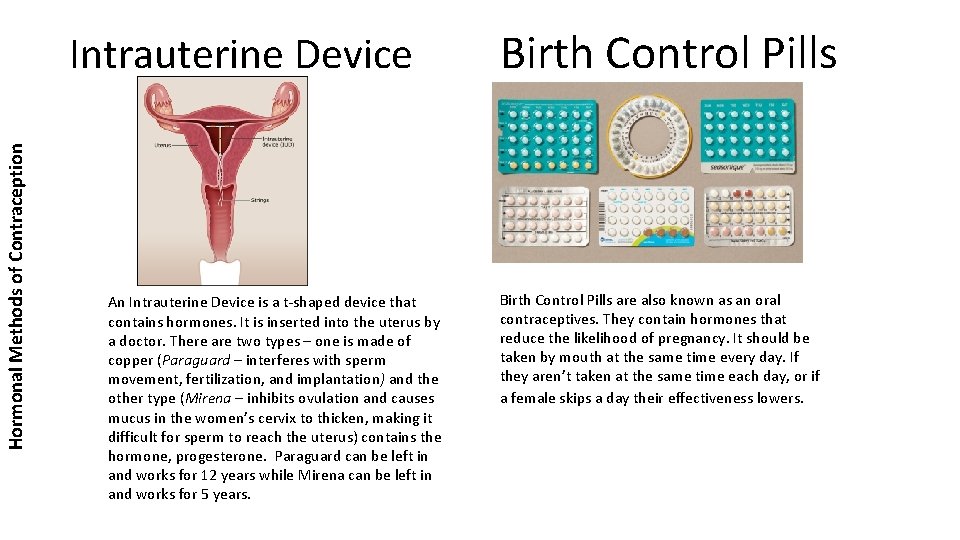
Hormonal Methods of Contraception Intrauterine Device An Intrauterine Device is a t-shaped device that contains hormones. It is inserted into the uterus by a doctor. There are two types – one is made of copper (Paraguard – interferes with sperm movement, fertilization, and implantation) and the other type (Mirena – inhibits ovulation and causes mucus in the women’s cervix to thicken, making it difficult for sperm to reach the uterus) contains the hormone, progesterone. Paraguard can be left in and works for 12 years while Mirena can be left in and works for 5 years. Birth Control Pills are also known as an oral contraceptives. They contain hormones that reduce the likelihood of pregnancy. It should be taken by mouth at the same time every day. If they aren’t taken at the same time each day, or if a female skips a day their effectiveness lowers.
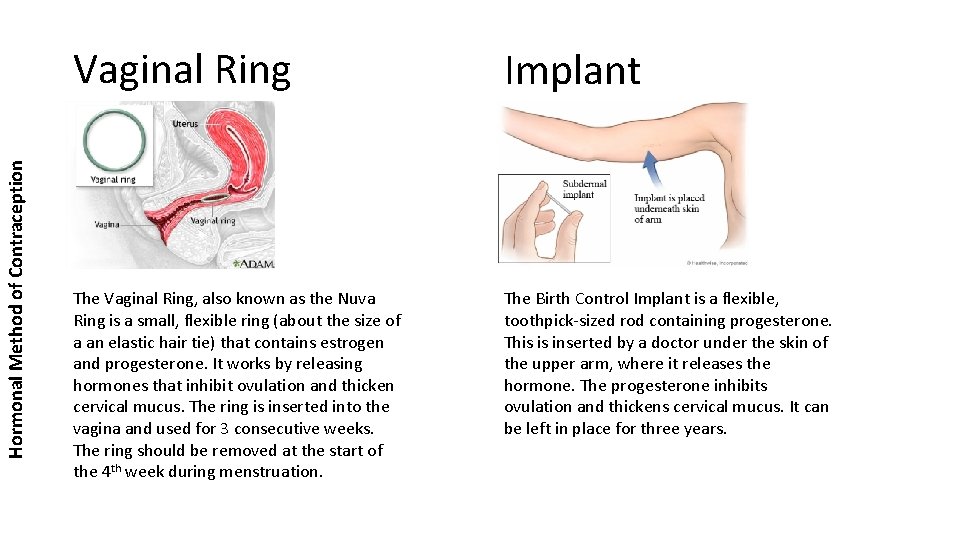
Hormonal Method of Contraception Vaginal Ring Implant The Vaginal Ring, also known as the Nuva Ring is a small, flexible ring (about the size of a an elastic hair tie) that contains estrogen and progesterone. It works by releasing hormones that inhibit ovulation and thicken cervical mucus. The ring is inserted into the vagina and used for 3 consecutive weeks. The ring should be removed at the start of the 4 th week during menstruation. The Birth Control Implant is a flexible, toothpick-sized rod containing progesterone. This is inserted by a doctor under the skin of the upper arm, where it releases the hormone. The progesterone inhibits ovulation and thickens cervical mucus. It can be left in place for three years.
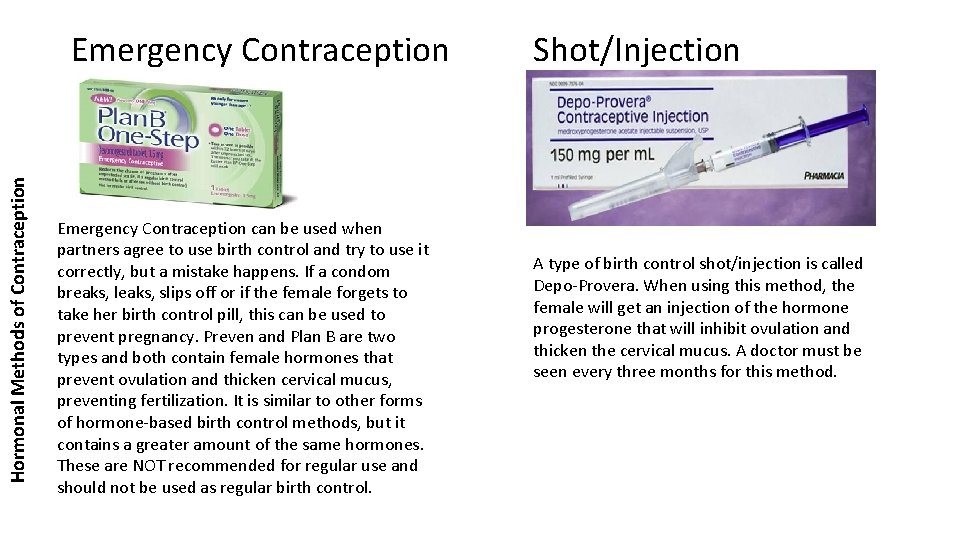
Hormonal Methods of Contraception Emergency Contraception can be used when partners agree to use birth control and try to use it correctly, but a mistake happens. If a condom breaks, leaks, slips off or if the female forgets to take her birth control pill, this can be used to prevent pregnancy. Preven and Plan B are two types and both contain female hormones that prevent ovulation and thicken cervical mucus, preventing fertilization. It is similar to other forms of hormone-based birth control methods, but it contains a greater amount of the same hormones. These are NOT recommended for regular use and should not be used as regular birth control. Shot/Injection A type of birth control shot/injection is called Depo-Provera. When using this method, the female will get an injection of the hormone progesterone that will inhibit ovulation and thicken the cervical mucus. A doctor must be seen every three months for this method.
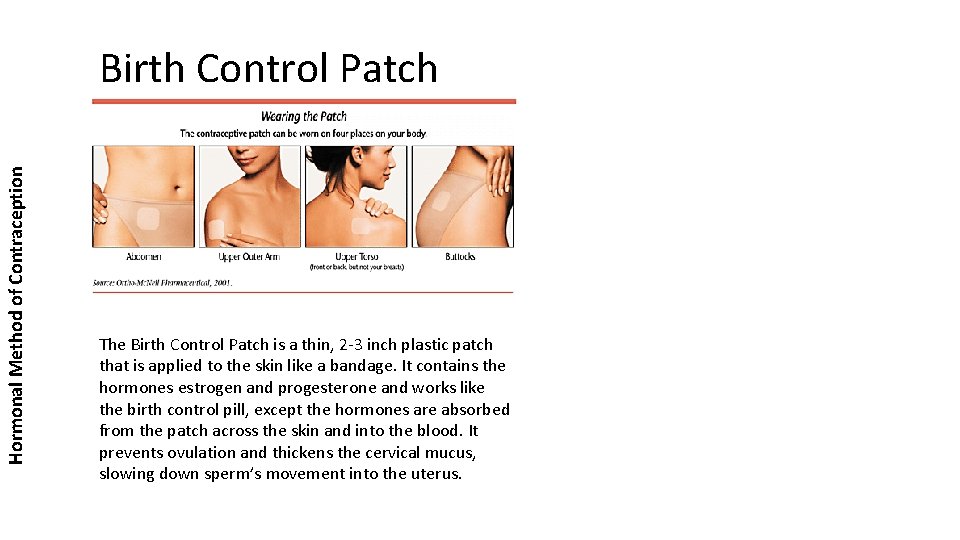
Hormonal Method of Contraception Birth Control Patch The Birth Control Patch is a thin, 2 -3 inch plastic patch that is applied to the skin like a bandage. It contains the hormones estrogen and progesterone and works like the birth control pill, except the hormones are absorbed from the patch across the skin and into the blood. It prevents ovulation and thickens the cervical mucus, slowing down sperm’s movement into the uterus.
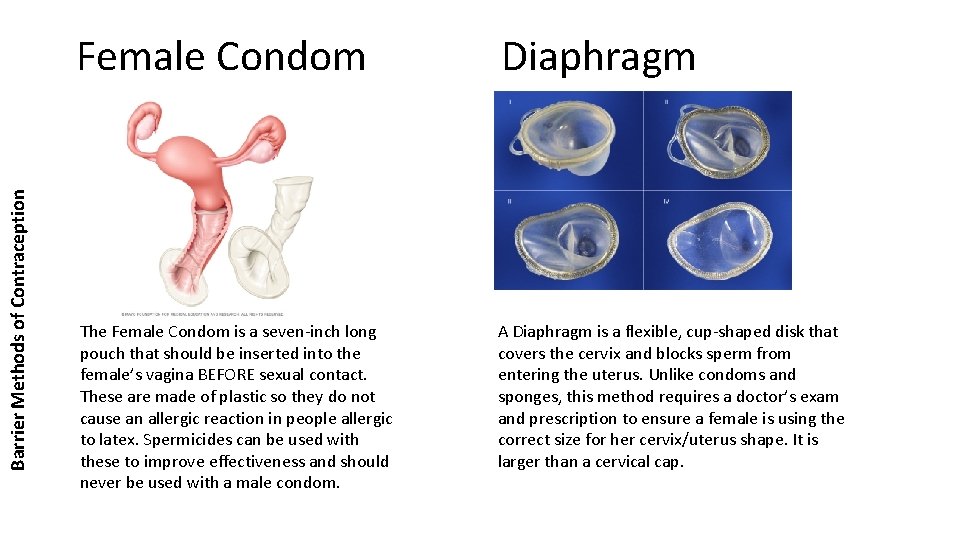
Barrier Methods of Contraception Female Condom Diaphragm The Female Condom is a seven-inch long pouch that should be inserted into the female’s vagina BEFORE sexual contact. These are made of plastic so they do not cause an allergic reaction in people allergic to latex. Spermicides can be used with these to improve effectiveness and should never be used with a male condom. A Diaphragm is a flexible, cup-shaped disk that covers the cervix and blocks sperm from entering the uterus. Unlike condoms and sponges, this method requires a doctor’s exam and prescription to ensure a female is using the correct size for her cervix/uterus shape. It is larger than a cervical cap.
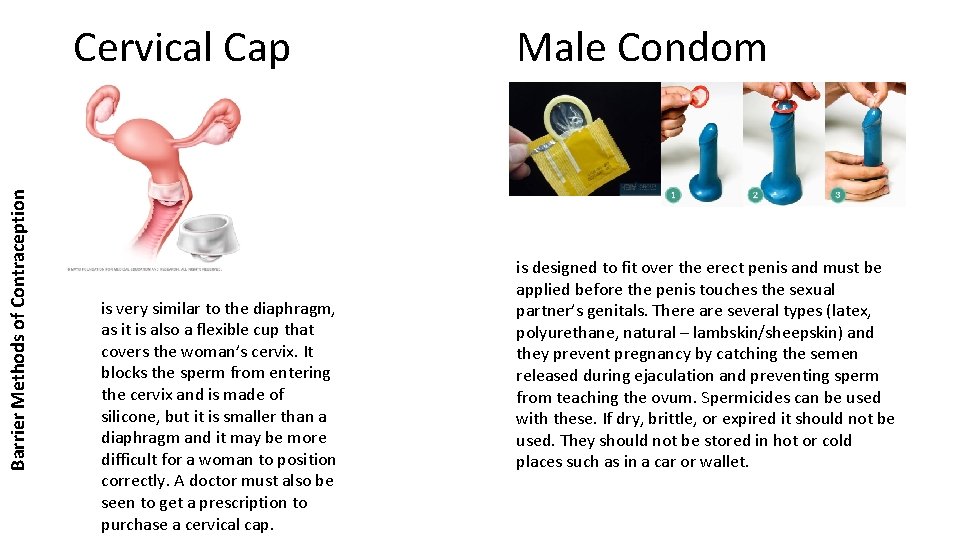
Barrier Methods of Contraception Cervical Cap is very similar to the diaphragm, as it is also a flexible cup that covers the woman’s cervix. It blocks the sperm from entering the cervix and is made of silicone, but it is smaller than a diaphragm and it may be more difficult for a woman to position correctly. A doctor must also be seen to get a prescription to purchase a cervical cap. Male Condom is designed to fit over the erect penis and must be applied before the penis touches the sexual partner’s genitals. There are several types (latex, polyurethane, natural – lambskin/sheepskin) and they prevent pregnancy by catching the semen released during ejaculation and preventing sperm from teaching the ovum. Spermicides can be used with these. If dry, brittle, or expired it should not be used. They should not be stored in hot or cold places such as in a car or wallet.
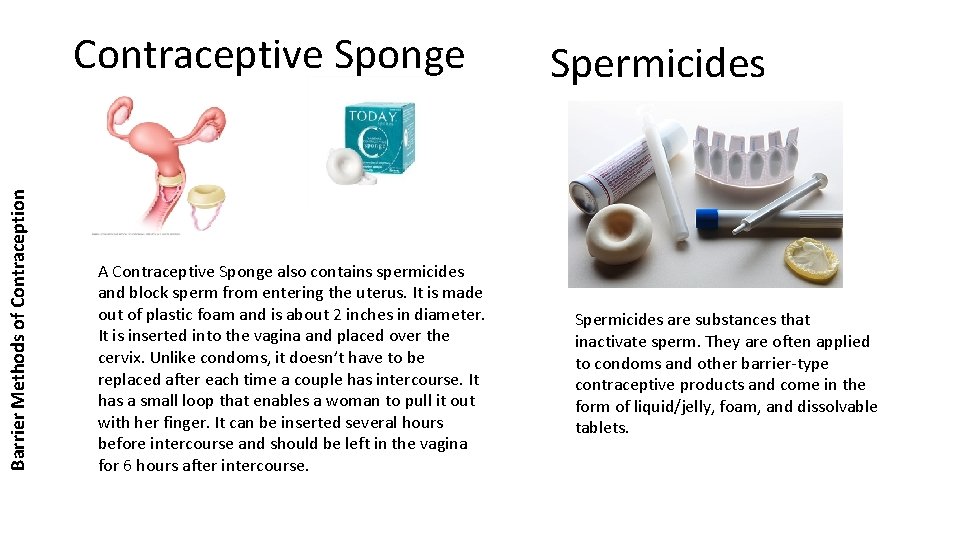
Barrier Methods of Contraception Contraceptive Sponge A Contraceptive Sponge also contains spermicides and block sperm from entering the uterus. It is made out of plastic foam and is about 2 inches in diameter. It is inserted into the vagina and placed over the cervix. Unlike condoms, it doesn’t have to be replaced after each time a couple has intercourse. It has a small loop that enables a woman to pull it out with her finger. It can be inserted several hours before intercourse and should be left in the vagina for 6 hours after intercourse. Spermicides are substances that inactivate sperm. They are often applied to condoms and other barrier-type contraceptive products and come in the form of liquid/jelly, foam, and dissolvable tablets.
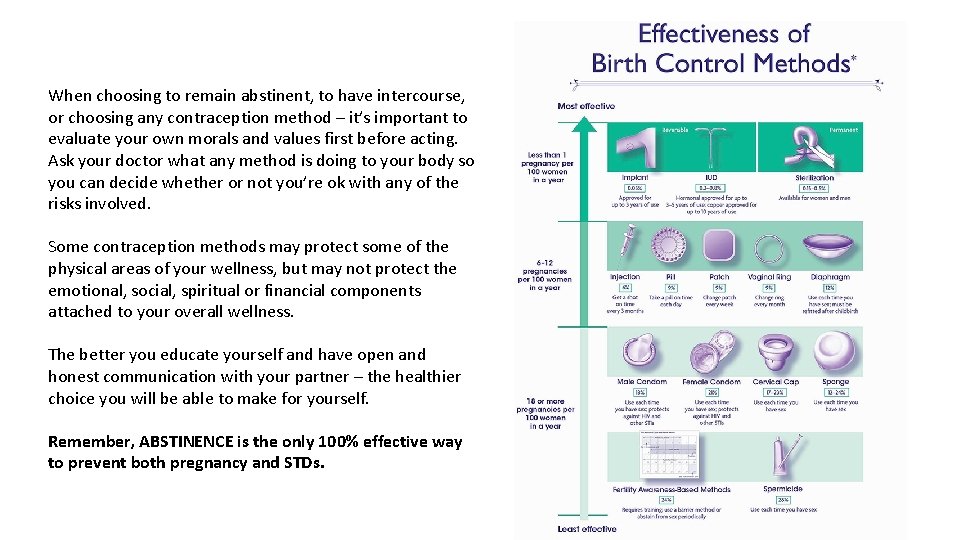
When choosing to remain abstinent, to have intercourse, or choosing any contraception method – it’s important to evaluate your own morals and values first before acting. Ask your doctor what any method is doing to your body so you can decide whether or not you’re ok with any of the risks involved. Some contraception methods may protect some of the physical areas of your wellness, but may not protect the emotional, social, spiritual or financial components attached to your overall wellness. The better you educate yourself and have open and honest communication with your partner – the healthier choice you will be able to make for yourself. Remember, ABSTINENCE is the only 100% effective way to prevent both pregnancy and STDs.
- Slides: 20