
Absorption transport and metabolism of vitamin C Domina
Absorption, transport and metabolism of vitamin C Domina Petric, MD

Absorption of vitamin C I. 12/20/2021 Combs GF. The Vitamins. Fundamental Aspects in Nutrition and Health. Elsevier Inc. 2008. 2

Absorption of vitamin C Humans do not synthesize ascorbic acid, but absorb the vitamin by: • passive diffusion important at high doses • saturable, carrier-mediated, active transport mechanisms important at low doses 12/20/2021 Combs GF. The Vitamins. Fundamental Aspects in Nutrition and Health. Elsevier Inc. 2008. 3
Absorption of vitamin C • The efficiency of absorption of physiological doses (≤ 180 mg/day for adult) of vitamin C is high, 80 -90%, and declines markedly at vitamin C doses greater than about 1 g. • The reduced and oxidized forms of the vitamin are absorbed by different mechanisms of active transport that occur throughout the small intestine. 12/20/2021 Combs GF. The Vitamins. Fundamental Aspects in Nutrition and Health. Elsevier Inc. 2008. 4
Ascorbic acid uptake by the sodiumdependent vitamin C transporter (SVTC) • This carrier moves L-ascorbic acid by an electrogenic, Na+ dependent process with a stoichiometric ratio of two Na+ ions per ascorbic acid molecule. • In the absence of ascorbic acid, the SVCT can facilitate the unitransport of Na+, allowing that ion to leak from cells. • The SVCT is noncompetitively inhibited by flavonoids. 12/20/2021 Combs GF. The Vitamins. Fundamental Aspects in Nutrition and Health. Elsevier Inc. 2008. 5
Dehydroascorbic acid uptake by glucose transporters • The uptake of dehydroascorbic acid is 10 - to 20 -fold faster than that of ascorbic acid and involves isoforms of the glucose transporter, GLUT 1, GLUT 3 and perhaps GLUT 4. • Upon entry into the cell, dehydroascorbic acid is quickly reduced to ascorbic acid, probably by glutaredoxine reductase and/or reduced glutathione (GSH). 12/20/2021 Combs GF. The Vitamins. Fundamental Aspects in Nutrition and Health. Elsevier Inc. 2008. 6
Transport of vitamin C II. 12/20/2021 Combs GF. The Vitamins. Fundamental Aspects in Nutrition and Health. Elsevier Inc. 2008. 7
Transport predominantly in reduced form • Vitamin C is transported in the plasma predominantly (80 -90%) in the reduced form, ascorbic acid. • Plasma ascorbic acid shows a sigmoid relationship with the level of vitamin C intake, saturation being achieved at daily doses of 1000 mg or more. • Plasma ascorbic acid levels in healthy adults are typically 30 -70 µmol/L and appear to be affected by body fat distribution. 12/20/2021 Combs GF. The Vitamins. Fundamental Aspects in Nutrition and Health. Elsevier Inc. 2008. 8
Cellular uptake Cells accumulate in ascorbic acid to levels 5 - to 100 fold those of plasma. Human cells become saturated at intakes of about 100 mg/day. Mechanisms of cellular uptake of vitamin C are the same as those responsible for its enteric absorption. 12/20/2021 Combs GF. The Vitamins. Fundamental Aspects in Nutrition and Health. Elsevier Inc. 2008. 9
Cellular uptake mechanisms Ascorbic acid uptake by sodium-dependent vitamin C transporters (SVCT 1 and SVCT 2) • SVCT 1 is expressed in epithelial tissues including the intestine, liver and kidney. • SVCT 2 is expressed in brain, lung, heart, eye, placenta, in neuroendocrine, exocrine and in endothelial tissues. 12/20/2021 Combs GF. The Vitamins. Fundamental Aspects in Nutrition and Health. Elsevier Inc. 2008. 10
Cellular uptake mechanisms Dehydroascorbic acid transport by glucose transporters (GLUT 1, GLUT 3, GLUT 4) • By interacting at the level of these transporters, insulin can promote the cellular uptake of dehydroascorbic acid. • By competing for uptake by the transporter, physiological levels of glucose can inhibit dehydroascorbic acid uptake by several cell types: adipocytes, erythrocytes, granulose cells, neutrophils, osteoblasts and smooth muscle cells. • Diabetic patients can have abnormally high plasma levels of dehydroascorbic acid. 12/20/2021 Combs GF. The Vitamins. Fundamental Aspects in Nutrition and Health. Elsevier Inc. 2008. 11
Tissue distribution Nearly all tissues accumulate vitamin C, including some that lack ascorbic aciddependent enzymes. Certain cell types (peripheral mononuclear leukocytes) can accumulate concentrations as great as several millimolar. Tissue levels are decreased by virtually all forms of stress. 12/20/2021 Combs GF. The Vitamins. Fundamental Aspects in Nutrition and Health. Elsevier Inc. 2008. 12
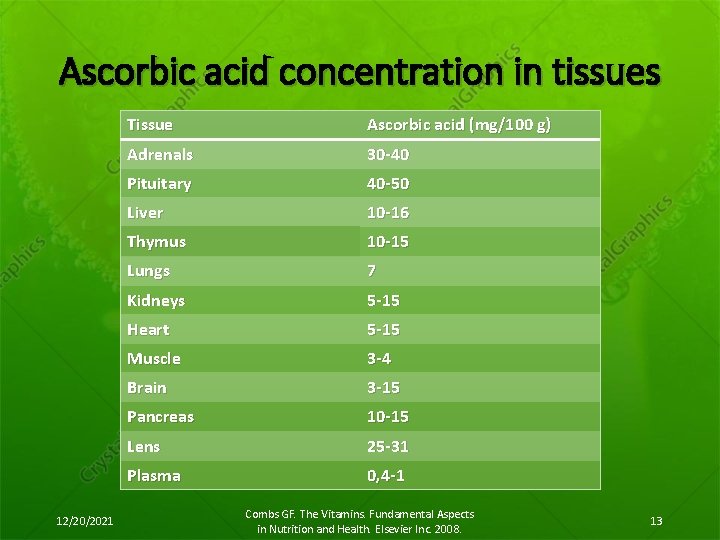
Ascorbic acid concentration in tissues 12/20/2021 Tissue Ascorbic acid (mg/100 g) Adrenals 30 -40 Pituitary 40 -50 Liver 10 -16 Thymus 10 -15 Lungs 7 Kidneys 5 -15 Heart 5 -15 Muscle 3 -4 Brain 3 -15 Pancreas 10 -15 Lens 25 -31 Plasma 0, 4 -1 Combs GF. The Vitamins. Fundamental Aspects in Nutrition and Health. Elsevier Inc. 2008. 13
Metabolism of vitamin C III. 12/20/2021 Combs GF. The Vitamins. Fundamental Aspects in Nutrition and Health. Elsevier Inc. 2008. 14

Oxidation • Ascorbic acid is oxidized in vivo by two successive losses of single electrons. • The first monovalent oxidation results in the formation of the ascorbyl free radical. • The ascorbyl radical forms a reversible electrochemical couple with ascorbic acid, but can be further oxidized irreversibly to dehydro-L-ascorbic acid. 12/20/2021 Combs GF. The Vitamins. Fundamental Aspects in Nutrition and Health. Elsevier Inc. 2008. 15

Oxidation Subsequent irreversible hydrolysis of dehydroascorbic acid yields 2, 3 -diketo-Lgulonic acid, which undergoes either: • decarboxylation to CO 2 and carbon fragments: xylose, xylonic acid, lyxonic acid • or oxidation to oxalic acid and 4 -C fragments: threonic acid 12/20/2021 Combs GF. The Vitamins. Fundamental Aspects in Nutrition and Health. Elsevier Inc. 2008. 16
Oxidation Ascorbic acid may also undergo oxidation by reaction with tocopheroxyl or urate radicals. 12/20/2021 Combs GF. The Vitamins. Fundamental Aspects in Nutrition and Health. Elsevier Inc. 2008. 17
Ascorbic acid can be regenerated in three ways! Combs GF. The Vitamins. Fundamental Aspects in Nutrition and Health. Elsevier Inc. 2008.
Ascorbic acid regeneration goes by: recycling of the ascorbic aciddehydroascorbic acid redox couple glutathione (GSH) or dihydrolipoic acid reduction of dehydroascorbic acid enzymatic reduction of ascorbyl radical 12/20/2021 Combs GF. The Vitamins. Fundamental Aspects in Nutrition and Health. Elsevier Inc. 2008. 19
Excretion Ascorbate is thought to pass unchanged through the glomeruli and to be actively reabsorbed in the tubules by a saturable, carrier-mediated process. Little ascorbic acid is excreted in the urine of humans consuming less than 100 mg/day. Only one-fourth of the dose is excreted at twice that intake. At doses greater than about 500 mg/day, virtually all ascorbic acid above that level is excreted unchanged in the urine, thus producing no further increases in body ascorbate stores. 12/20/2021 Combs GF. The Vitamins. Fundamental Aspects in Nutrition and Health. Elsevier Inc. 2008. 20
Excretion The epithelial cells of the renal tubules reabsorb dehydroascorbic acid after it has been filtered from the plasma. Humans convert only 1. 5% of ingested ascorbic acid to oxalic acid within 24 hours. The excretion of oxalate is relevant to risk of renal stone formation. 12/20/2021 Combs GF. The Vitamins. Fundamental Aspects in Nutrition and Health. Elsevier Inc. 2008. 21
Excretion Ascorbic acid is also excreted in the gastric juice, which typically has levels three times that of plasma. Notable exceptions are in patients with atrophic gastritis or Helicobacter pylori infection: low gastric juice ascorbic acid. 12/20/2021 Combs GF. The Vitamins. Fundamental Aspects in Nutrition and Health. Elsevier Inc. 2008. 22
Literature • Combs GF. The Vitamins. Fundamental Aspects in Nutrition and Health. Elsevier Inc. 2008. 12/20/2021 23
- Slides: 23