
Absorption of Amino Acids It is an active
Absorption of Amino Acids It is an active process that needs energy. Energy needed is derived from hydrolysis of ATP. It occurs in small intestine.
Mechanisms of amino acids absorption There are two mechanisms for amino acids absorption. 1 -Carrier proteins transport system 2 -Glutathione transport system (g-Glutamyl cycle)
Carrier proteins transport system • It is the main system for amino acid absorption. • It is an active process that needs energy derived from ATP. • Absorption of one amino acid molecule needs one ATP molecule. • There are 7 carrier proteins, one for each group of amino acids. • Each carrier protein has to sites one for amino acid and one for Na+. • The absorbed amino acid passes to the portal circulation, while Na+ is extruded out of the cell in exchange with K+ by sodium pump.


Glutathione transport system (γ-Glutamyl cycle) -Glutathione is used to transport amino acids from intestinal lumen to cytosol of intestinal mucosa cells. -It is an active process that needs energy derived from ATP. -Absorption of one amino acid molecule needs 3 ATP molecules. -Glutathione reacts with amino acid in the presence of γglutamyl transpeptidase to form γ-glutamyl amino acid.
-γ-glutamyl amino acid releases amino acid in the cytosol of intestinal mucosa cells with formation of 5 -oxoproline that is used for regeneration of glutathione to begin another turn of the cycle.

Clinical Applications ●Oxoprolinuria: The deficiency of the enzyme 5 -oxoprolinase leads to accumulation of 5 -oxoproline in blood and hence excreted in urine. It is associated with mental retardation. ●The allergy to certain food proteins (milk, fish) is believed to result from absorption of partially digested proteins.
●Defects in the intestinal amino acid transport systems are seen in inborn errors of metabolism such as cystinuria. ●Partial gastrectomy, pancreatitis, carcinoma of pancreas and cystic fibrosis may affect the digestion and absorption of proteins. ●Protein losing enteropathy: There is an excessive loss of proteins through the gastrointestinal tract.
Amino Acid Pool The amount of free amino acids distributed throughout the body is called amino acid pool. Plasma level for most amino acids varies widely throughout the day. It ranges between 4– 5 mg/dl. Following a protein containing meal, the amino acid levels rise to (45 - 100 mg / dl).
Tissue Amino acids The amino acids are transported into tissues actively. Pyridoxal-P (B 6 -P) is one of the requirement for this active transport. Tissue uptake is also favoured by hormones: • Insulin, growth hormone and testosterone favour the uptake of amino acids by tissues (anabolic hormones). • Estradiol stimulates selectively their uptake by uterus. • Epinephrine and glucocorticoids: Stimulate the uptake of amino acids by the Liver.
Sources of amino acid pool 1. Dietary protein 2. Breakdown of tissue proteins 3. Biosynthesis of amino acids in liver (except essential amino acid).
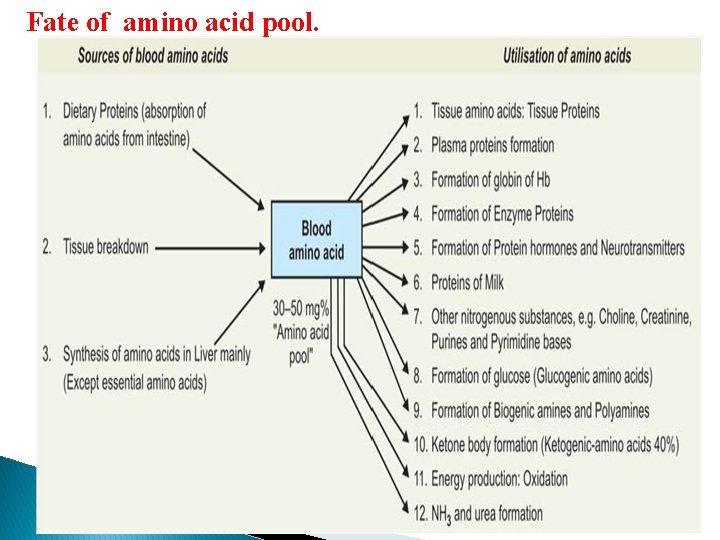
Fate of amino acid pool.
Protein Turnover All the body proteins except collagen are in a constant state of degradation and resynthesis. About 1 -2% of total body proteins are degraded and resynthesized every day Nitrogen Balance Nitrogen balance means the difference between nitrogen intake and nitrogen loss.
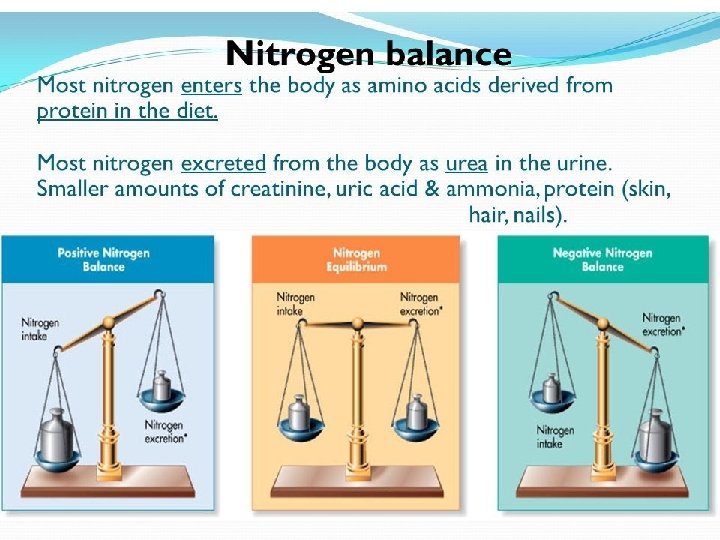
Nitrogen Intake 1 -Dietary protein, every 100 gram proteins contain 16 gram nitrogen. 2 -Traces of inorganic nitrogen in the form of nitrates (NO 3 - ) and nitrites (NO 2 -) Nitrogen loss 1 -In urine in the form of non-protein nitrogenous substances as urea, uric acid, creatine, creatinine and ammonia 2 -In stools in the form of digestive juices 3 -In sweat in the form of urea
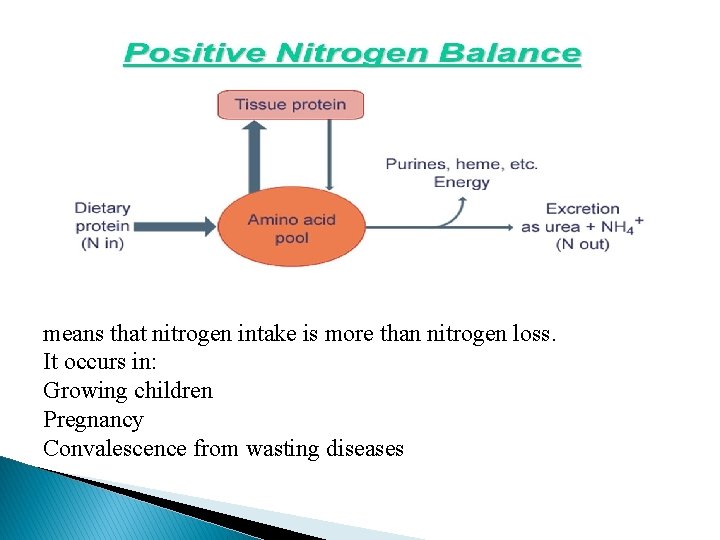
means that nitrogen intake is more than nitrogen loss. It occurs in: Growing children Pregnancy Convalescence from wasting diseases
Negative Nitrogen Balance means that nitrogen loss is more than nitrogen intake. It occurs in: Diabetes mellitus Fever Starvation Wasting diseases Nitrogen equilibrium means that nitrogen intake equals nitrogen loss. It occurs in healthy adults on an adequate diet
- Slides: 18