
Absorption and Marginal Costing Lesson 4 1 Explain
Absorption and Marginal Costing Lesson 4 1
Explain the differences between absorption costing and marginal costing 2
Question Case 1: Alan Tam, head of the production department of ABC Company, wondered whether it would be more profitable to buy components from an outside supplier or continue to produce by the company itself. Case 2: Peter Lee, CFO of XYZ Company, needed to present the financial performance of the company for last year in the coming Board meeting. Which costing method (absorption costing or marginal costing) should be adopted for each case? 3
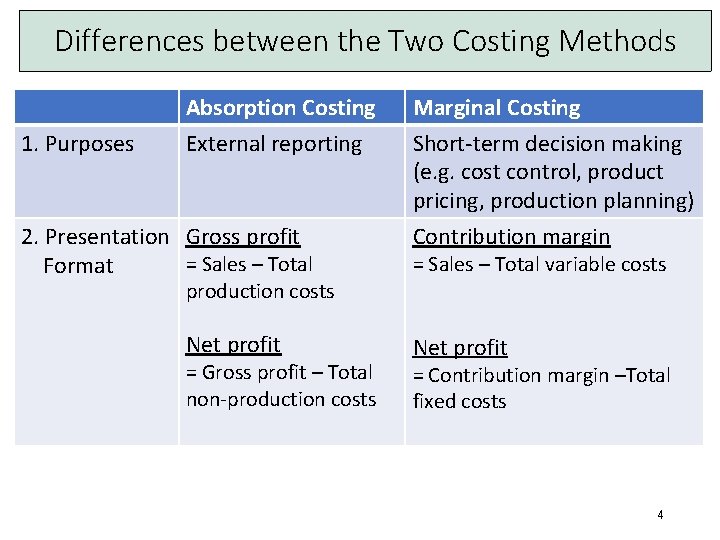
Differences between the Two Costing Methods 1. Purposes Absorption Costing External reporting 2. Presentation Gross profit = Sales – Total Format production costs Net profit = Gross profit – Total non-production costs Marginal Costing Short-term decision making (e. g. cost control, product pricing, production planning) Contribution margin = Sales – Total variable costs Net profit = Contribution margin –Total fixed costs 4
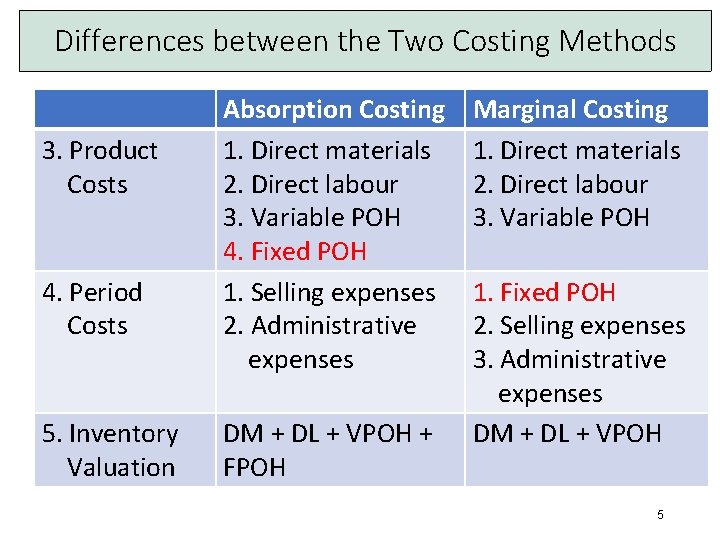
Differences between the Two Costing Methods 3. Product Costs 4. Period Costs 5. Inventory Valuation Absorption Costing 1. Direct materials 2. Direct labour 3. Variable POH 4. Fixed POH 1. Selling expenses 2. Administrative expenses DM + DL + VPOH + FPOH Marginal Costing 1. Direct materials 2. Direct labour 3. Variable POH 1. Fixed POH 2. Selling expenses 3. Administrative expenses DM + DL + VPOH 5
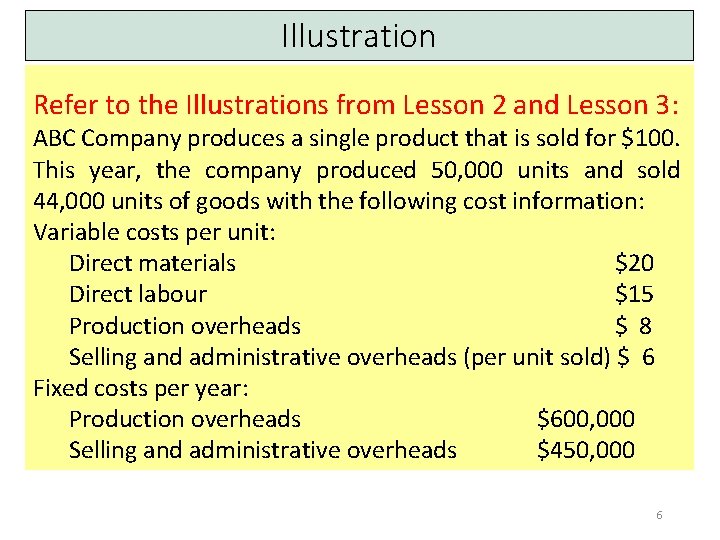
Illustration Refer to the Illustrations from Lesson 2 and Lesson 3: ABC Company produces a single product that is sold for $100. This year, the company produced 50, 000 units and sold 44, 000 units of goods with the following cost information: Variable costs per unit: Direct materials $20 Direct labour $15 Production overheads $ 8 Selling and administrative overheads (per unit sold) $ 6 Fixed costs per year: Production overheads $600, 000 Selling and administrative overheads $450, 000 6
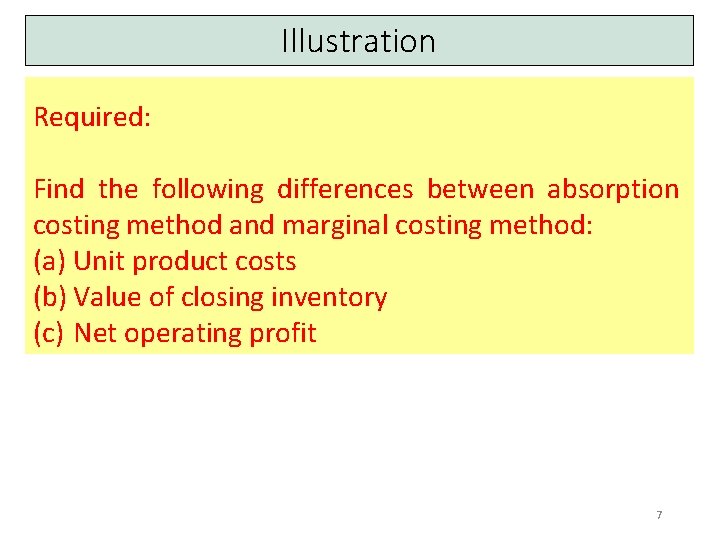
Illustration Required: Find the following differences between absorption costing method and marginal costing method: (a) Unit product costs (b) Value of closing inventory (c) Net operating profit 7
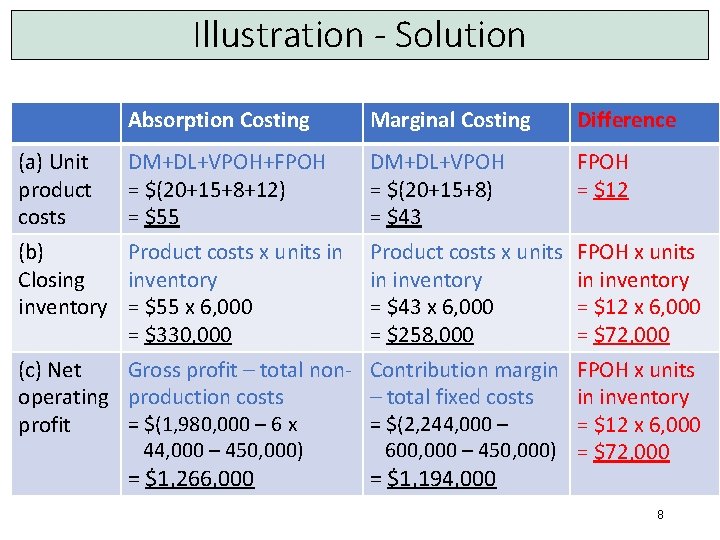
Illustration - Solution Absorption Costing Marginal Costing Difference DM+DL+VPOH+FPOH = $(20+15+8+12) = $55 DM+DL+VPOH = $(20+15+8) = $43 FPOH = $12 (b) Product costs x units in Closing inventory = $55 x 6, 000 = $330, 000 Product costs x units in inventory = $43 x 6, 000 = $258, 000 FPOH x units in inventory = $12 x 6, 000 = $72, 000 (c) Net Gross profit – total nonoperating production costs = $(1, 980, 000 – 6 x profit 44, 000 – 450, 000) = $1, 266, 000 Contribution margin – total fixed costs = $(2, 244, 000 – 600, 000 – 450, 000) = $1, 194, 000 FPOH x units in inventory = $12 x 6, 000 = $72, 000 (a) Unit product costs 8
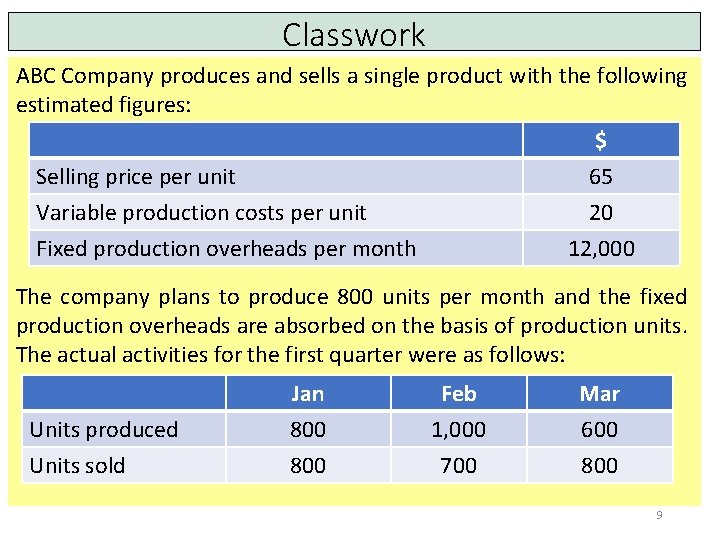
Classwork ABC Company produces and sells a single product with the following estimated figures: $ Selling price per unit 65 Variable production costs per unit 20 Fixed production overheads per month 12, 000 The company plans to produce 800 units per month and the fixed production overheads are absorbed on the basis of production units. The actual activities for the first quarter were as follows: Units produced Units sold Jan 800 Feb 1, 000 700 Mar 600 800 9
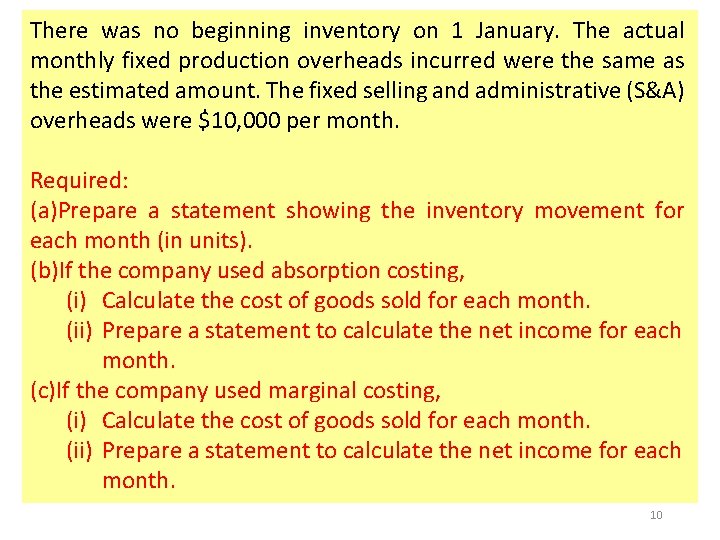
There was no beginning inventory on 1 January. The actual monthly fixed production overheads incurred were the same as the estimated amount. The fixed selling and administrative (S&A) overheads were $10, 000 per month. Required: (a)Prepare a statement showing the inventory movement for each month (in units). (b)If the company used absorption costing, (i) Calculate the cost of goods sold for each month. (ii) Prepare a statement to calculate the net income for each month. (c)If the company used marginal costing, (i) Calculate the cost of goods sold for each month. (ii) Prepare a statement to calculate the net income for each month. 10
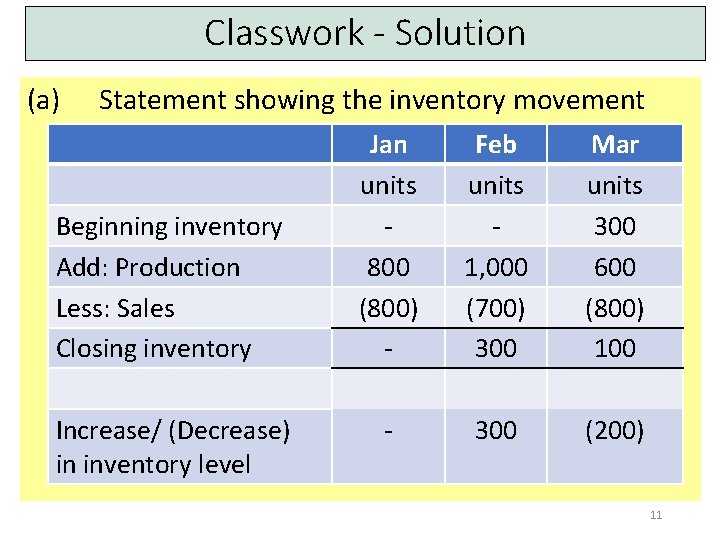
Classwork - Solution (a) Statement showing the inventory movement Beginning inventory Add: Production Less: Sales Closing inventory Increase/ (Decrease) in inventory level Jan units 800 (800) - Feb units 1, 000 (700) 300 Mar units 300 600 (800) 100 - 300 (200) 11
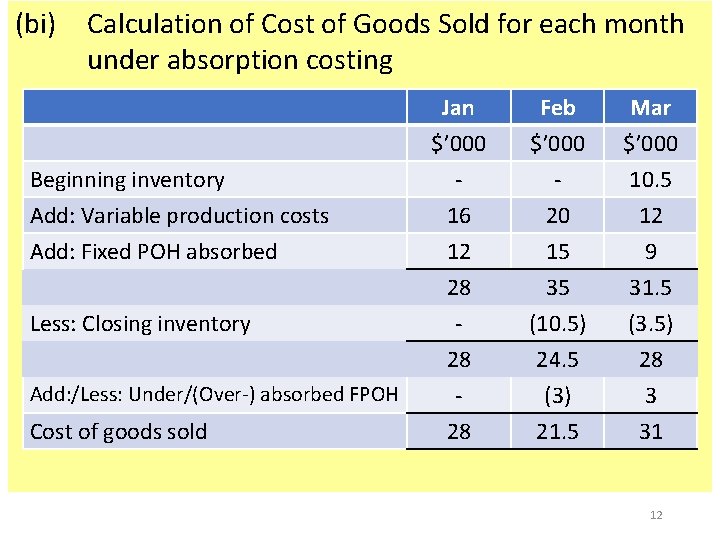
(bi) Calculation of Cost of Goods Sold for each month under absorption costing Beginning inventory Add: Variable production costs Add: Fixed POH absorbed Less: Closing inventory Add: /Less: Under/(Over-) absorbed FPOH Cost of goods sold Jan $’ 000 16 Feb $’ 000 20 Mar $’ 000 10. 5 12 12 28 28 28 15 35 (10. 5) 24. 5 (3) 21. 5 9 31. 5 (3. 5) 28 3 31 12
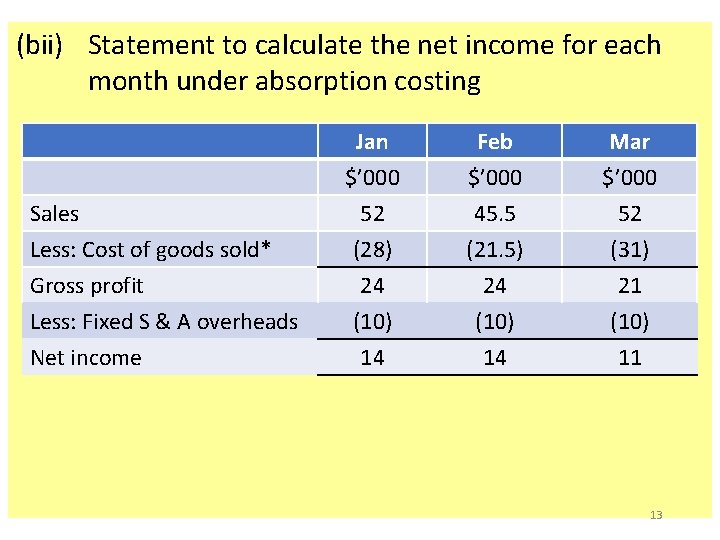
(bii) Statement to calculate the net income for each month under absorption costing Sales Less: Cost of goods sold* Gross profit Less: Fixed S & A overheads Net income Jan $’ 000 52 (28) 24 (10) 14 Feb $’ 000 45. 5 (21. 5) 24 (10) 14 Mar $’ 000 52 (31) 21 (10) 11 13
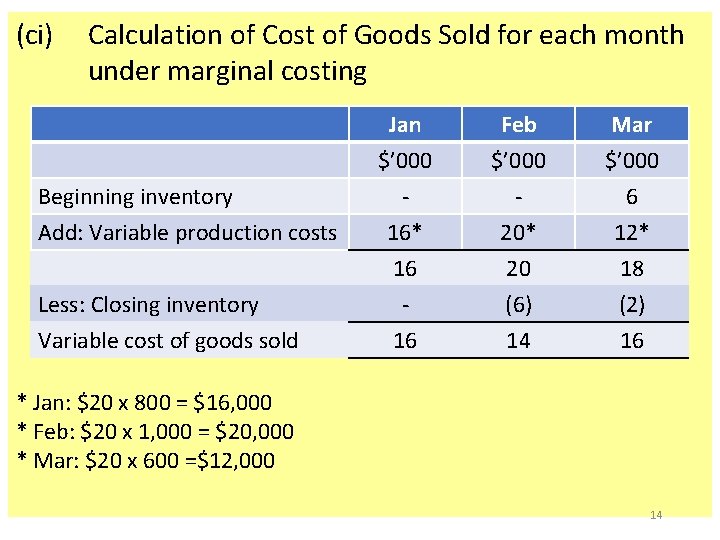
(ci) Calculation of Cost of Goods Sold for each month under marginal costing Beginning inventory Add: Variable production costs Less: Closing inventory Variable cost of goods sold Jan $’ 000 16* 16 16 Feb $’ 000 20* 20 (6) 14 Mar $’ 000 6 12* 18 (2) 16 * Jan: $20 x 800 = $16, 000 * Feb: $20 x 1, 000 = $20, 000 * Mar: $20 x 600 =$12, 000 14

(cii) Statement to calculate the net income for each month under marginal costing Sales Less: Variable cost of goods sold* Contribution margin Less: Fixed POH Less: Fixed S & A overheads Net income Jan $’ 000 52 (16) Feb $’ 000 45. 5 (14) Mar $’ 000 52 (16) 36 (12) (10) 14 31. 5 (12) (10) 9. 5 36 (12) (10) 14 15

Relationships between Production Level, Sales Level, and Net Income From the classwork, we can conclude the following relationships. In January • Units produced = Units sold (800 units) • Net incomes ($14, 000) were the same under both costing methods. • It was because when production equalled sales, all fixed production overheads ($12, 000) incurred in January were charged to the income statement under both costing methods. 16
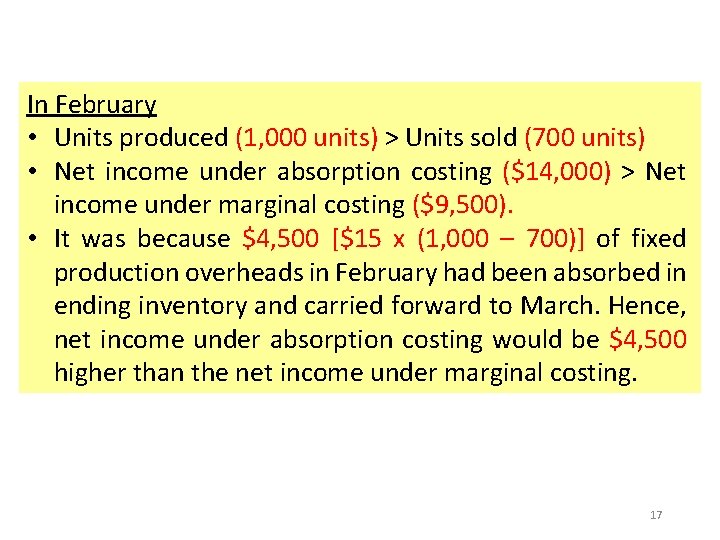
In February • Units produced (1, 000 units) > Units sold (700 units) • Net income under absorption costing ($14, 000) > Net income under marginal costing ($9, 500). • It was because $4, 500 [$15 x (1, 000 – 700)] of fixed production overheads in February had been absorbed in ending inventory and carried forward to March. Hence, net income under absorption costing would be $4, 500 higher than the net income under marginal costing. 17

In March • Units produced (600 units) < Units sold (800 units) • Net income under absorption costing ($11, 000) < Net income under marginal costing ($14, 000). • It was because when the beginning inventory 200 units (800 – 600) brought forward from February were sold in March, the fixed production overheads ($15 x 200 = $3, 000) that had been brought over became part of March’s cost of goods sold, leading the net profit under the absorption costing ($3, 000) lower than that under the marginal costing. 18

Summary Relation between production and sales for the period (Units) Effect on inventories (Units) Relation between the net Incomes ($) 1. Production > Sales Inventories increase Absorption costing > Marginal costing* 2. Production < Sales Inventories decrease Absorption costing < Marginal costing** 3. Production = Sales No change in inventories Absorption costing = Marginal costing * Net income is higher under absorption costing because part of fixed production overheads is absorbed in the ending inventory and deferred to be expensed as inventories increase. ** Net income is lower under absorption costing because the fixed production overheads are released from the beginning inventory brought forward from the previous period and expensed in the income statement for the current period as inventories decrease. 19
Key Points Covered 1. The differences between absorption costing and marginal costing. 2. The relationships between production level, sales level and net income of the two costing methods. 20

Homework: Q 4 21
END 22
- Slides: 22