
Absorption and Marginal Costing Lesson 2 1 Question
Absorption and Marginal Costing Lesson 2 1
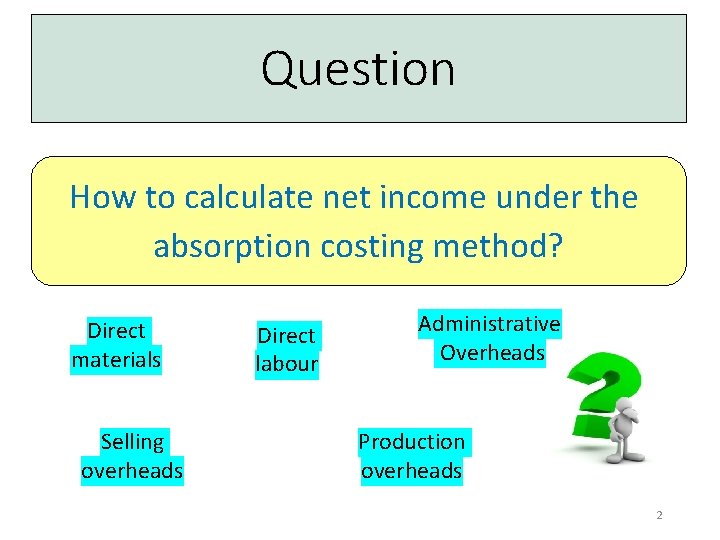
Question How to calculate net income under the absorption costing method? Direct materials Selling overheads Direct labour Administrative Overheads Production overheads 2
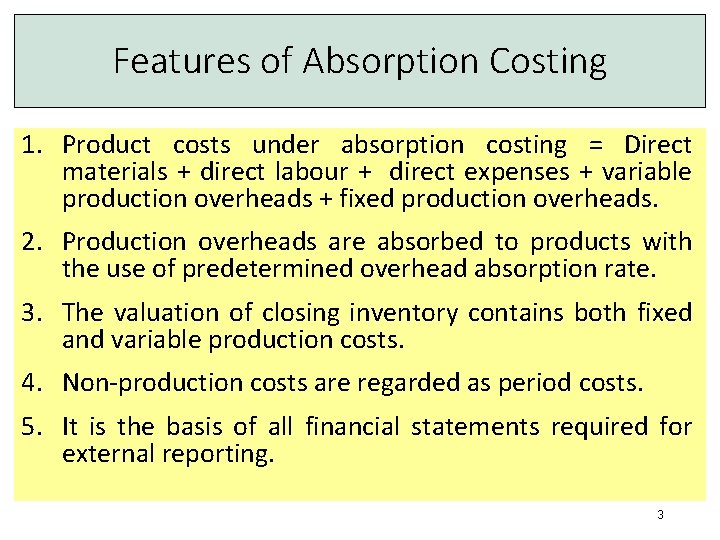
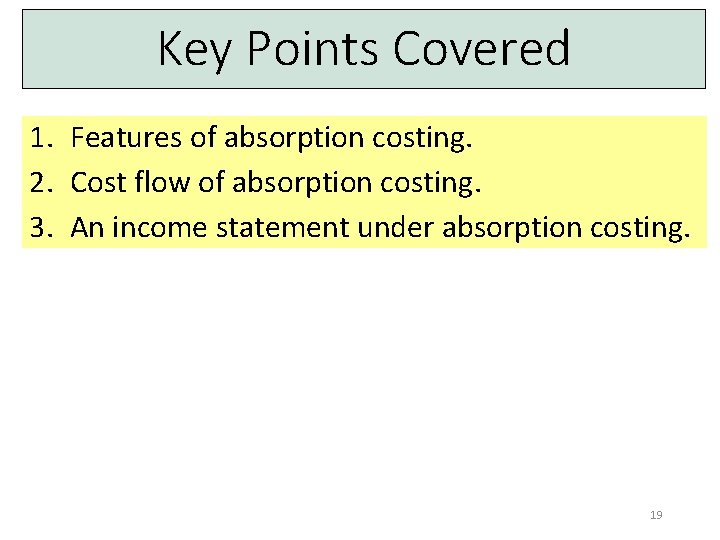
Features of Absorption Costing 1. Product costs under absorption costing = Direct materials + direct labour + direct expenses + variable production overheads + fixed production overheads. 2. Production overheads are absorbed to products with the use of predetermined overhead absorption rate. 3. The valuation of closing inventory contains both fixed and variable production costs. 4. Non-production costs are regarded as period costs. 5. It is the basis of all financial statements required for external reporting. 3
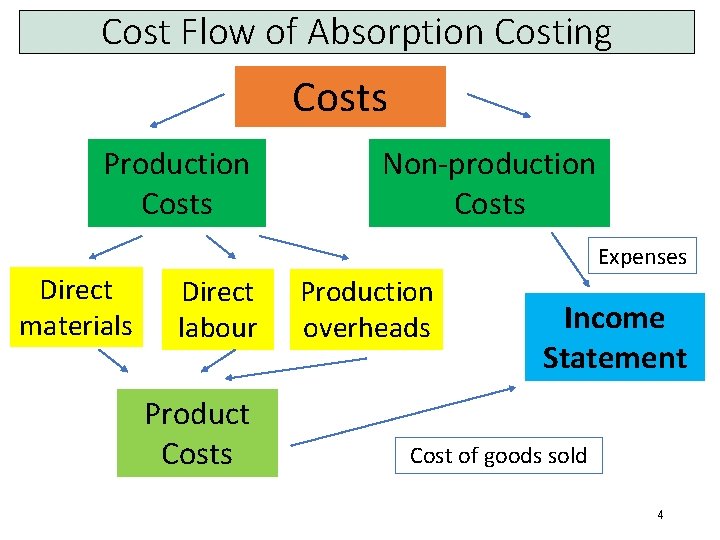
Cost Flow of Absorption Costing Costs Production Costs Non-production Costs Expenses Direct materials Direct labour Product Costs Production overheads Income Statement Cost of goods sold 4
Prepare an income statement under absorption costing 5

Format of Income Statement under Absorption Costing Income Statement for the year ended 31 December 20 XX $ Sales Less: $ x Cost of goods sold Opening inventory Add: Direct materials Add: Direct labour Add: Direct expenses Add: Production overheads Less: Closing inventory Gross profit Less: Selling and administrative overheads Net operating profit x x x 6
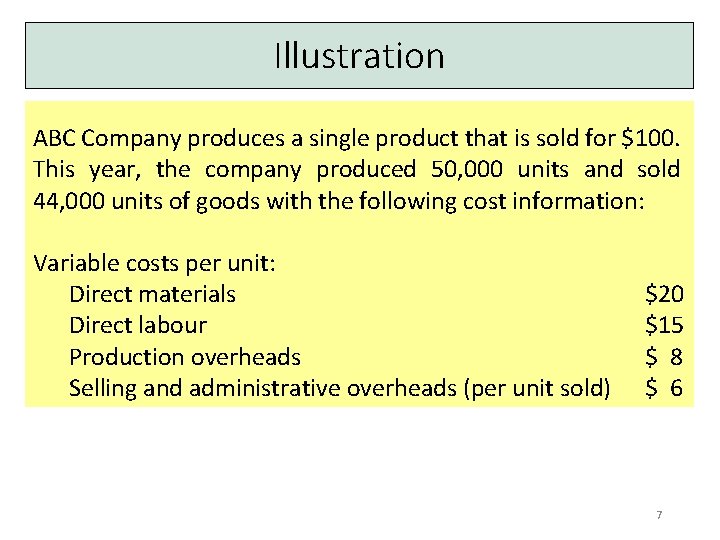
Illustration ABC Company produces a single product that is sold for $100. This year, the company produced 50, 000 units and sold 44, 000 units of goods with the following cost information: Variable costs per unit: Direct materials Direct labour Production overheads Selling and administrative overheads (per unit sold) $20 $15 $ 8 $ 6 7
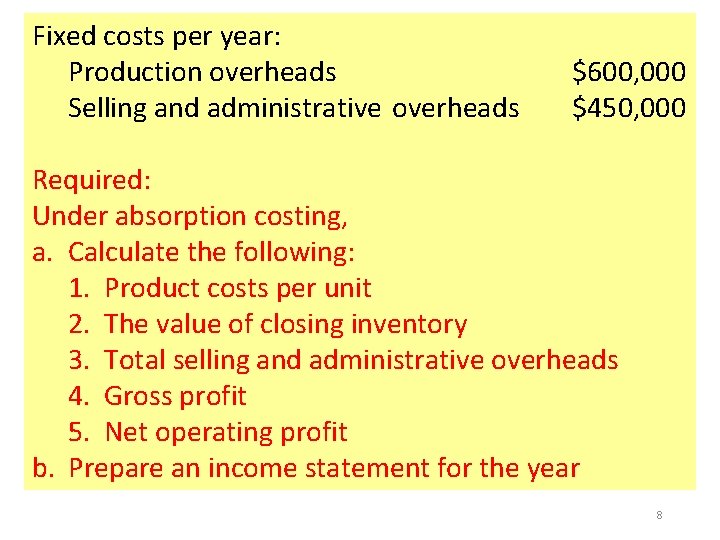
Fixed costs per year: Production overheads Selling and administrative overheads $600, 000 $450, 000 Required: Under absorption costing, a. Calculate the following: 1. Product costs per unit 2. The value of closing inventory 3. Total selling and administrative overheads 4. Gross profit 5. Net operating profit b. Prepare an income statement for the year 8

Illustration - Solution a. 1. Product costs per unit = DM + DL + VPOH + FPOH = $20 + $15 + $8 + ($600, 000 / 50, 000) = $55 2. The value of closing inventory = Product costs per unit x units remained unsold in closing inventory = $55 x (50, 000 - 44, 000) = $330, 000 3. Total selling and administrative overheads = Variable selling and administrative overheads per unit x units sold + total fixed selling and administrative overheads = $6 x 44, 000 + $450, 000 = $714, 000 9
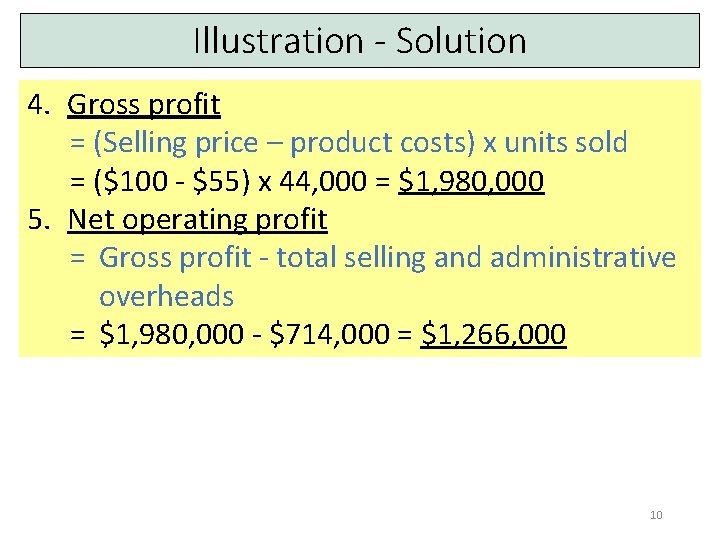
Illustration - Solution 4. Gross profit = (Selling price – product costs) x units sold = ($100 - $55) x 44, 000 = $1, 980, 000 5. Net operating profit = Gross profit - total selling and administrative overheads = $1, 980, 000 - $714, 000 = $1, 266, 000 10
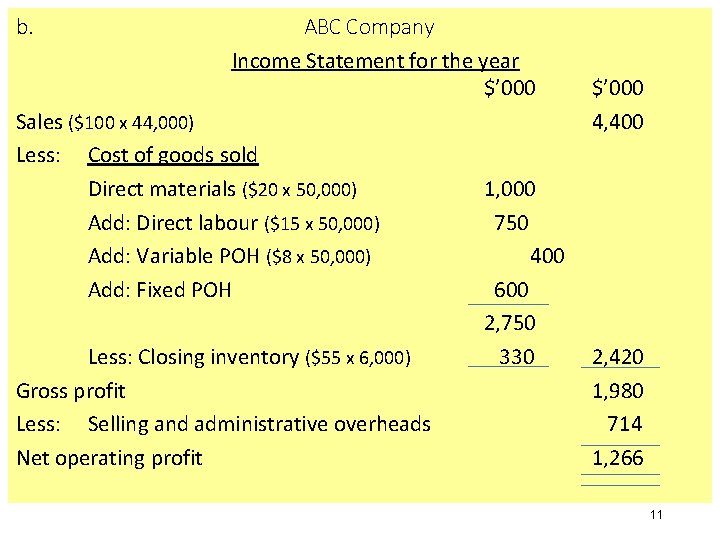
b. ABC Company Income Statement for the year $’ 000 Sales ($100 x 44, 000) Less: Cost of goods sold Direct materials ($20 x 50, 000) Add: Direct labour ($15 x 50, 000) Add: Variable POH ($8 x 50, 000) Add: Fixed POH Less: Closing inventory ($55 x 6, 000) Gross profit Less: Selling and administrative overheads Net operating profit 1, 000 750 400 600 2, 750 330 $’ 000 4, 400 2, 420 1, 980 714 1, 266 11
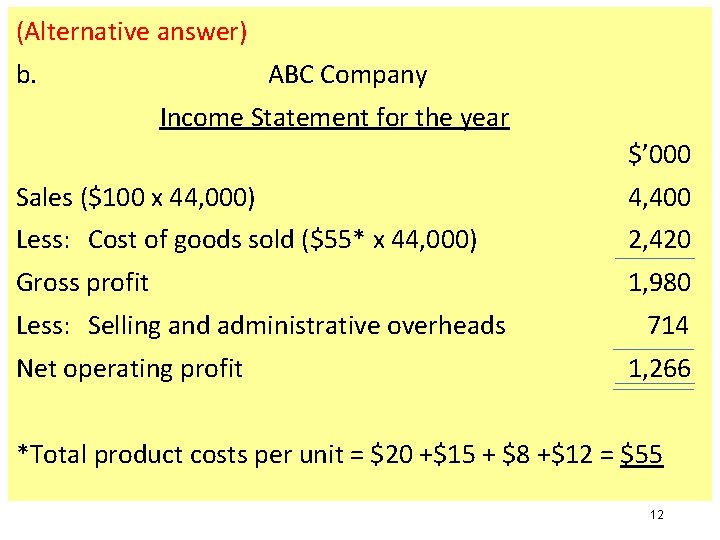
(Alternative answer) b. ABC Company Income Statement for the year $’ 000 Sales ($100 x 44, 000) 4, 400 Less: Cost of goods sold ($55* x 44, 000) 2, 420 Gross profit 1, 980 Less: Selling and administrative overheads Net operating profit 714 1, 266 *Total product costs per unit = $20 +$15 + $8 +$12 = $55 12
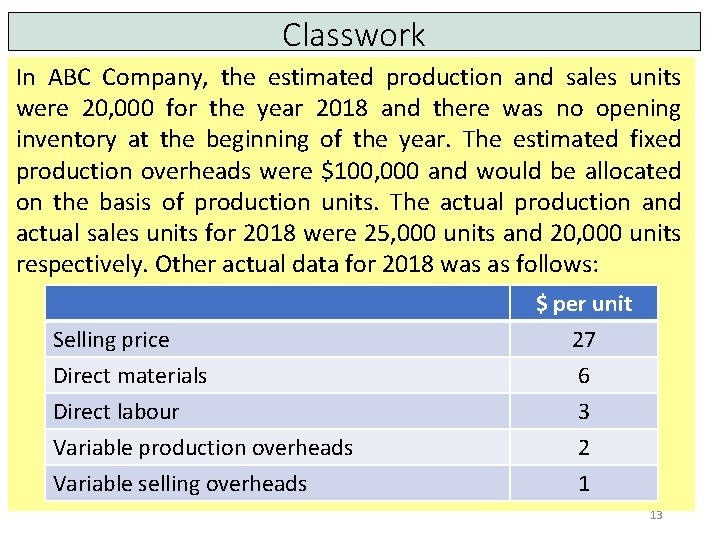
Classwork In ABC Company, the estimated production and sales units were 20, 000 for the year 2018 and there was no opening inventory at the beginning of the year. The estimated fixed production overheads were $100, 000 and would be allocated on the basis of production units. The actual production and actual sales units for 2018 were 25, 000 units and 20, 000 units respectively. Other actual data for 2018 was as follows: Selling price Direct materials Direct labour Variable production overheads Variable selling overheads $ per unit 27 6 3 2 1 13
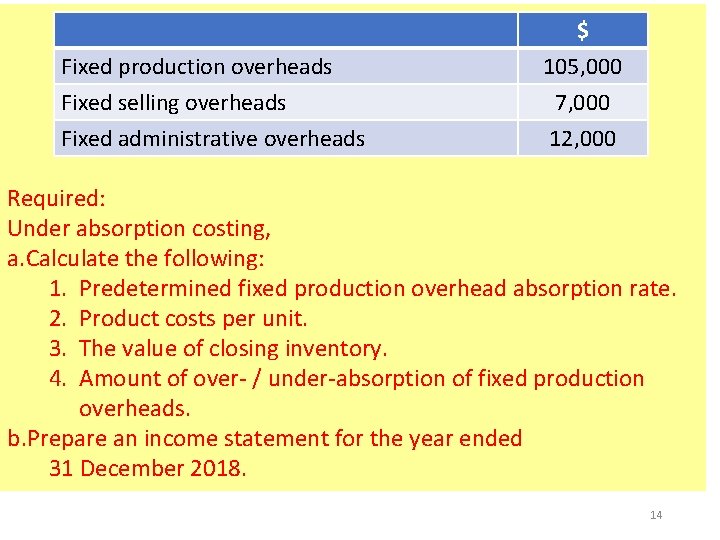
Fixed production overheads $ 105, 000 Fixed selling overheads Fixed administrative overheads 7, 000 12, 000 Required: Under absorption costing, a. Calculate the following: 1. Predetermined fixed production overhead absorption rate. 2. Product costs per unit. 3. The value of closing inventory. 4. Amount of over- / under-absorption of fixed production overheads. b. Prepare an income statement for the year ended 31 December 2018. 14
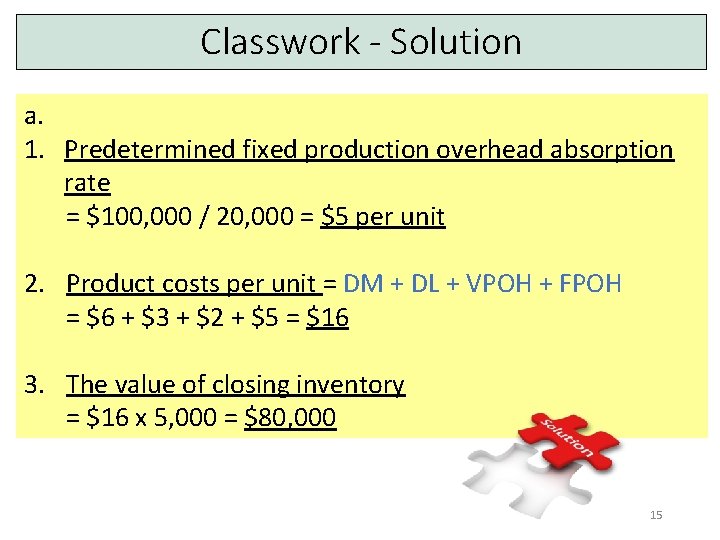
Classwork - Solution a. 1. Predetermined fixed production overhead absorption rate = $100, 000 / 20, 000 = $5 per unit 2. Product costs per unit = DM + DL + VPOH + FPOH = $6 + $3 + $2 + $5 = $16 3. The value of closing inventory = $16 x 5, 000 = $80, 000 15
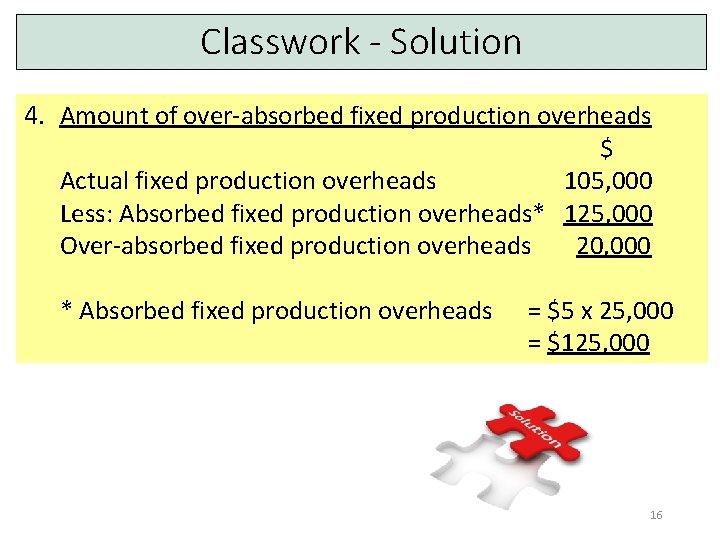
Classwork - Solution 4. Amount of over-absorbed fixed production overheads $ Actual fixed production overheads 105, 000 Less: Absorbed fixed production overheads* 125, 000 Over-absorbed fixed production overheads 20, 000 * Absorbed fixed production overheads = $5 x 25, 000 = $125, 000 16
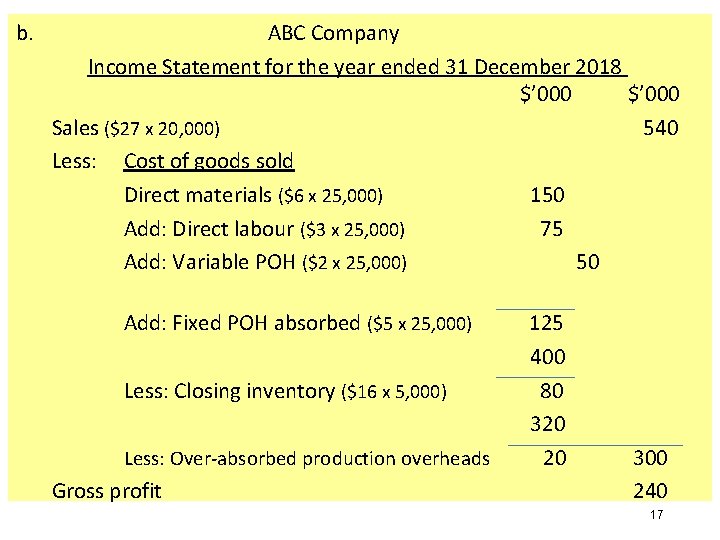
b. ABC Company Income Statement for the year ended 31 December 2018 $’ 000 Sales ($27 x 20, 000) 540 Less: Cost of goods sold Direct materials ($6 x 25, 000) 150 Add: Direct labour ($3 x 25, 000) 75 Add: Variable POH ($2 x 25, 000) 50 Add: Fixed POH absorbed ($5 x 25, 000) Less: Closing inventory ($16 x 5, 000) Less: Over-absorbed production overheads Gross profit 125 400 80 320 20 300 240 17
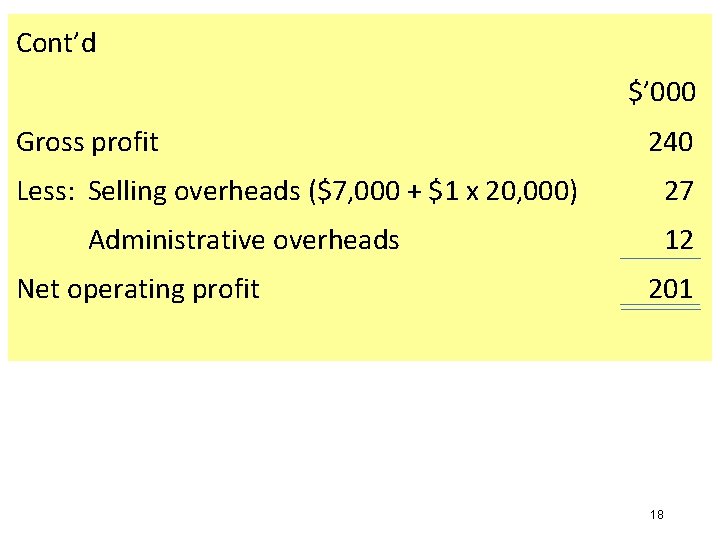
Cont’d $’ 000 Gross profit 240 Less: Selling overheads ($7, 000 + $1 x 20, 000) 27 Administrative overheads Net operating profit 12 201 18
Key Points Covered 1. Features of absorption costing. 2. Cost flow of absorption costing. 3. An income statement under absorption costing. 19

Homework: Q 2 20
END 21
- Slides: 21