
Absolute stability biomechanics techniques and fracture healing AO
Absolute stability: biomechanics, techniques, and fracture healing AO Trauma Basic Principles Course
Learning objectives 2 • Define absolute stability • Describe how the biological behavior of fractured bone is affected by absolute stability • Define indications for selection of absolute stability according to AO principles • Explain techniques for achieving absolute stability

Bone fracture • Intact cortical bone is strong and stiff • Intact cortical bone can deform only 2% before it breaks • When stiffness is lost, instability occurs
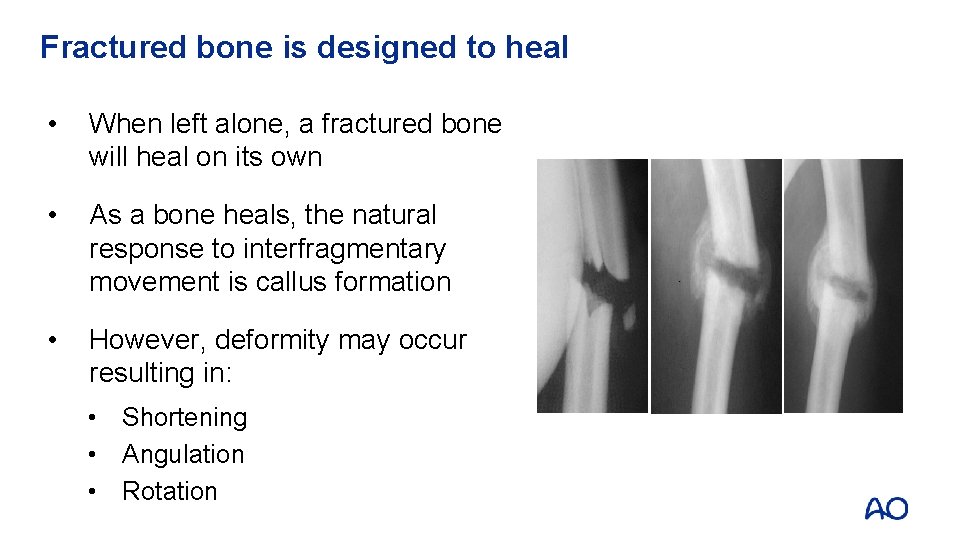
Fractured bone is designed to heal • When left alone, a fractured bone will heal on its own • As a bone heals, the natural response to interfragmentary movement is callus formation • However, deformity may occur resulting in: • Shortening • Angulation • Rotation

Aim of fracture treatment • Obtain and maintain reduction • Restore stiffness (stability) for healing • Decrease pain • Promote healing • Return of function Degree of stability will determine the type of bone healing 5

How stability affects healing • Internal fixation of fractures alters the biology of fracture healing • Method of bone healing depends on: • Type of fracture (simple or complex) • Type of reduction (anatomical or functional) • Type of stability achieved (absolute or relative) • Type of implant chosen (providing absolute or relative stability)
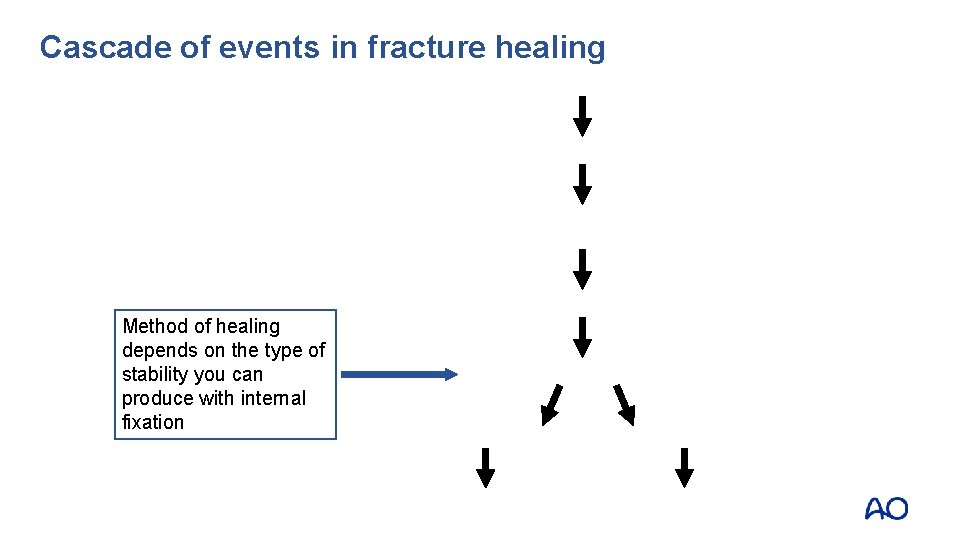
Cascade of events in fracture healing Method of healing depends on the type of stability you can produce with internal fixation

Definition of absolute stability • Absolute stability means that there is no micro-motion at the fracture site under normal physiological loads • This requires open reduction • This requires anatomical reduction of the fracture 8 • Best method to produce absolute stability is with interfragmentary compression • Absolute stability usually leads to direct bone healing

Results of absolute stability Direct bone healing • Formerly called primary bone healing • Occurs by internal (osteonal) remodeling • Direct contact is needed between fracture ends • Requires anatomical reduction • No motion between fragments • Little or no callus forms 9 Photomicrograph of fracture healing with absolute stability • Anatomical reduction • Absolute stability • Osteons growing across fracture

Effect of stability on blood supply Absolute stability has a positive effect on revascularization of the healing bone
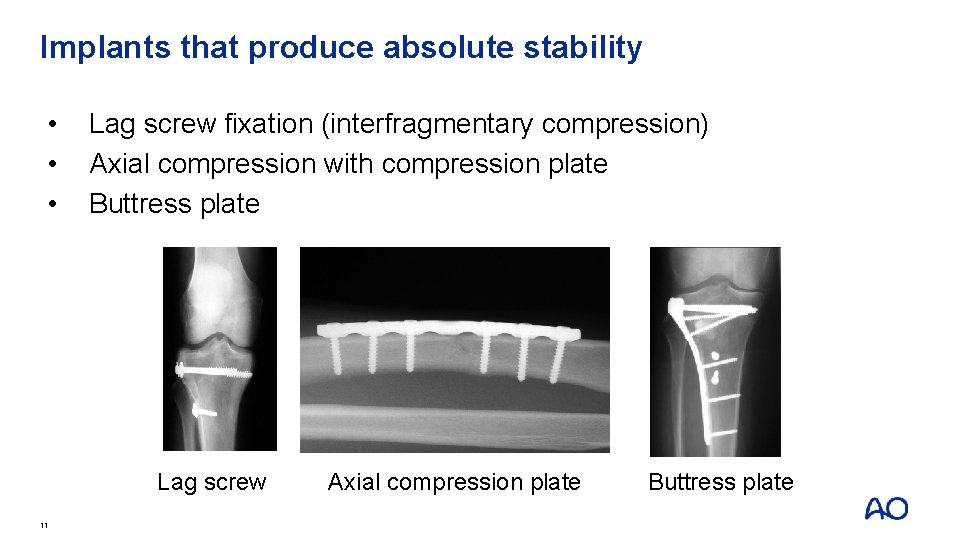
Implants that produce absolute stability • • • Lag screw fixation (interfragmentary compression) Axial compression with compression plate Buttress plate Lag screw 11 Axial compression plate Buttress plate
Lag screw fixation • Lag screw is a technique, not a type of screw • Any screw can function as a lag screw to provide interfragmentary compression if it is inserted properly • Shaft screw is the only screw that is designed as a lag screw to provide interfragmentary compression 12
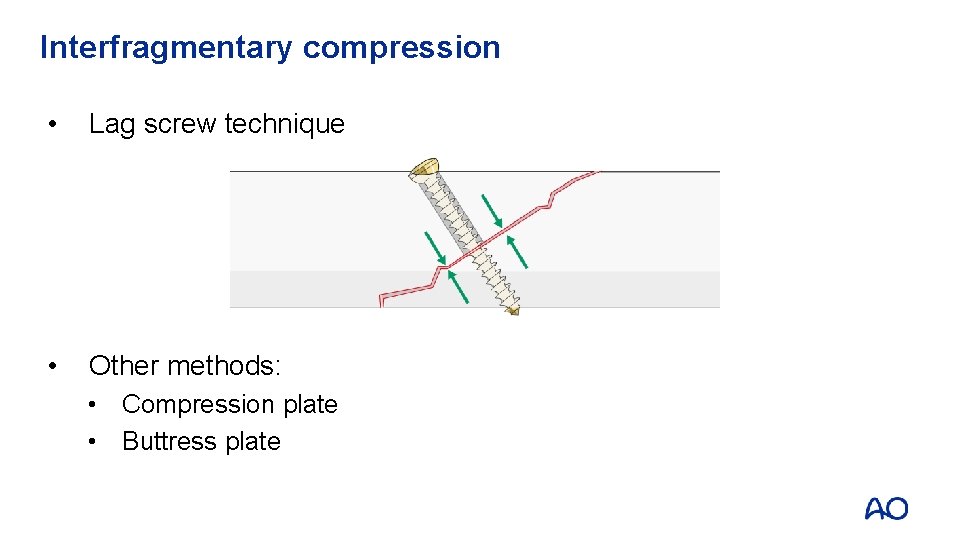
Interfragmentary compression • Lag screw technique • Other methods: • Compression plate • Buttress plate
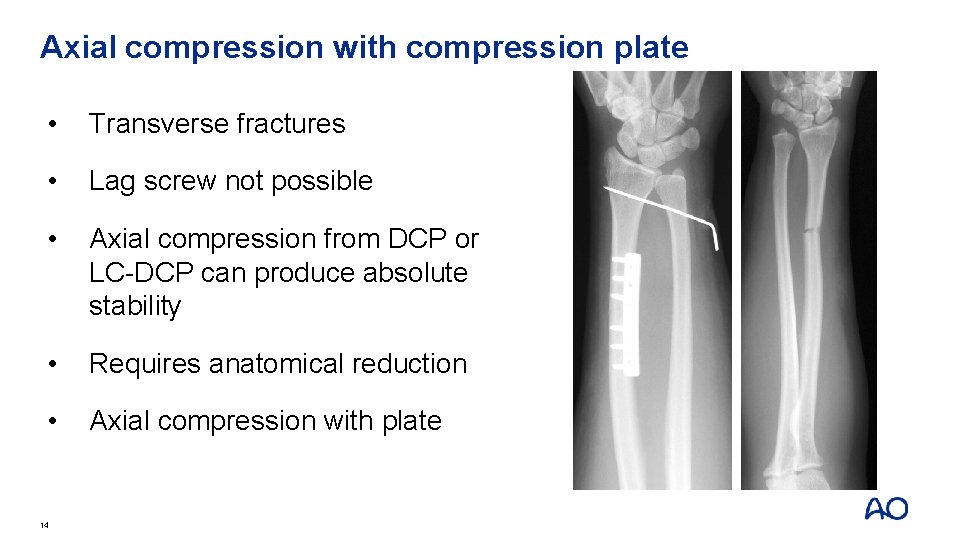
Axial compression with compression plate • Transverse fractures • Lag screw not possible • Axial compression from DCP or LC-DCP can produce absolute stability • Requires anatomical reduction • Axial compression with plate 14

Axial compression with a plate Dynamic compression holes allow axial compression through the plate 15

Clinical indications for absolute stability • • • 16 Articular fractures Simple diaphyseal fractures, especially in forearm Some simple (Type A) metaphyseal fractures Osteotomies Utmost care for the vascularity of soft tissues, periosteum, and bone
Principles of the lag screw technique • It is a technique of insertion, not a type of screw • Any screw can function as a lag screw • A lag screw produces interfragmentary compression • A lag screw can produce up to 2, 500– 3, 000 Newtons of force • Lag screw fixation will result in absolute stability
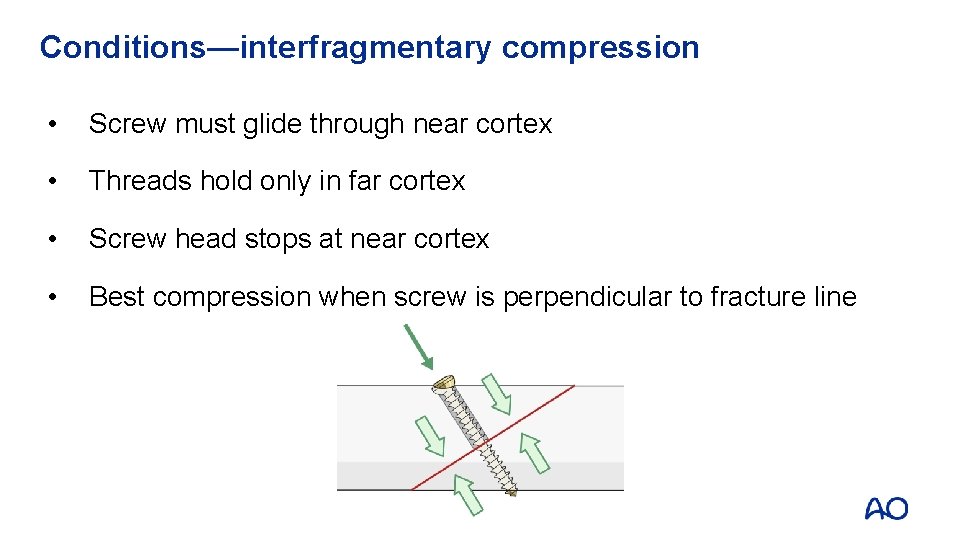
Conditions—interfragmentary compression • Screw must glide through near cortex • Threads hold only in far cortex • Screw head stops at near cortex • Best compression when screw is perpendicular to fracture line
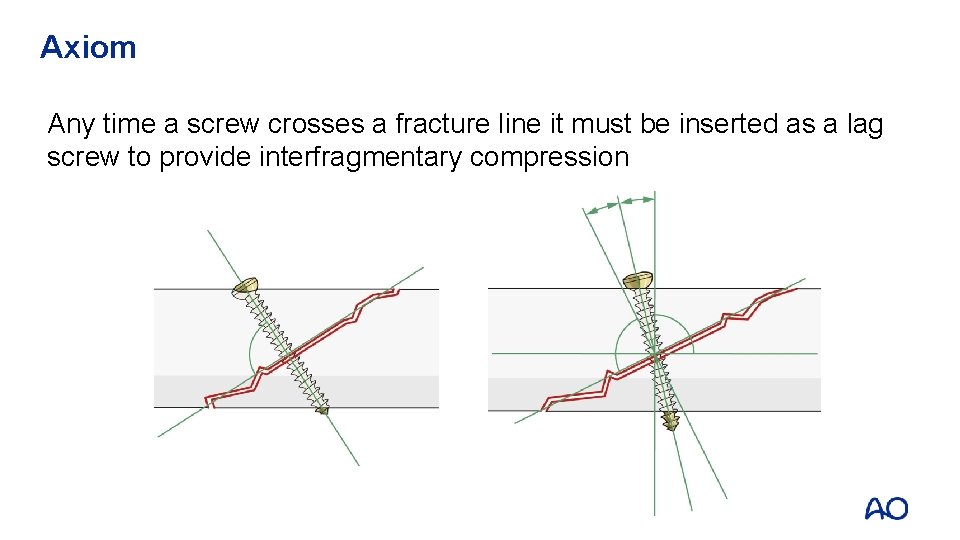
Axiom Any time a screw crosses a fracture line it must be inserted as a lag screw to provide interfragmentary compression
Take-home messages • Absolute stability implies there is no motion between fracture fragments with normal functional loads • The best method to achieve absolute stability is with interfragmentary compression (lag screw technique) • Absolute stability is indicated for articular fractures and simple diaphyseal fractures • Fractures treated with absolute stability can be expected to heal with direct bone healing with no callus 20
- Slides: 20