
Absolute Pitch Chris Darwin Perception of Musical Sounds
Absolute Pitch Chris Darwin Perception of Musical Sounds: 2007
What is it? Tone-AP • Ability to name notes in isolation • Ability to adjust a note to be, say, F# • Ability to sing F# to order Pseudo-AP • Ability to name only A, but then relative Piece-AP • Ability to say when a piece is in correct key Graded rather than all or none Tone & Pseudo may be better for particular instruments
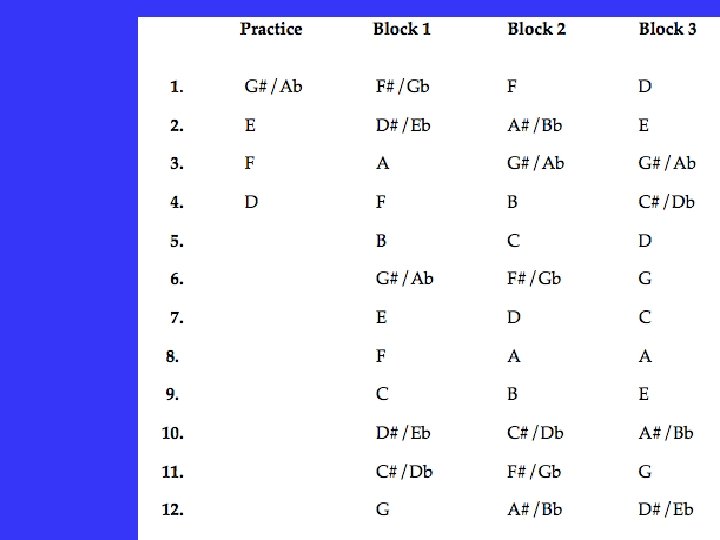
Have you got it? write down each note 4 practice notes then 3 groups of 12 http: //www. aip. org/148 th/Test_for_Absolute_Pitch. htm
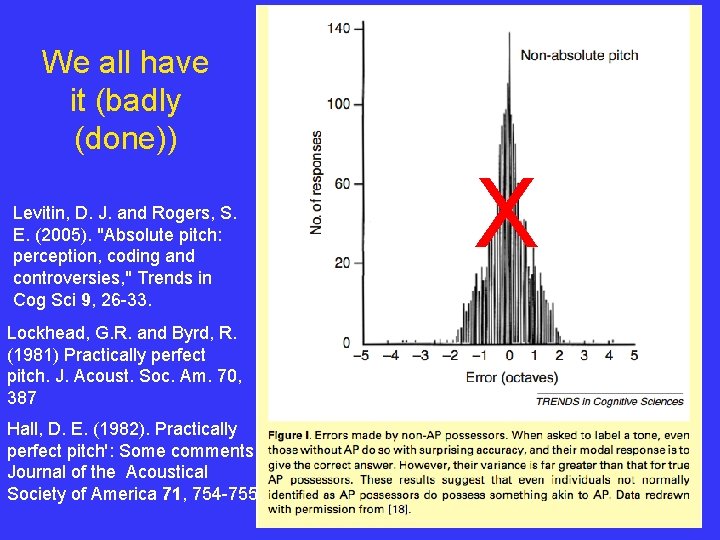
We all have it (badly (done)) Levitin, D. J. and Rogers, S. E. (2005). "Absolute pitch: perception, coding and controversies, " Trends in Cog Sci 9, 26 -33. Lockhead, G. R. and Byrd, R. (1981) Practically perfect pitch. J. Acoust. Soc. Am. 70, 387 Hall, D. E. (1982). Practically perfect pitch': Some comments, Journal of the Acoustical Society of America 71, 754 -755. X
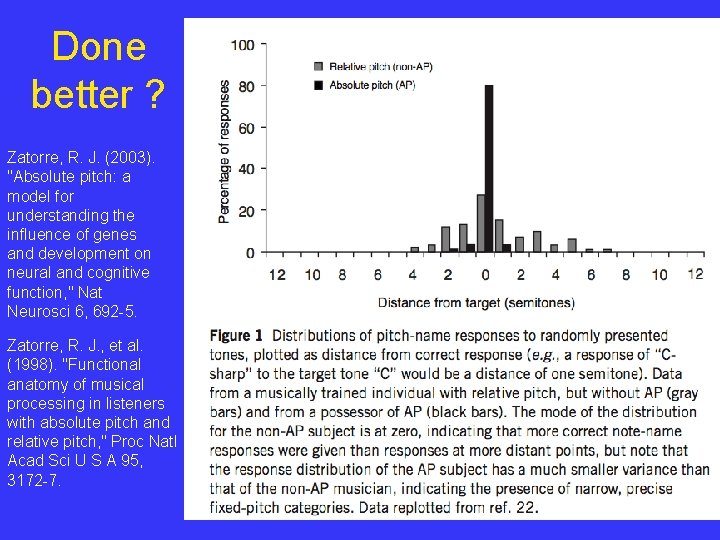
Done better ? Zatorre, R. J. (2003). "Absolute pitch: a model for understanding the influence of genes and development on neural and cognitive function, " Nat Neurosci 6, 692 -5. Zatorre, R. J. , et al. (1998). "Functional anatomy of musical processing in listeners with absolute pitch and relative pitch, " Proc Natl Acad Sci U S A 95, 3172 -7.
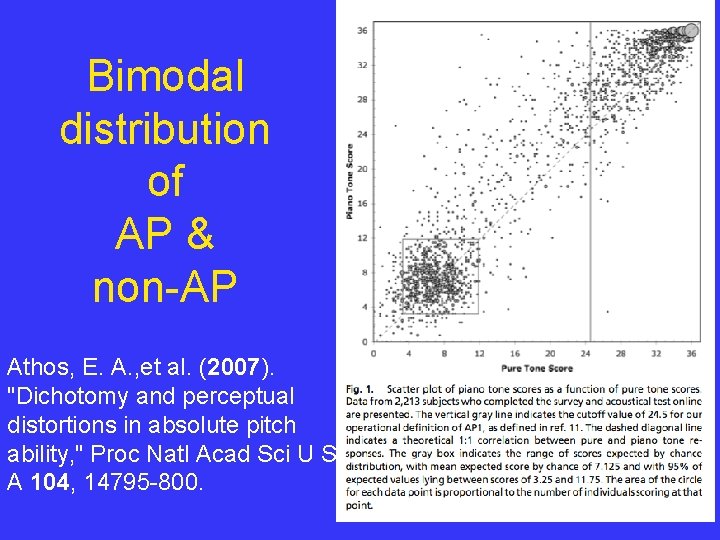
Bimodal distribution of AP & non-AP Athos, E. A. , et al. (2007). "Dichotomy and perceptual distortions in absolute pitch ability, " Proc Natl Acad Sci U S A 104, 14795 -800.
How about Piece-AP? • 46 subjects sang two different popular songs • 40% correct pitch on at least one trial • 12% correct pitch on both trials • 44% ± 2 semits on both trials. Levitin, D. J. (1994). " Absolute memory for musical pitch: Evidence from the production of learned melodies. , " Percept. Psychophys. 56, 414 -423. • Musically trained listeners were presented with excerpts of Bach preludes at original key or shifted by a semitone 30% of those without absolute pitch could do it Terhardt, E. and Seewann, M. (1983). "Aural key identification and its relationship to absolute pitch, " Music Percepn 1, 63 -83.
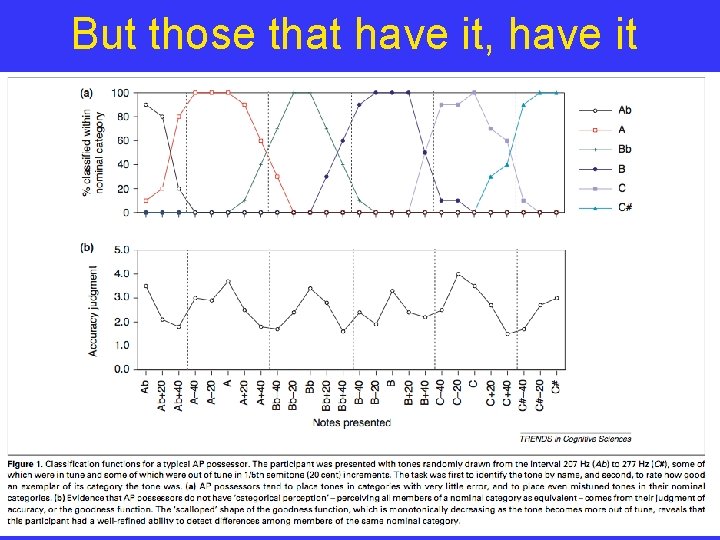
But those that have it, have it
Magic number 7(0) ± 2 • Non-AP: Identify c. 8 categories of pitch • AP: c. 70 categories Zatorre, R. J. (2003). "Absolute pitch: a model for understanding the influence of genes and development on neural and cognitive function, " Nat Neurosci 6, 692 -5.

Who has it? Nurture: Early musical training appears to be necessary but not sufficient for the development of AP. Interviewed 600 musicians (conservatoires, orchestras) <=4 years of age: 40% reported AP >=9 years of age: 3% cf age of acquiring foreign-accent-free second language Baharloo, S. , Johnston, P. A. , Service, S. K. , Gitschier, J. and Freimer, N. B. (1998). "Absolute pitch: an approach for identification of genetic and nongenetic components, " Am J Hum Genet 62, 224 -31.

Start of musical training Levitin, D. J. and Zatorre, R. J. (2003) On the nature of early training and absolute pitch: A reply to Brown, Sachs, Cammuso and Foldstein. Music Perception 21, 105– 110

Tonelanguage talkers Deutsch, D. , Henthorn, T. , Marvin, E. and Xu, H. (2006). "Absolute pitch among American and Chinese conservatory students: prevalence differences, and evidence for a speech-related critical period, " J Acoust Soc Am 119, 719 -22.
Digression into speech perception
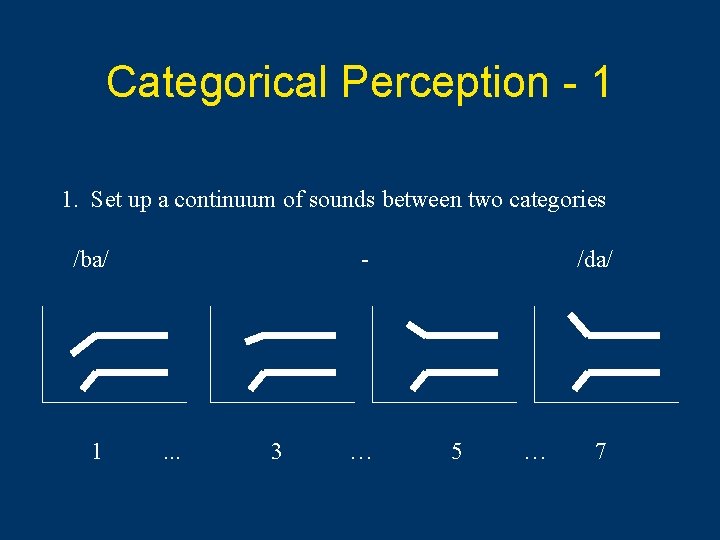
Categorical Perception - 1 1. Set up a continuum of sounds between two categories /ba/ 1 - . . . 3 … /da/ 5 … 7
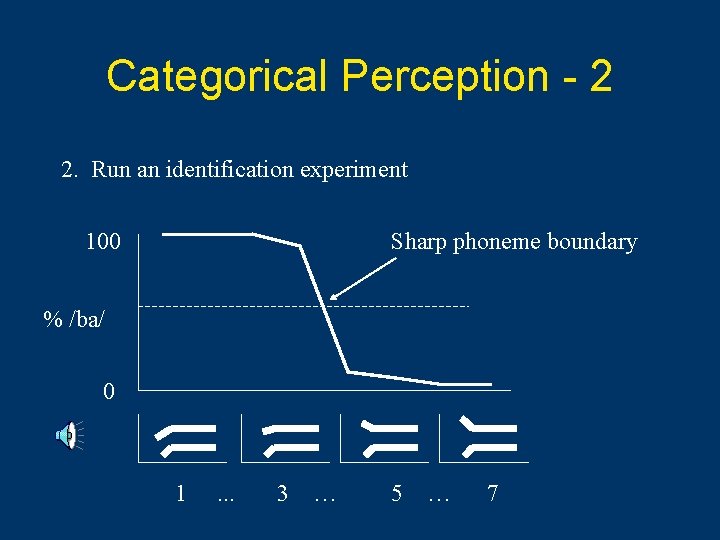
Categorical Perception - 2 2. Run an identification experiment 100 Sharp phoneme boundary % /ba/ 0 1 . . . 3 … 5 … 7
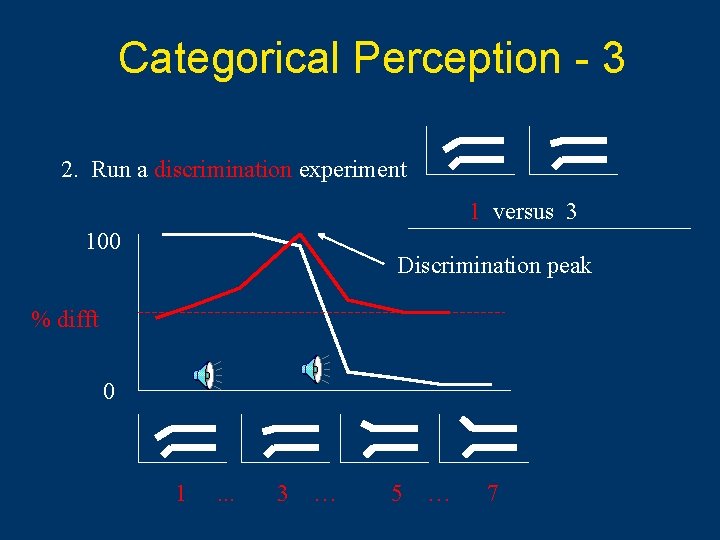
Categorical Perception - 3 2. Run a discrimination experiment 1 versus 3 100 Discrimination peak % difft 0 1 . . . 3 … 5 … 7
Different languages make different regions of acoustic space distinctive
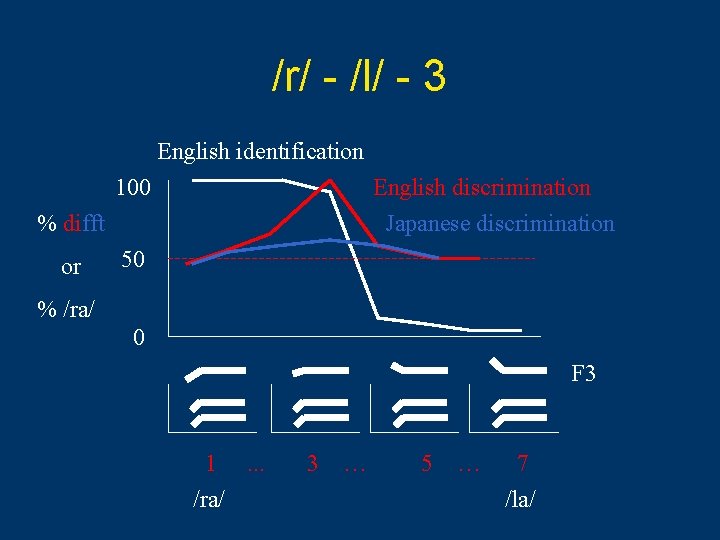
/r/ - /l/ - 3 English identification 100 English discrimination Japanese discrimination % difft or 50 % /ra/ 0 F 3 1. . . /ra/ 3 … 5 … 7 /la/
Phonemes by 12 months Discrimination of Hindi /t/ from /T/ Head-turning: Werker & Tees 1981

Back to Absolute Pitch
Who has it? 12 of 21 early-blind trained musicians had AP compared with <20% of sighted musicians (plus some f. MRI evidence of change in STP asymmetry) Hamilton, R. H. et al. (2004) Absolute pitch in blind musicians. Neuroreport 15, 803– 806
Who has it? Nature: Links to autism Absolute pitch possessors 46% Socially eccentric Relatively good at Block Design (autism indicator) Musician Controls 15% Socially eccentric Relatively bad at Block Design Brown, W. A. , et al. (2003). "Autism-related language, personality, and cognition in people with absolute pitch: results of a preliminary study, " J Autism Dev Disord 33, 163 -7; discussion 169.
Who has it? Nature: Gene? ? Nature? ? : Self-reported AP possessors were four times more likely to report another AP possessor in their families than were non-AP possessors. Baharloo, S. , Johnston, P. A. , Service, S. K. , Gitschier, J. and Freimer, N. B. (1998). "Absolute pitch: an approach for identification of genetic and nongenetic components, " Am J Hum Genet 62, 224 -31.
How do they do it? 18 musicians with absolute pitch (AP) Identified three successive piano tones by their letter names. • Perfect recall of these note names after upto 27 sec of: – counting backwards – hearing random piano tones – singing descending scale • But significant forgetting retaining letter trigrams while counting backwards for 18 sec. Multiple codes (e. g. , auditory, kinesthetic, and visual imagery) are probably used. Zatorre, R. J. & Beckett, C. (1989). Multiple coding strategies in the retention of musical tones by possessors of absolute pitch. Memory and Cognition 17, 582 -589.

Possible cognitive factors • AP don’t need to refresh working memory in pitch memory tests - less activity in right frontal cortex • Dorso-lateral cortex (forms associations? ) active in AP when labelling individual tones and intervals, but in non-AP only when naming intervals.
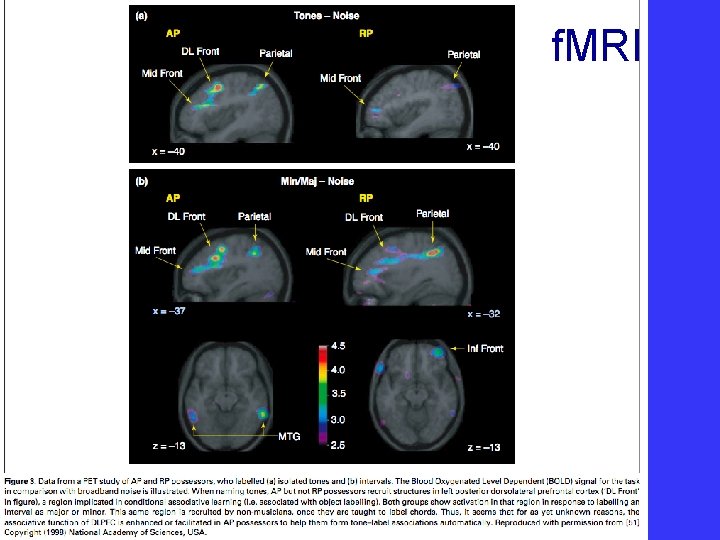
f. MRI
- Slides: 27