
Absolute monopoly One seller The firm is the
Absolute monopoly: • One seller • The firm is the industry • Firm’s demand is also the market demand.
Why monopolies? .
Why monopolies? • Governmental monopoly: USPS • Government-granted: patents, copyrights • Legal barriers to entry.
What is • a natural monopoly?
Natural monopoly • High fixed cost. • Low marginal cost. • Continuingly declining long-run average cost.
Monopoly’s supply and demand • If no price controls, firm is a complete price maker. • In a market, the firm can infuence demand, but the demand is determined by the customers. • The firm can set price or quantity, but not both.
Marginal revenue • Always below demand, and with steeper slope. • Straight-line demand: MR twice as steep • Lower price for previous and additional quantities.
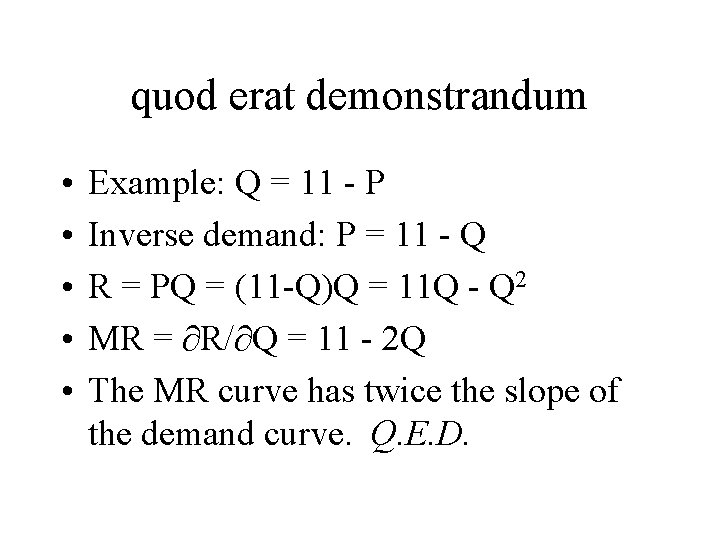
quod erat demonstrandum • • • Example: Q = 11 - P Inverse demand: P = 11 - Q R = PQ = (11 -Q)Q = 11 Q - Q 2 MR = ∂R/∂Q = 11 - 2 Q The MR curve has twice the slope of the demand curve. Q. E. D.
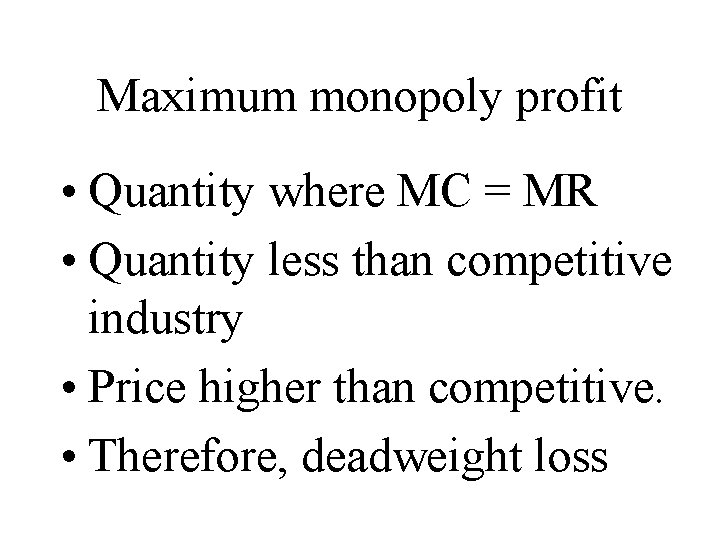
Maximum monopoly profit • Quantity where MC = MR • Quantity less than competitive industry • Price higher than competitive. • Therefore, deadweight loss
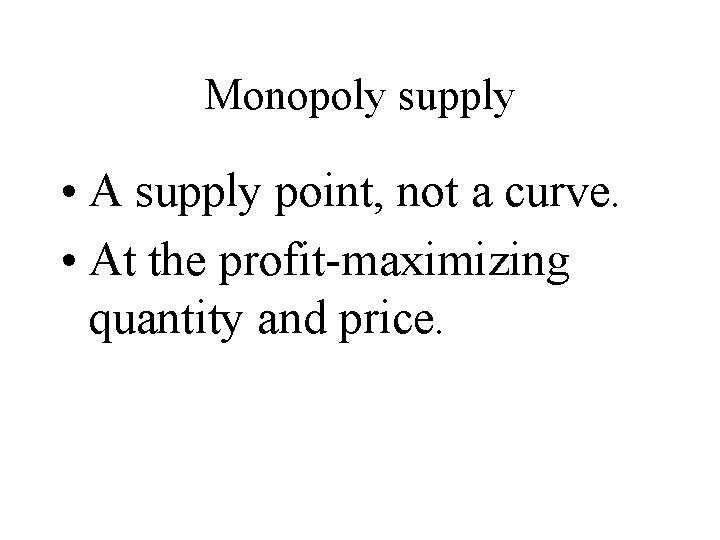
Monopoly supply • A supply point, not a curve. • At the profit-maximizing quantity and price.
Is monopoly bad? • Discuss!
Monopoly bad? • Yes, if due to government protection. • Can be offset by incentive to creation and invention (copyright, patent). • Big firm can have economies of scale. • Big firm can afford big research. • Can have network externalities.
Policy for natural monopoly • Efficient price: MC • Rent can pay fixed cost. • If price set at average cost, incentive to increase costs. • Firm can be owned by the community.
Who gains • from monopoly profit?
Who gains from monopoly profit? • Market price of stock goes up to make normal returns. • Owners at the time it becomes a monopoly are the gainers.
Price discrimination • Charging different prices to various customers for the same goods. • Perfect price discrimination: complete, • Each buyer pays his maximum. • Minimal consumer surplus. • No DWL. Max monopoly profit.
Does monopoly profit cause DWL? • No. • Profit does not harm society. • Loss of socal surplus is the harm. • Correlation is not causation.
- Slides: 18