
Absolute Monarchs Rulers France Louis XIII Louis XIV
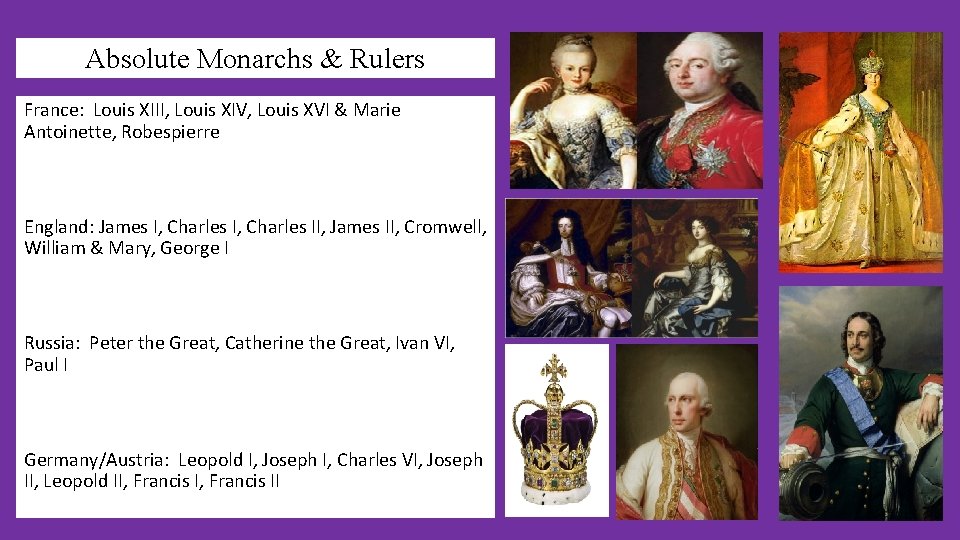
Absolute Monarchs & Rulers France: Louis XIII, Louis XIV, Louis XVI & Marie Antoinette, Robespierre England: James I, Charles II, James II, Cromwell, William & Mary, George I Russia: Peter the Great, Catherine the Great, Ivan VI, Paul I Germany/Austria: Leopold I, Joseph I, Charles VI, Joseph II, Leopold II, Francis II
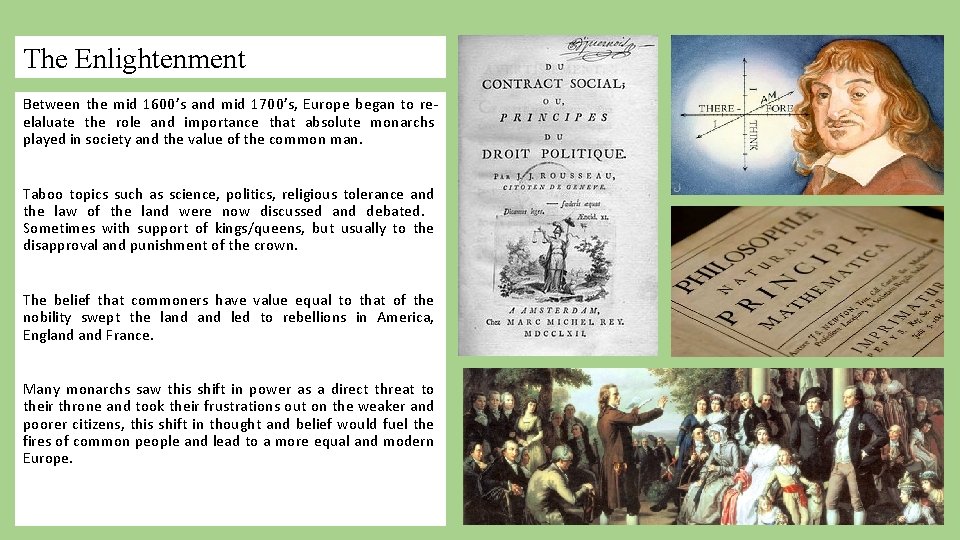
The Enlightenment Between the mid 1600’s and mid 1700’s, Europe began to reelaluate the role and importance that absolute monarchs played in society and the value of the common man. Taboo topics such as science, politics, religious tolerance and the law of the land were now discussed and debated. Sometimes with support of kings/queens, but usually to the disapproval and punishment of the crown. The belief that commoners have value equal to that of the nobility swept the land led to rebellions in America, England France. Many monarchs saw this shift in power as a direct threat to their throne and took their frustrations out on the weaker and poorer citizens, this shift in thought and belief would fuel the fires of common people and lead to a more equal and modern Europe.
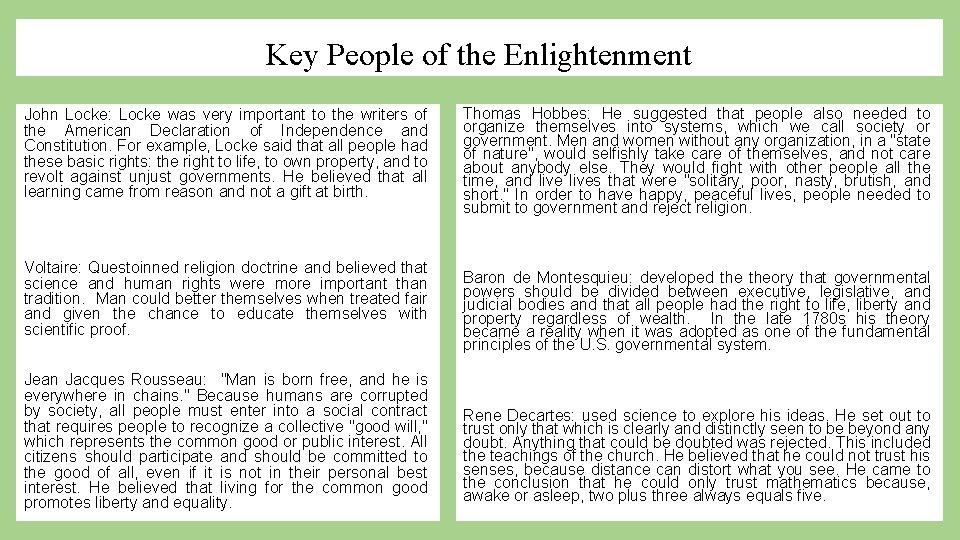
Key People of the Enlightenment John Locke: Locke was very important to the writers of the American Declaration of Independence and Constitution. For example, Locke said that all people had these basic rights: the right to life, to own property, and to revolt against unjust governments. He believed that all learning came from reason and not a gift at birth. Voltaire: Questoinned religion doctrine and believed that science and human rights were more important than tradition. Man could better themselves when treated fair and given the chance to educate themselves with scientific proof. Jean Jacques Rousseau: "Man is born free, and he is everywhere in chains. " Because humans are corrupted by society, all people must enter into a social contract that requires people to recognize a collective "good will, " which represents the common good or public interest. All citizens should participate and should be committed to the good of all, even if it is not in their personal best interest. He believed that living for the common good promotes liberty and equality. Thomas Hobbes: He suggested that people also needed to organize themselves into systems, which we call society or government. Men and women without any organization, in a "state of nature", would selfishly take care of themselves, and not care about anybody else. They would fight with other people all the time, and lives that were "solitary, poor, nasty, brutish, and short. " In order to have happy, peaceful lives, people needed to submit to government and reject religion. Baron de Montesquieu: developed theory that governmental powers should be divided between executive, legislative, and judicial bodies and that all people had the right to life, liberty and property regardless of wealth. In the late 1780 s his theory became a reality when it was adopted as one of the fundamental principles of the U. S. governmental system. Rene Decartes: used science to explore his ideas. He set out to trust only that which is clearly and distinctly seen to be beyond any doubt. Anything that could be doubted was rejected. This included the teachings of the church. He believed that he could not trust his senses, because distance can distort what you see. He came to the conclusion that he could only trust mathematics because, awake or asleep, two plus three always equals five.
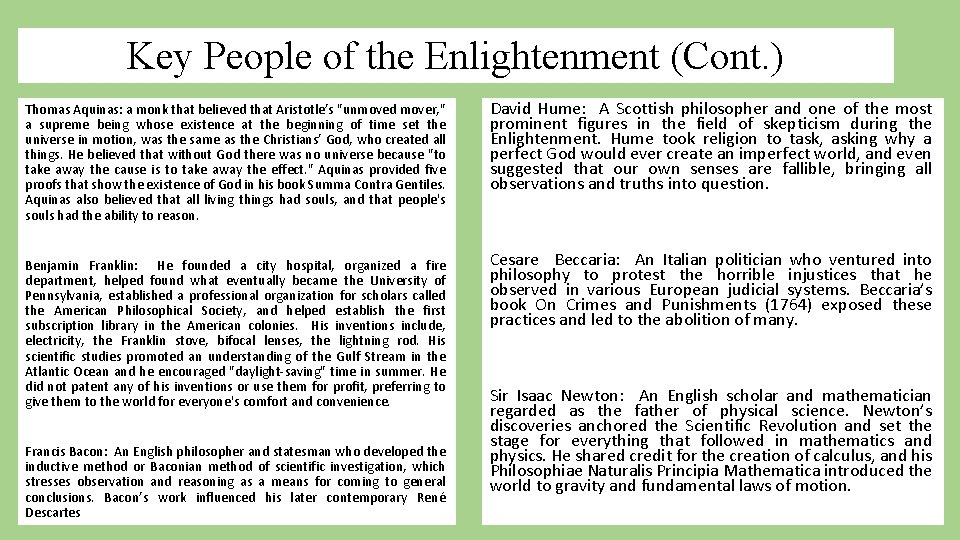
Key People of the Enlightenment (Cont. ) Thomas Aquinas: a monk that believed that Aristotle’s "unmoved mover, " a supreme being whose existence at the beginning of time set the universe in motion, was the same as the Christians’ God, who created all things. He believed that without God there was no universe because "to take away the cause is to take away the effect. " Aquinas provided five proofs that show the existence of God in his book Summa Contra Gentiles. Aquinas also believed that all living things had souls, and that people's souls had the ability to reason. Benjamin Franklin: He founded a city hospital, organized a fire department, helped found what eventually became the University of Pennsylvania, established a professional organization for scholars called the American Philosophical Society, and helped establish the first subscription library in the American colonies. His inventions include, electricity, the Franklin stove, bifocal lenses, the lightning rod. His scientific studies promoted an understanding of the Gulf Stream in the Atlantic Ocean and he encouraged "daylight-saving" time in summer. He did not patent any of his inventions or use them for profit, preferring to give them to the world for everyone's comfort and convenience. Francis Bacon: An English philosopher and statesman who developed the inductive method or Baconian method of scientific investigation, which stresses observation and reasoning as a means for coming to general conclusions. Bacon’s work influenced his later contemporary René Descartes David Hume: A Scottish philosopher and one of the most prominent figures in the field of skepticism during the Enlightenment. Hume took religion to task, asking why a perfect God would ever create an imperfect world, and even suggested that our own senses are fallible, bringing all observations and truths into question. Cesare Beccaria: An Italian politician who ventured into philosophy to protest the horrible injustices that he observed in various European judicial systems. Beccaria’s book On Crimes and Punishments (1764) exposed these practices and led to the abolition of many. Sir Isaac Newton: An English scholar and mathematician regarded as the father of physical science. Newton’s discoveries anchored the Scientific Revolution and set the stage for everything that followed in mathematics and physics. He shared credit for the creation of calculus, and his Philosophiae Naturalis Principia Mathematica introduced the world to gravity and fundamental laws of motion.
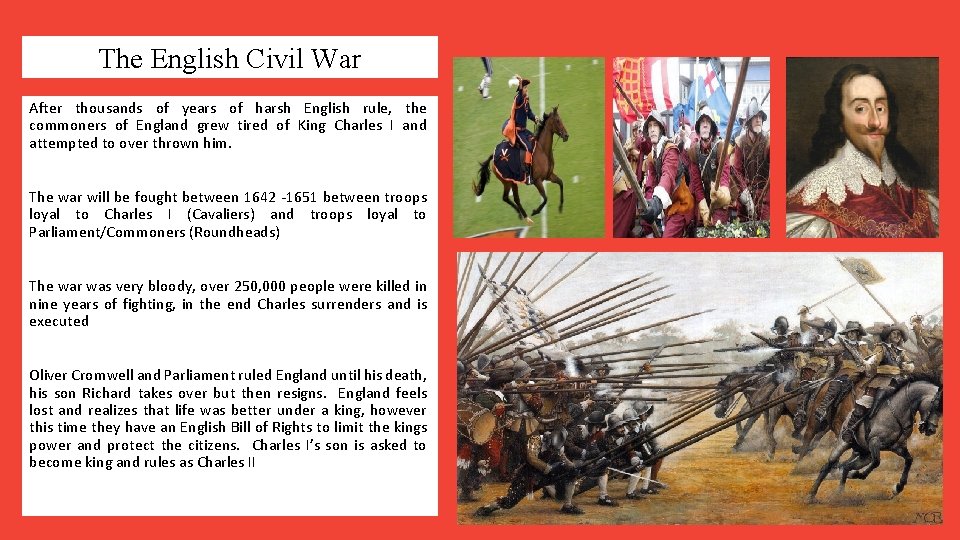
The English Civil War After thousands of years of harsh English rule, the commoners of England grew tired of King Charles I and attempted to over thrown him. The war will be fought between 1642 -1651 between troops loyal to Charles I (Cavaliers) and troops loyal to Parliament/Commoners (Roundheads) The war was very bloody, over 250, 000 people were killed in nine years of fighting, in the end Charles surrenders and is executed Oliver Cromwell and Parliament ruled England until his death, his son Richard takes over but then resigns. England feels lost and realizes that life was better under a king, however this time they have an English Bill of Rights to limit the kings power and protect the citizens. Charles I’s son is asked to become king and rules as Charles II
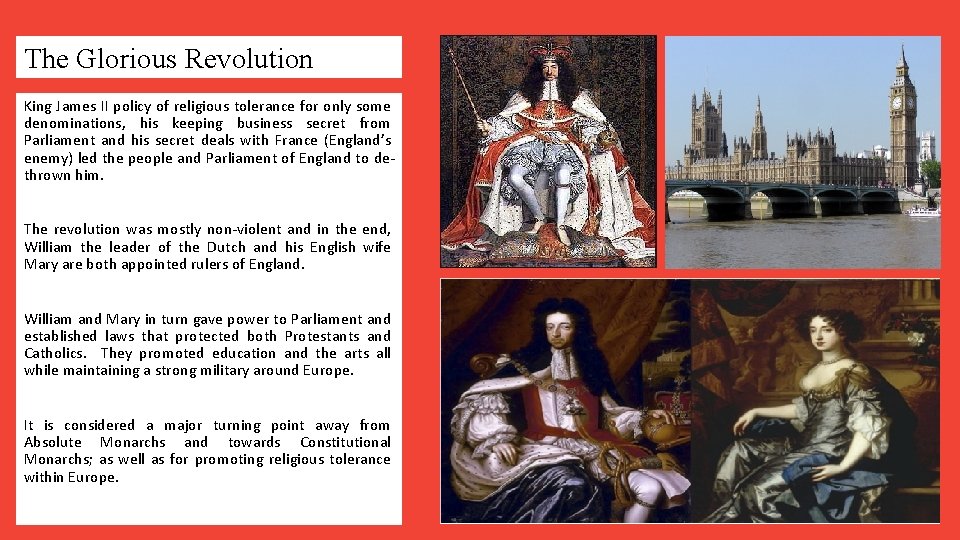
The Glorious Revolution King James II policy of religious tolerance for only some denominations, his keeping business secret from Parliament and his secret deals with France (England’s enemy) led the people and Parliament of England to dethrown him. The revolution was mostly non-violent and in the end, William the leader of the Dutch and his English wife Mary are both appointed rulers of England. William and Mary in turn gave power to Parliament and established laws that protected both Protestants and Catholics. They promoted education and the arts all while maintaining a strong military around Europe. It is considered a major turning point away from Absolute Monarchs and towards Constitutional Monarchs; as well as for promoting religious tolerance within Europe.
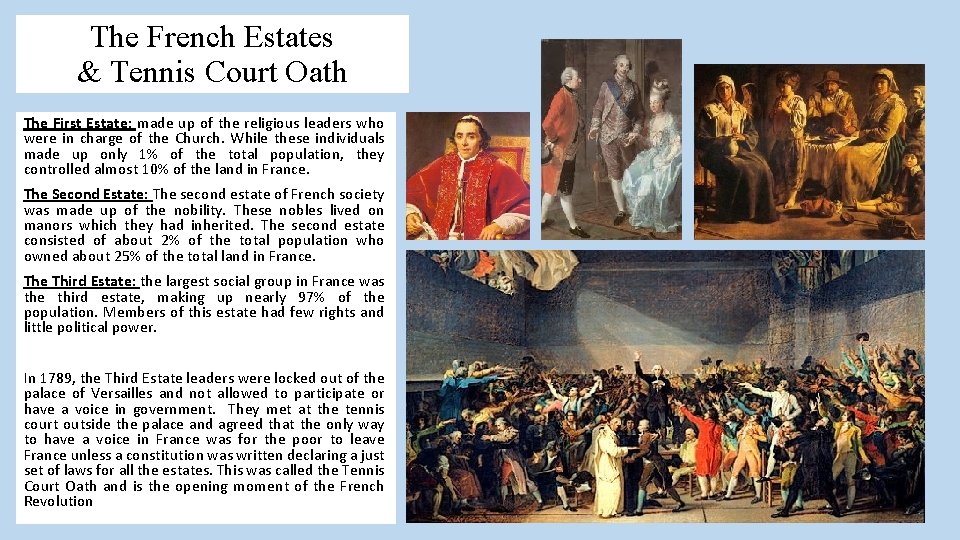
The French Estates & Tennis Court Oath The First Estate: made up of the religious leaders who were in charge of the Church. While these individuals made up only 1% of the total population, they controlled almost 10% of the land in France. The Second Estate: The second estate of French society was made up of the nobility. These nobles lived on manors which they had inherited. The second estate consisted of about 2% of the total population who owned about 25% of the total land in France. The Third Estate: the largest social group in France was the third estate, making up nearly 97% of the population. Members of this estate had few rights and little political power. In 1789, the Third Estate leaders were locked out of the palace of Versailles and not allowed to participate or have a voice in government. They met at the tennis court outside the palace and agreed that the only way to have a voice in France was for the poor to leave France unless a constitution was written declaring a just set of laws for all the estates. This was called the Tennis Court Oath and is the opening moment of the French Revolution
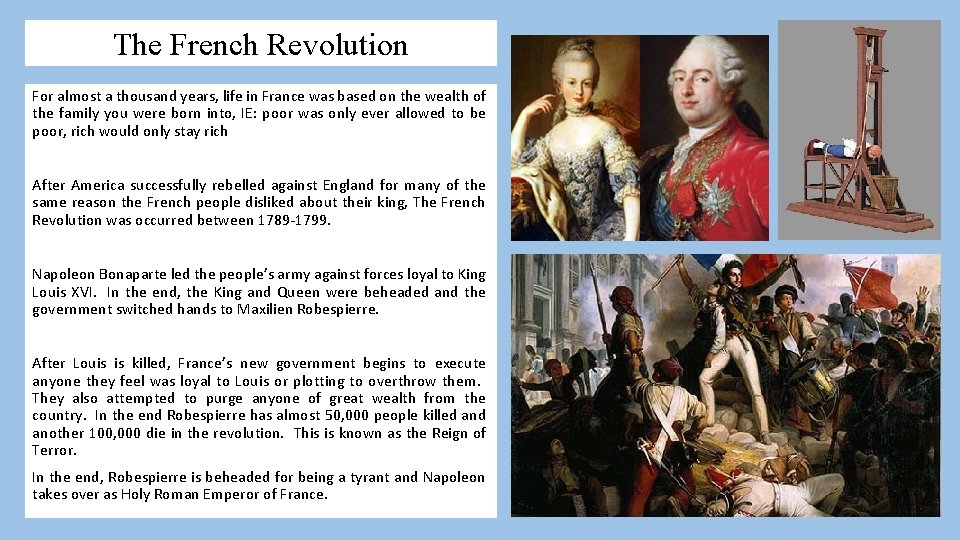
The French Revolution For almost a thousand years, life in France was based on the wealth of the family you were born into, IE: poor was only ever allowed to be poor, rich would only stay rich After America successfully rebelled against England for many of the same reason the French people disliked about their king, The French Revolution was occurred between 1789 -1799. Napoleon Bonaparte led the people’s army against forces loyal to King Louis XVI. In the end, the King and Queen were beheaded and the government switched hands to Maxilien Robespierre. After Louis is killed, France’s new government begins to execute anyone they feel was loyal to Louis or plotting to overthrow them. They also attempted to purge anyone of great wealth from the country. In the end Robespierre has almost 50, 000 people killed another 100, 000 die in the revolution. This is known as the Reign of Terror. In the end, Robespierre is beheaded for being a tyrant and Napoleon takes over as Holy Roman Emperor of France.
- Slides: 8