
Absolute Comparative Advantage Analysis of how countries trade
Absolute & Comparative Advantage Analysis of how countries trade with each other…
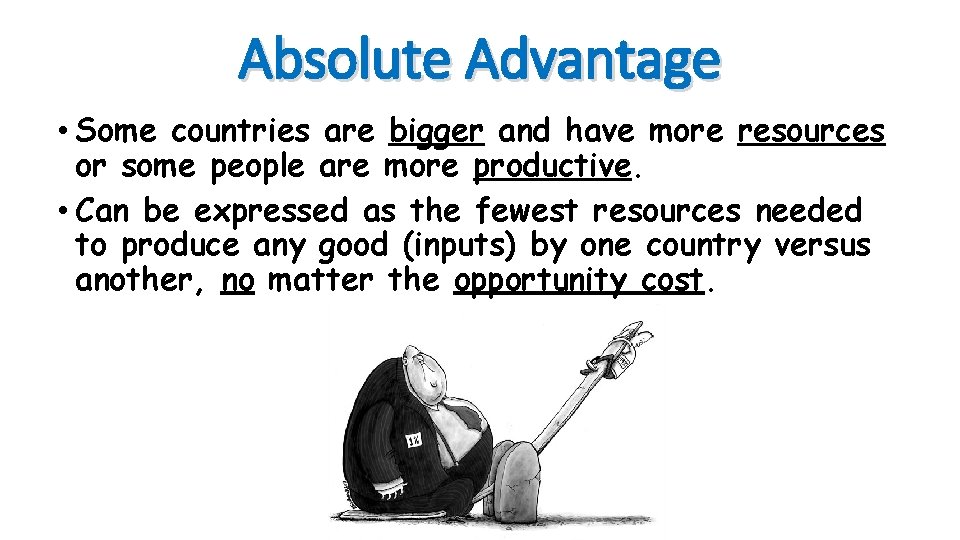
Absolute Advantage • Some countries are bigger and have more resources or some people are more productive. • Can be expressed as the fewest resources needed to produce any good (inputs) by one country versus another, no matter the opportunity cost.
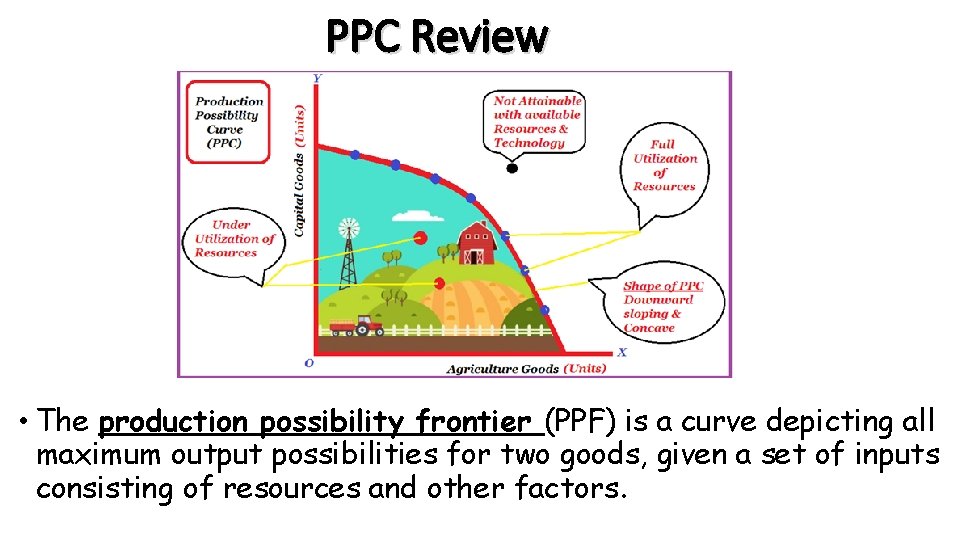
PPC Review • The production possibility frontier (PPF) is a curve depicting all maximum output possibilities for two goods, given a set of inputs consisting of resources and other factors.
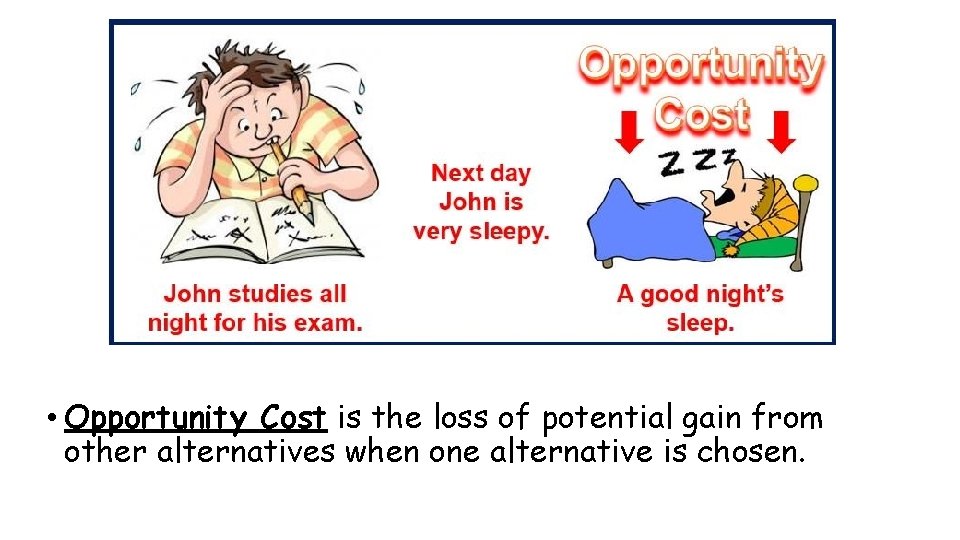
• Opportunity Cost is the loss of potential gain from other alternatives when one alternative is chosen.
Comparative Advantage • Comparative Advantage is the ability of one person or nation to produce a good at a lower opportunity cost than that of another person or nation.
Comparative Advantage & Opportunity Cost • Least effort needed to complete a task. • Fewest number of resources needed to create one unit of output. §LOWEST OPPORTUNITY COST WINS!!!
Comparative & Absolute Advantage
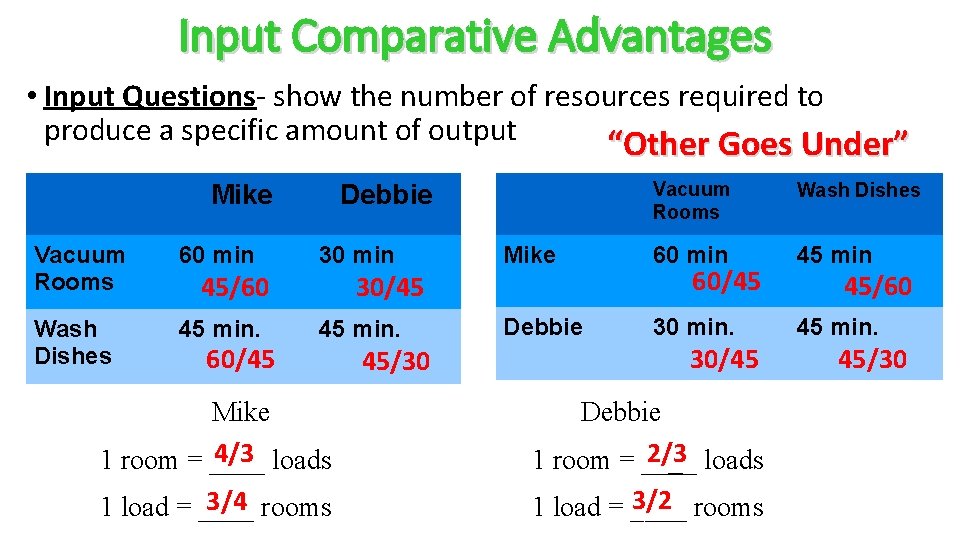
Input Comparative Advantages • Input Questions- show the number of resources required to produce a specific amount of output “Other Goes Under” Mike Vacuum Rooms 60 min Wash Dishes 45 min. Debbie 30 min 45/60 60/45 Mike 30/45 45 min. 45/30 Debbie Vacuum Rooms Wash Dishes 60 min 45 min 60/45 30 min. 30/45 Mike 4/3 loads 1 room = ____ Debbie 2/3 loads 1 room = ____ 3/4 rooms 1 load = ____ 3/2 rooms 1 load = ____ 45/60 45 min. 45/30
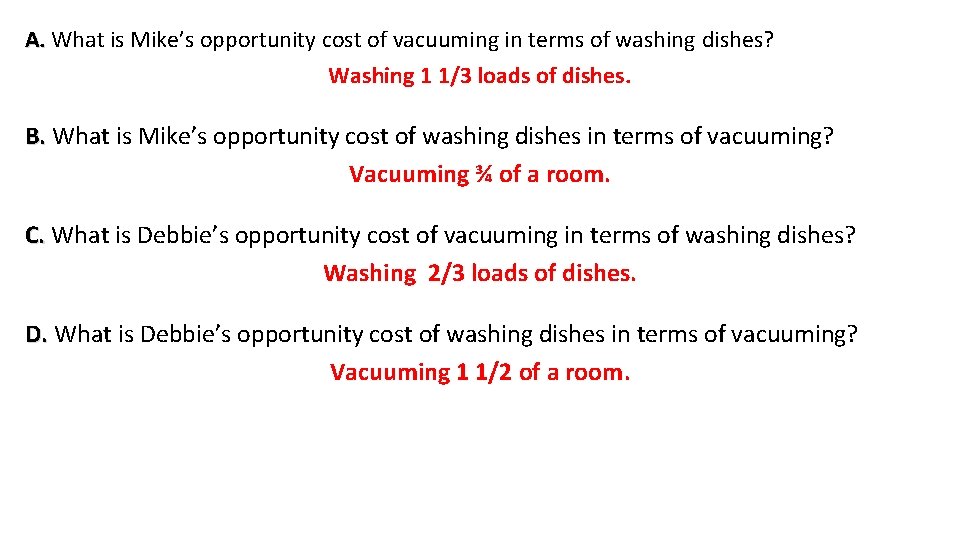
A. What is Mike’s opportunity cost of vacuuming in terms of washing dishes? Washing 1 1/3 loads of dishes. B. What is Mike’s opportunity cost of washing dishes in terms of vacuuming? Vacuuming ¾ of a room. C. What is Debbie’s opportunity cost of vacuuming in terms of washing dishes? Washing 2/3 loads of dishes. D. What is Debbie’s opportunity cost of washing dishes in terms of vacuuming? Vacuuming 1 1/2 of a room.
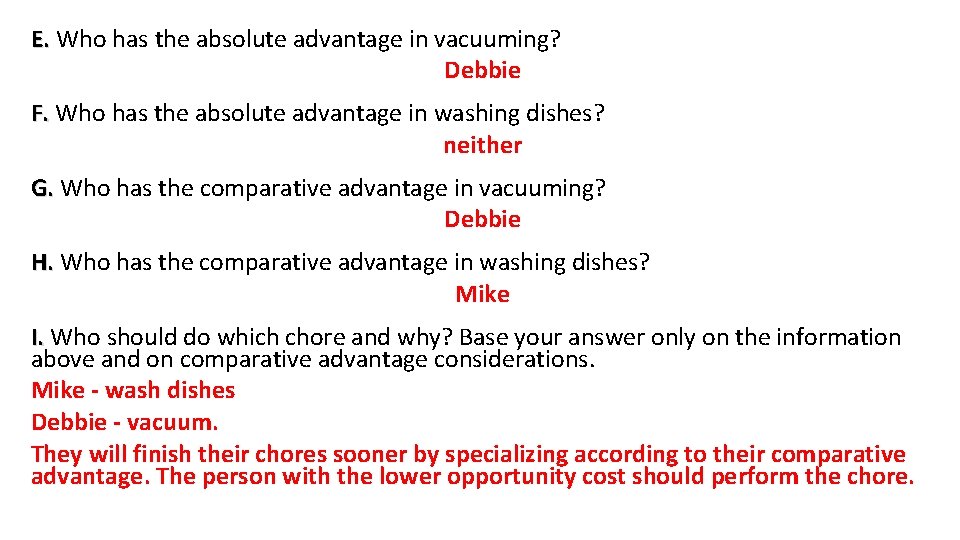
E. Who has the absolute advantage in vacuuming? Debbie F. Who has the absolute advantage in washing dishes? neither G. Who has the comparative advantage in vacuuming? Debbie H. Who has the comparative advantage in washing dishes? Mike I. Who should do which chore and why? Base your answer only on the information above and on comparative advantage considerations. Mike - wash dishes Debbie - vacuum. They will finish their chores sooner by specializing according to their comparative advantage. The person with the lower opportunity cost should perform the chore.
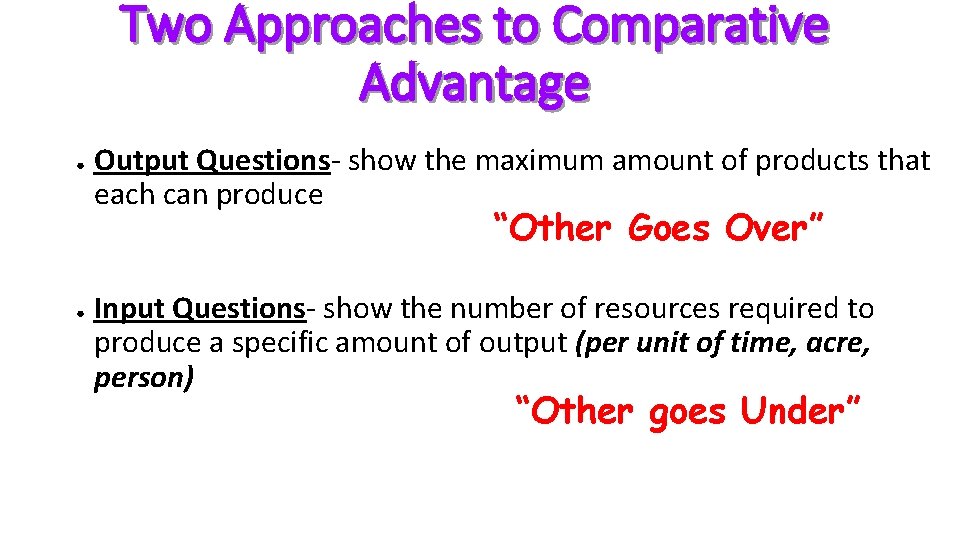
Two Approaches to Comparative Advantage ● Output Questions- show the maximum amount of products that each can produce “Other Goes Over” ● Input Questions- show the number of resources required to produce a specific amount of output (per unit of time, acre, person) “Other goes Under”
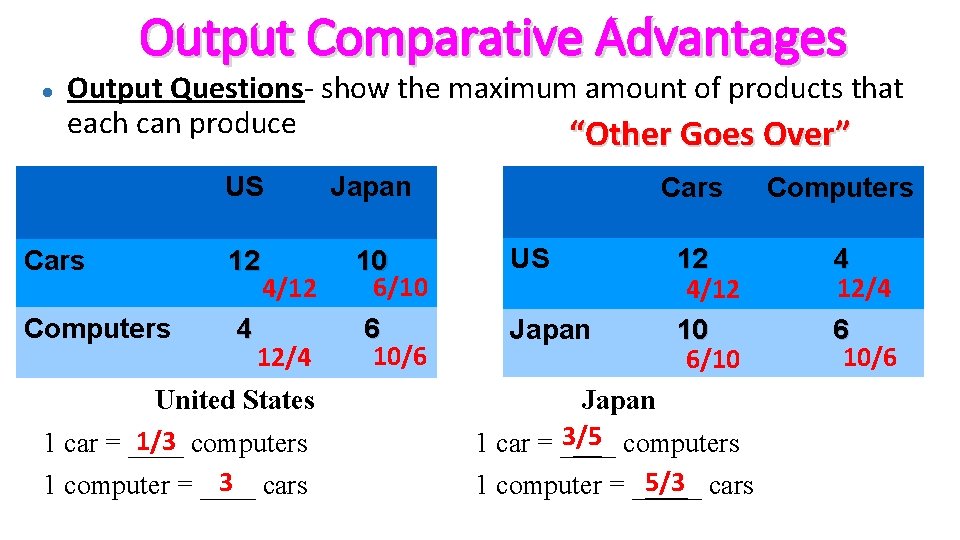
Output Comparative Advantages Output Questions- show the maximum amount of products that each can produce “Other Goes Over” US Japan Cars 4/12 10 6/10 US 12/4 6 10/6 Japan Cars 12 Computers 4 United States 1/3 computers 1 car = ____ 3 cars 1 computer = ____ 12 4/12 10 6/10 Japan 3/5 computers 1 car = ____ 5/3 cars 1 computer = _____ Computers 4 12/4 6 10/6
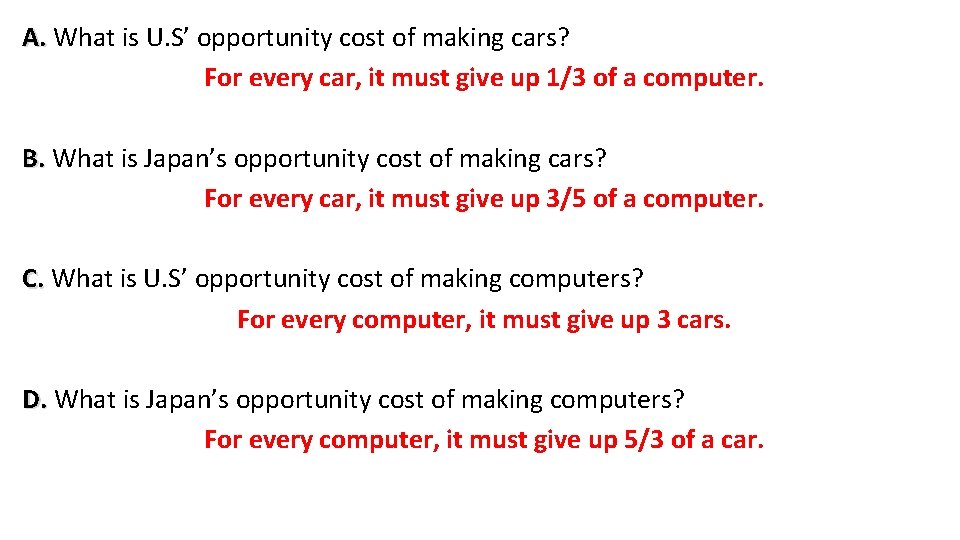
A. What is U. S’ opportunity cost of making cars? For every car, it must give up 1/3 of a computer. B. What is Japan’s opportunity cost of making cars? For every car, it must give up 3/5 of a computer. C. What is U. S’ opportunity cost of making computers? For every computer, it must give up 3 cars. D. What is Japan’s opportunity cost of making computers? For every computer, it must give up 5/3 of a car.
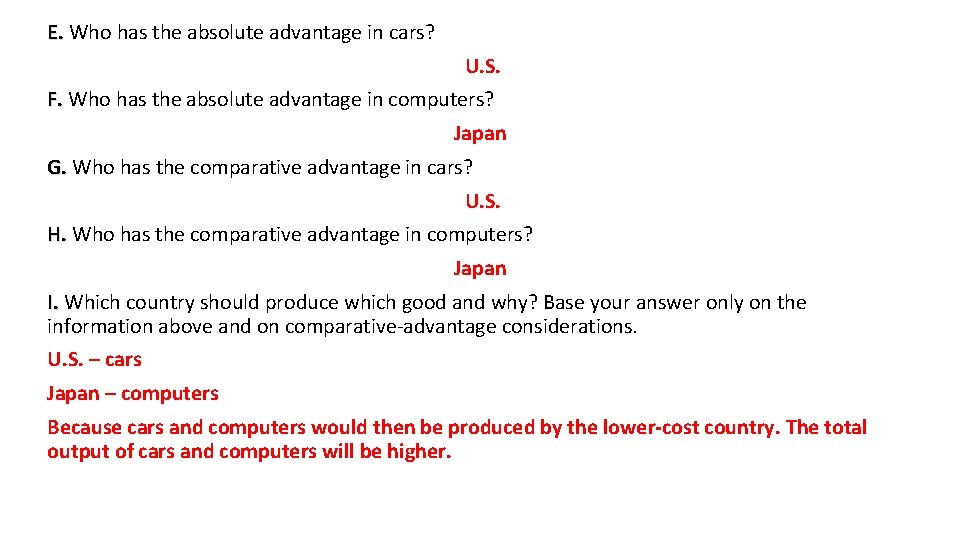
E. Who has the absolute advantage in cars? U. S. F. Who has the absolute advantage in computers? Japan G. Who has the comparative advantage in cars? U. S. H. Who has the comparative advantage in computers? Japan I. Which country should produce which good and why? Base your answer only on the information above and on comparative-advantage considerations. U. S. – cars Japan – computers Because cars and computers would then be produced by the lower-cost country. The total output of cars and computers will be higher.
Terms of Trade • If a country can buy more imports with a given quantity of exports, its terms of trade are favorable. • When figuring out terms of trade both countries must find the terms acceptable. t i f e n e B t s u M Both Countries r u c c O o t e d a r for T
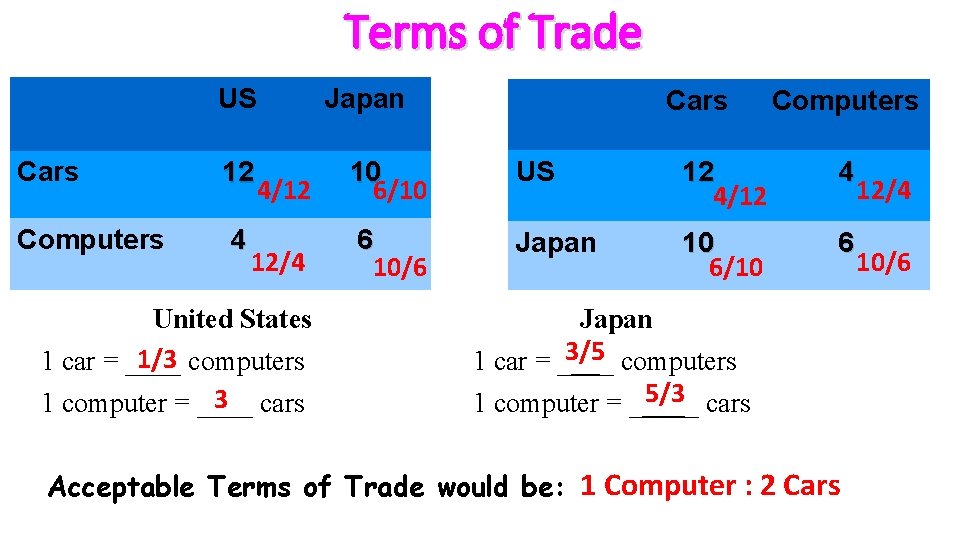
Terms of Trade US Japan Cars Computers 4/12 10 6/10 US 12 4/12 4 12/4 6 10/6 Japan 10 6/10 6 Cars 12 Computers 4 United States 1/3 computers 1 car = ____ 3 cars 1 computer = ____ Japan 3/5 computers 1 car = ____ 5/3 cars 1 computer = _____ Acceptable Terms of Trade would be: 1 Computer : 2 Cars 12/4 10/6
- Slides: 16