
Abraham Maslow Becoming SelfActualized I Biography n Growing
Abraham Maslow Becoming Self-Actualized
I. Biography n Growing up a Jewish boy in a predominantly non-Jewish neighborhood, Maslow sought solace in the library reading. n Maslow, urged by his parents (Russian immigrants), enrolled in law school in CUNY. However, he found it dull & dropped out during the 1 st year. n He attended Cornell & then the University of Wisconsin to study psychology (finished doctorate at UW). n Initially drawn to psychology due to behaviorism, his interest in that particular field of psychology diminished.
Biography (contd. ) n Maslow worked with Harry Harlow at Wisconsin. n After graduation Maslow went to Columbia U. to work with E. L. Thorndike. n The birth of his daughter was a peak experience for Maslow, who decided behaviorism wasn’t for him. n Maslow taught at Brooklyn College for 14 yrs, where he came into contact with Neofreudians (Horney, Fromm, & Adler) & Max Wertheimer, a founder of Gestalt psychology. n He moved to Brandeis U. until his death in 1970.
II. Motivation & Hierarchy of Needs n Maslow was interested in what motivates us. n He looked at the kinds of issues people worry about now (relationships with others, being happy in one’s career & life, living up to one’s potential) & in the 30’s during the Great Depression when people were literally starving to death in the streets. n It struck him that there are two types of motives that guide our behavior: Deficiency motives & growth needs.
A. Deficiency motive (needs) n This results from a lack of some needed object. n Needs like hunger, thirst, & the need for respect from others fall into this category. n These are satisfied once the needed object is obtained.
B. Growth needs n Unlike deficiency needs, these needs are not satisfied once the target object has been found. n Rather, the satisfaction comes from the growth that provides the expression of this motive. n Examples of growth needs include: the unselfish giving of love to others & the development of potential as a human being. The process is as important if not more than the outcome. n Motto: “Strive to be the best person you can be!!!”
III. Maslow’s Hierarchy of Needs n Maslow argued that human motives can be placed in a hierarchy of prominence. n Some needs demand satisfaction before others can be met. n Usually, we satisfy the needs at the lower levels before becoming concerned with the needs at the higher levels. n (e. g. , if you are hungry, your behavior will be focused on foraging. You will be less concerned with making friends with others when you are dying of hunger. )


1. Physiological Needs-are biological needs n They consist of needs for oxygen, food, water, & a relatively constant body temperature. n They are the strongest needs because if a person were deprived of all needs, the physiological ones would come first in the person's search for satisfaction. n We need these for basic survival.
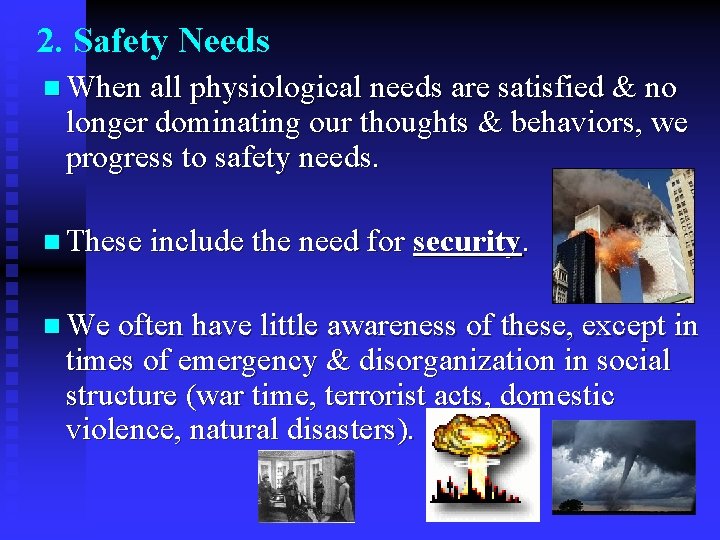
2. Safety Needs n When all physiological needs are satisfied & no longer dominating our thoughts & behaviors, we progress to safety needs. n These include the need for security. n We often have little awareness of these, except in times of emergency & disorganization in social structure (war time, terrorist acts, domestic violence, natural disasters).
3. Belongingness & Love needs n When safety & physiological needs are met, we desire, to be loved by others & to belong. n Maslow states that people seek to overcome feelings of loneliness & alienation. n This involves both giving & receiving love, affection & the sense of belonging (family, friends, social groups).
4. Esteem Needs n After the first 3 classes of needs are met, the esteem can become dominant. needs for n These involve needs for both self-esteem & for the esteem a person gets from others. n Humans have a need for a stable, firmly based, high level of self-respect, & respect from others. n When these needs are satisfied, the person feels self- confident & valuable as a person in the world. When these needs are frustrated, the person feels inferior, weak, helpless & worthless.
5. Need for Self-Actualization n When all of the foregoing needs are satisfied, then & only then are the needs for self-actualization activated. n Maslow describes self-actualization as a person's need to be & do that which the person was "born to do. " "A musician must make music, an artist must paint, & a poet must write. " n These needs make themselves felt in signs of restlessness (person feels edgy, tense, lacking something, in short, restless. ) n The person must be true to his or her own nature, be what you are meant to be.
On Self-Actualization n Maslow believed that very few people reach the state of self-actualization. n Although we all have the need to move toward the goal of reaching our full potential, other needs may get in the way.
IV. Misconceptions about Maslow’s Hierarchy of Needs n 1. Maslow himself agreed that his 5 -level need hierarchy oversimplifies the relationship between needs & behavior. n 2. The order of needs makes sense for most of us, though there may be some notable exceptions (e. g. , some people need to satisfy their needs for self-esteem & respect before they can enter a love relationship). n 3. We may so desire fulfilling a need that we sacrifice others below it (e. g. , “The starving actor/artist”).
V. The study of psychologically healthy people n Maslow was interested in studying people who are psychologically healthy. n These were people who had become self-actualized. He interviewed these people to see how they were able to satisfy all of the needs on the hierarchy. n He conducted what he called a “holistic analysis” in which he sought general impressions from his efforts to understand these people in depth.
What are Self-Actualized People Like? n 1. They tend to accept themselves for what they are. They freely admit their weaknesses, but do make attempts to improve. n 2. They don’t worry excessively over the mistakes they have made, but instead focus on improving. n 3. They respect & feel good about themselves. However, this self love is healthy & not narcissistic. n 4. They are less restricted by cultural norms than the average person. They feel free to express their desires, even if contrary to the popular view.
5. These folks are creative n 6. They are innovative & creative at solving problems. n 7. They have relatively few friends, but the friendships are deep & rewarding. n 8. They have a great sense of humor, poking fun at the human condition. n 9. These people have frequent peak experiences, in which time & place are transcended, anxieties are lost, & a unity of self with the universe is obtained (birth of a child, marriage, deciding to go to school).
- Slides: 18