
ABPA Allergic Bronchopulmonary Aspergillosis Case B C chronology
ABPA Allergic Bronchopulmonary Aspergillosis
Case – B. C. - chronology • 1983 -Age 36, hx asthma. Persisting cough, mucous, sweats led to consultation and evaluation • CXR-LLL infiltrate w/ cavitation and RUL cavity • TEC 112 (on Prednisone) • ESR 30 – 50 • Fungal CF and Immunodiffusion neg.
1983 • Bronchoscopy – Bx=Fibrosis and inflammatory debris. “A large number of inflammatory cells are eosinophils and macrophages” • Open lung biopsy rec. by Dr. Ed Goodman “Chronic bronchitis and bronchiolitis with acute bronchopneumonia-etiology not demonstrated. ” Specifically no vasculitis, no granuloma, no mucoid impaction, and neg. AFB and Fungal stains.
1983 • Negative AFB cultures from sputum, bronchoscopy, and OLBx. • Aspergillus species grew from sputum, bronchoscopy, and OLBx • No specific diagnosis made, no specific Rx given – on Vanceril, Theo. Dur, and Ventolin
Various Years • 1988 Ig. G, Ig. M, Ig. A, and Alpha-1 antitrypsin negative • 1990 TEC 400+ • 1991 Opinion from Dr. John Weissler at UTSWMS No information or letter received • 1994 TEC 400 • 1995 Evaluation by Dr. Gary Gross + Ragweed, molds, and animal dander. Rx Intal and nasal Atrovent. • 1998 Hospitaliztion for pneumonia • 1999 Outpatient pneumonia
1999 • Opinion from Dr. Robert Sugarman, immunologist, for recurring pneumonias • Diff Dx – ABPA, ciliary dyskinesis, ASA hypersensitivity, Cystic Fibrosis • Ig. E 1810, RAST Ig. E and Ig. G for Aspergillus fumigatus elevated. • ABPA unifying diagnosis
More of the saga • 2000 – episode of pleurisy • 2001 – Sputum grew Mycobacterium avium complex…Rx EMB, RMP, Biaxin • 2001 - Right back/flank pain – H. zoster
2003 • 4/03 CXR worsened • 5/03 CT – Bronchiectasis, Adenopathy, and pancreatic lesion • 5/03 Sputum grew Candida; AFB negative • 6/03 PET scan negative • 7/03 Bronchoscopy for Bx and Lavage. Bx=“chronic inflammation with eosinophilia. ” Culture grew Aspergillus terreus. AFB negative. Spirometry: FVC 85%, FEV 1 70%, FEF 25 -75 34% Bone Density: osteopenia
2003 cont’d • 7/03 Rx: Prednisone 80 -40 -20, Sporanox 100 mg BID, Advair 500/50 BID • 9/03 FEV 1 up to 2. 1 liters, Less cough, subjectively improved, TEC 100, HRT added by GYN, CXR/CT remarkably improved. Prednisone reduced to 20 QOD • 12/03 TEC 200, Ig. E 739. Prednisone reduced to 15 QOD, Advair to 250 due to hoarseness, and Sporanox continued
ABPA • Complex hypersensitivity reaction in patients with asthma that occurs when bronchi become colonized by Aspergillus • Repeated episodes of bronchial obstruction, inflammation, and mucoid impaction can lead to Bronchiectasis, Fibrosis, and respiratory compromise
ABPA Pathology • Mucoid impaction of bronchi, eosinophilic pneumonia, bronchocentric granulomatosis • Asthma • Septated hyphae with dichotomous branching may be seen in mucous, but do not invade the mucosa. • Culture + in 2/3 of patients
ABPA Physiology • No relationship between intensity of airborne exposure and rates of sensitization • Healthy individuals can eliminate fungal spores • Atopic individuals may form Ig. E and Ig. G antibodies. Vigorous Ig. E and Ig. G immune responses do not prevent this colonization. Fungal proteolytic enzymes and mycotoxins are released, in concert with Th 2 -mediated eosinophilic inflammation, may lead to airway damage and bronchiectasis
ABPA Clinical • • Asthma Bronchial obstruction Fever, malaise Expectoration of brownish mucous plugs Eosinophilia Hemoptysis Wheezing +/-
ABPA Radiologic features • • • Upper lobe infiltrates Atelectasis “Tram lines” “Parallel lines” Ring shadows “Toothpaste shadows” “Gloved finger shadows” Perihilar infiltrates may simulate adenopathy Cylindrical bronchiectasis
ABPA PFTs • • Airflow obstruction – reduced FEV 1 Air trapping – increased RV Positive BD response in ½ Mixed obst. and rest. if bronchiectasis and fibrosis present • Reduced DLCO if bronchiectasis present
ABPA Diagnosis • • Hx Asthma Skin test reactivity to Aspergillus Ppt. serum antibodies to A. fumigatus Serum Ig. E > 1000 ng/ml Peripheral blood eosinophilia >500/mm 3 Pulmonary infiltrates Central bronchiectasis Elevated Ig. E and Ig. G to A. fumigatus
Pulmonary Eosinophilia • • • Drug and Toxin Induced Helminthic and Fungal Infection Acute Eosinophilic Pneumonia Chronic Eosinophilic Pneumonia Churg – Strauss Syndrome Others-Hypereosinophilic Syndrome, Idiopathic Lung diseases, neoplasms, non-helminthic infections
ABPA vs. Asthma • ABPA in 6 – 30% of asthmatics with skin test reactivity to Aspergillus • Features of ABPA may be common in asthmatics without ABPA • Positive skin test to Aspergillus in 20 -30% • Positive serum ppt. to Aspergillus in 10% asthmatics and 10% of nonasthmatic chronic lung disease patients • Recurrent Mucoid impaction and atelectasis • Peripheral blood eosinophilia and elevated Ig. E
ABPA and Bronchiectasis • Evaluate patients with Bronchiectasis for ABPA unless prior necrotizing pneumonia • CT characteristics of bronchiectasis have failed to differentiate ABPA from CF, ciliary dysfunction, hypogammaglobulinemia, or idiopathic causes.
ABPA Treatment • Corticosteroids • Inhaled steroids may help control symptoms of asthma but do not have documented efficacy in preventing acute episodes of ABPA • Itraconazole
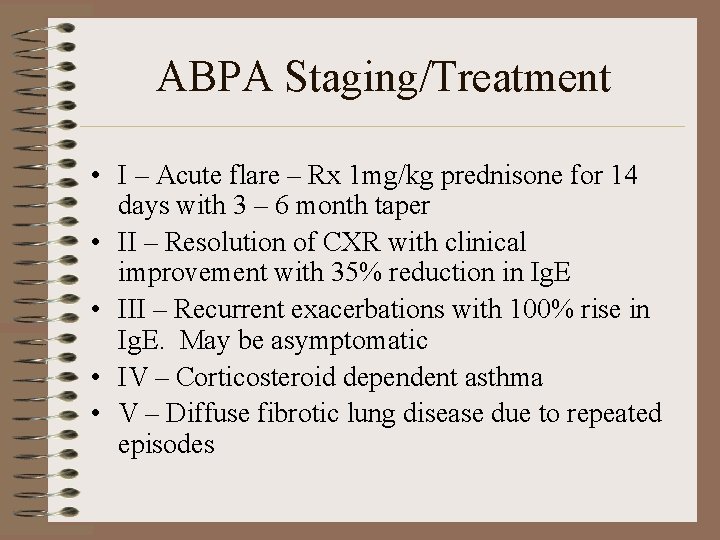
ABPA Staging/Treatment • I – Acute flare – Rx 1 mg/kg prednisone for 14 days with 3 – 6 month taper • II – Resolution of CXR with clinical improvement with 35% reduction in Ig. E • III – Recurrent exacerbations with 100% rise in Ig. E. May be asymptomatic • IV – Corticosteroid dependent asthma • V – Diffuse fibrotic lung disease due to repeated episodes
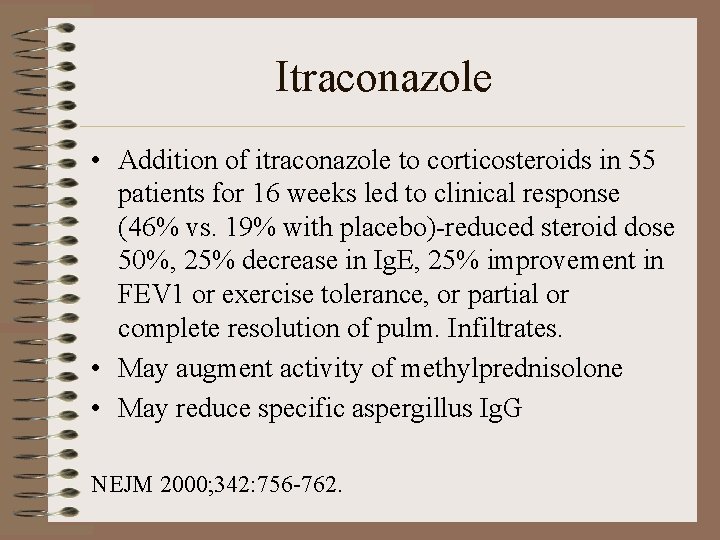
Itraconazole • Addition of itraconazole to corticosteroids in 55 patients for 16 weeks led to clinical response (46% vs. 19% with placebo)-reduced steroid dose 50%, 25% decrease in Ig. E, 25% improvement in FEV 1 or exercise tolerance, or partial or complete resolution of pulm. Infiltrates. • May augment activity of methylprednisolone • May reduce specific aspergillus Ig. G NEJM 2000; 342: 756 -762.
- Slides: 22