
About the Language Ego Tu Verbs pg 59
About the Language: Ego & Tu Verbs pg 59
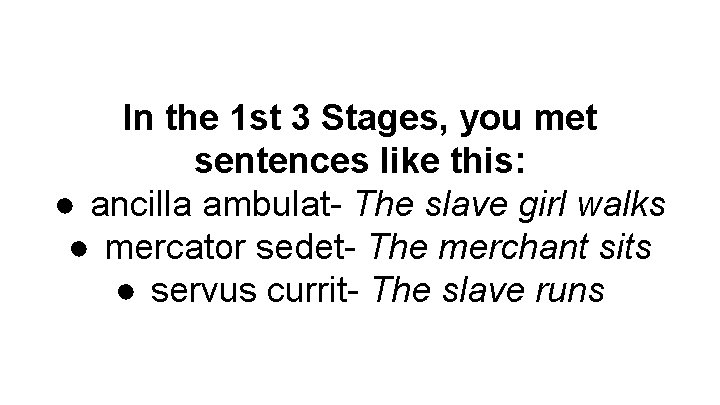
In the 1 st 3 Stages, you met sentences like this: ● ancilla ambulat- The slave girl walks ● mercator sedet- The merchant sits ● servus currit- The slave runs
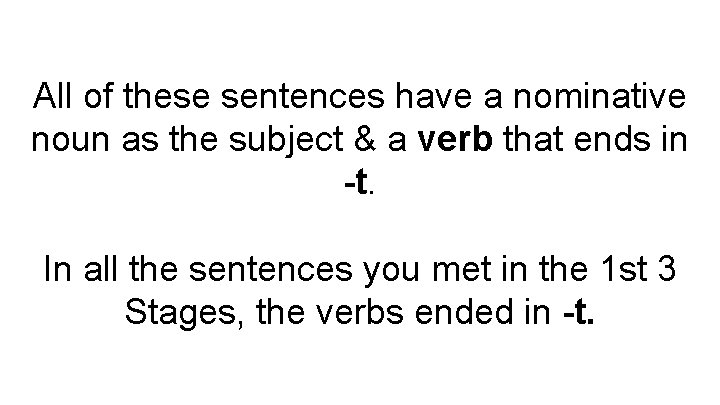
All of these sentences have a nominative noun as the subject & a verb that ends in -t. In all the sentences you met in the 1 st 3 Stages, the verbs ended in -t.
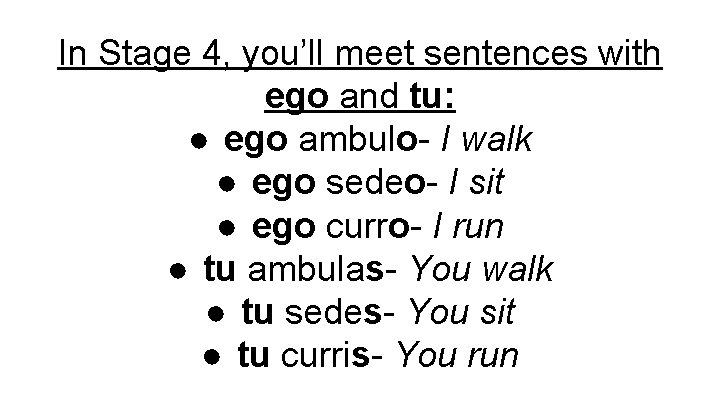
In Stage 4, you’ll meet sentences with ego and tu: ● ego ambulo- I walk ● ego sedeo- I sit ● ego curro- I run ● tu ambulas- You walk ● tu sedes- You sit ● tu curris- You run
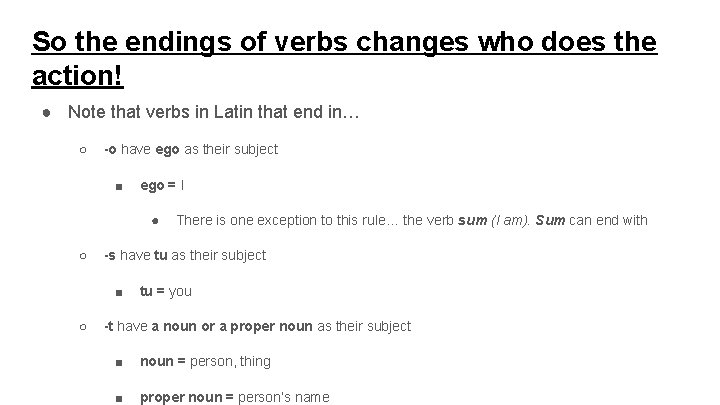
So the endings of verbs changes who does the action! ● Note that verbs in Latin that end in… ○ -o have ego as their subject ■ ego = I ● ○ -s have tu as their subject ■ ○ There is one exception to this rule… the verb sum (I am). Sum can end with tu = you -t have a noun or a proper noun as their subject ■ noun = person, thing ■ proper noun = person’s name
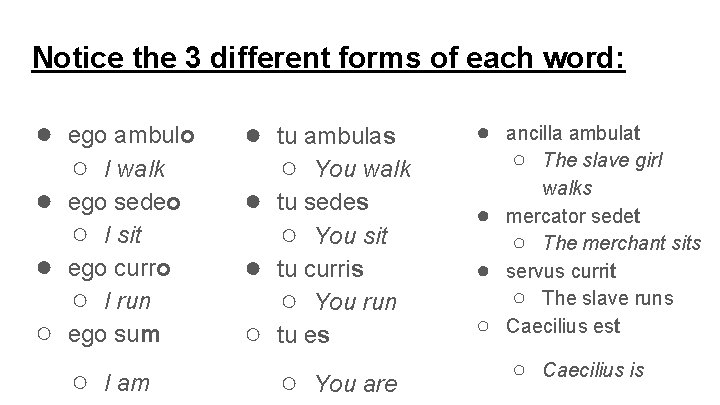
Notice the 3 different forms of each word: ● ● ● ○ ego ambulo ○ I walk ego sedeo ○ I sit ego curro ○ I run ego sum ○ I am ● ● ● ○ tu ambulas ○ You walk tu sedes ○ You sit tu curris ○ You run tu es ○ You are ● ancilla ambulat ○ The slave girl ● ● ○ walks mercator sedet ○ The merchant sits servus currit ○ The slave runs Caecilius est ○ Caecilius is

Notice also that the words ego and tu are not strictly necessary, since the endings -o and -s make it clear that I and you are performing the action of the sentence. The Romans generally used ego and tu only for emphasis.
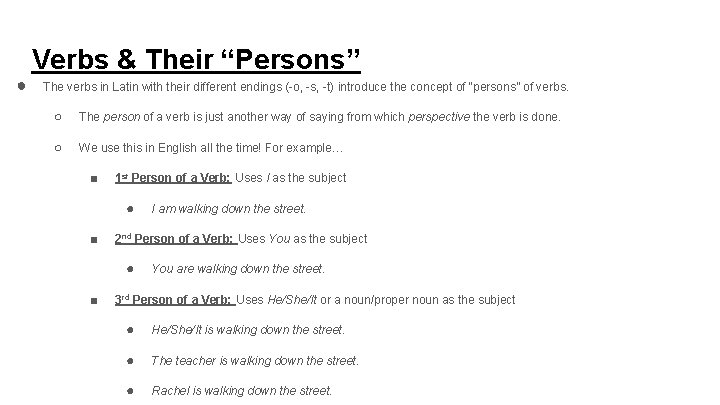
● Verbs & Their “Persons” The verbs in Latin with their different endings (-o, -s, -t) introduce the concept of “persons” of verbs. ○ The person of a verb is just another way of saying from which perspective the verb is done. ○ We use this in English all the time! For example… ■ 1 st Person of a Verb: Uses I as the subject ● ■ 2 nd Person of a Verb: Uses You as the subject ● ■ I am walking down the street. You are walking down the street. 3 rd Person of a Verb: Uses He/She/It or a noun/proper noun as the subject ● He/She/It is walking down the street. ● The teacher is walking down the street. ● Rachel is walking down the street.
- Slides: 8