
About Science Prof Online Power Point Resources Science
About Science Prof Online Power. Point Resources • Science Prof Online (SPO) is a free science education website that provides fully-developed Virtual Science Classrooms, science-related Power. Points, articles and images. The site is designed to be a helpful resource for students, educators, and anyone interested in learning about science. • The SPO Virtual Classrooms offer many educational resources, including practice test questions, review questions, lecture Power. Points, video tutorials, sample assignments and course syllabi. New materials are continually being developed, so check back frequently, or follow us on Facebook (Science Prof Online) or Twitter (Science. Prof. SPO) for updates. • Many SPO Power. Points are available in a variety of formats, such as fully editable Power. Point files, as well as uneditable versions in smaller file sizes, such as Power. Point Shows and Portable Document Format (. pdf), for ease of printing. • Images used on this resource, and on the SPO website are, wherever possible, credited and linked to their source. Any words underlined and appearing in blue are links that can be clicked on for more information. Power. Points must be viewed in slide show mode to use the hyperlinks directly. • Several helpful links to fun and interactive learning tools are included throughout the PPT and on the Smart Links slide, near the end of each presentation. You must be in slide show mode to utilize hyperlinks and animations. • This digital resource is licensed under Creative Commons Attribution-Share. Alike 3. 0: http: //creativecommons. org/licenses/by-sa/3. 0/ Alicia Cepaitis, MS Chief Creative Nerd Science Prof Online Education Resources, LLC alicia@scienceprofonline. com From the Virtual Biology Classroom on Science. Prof. Online. com Tami Port, MS Creator of Science Prof Online Chief Executive Nerd Science Prof Online Education Resources, LLC info@scienceprofonline. com Image: Compound microscope objectives, T. Port
Introduction to Biology VIDEO: Introduction to Biology From the Virtual Biology Classroom on Science. Prof. Online. com Image: Hawaiian Ginger, T. Port
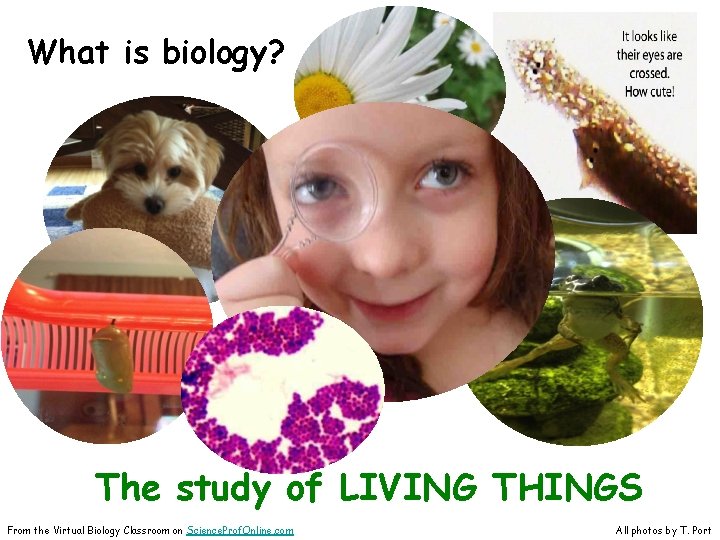
What is biology? The study of LIVING THINGS From the Virtual Biology Classroom on Science. Prof. Online. com All photos by T. Port
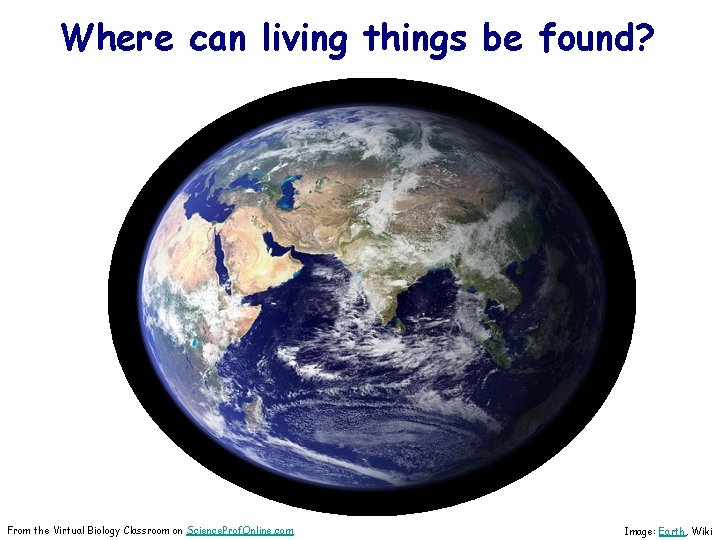
Where can living things be found? From the Virtual Biology Classroom on Science. Prof. Online. com Image: Earth, Wiki
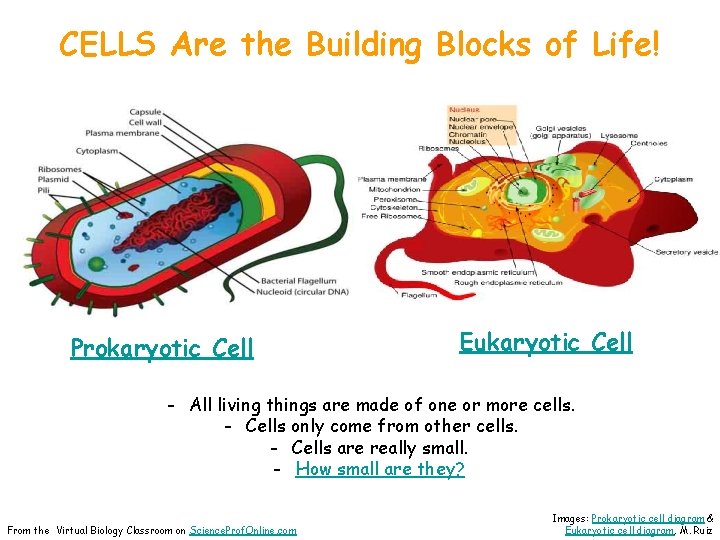
CELLS Are the Building Blocks of Life! Prokaryotic Cell Eukaryotic Cell - All living things are made of one or more cells. - Cells only come from other cells. - Cells are really small. - How small are they? From the Virtual Biology Classroom on Science. Prof. Online. com Images: Prokaryotic cell diagram & Eukaryotic cell diagram, M. Ruiz
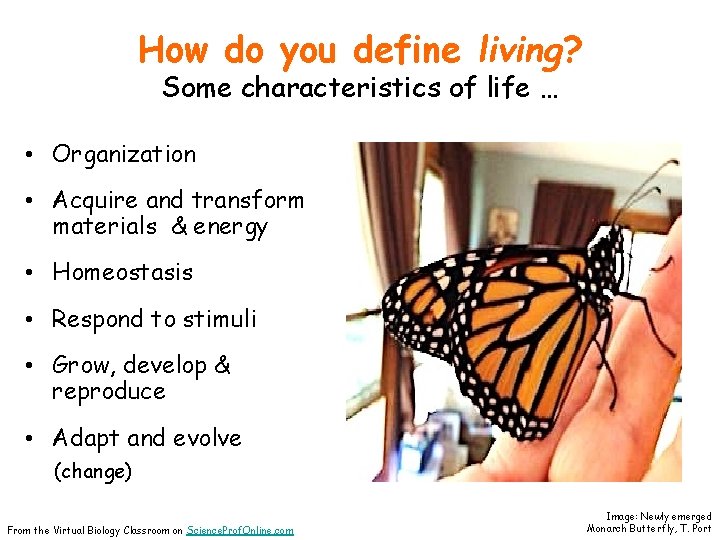
How do you define living? Some characteristics of life … • Organization • Acquire and transform materials & energy • Homeostasis • Respond to stimuli • Grow, develop & reproduce • Adapt and evolve (change) From the Virtual Biology Classroom on Science. Prof. Online. com Image: Newly emerged Monarch Butterfly, T. Port
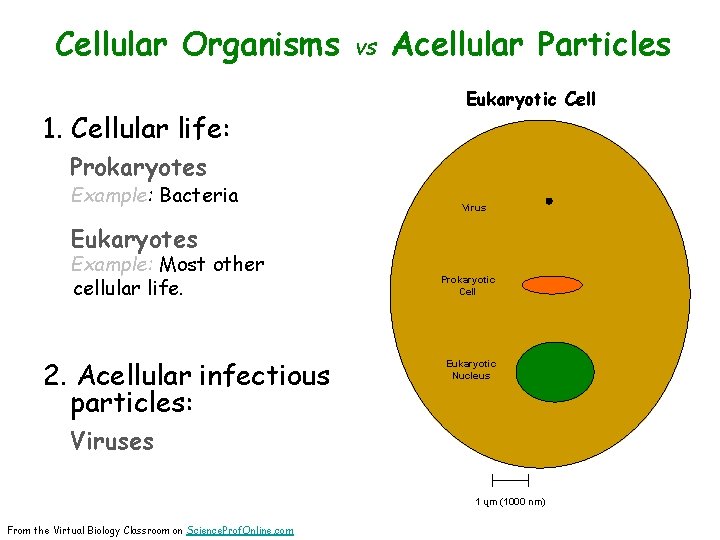
Cellular Organisms 1. Cellular life: vs Acellular Particles Eukaryotic Cell Prokaryotes Example: Bacteria Virus Eukaryotes Example: Most other cellular life. 2. Acellular infectious particles: Prokaryotic Cell Eukaryotic Nucleus Viruses 1 ųm (1000 nm) From the Virtual Biology Classroom on Science. Prof. Online. com
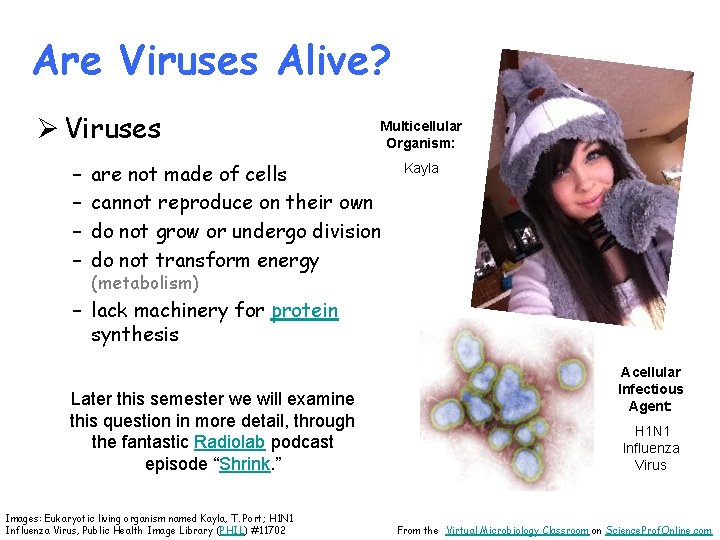
Are Viruses Alive? Ø Viruses – – Multicellular Organism: are not made of cells cannot reproduce on their own do not grow or undergo division do not transform energy Kayla (metabolism) – lack machinery for protein synthesis Later this semester we will examine this question in more detail, through the fantastic Radiolab podcast episode “Shrink. ” Images: Eukaryotic living organism named Kayla, T. Port; H 1 N 1 Influenza Virus, Public Health Image Library (PHIL) #11702 Acellular Infectious Agent: H 1 N 1 Influenza Virus From the Virtual Microbiology Classroom on Science. Prof. Online. com

Sizing Things Up (and Down) 1 m = 100 cm = 1, 000 mm = 1, 000 µm = 1, 000, 000 nm 1 mm = 1000 µm = 1000000 nm 1 µm = 1000 nm Click link for an interactive “Size of Microscopic Things” From the Virtual Biology Classroom on Science. Prof. Online. com animation on Cells Alive.
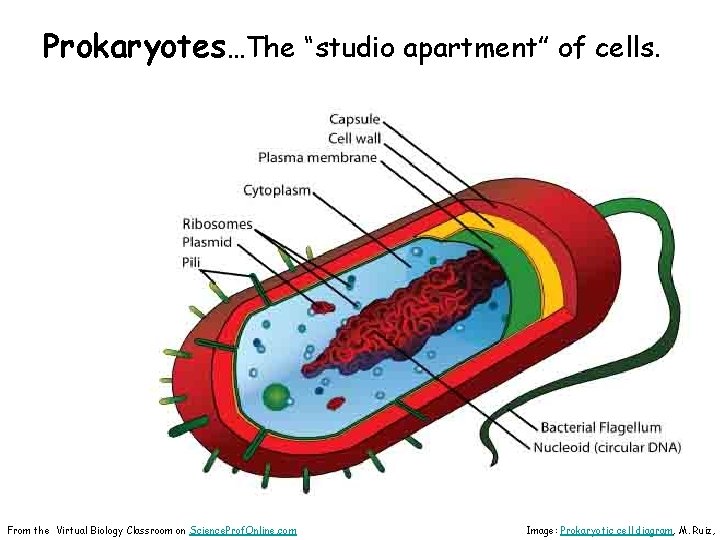
Prokaryotes…The “studio apartment” of cells. From the Virtual Biology Classroom on Science. Prof. Online. com Image: Prokaryotic cell diagram, M. Ruiz,
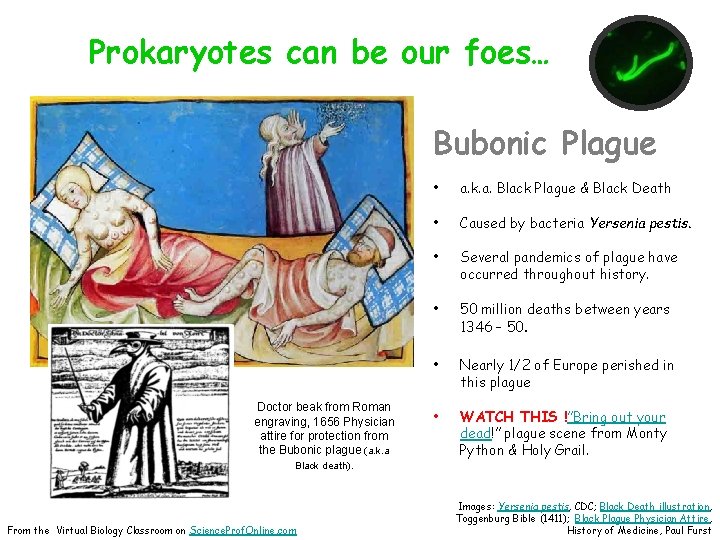
Prokaryotes can be our foes… Bubonic Plague Doctor beak from Roman engraving, 1656 Physician attire for protection from the Bubonic plague (a. k. a • a. k. a. Black Plague & Black Death • Caused by bacteria Yersenia pestis. • Several pandemics of plague have occurred throughout history. • 50 million deaths between years 1346 – 50. • Nearly 1/2 of Europe perished in this plague • WATCH THIS !”Bring out your dead!” plague scene from Monty Python & Holy Grail. Black death). From the Virtual Biology Classroom on Science. Prof. Online. com Images: Yersenia pestis, CDC; Black Death illustration, Toggenburg Bible (1411); Black Plague Physician Attire, History of Medicine, Paul Furst
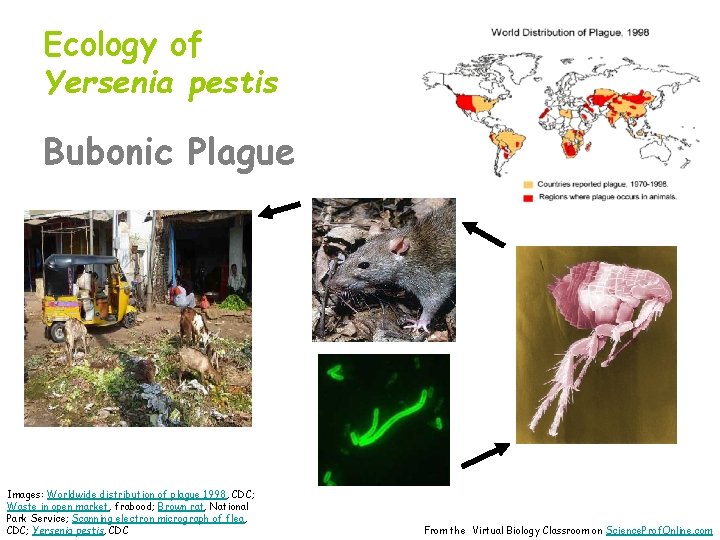
Ecology of Yersenia pestis Bubonic Plague Images: Worldwide distribution of plague 1998, CDC; Waste in open market, frabood; Brown rat, National Park Service; Scanning electron micrograph of flea, CDC; Yersenia pestis, CDC From the Virtual Biology Classroom on Science. Prof. Online. com
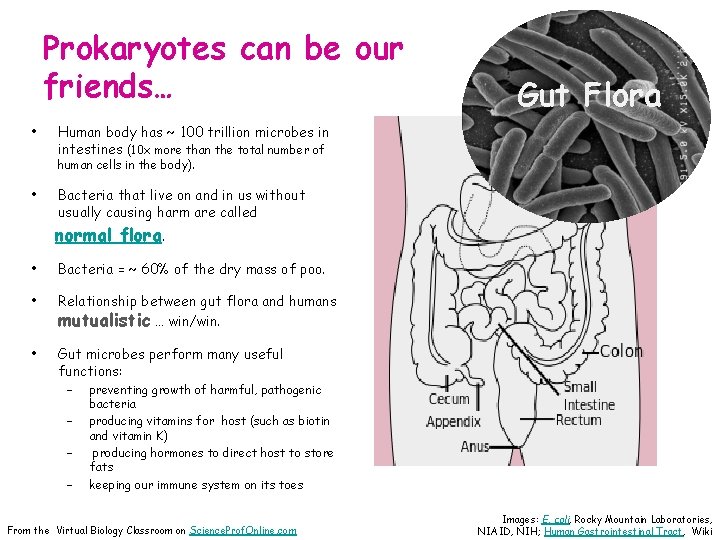
Prokaryotes can be our friends… • Gut Flora Human body has ~ 100 trillion microbes in intestines (10 x more than the total number of human cells in the body). • Bacteria that live on and in us without usually causing harm are called normal flora. • Bacteria = ~ 60% of the dry mass of poo. • Relationship between gut flora and humans mutualistic … win/win. • Gut microbes perform many useful functions: – – preventing growth of harmful, pathogenic bacteria producing vitamins for host (such as biotin and vitamin K) producing hormones to direct host to store fats keeping our immune system on its toes From the Virtual Biology Classroom on Science. Prof. Online. com Images: E. coli, Rocky Mountain Laboratories, NIAID, NIH; Human Gastrointestinal Tract, Wiki
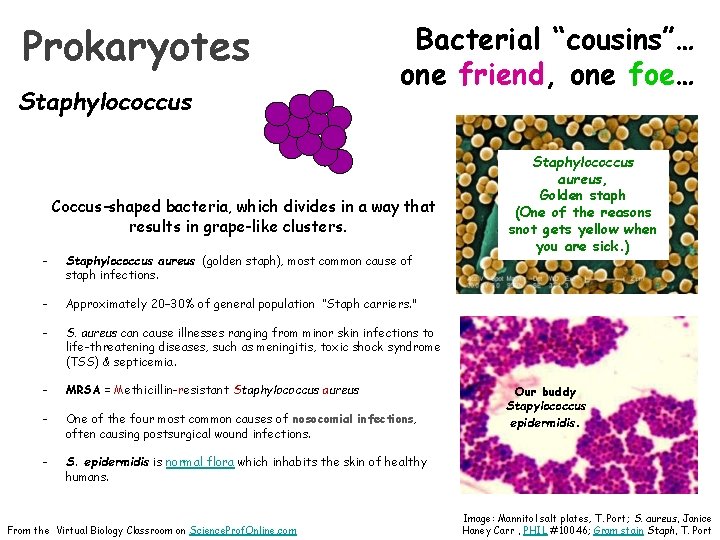
Prokaryotes Staphylococcus Bacterial “cousins”… one friend, one foe… Coccus-shaped bacteria, which divides in a way that results in grape-like clusters. - Staphylococcus aureus (golden staph), most common cause of staph infections. - Approximately 20– 30% of general population “Staph carriers. " - S. aureus can cause illnesses ranging from minor skin infections to life-threatening diseases, such as meningitis, toxic shock syndrome (TSS) & septicemia. - MRSA = Methicillin-resistant Staphylococcus aureus - One of the four most common causes of nosocomial infections, often causing postsurgical wound infections. - S. epidermidis is normal flora which inhabits the skin of healthy humans. From the Virtual Biology Classroom on Science. Prof. Online. com Staphylococcus aureus, Golden staph (One of the reasons snot gets yellow when you are sick. ) Our buddy Stapylococcus epidermidis. Image: Mannitol salt plates, T. Port; S. aureus, Janice Haney Carr , PHIL #10046; Gram stain Staph, T. Port
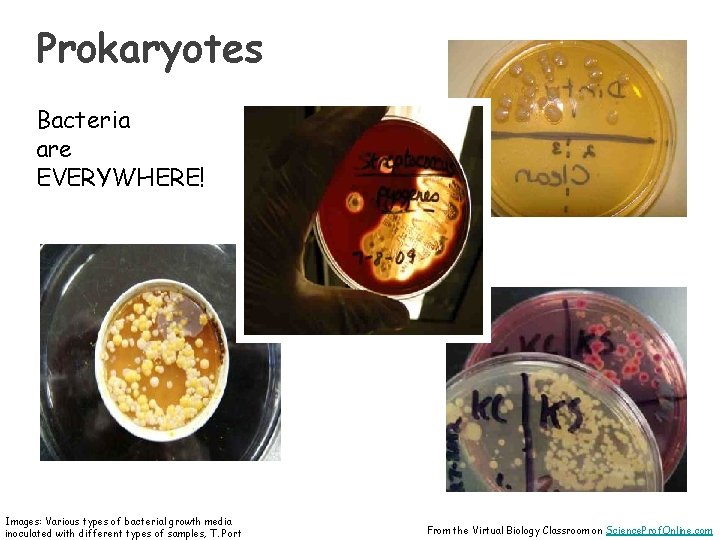
Prokaryotes Bacteria are EVERYWHERE! Images: Various types of bacterial growth media inoculated with different types of samples, T. Port From the Virtual Biology Classroom on Science. Prof. Online. com
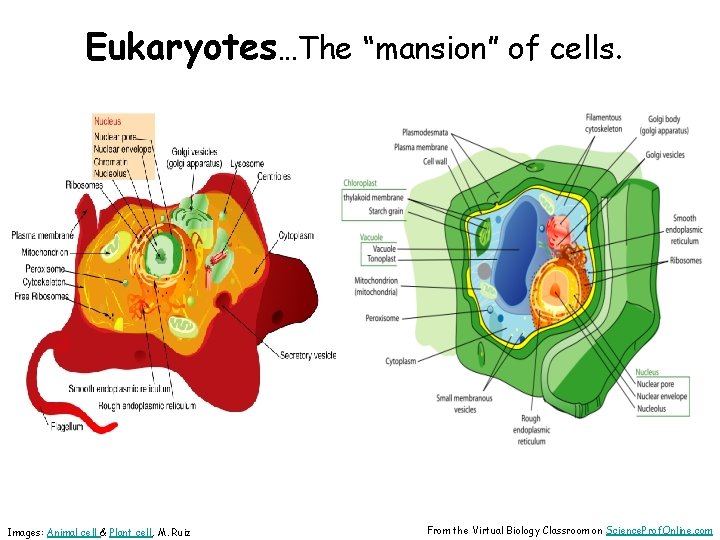
Eukaryotes…The “mansion” of cells. Images: Animal cell & Plant cell, M. Ruiz From the Virtual Biology Classroom on Science. Prof. Online. com
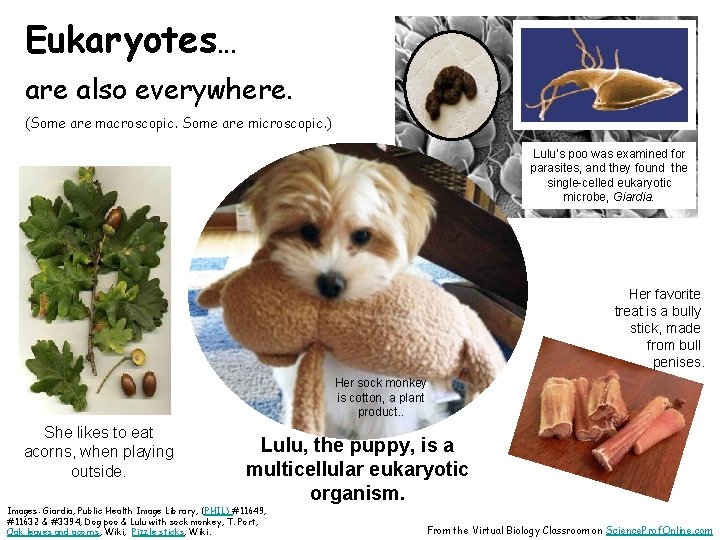
Eukaryotes… are also everywhere. (Some are macroscopic. Some are microscopic. ) Lulu’s poo was examined for parasites, and they found the single-celled eukaryotic microbe, Giardia. Her favorite treat is a bully stick, made from bull penises. Her sock monkey is cotton, a plant product. . She likes to eat acorns, when playing outside. Lulu, the puppy, is a multicellular eukaryotic organism. Images: Giardia, Public Health Image Library, (PHIL) #11649; #11632 & #3394; Dog poo & Lulu with sock monkey, T. Port; Oak leaves and acorns, Wiki, Pizzle sticks, Wiki. From the Virtual Biology Classroom on Science. Prof. Online. com
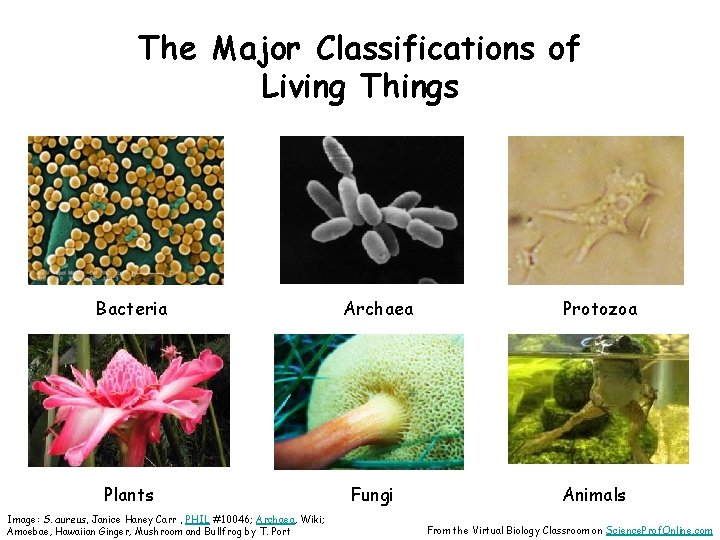
The Major Classifications of Living Things Bacteria Plants Image: S. aureus, Janice Haney Carr , PHIL #10046; Archaea, Wiki; Amoebae, Hawaiian Ginger, Mushroom and Bullfrog by T. Port Archaea Fungi Protozoa Animals From the Virtual Biology Classroom on Science. Prof. Online. com
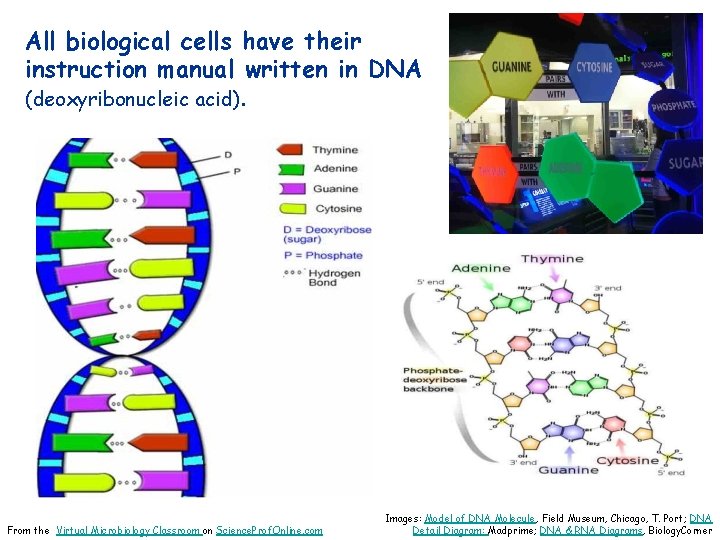
All biological cells have their instruction manual written in DNA (deoxyribonucleic acid). From the Virtual Microbiology Classroom on Science. Prof. Online. com Images: Model of DNA Molecule, Field Museum, Chicago, T. Port; DNA Detail Diagram: Madprime; DNA & RNA Diagrams, Biology. Corner
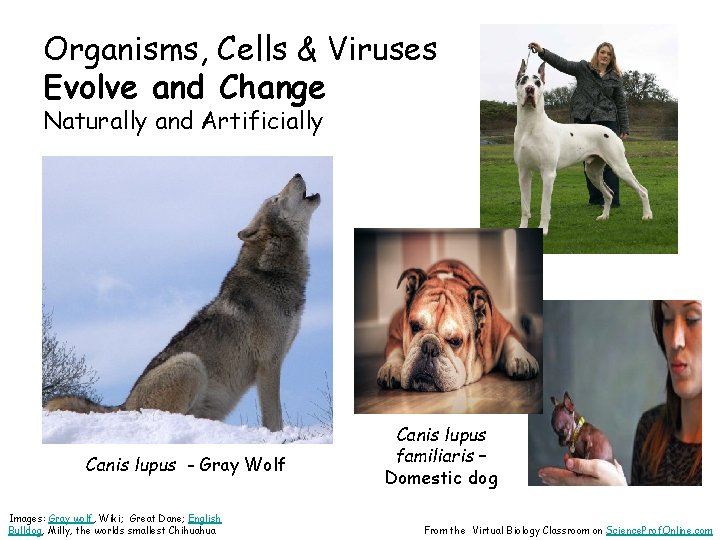
Organisms, Cells & Viruses Evolve and Change Naturally and Artificially Canis lupus - Gray Wolf Images: Gray wolf, Wiki; Great Dane; English Bulldog, Milly, the worlds smallest Chihuahua Canis lupus familiaris – Domestic dog From the Virtual Biology Classroom on Science. Prof. Online. com
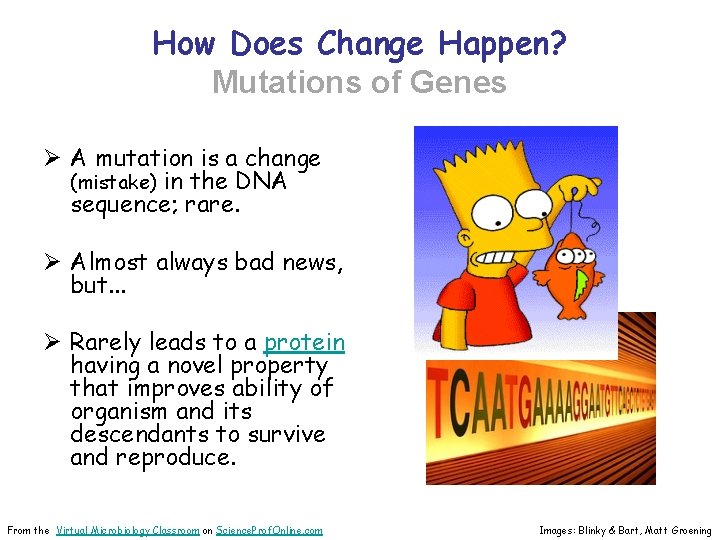
How Does Change Happen? Mutations of Genes Ø A mutation is a change (mistake) in the DNA sequence; rare. Ø Almost always bad news, but. . . Ø Rarely leads to a protein having a novel property that improves ability of organism and its descendants to survive and reproduce. From the Virtual Microbiology Classroom on Science. Prof. Online. com Images: Blinky & Bart, Matt Groening
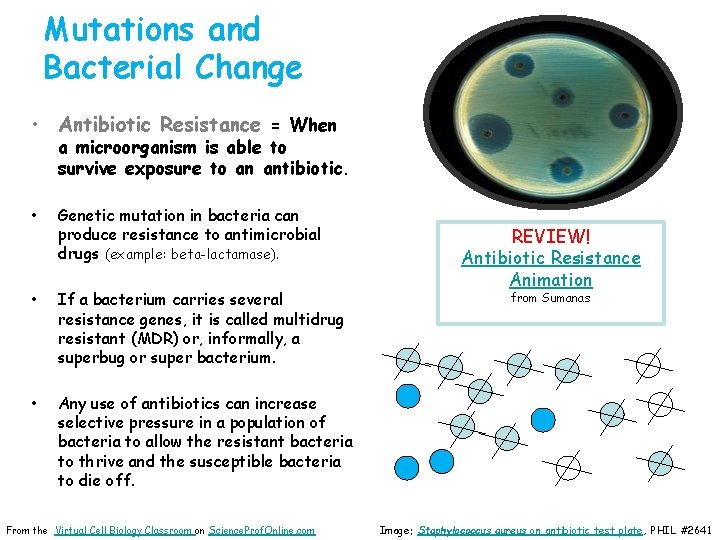
Mutations and Bacterial Change • Antibiotic Resistance = When a microorganism is able to survive exposure to an antibiotic. • Genetic mutation in bacteria can produce resistance to antimicrobial drugs (example: beta-lactamase). • If a bacterium carries several resistance genes, it is called multidrug resistant (MDR) or, informally, a superbug or super bacterium. • Any use of antibiotics can increase selective pressure in a population of bacteria to allow the resistant bacteria to thrive and the susceptible bacteria to die off. From the Virtual Cell Biology Classroom on Science. Prof. Online. com REVIEW! Antibiotic Resistance Animation from Sumanas Image: Staphylococcus aureus on antibiotic test plate, PHIL #2641
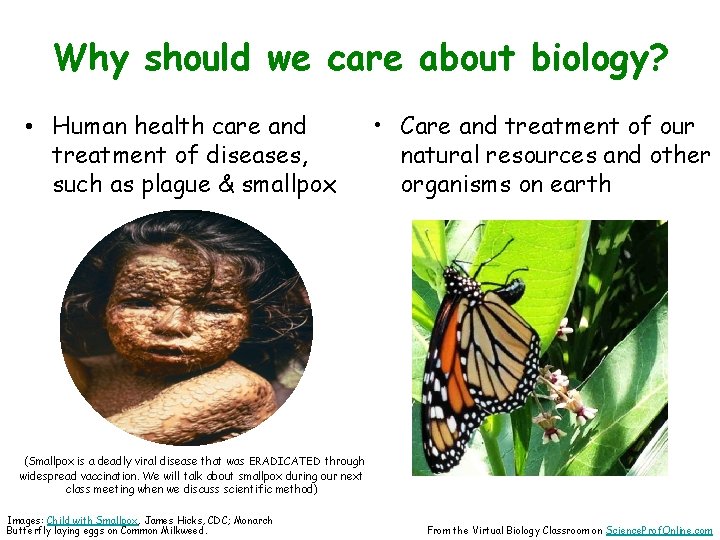
Why should we care about biology? • Human health care and treatment of diseases, such as plague & smallpox • Care and treatment of our natural resources and other organisms on earth (Smallpox is a deadly viral disease that was ERADICATED through widespread vaccination. We will talk about smallpox during our next class meeting when we discuss scientific method) Images: Child with Smallpox, James Hicks, CDC; Monarch Butterfly laying eggs on Common Milkweed. From the Virtual Biology Classroom on Science. Prof. Online. com
Some Areas of Biological Study • • • Botany: Study of plants Zoology: Study of animals Anatomy: Structures of organisms Physiology: Functions within organisms Ecology: Study of how organism in an ecosystem interact with each other and their environment. • Microbiology: Study of organisms too small to see with the naked eye From the Virtual Biology Classroom on Science. Prof. Online. com
Confused? Here are some links to fun resources that can help introduce you to biology: • “Science Is Real” • Science Prof Online: • Discovery Education: Free science resources for students. • Cells Alive! • “Put It To The Test” • The Biology Project: • “She Blinded Me With Science” music video by They Might Be Giants. Free science education resource with virtual classrooms, biology Power. Point lectures, laboratory exercises, practice test and review questions, science photos, videos and more. activities. Website with many helpful biology animations and music video by They Might Be Giants. Has tutorials and problem sets for learning biochemistry, cell, developmental, molecular, and human biology, Mendelian genetics and immunology. Dolby. music video Thomas (You must be in PPT slideshow view to click on links. ) From the Virtual Biology Classroom on Science. Prof. Online. com
- Slides: 25