
About Science Prof Online Power Point Resources Science
About Science Prof Online Power. Point Resources • Science Prof Online (SPO) is a free science education website that provides fully-developed Virtual Science Classrooms, science-related Power. Points, articles and images. The site is designed to be a helpful resource for students, educators, and anyone interested in learning about science. • The SPO Virtual Classrooms offer many educational resources, including practice test questions, review questions, lecture Power. Points, video tutorials, sample assignments and course syllabi. New materials are continually being developed, so check back frequently, or follow us on Facebook (Science Prof Online) or Twitter (Science. Prof. SPO) for updates. • Many SPO Power. Points are available in a variety of formats, such as fully editable Power. Point files, as well as uneditable versions in smaller file sizes, such as Power. Point Shows and Portable Document Format (. pdf), for ease of printing. • Images used on this resource, and on the SPO website are, wherever possible, credited and linked to their source. Any words underlined and appearing in blue are links that can be clicked on for more information. Power. Points must be viewed in slide show mode to use the hyperlinks directly. • Several helpful links to fun and interactive learning tools are included throughout the PPT and on the Smart Links slide, near the end of each presentation. You must be in slide show mode to utilize hyperlinks and animations. • This digital resource is licensed under Creative Commons Attribution-Share. Alike 3. 0: http: //creativecommons. org/licenses/by-sa/3. 0/ Alicia Cepaitis, MS Chief Creative Nerd Science Prof Online Education Resources, LLC alicia@scienceprofonline. com From the Virtual Microbiology Classroom on Science. Prof. Online. com Tami Port, MS Creator of Science Prof Online Chief Executive Nerd Science Prof Online Education Resources, LLC info@scienceprofonline. com Image: Compound microscope objectives, T. Port
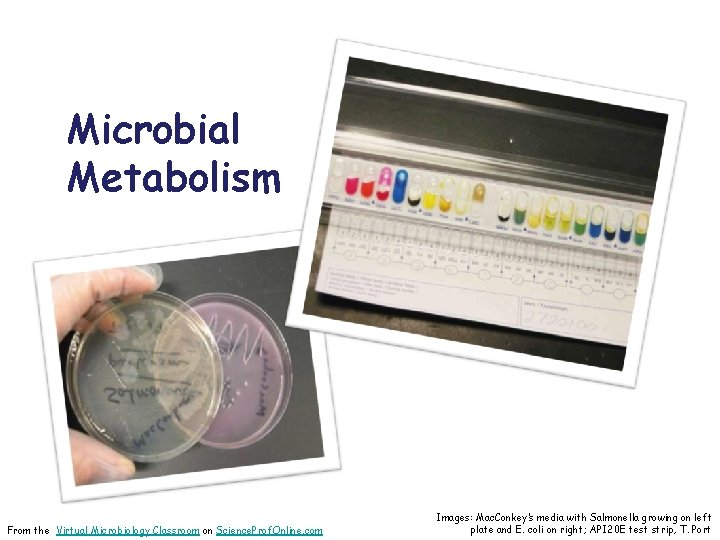
Microbial Metabolism From the Virtual Microbiology Classroom on Science. Prof. Online. com Images: Mac. Conkey’s media with Salmonella growing on left plate and E. coli on right; API 20 E test strip, T. Port
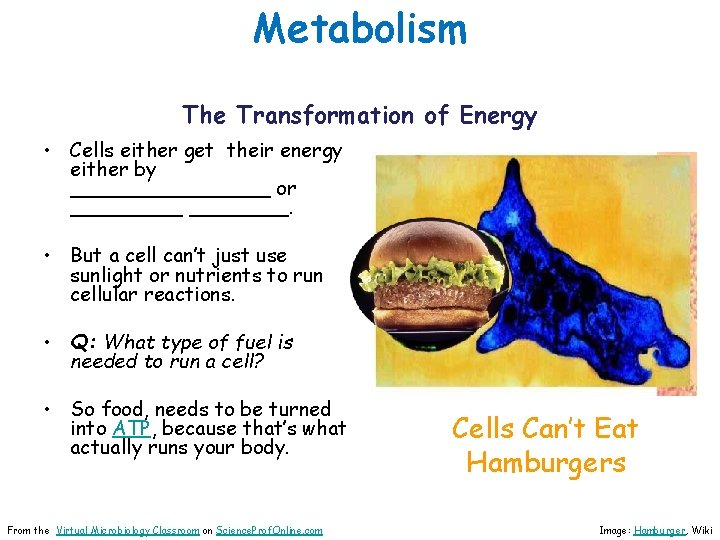
Metabolism The Transformation of Energy • Cells either get their energy either by ________ or _____. • But a cell can’t just use sunlight or nutrients to run cellular reactions. • Q: What type of fuel is needed to run a cell? • So food, needs to be turned into ATP, because that’s what actually runs your body. From the Virtual Microbiology Classroom on Science. Prof. Online. com Cells Can’t Eat Hamburgers Image: Hamburger, Wiki
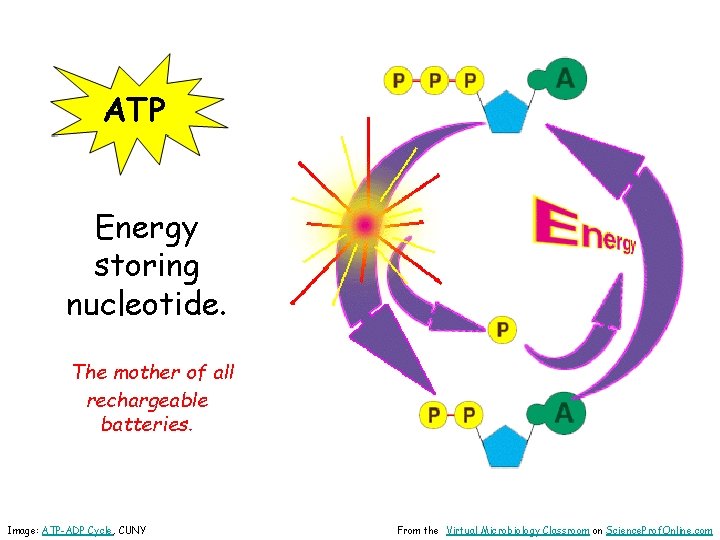
ATP Energy storing nucleotide. The mother of all rechargeable batteries. Image: ATP-ADP Cycle, CUNY From the Virtual Microbiology Classroom on Science. Prof. Online. com
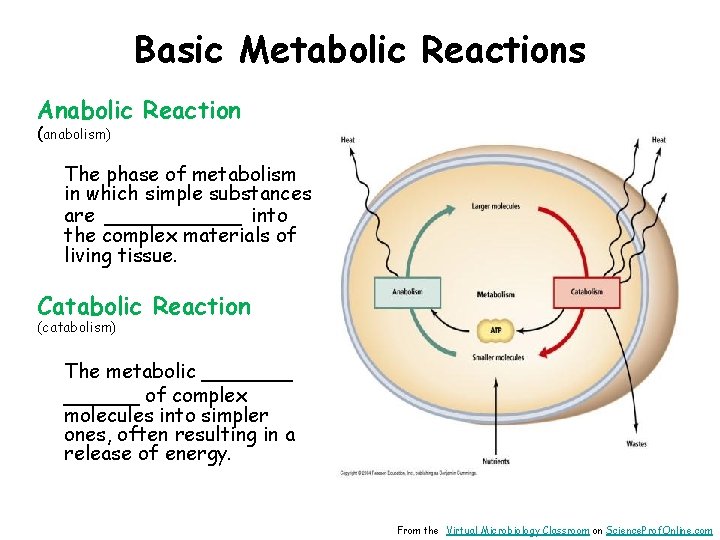
Basic Metabolic Reactions Anabolic Reaction (anabolism) The phase of metabolism in which simple substances are _____ into the complex materials of living tissue. Catabolic Reaction (catabolism) The metabolic ______ of complex molecules into simpler ones, often resulting in a release of energy. From the Virtual Microbiology Classroom on Science. Prof. Online. com
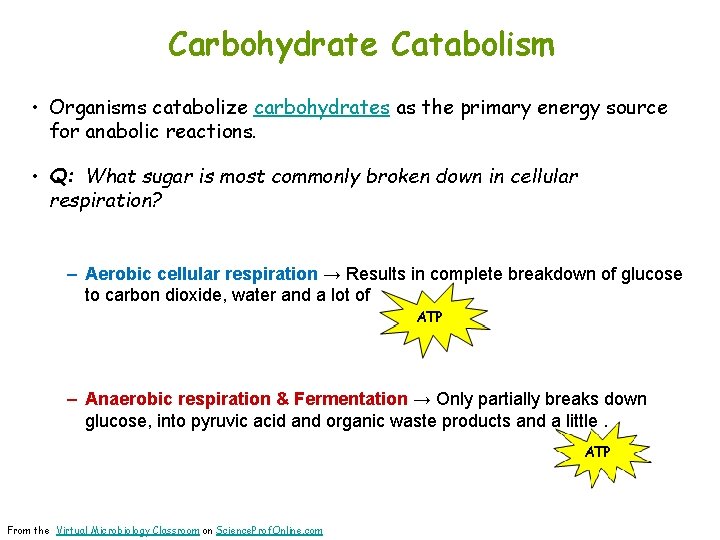
Carbohydrate Catabolism • Organisms catabolize carbohydrates as the primary energy source for anabolic reactions. • Q: What sugar is most commonly broken down in cellular respiration? – Aerobic cellular respiration → Results in complete breakdown of glucose to carbon dioxide, water and a lot of ATP – Anaerobic respiration & Fermentation → Only partially breaks down glucose, into pyruvic acid and organic waste products and a little. ATP From the Virtual Microbiology Classroom on Science. Prof. Online. com
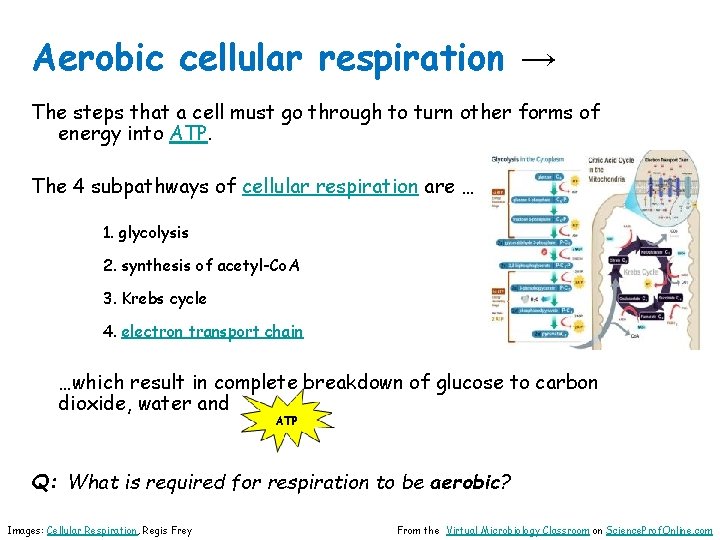
Aerobic cellular respiration → The steps that a cell must go through to turn other forms of energy into ATP. The 4 subpathways of cellular respiration are … 1. glycolysis 2. synthesis of acetyl-Co. A 3. Krebs cycle 4. electron transport chain …which result in complete breakdown of glucose to carbon dioxide, water and ATP Q: What is required for respiration to be aerobic? Images: Cellular Respiration, Regis Frey From the Virtual Microbiology Classroom on Science. Prof. Online. com
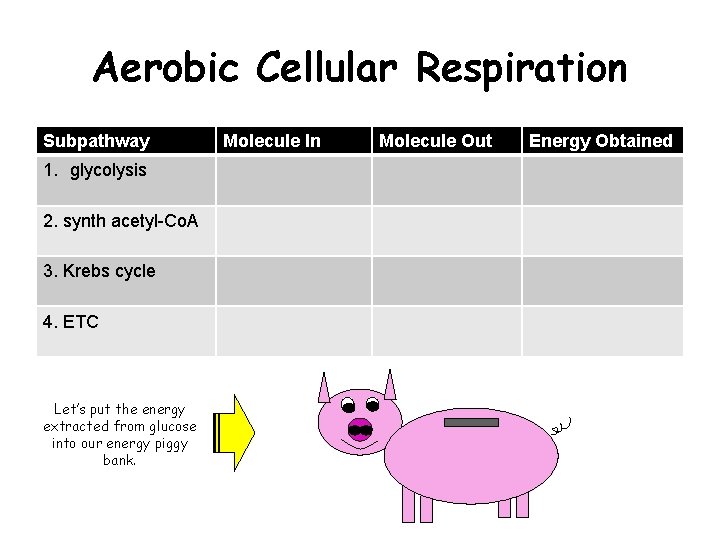
Aerobic Cellular Respiration Subpathway 1. glycolysis 2. synth acetyl-Co. A 3. Krebs cycle 4. ETC Let’s put the energy extracted from glucose into our energy piggy bank. Molecule In Molecule Out Energy Obtained
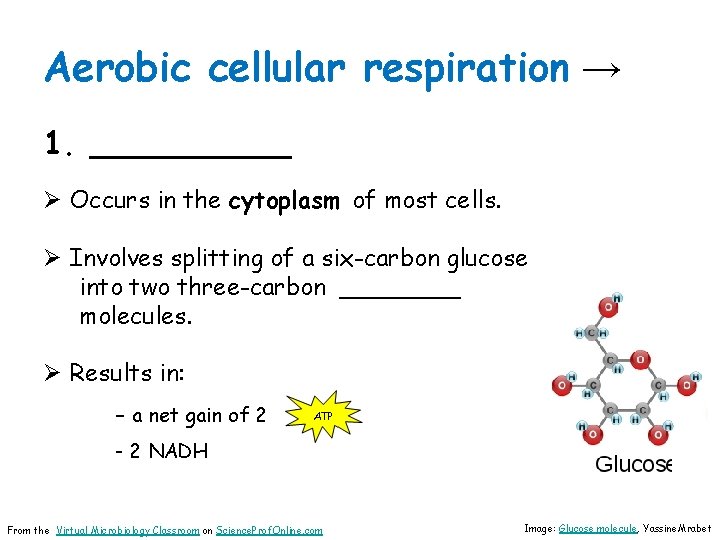
Aerobic cellular respiration → 1. _____ Ø Occurs in the cytoplasm of most cells. Ø Involves splitting of a six-carbon glucose into two three-carbon ____ molecules. Ø Results in: - a net gain of 2 ATP - 2 NADH From the Virtual Microbiology Classroom on Science. Prof. Online. com Image: Glucose molecule, Yassine. Mrabet
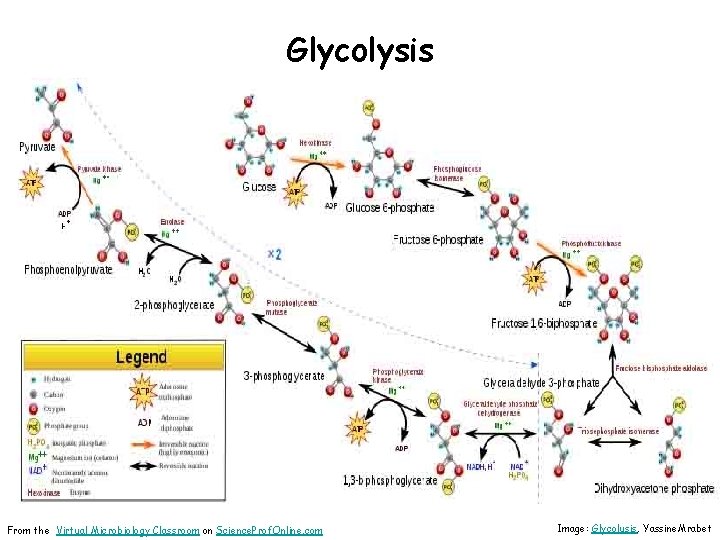
Glycolysis From the Virtual Microbiology Classroom on Science. Prof. Online. com Image: Glycolusis, Yassine. Mrabet
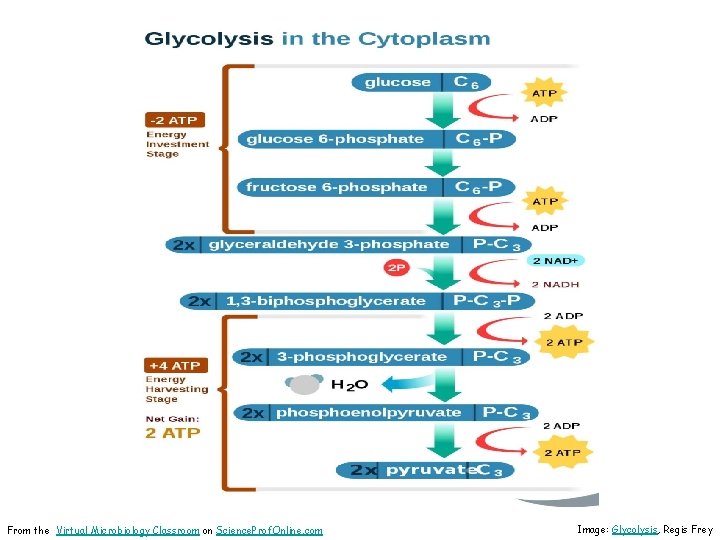
From the Virtual Microbiology Classroom on Science. Prof. Online. com Image: Glycolysis, Regis Frey
Q: What is NADH? • Cells use special molecules to carry electrons atoms). (often in H • This is potential energy, another way to transport energy. • Two important __________ – Nicotinamide adenine dinucleotide (NAD+) → add electrons & hydrogen → NADH – Flavine adenine dinucleotide (FAD) → add electrons and hydrogen → FADH 2 • Think of these energy carriers as rechargeable batteries. (When they have the electrons and hydrogens they are charged up, when they don’t, they need charging. ) From the Virtual Microbiology Classroom on Science. Prof. Online. com
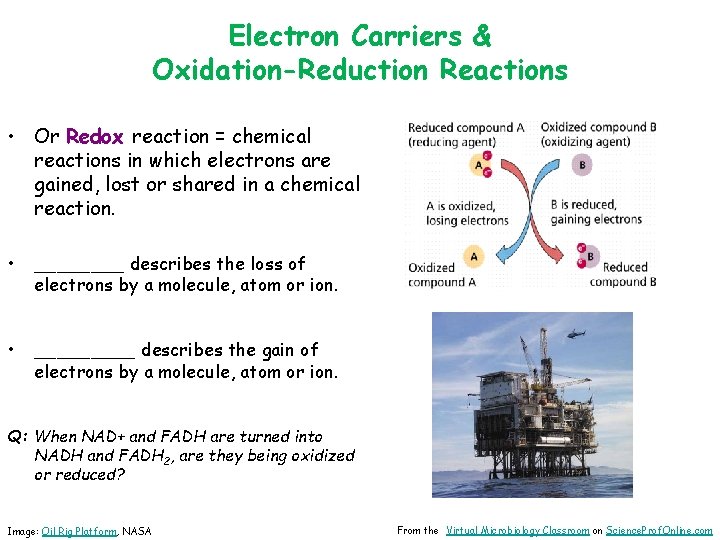
Electron Carriers & Oxidation-Reduction Reactions • Or Redox reaction = chemical reactions in which electrons are gained, lost or shared in a chemical reaction. • ____ describes the loss of electrons by a molecule, atom or ion. • _____ describes the gain of electrons by a molecule, atom or ion. Q: When NAD+ and FADH are turned into NADH and FADH 2, are they being oxidized or reduced? Image: Oil Rig Platform, NASA From the Virtual Microbiology Classroom on Science. Prof. Online. com
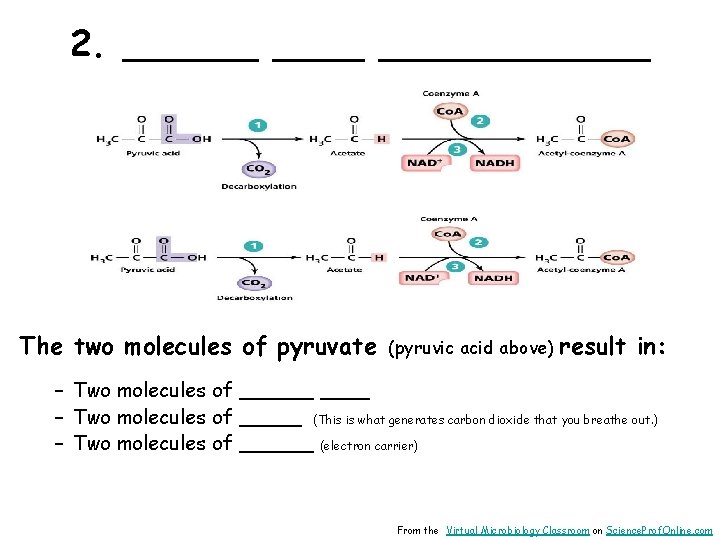
2. ______ The two molecules of pyruvate (pyruvic acid above) result in: – Two molecules of ______ – Two molecules of _____ (This is what generates carbon dioxide that you breathe out. ) – Two molecules of ______ (electron carrier) From the Virtual Microbiology Classroom on Science. Prof. Online. com
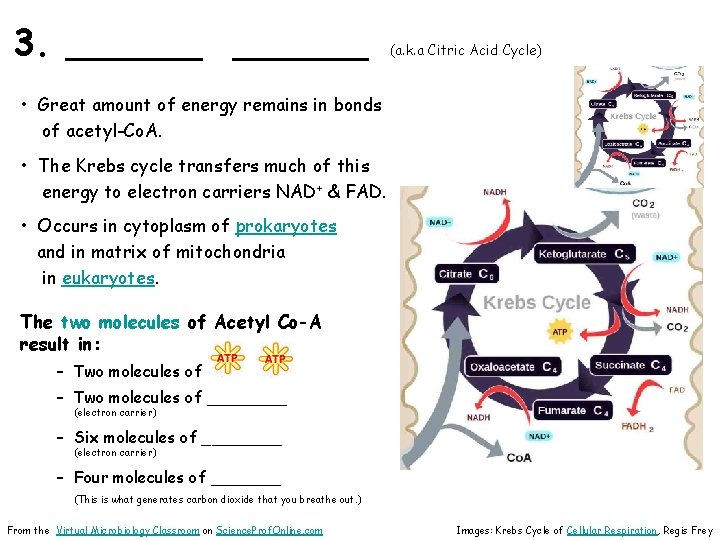
3. ______ (a. k. a Citric Acid Cycle) • Great amount of energy remains in bonds of acetyl-Co. A. • The Krebs cycle transfers much of this energy to electron carriers NAD+ & FAD. • Occurs in cytoplasm of prokaryotes and in matrix of mitochondria in eukaryotes. The two molecules of Acetyl Co-A result in: – Two molecules of ____ (electron carrier) – Six molecules of ____ (electron carrier) – Four molecules of _______ (This is what generates carbon dioxide that you breathe out. ) From the Virtual Microbiology Classroom on Science. Prof. Online. com Images: Krebs Cycle of Cellular Respiration, Regis Frey
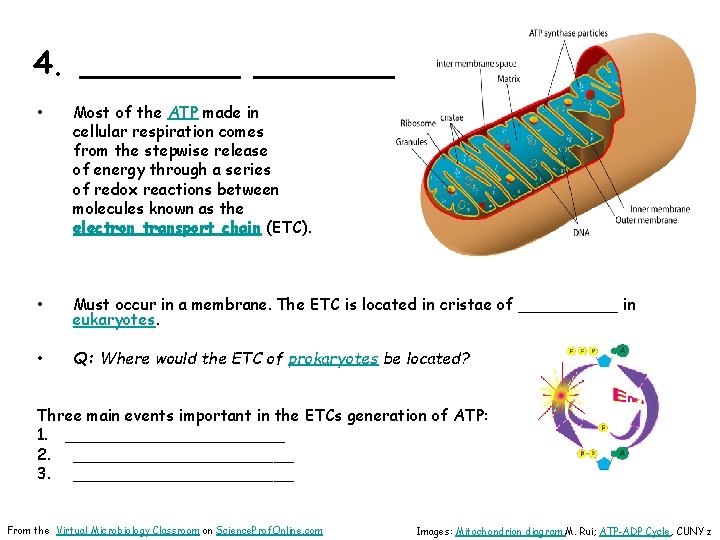
4. _______ • Most of the ATP made in cellular respiration comes from the stepwise release of energy through a series of redox reactions between molecules known as the electron transport chain (ETC). • Must occur in a membrane. The ETC is located in cristae of _____ in eukaryotes. • Q: Where would the ETC of prokaryotes be located? Three main events important in the ETCs generation of ATP: 1. ___________ 2. ___________ 3. ___________ From the Virtual Microbiology Classroom on Science. Prof. Online. com Images: Mitochondrion diagram M. Rui; ATP-ADP Cycle, CUNY z
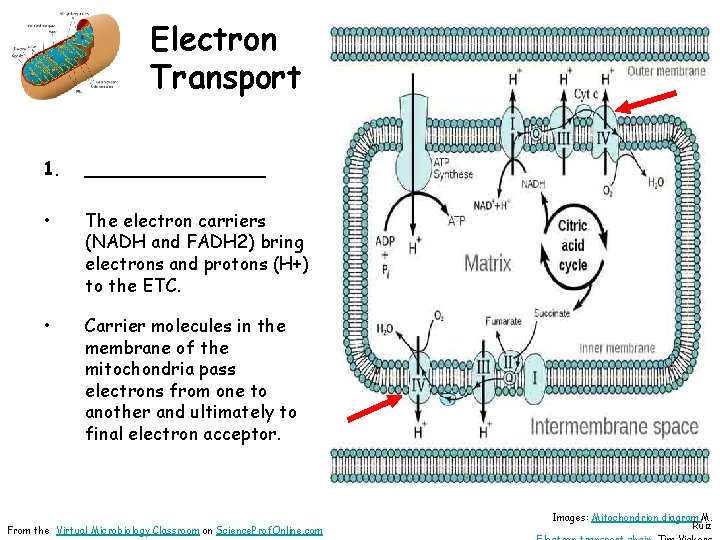
Electron Transport 1. ________ • The electron carriers (NADH and FADH 2) bring electrons and protons (H+) to the ETC. • Carrier molecules in the membrane of the mitochondria pass electrons from one to another and ultimately to final electron acceptor. From the Virtual Microbiology Classroom on Science. Prof. Online. com Images: Mitochondrion diagram M. Ruiz
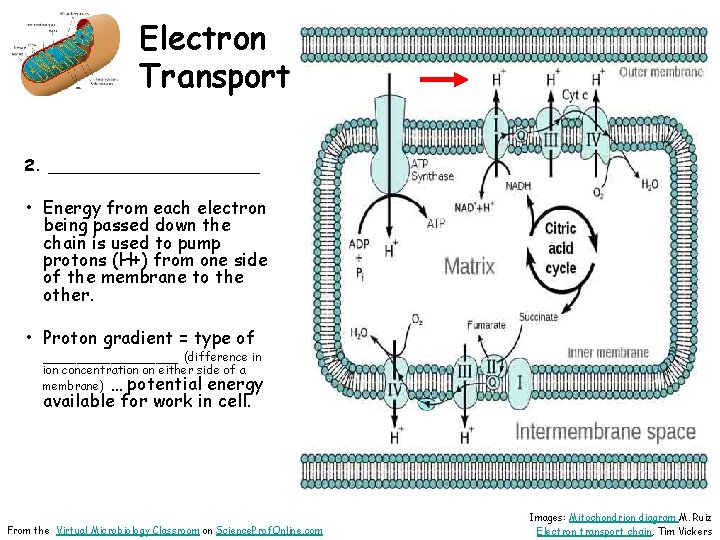
Electron Transport 2. ___________ • Energy from each electron being passed down the chain is used to pump protons (H+) from one side of the membrane to the other. • Proton gradient = type of ______ (difference in ion concentration on either side of a membrane) … potential energy available for work in cell. From the Virtual Microbiology Classroom on Science. Prof. Online. com Images: Mitochondrion diagram M. Ruiz Electron transport chain, Tim Vickers
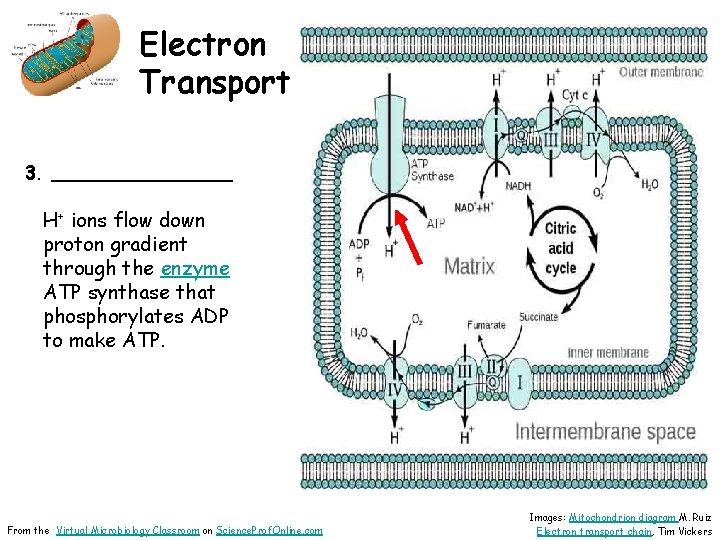
Electron Transport 3. ________ H+ ions flow down proton gradient through the enzyme ATP synthase that phosphorylates ADP to make ATP. From the Virtual Microbiology Classroom on Science. Prof. Online. com Images: Mitochondrion diagram M. Ruiz Electron transport chain, Tim Vickers
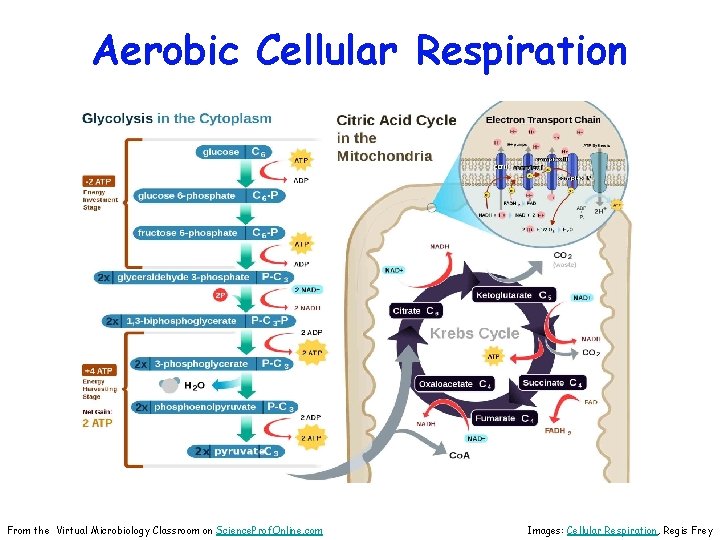
Aerobic Cellular Respiration From the Virtual Microbiology Classroom on Science. Prof. Online. com Images: Cellular Respiration, Regis Frey
Aerobic cellular respiration → Utilizes glycolysis, synthesis of acetyl-Co. A, Krebs cycle, and electron transport chain; results in complete breakdown of _____ to carbon dioxide, water & ATP The ultimate objective is to make cellular work. ATP molecules to do Each NADH results in 3 ATP, Each FADH 2 results in 2 ATP. A total of 38 molecules of ATP are formed from one molecule of glucose. Lets figure out how we got 38 ATP by the end of aerobic respiration. From the Virtual Microbiology Classroom on Science. Prof. Online. com
Using oxygen (1/2 O 2) in metabolism creates toxic waste. Microbes that are able to use aerobic respiration produce enzymes to detoxify oxygen: Catalase: H 2 O 2 ------- H 20 and 02 Superoxide dismutase (SOD): oxygen radical ----- H 20 and O 2 Microbes that don’t make these enzymes cannot exist in the presence of oxygen. Q: How do cells get energy if there is no if they can’t use O 2? From the Virtual Microbiology Classroom on Science. Prof. Online. com O 2 available to them, or
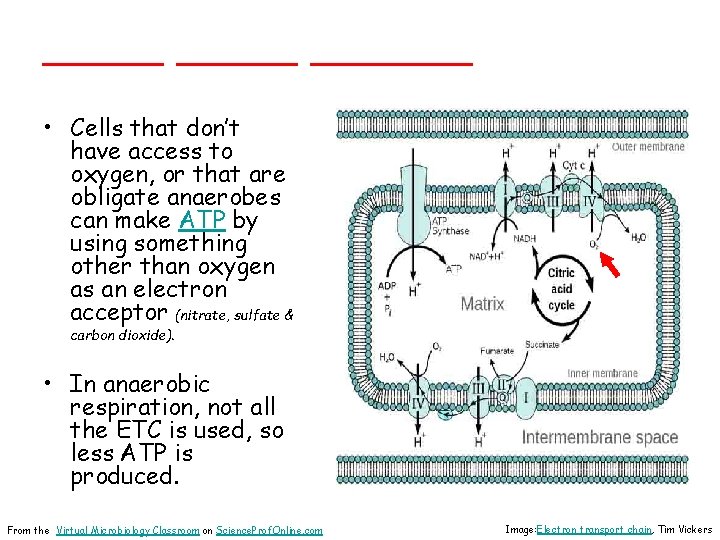
______ • Cells that don’t have access to oxygen, or that are obligate anaerobes can make ATP by using something other than oxygen as an electron acceptor (nitrate, sulfate & carbon dioxide). • In anaerobic respiration, not all the ETC is used, so less ATP is produced. From the Virtual Microbiology Classroom on Science. Prof. Online. com Image: Electron transport chain, Tim Vickers
_______ • When there is no final __________ for the ETC, the electron transport can’t happen. • Fermentation is an alternative system that allows glycolysis to continue without the other steps of respiration. • Not as energetically efficient as respiration. • Produces only 2 ATP From the Virtual Microbiology Classroom on Science. Prof. Online. com ATP
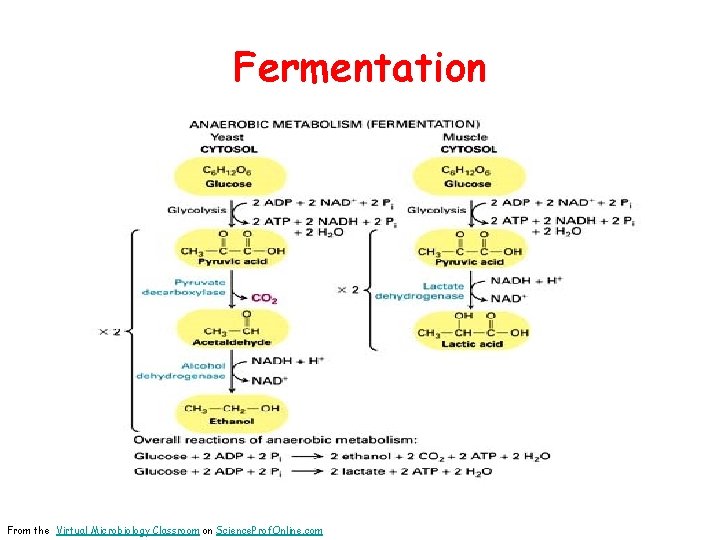
Fermentation From the Virtual Microbiology Classroom on Science. Prof. Online. com
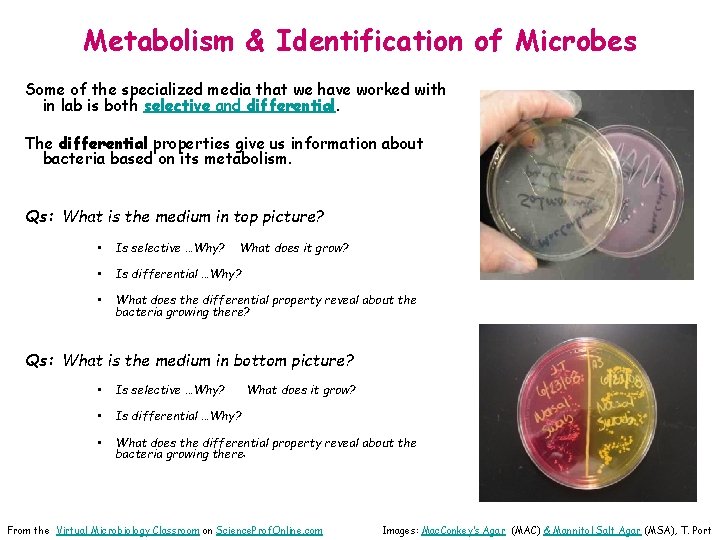
Metabolism & Identification of Microbes Some of the specialized media that we have worked with in lab is both selective and differential. The differential properties give us information about bacteria based on its metabolism. Qs: What is the medium in top picture? • Is selective …Why? • Is differential …Why? • What does the differential property reveal about the bacteria growing there? What does it grow? Qs: What is the medium in bottom picture? • Is selective …Why? • Is differential …Why? • What does the differential property reveal about the bacteria growing there What does it grow? ? From the Virtual Microbiology Classroom on Science. Prof. Online. com Images: Mac. Conkey’s Agar (MAC) & Mannitol Salt Agar (MSA), T. Port
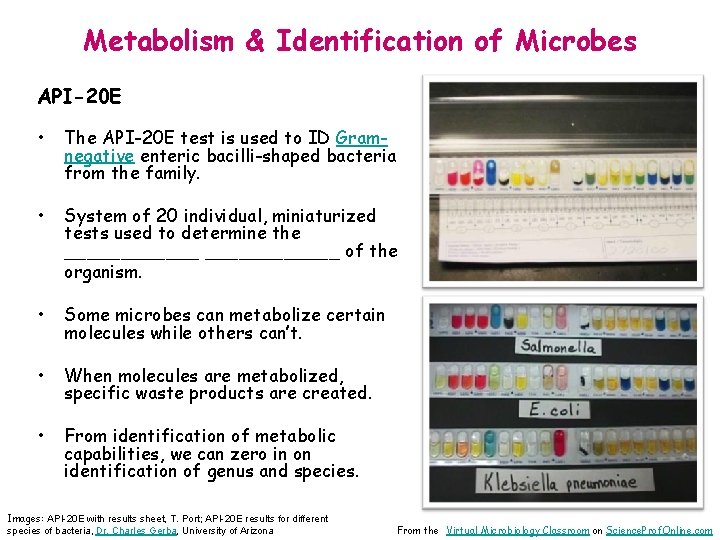
Metabolism & Identification of Microbes API-20 E • The API-20 E test is used to ID Gramnegative enteric bacilli-shaped bacteria from the family. • System of 20 individual, miniaturized tests used to determine the ____________ of the organism. • Some microbes can metabolize certain molecules while others can’t. • When molecules are metabolized, specific waste products are created. • From identification of metabolic capabilities, we can zero in on identification of genus and species. Images: API-20 E with results sheet, T. Port; API-20 E results for different species of bacteria, Dr. Charles Gerba, University of Arizona From the Virtual Microbiology Classroom on Science. Prof. Online. com
Confused? Here are links to fun resources that further explain cellular respiration: • • • • Microbial Metabolism Main Page on the Virtual Cell Biology Classroom of Science Prof Online. Cellular Respiration animation by Jay Phelan, “What is Life? A Guide to Biology”, W. H. Freeman & Co. Anaerobic Respiration Page by Timothy Paustain, University of Wisconsin, Madison. Alcohol and Lactate Fermentation by Central Michigan University. “The Body Machine” music video by School House Rock. How NAD+ Works animation and quiz from Mc. Graw-Hill. Glycolysis animation and quiz from Mc. Graw-Hill. Krebs Cycle Animation & Quiz 1 from Mc. Graw-Hill. Krebs Cycle Animation & Quiz 2 from Mc. Graw-Hill. Electron Transport Chain animation from Molecular & Cellular Biology Learning Center. Electron Transport Chain click through animation by Graham Kent Bio 231 Cell Biology Laboratory. Electron Transport System & Formation of ATP (Quiz 1) by Mc. Graw-Hill Electron Transport System & ATP Synthesis (Quiz 2) by Mc. Graw-Hill Food Molecules video from How. Stuff. Works, a Discovery company. “The Energy” song by Audiovent. (You must be in PPT slideshow view to click on links. ) From the Virtual Microbiology Classroom on Science. Prof. Online. com
Homework Assignment See the Science. Prof. Online Virtual Microbiology Classroom Microbial Metabolism lecture for a printable Word. doc of this assignment. Ø At the end of some lectures, I will give you some type of homework to evaluate your understanding of that day’s material. Ø This homework will always be openbook. Ø Today you will be given an activity on the topic of Microbial Metabolism & Selective Media. Ø If assigned, this homework is due at the start of class, next time we meet for lecture. Images: Osmosis animation From the Virtual Microbiology Classroom on Science. Prof. Online. com

Are microbes intimidating you? Do yourself a favor. Use the… Virtual Microbiology Classroom (VMC) ! The VMC is full of resources to help you succeed, including: • • • practice test questions review questions study guides and learning objectives You can access the VMC by going to the Science Prof Online website www. scienceprofonline. com Images: , Staphylococcus, Giant Microbes; Prokaryotic cell, Mariana Ruiz
- Slides: 30