
About Science Prof Online Power Point Resources Science
About Science Prof Online Power. Point Resources • Science Prof Online (SPO) is a free science education website that provides fully-developed Virtual Science Classrooms, science-related Power. Points, articles and images. The site is designed to be a helpful resource for students, educators, and anyone interested in learning about science. • The SPO Virtual Classrooms offer many educational resources, including practice test questions, review questions, lecture Power. Points, video tutorials, sample assignments and course syllabi. New materials are continually being developed, so check back frequently, or follow us on Facebook (Science Prof Online) or Twitter (Science. Prof. SPO) for updates. • Many SPO Power. Points are available in a variety of formats, such as fully editable Power. Point files, as well as uneditable versions in smaller file sizes, such as Power. Point Shows and Portable Document Format (. pdf), for ease of printing. • Images used on this resource, and on the SPO website are, wherever possible, credited and linked to their source. Any words underlined and appearing in blue are links that can be clicked on for more information. Power. Points must be viewed in slide show mode to use the hyperlinks directly. • Several helpful links to fun and interactive learning tools are included throughout the PPT and on the Smart Links slide, near the end of each presentation. You must be in slide show mode to utilize hyperlinks and animations. • This digital resource is licensed under Creative Commons Attribution-Share. Alike 3. 0: http: //creativecommons. org/licenses/by-sa/3. 0/ Alicia Cepaitis, MS Chief Creative Nerd Science Prof Online Education Resources, LLC alicia@scienceprofonline. com From the Virtual Biology Classroom on Science. Prof. Online. com Tami Port, MS Creator of Science Prof Online Chief Executive Nerd Science Prof Online Education Resources, LLC info@scienceprofonline. com Image: Compound microscope objectives, T. Port
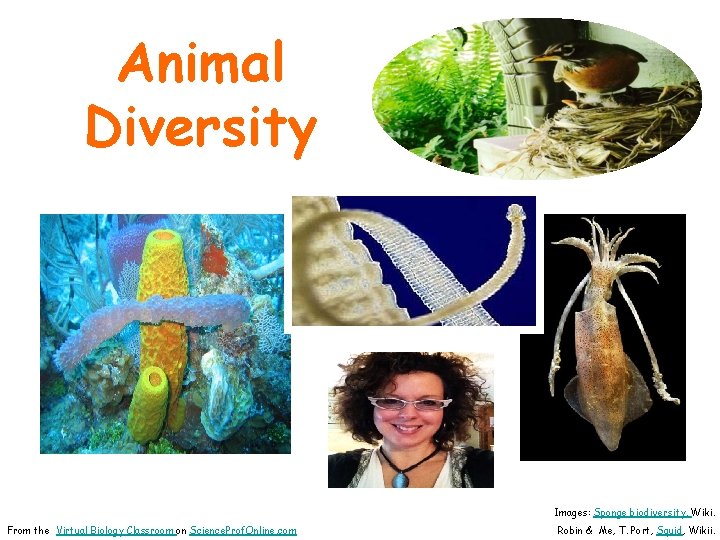
Animal Diversity Images: Sponge biodiversity, Wiki. From the Virtual Biology Classroom on Science. Prof. Online. com Robin & Me, T. Port, Squid, Wikii.
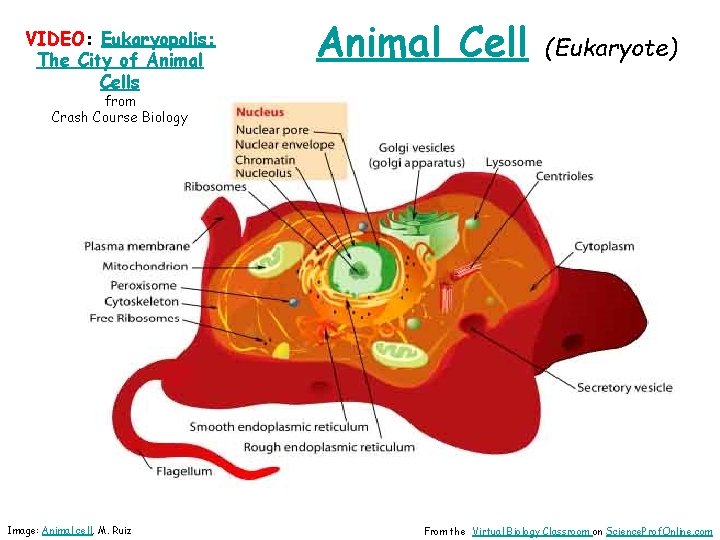
VIDEO: Eukaryopolis: The City of Animal Cells Animal Cell (Eukaryote) from Crash Course Biology Image: Animal cell, M. Ruiz From the Virtual Biology Classroom on Science. Prof. Online. com

Classifying Living Things The hierarchy of biological classification has eight major taxonomic ranks which encompass all known life. How about a trick to help us remember Word to your Mat’! Image: Biological classification diagram, Peter Halasz From Science. Prof. Online. com, free science education website.
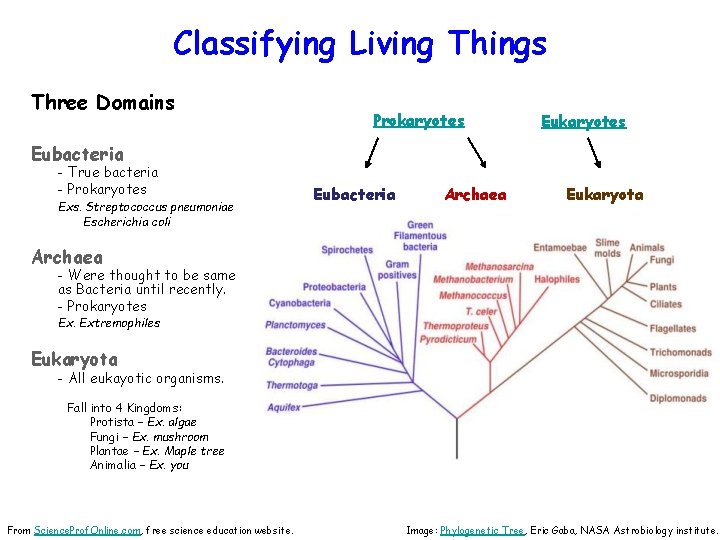
Classifying Living Things Three Domains Prokaryotes Eubacteria - True bacteria - Prokaryotes Exs. Streptococcus pneumoniae Escherichia coli Eubacteria Archaea Eukaryota Archaea - Were thought to be same as Bacteria until recently. - Prokaryotes Ex. Extremophiles Eukaryota - All eukayotic organisms. Fall into 4 Kingdoms: Protista – Ex. algae Fungi – Ex. mushroom Plantae – Ex. Maple tree Animalia – Ex. you From Science. Prof. Online. com, free science education website. Image: Phylogenetic Tree, Eric Gaba, NASA Astrobiology institute.
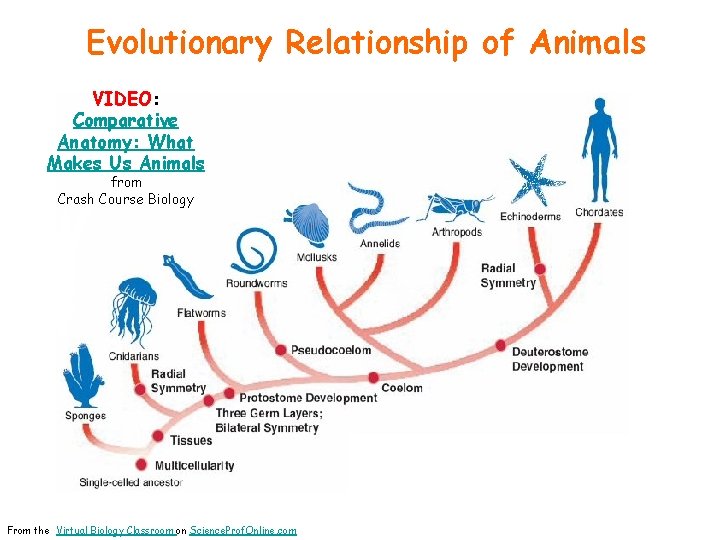
Evolutionary Relationship of Animals VIDEO: Comparative Anatomy: What Makes Us Animals from Crash Course Biology From the Virtual Biology Classroom on Science. Prof. Online. com
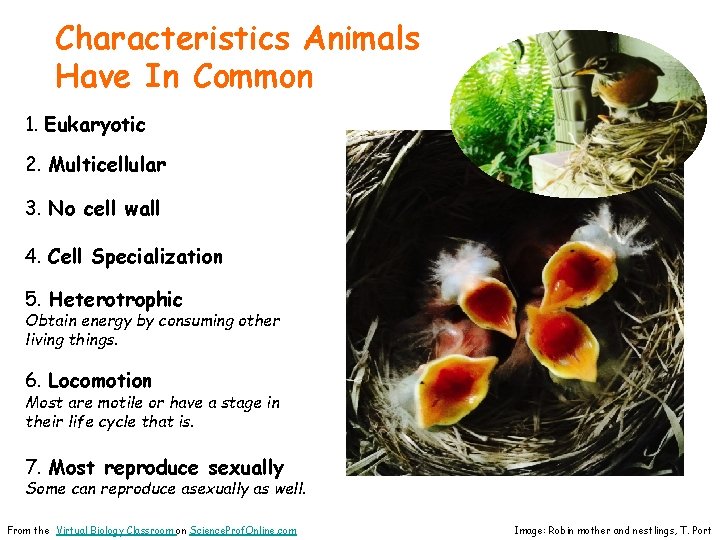
Characteristics Animals Have In Common 1. Eukaryotic 2. Multicellular 3. No cell wall 4. Cell Specialization 5. Heterotrophic Obtain energy by consuming other living things. 6. Locomotion Most are motile or have a stage in their life cycle that is. 7. Most reproduce sexually Some can reproduce asexually as well. From the Virtual Biology Classroom on Science. Prof. Online. com Image: Robin mother and nestlings, T. Port
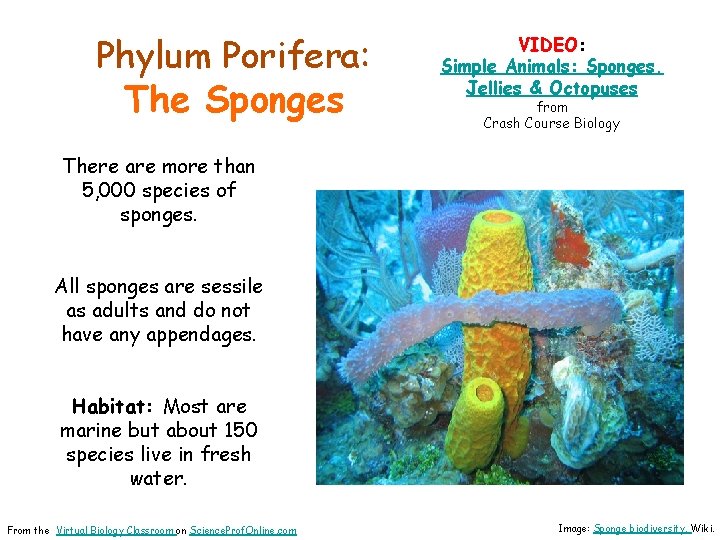
Phylum Porifera: The Sponges VIDEO: Simple Animals: Sponges, Jellies & Octopuses from Crash Course Biology There are more than 5, 000 species of sponges. All sponges are sessile as adults and do not have any appendages. Habitat: Most are marine but about 150 species live in fresh water. From the Virtual Biology Classroom on Science. Prof. Online. com Image: Sponge biodiversity, Wiki.
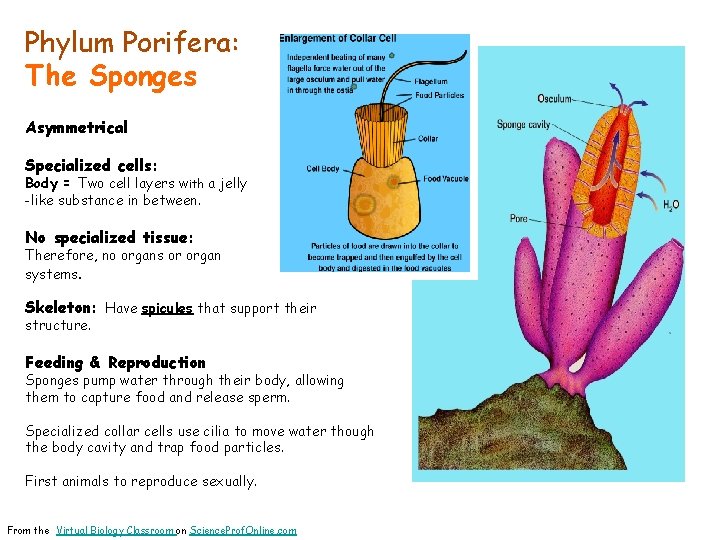
Phylum Porifera: The Sponges Asymmetrical Specialized cells: Body = Two cell layers with a jelly -like substance in between. No specialized tissue: Therefore, no organs or organ systems. Skeleton: Have spicules that support their structure. Feeding & Reproduction Sponges pump water through their body, allowing them to capture food and release sperm. Specialized collar cells use cilia to move water though the body cavity and trap food particles. First animals to reproduce sexually. From the Virtual Biology Classroom on Science. Prof. Online. com
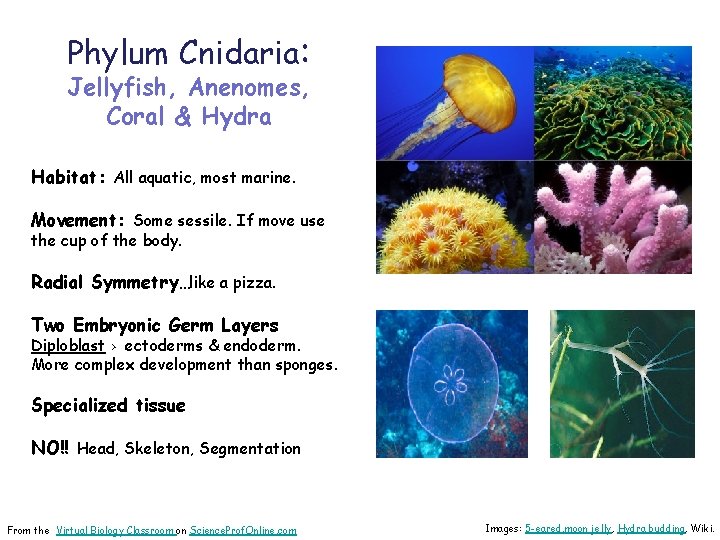
Phylum Cnidaria: Jellyfish, Anenomes, Coral & Hydra Habitat: All aquatic, most marine. Movement: Some sessile. If move use the cup of the body. Radial Symmetry…like a pizza. Two Embryonic Germ Layers Diploblast > ectoderms & endoderm. More complex development than sponges. Specialized tissue NO!! Head, Skeleton, Segmentation From the Virtual Biology Classroom on Science. Prof. Online. com Images: 5 -eared, moon jelly, Hydra budding, Wiki.
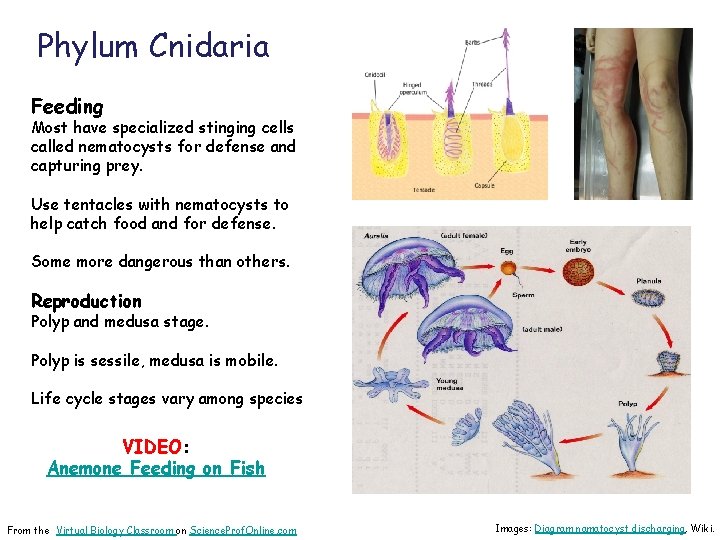
Phylum Cnidaria Feeding Most have specialized stinging cells called nematocysts for defense and capturing prey. Use tentacles with nematocysts to help catch food and for defense. Some more dangerous than others. Reproduction Polyp and medusa stage. Polyp is sessile, medusa is mobile. Life cycle stages vary among species VIDEO: Anemone Feeding on Fish From the Virtual Biology Classroom on Science. Prof. Online. com Images: Diagram namatocyst discharging, Wiki.
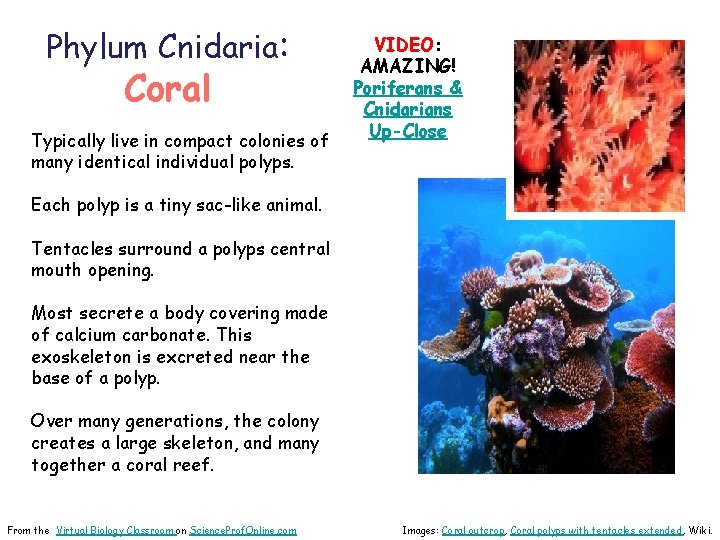
Phylum Cnidaria: Coral Typically live in compact colonies of many identical individual polyps. VIDEO: AMAZING! Poriferans & Cnidarians Up-Close Each polyp is a tiny sac-like animal. Tentacles surround a polyps central mouth opening. Most secrete a body covering made of calcium carbonate. This exoskeleton is excreted near the base of a polyp. Over many generations, the colony creates a large skeleton, and many together a coral reef. From the Virtual Biology Classroom on Science. Prof. Online. com Images: Coral outcrop, Coral polyps with tentacles extended, Wiki.
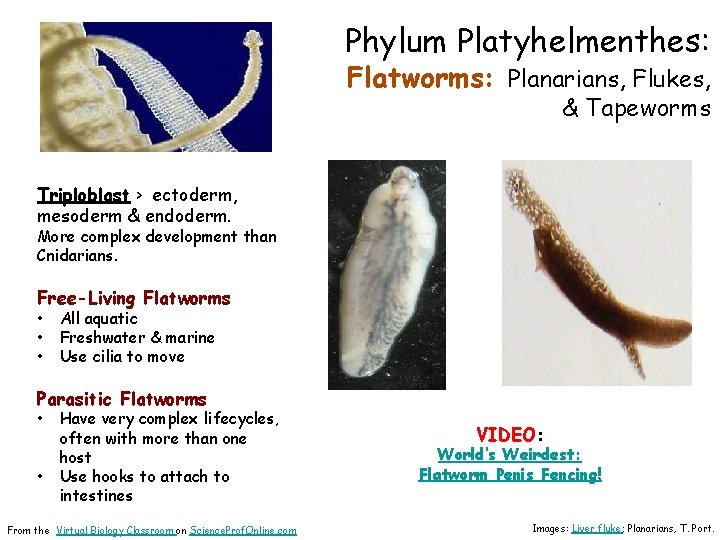
Phylum Platyhelmenthes: Flatworms: Planarians, Flukes, & Tapeworms Triploblast > ectoderm, mesoderm & endoderm. More complex development than Cnidarians. Free-Living Flatworms • • • All aquatic Freshwater & marine Use cilia to move Parasitic Flatworms • • Have very complex lifecycles, often with more than one host Use hooks to attach to intestines From the Virtual Biology Classroom on Science. Prof. Online. com VIDEO: World’s Weirdest: Flatworm Penis Fencing! Images: Liver fluke; Planarians, T. Port.
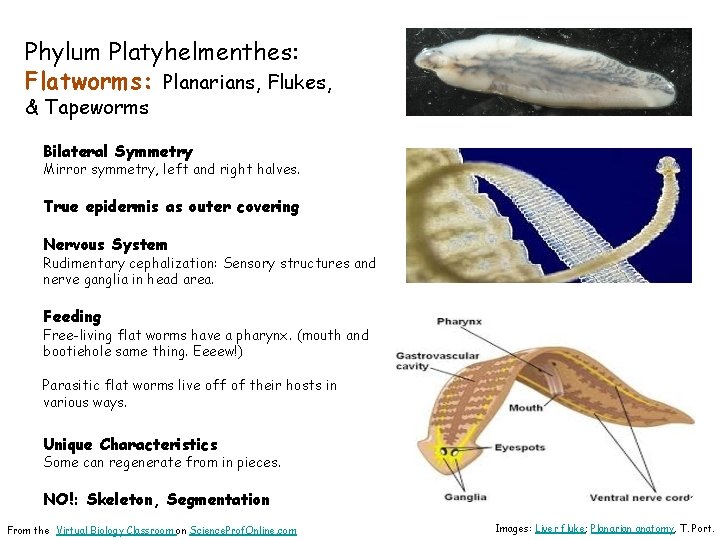
Phylum Platyhelmenthes: Flatworms: Planarians, Flukes, & Tapeworms Bilateral Symmetry Mirror symmetry, left and right halves. True epidermis as outer covering Nervous System Rudimentary cephalization: Sensory structures and nerve ganglia in head area. Feeding Free-living flat worms have a pharynx. (mouth and bootiehole same thing. Eeeew!) Parasitic flat worms live off of their hosts in various ways. Unique Characteristics Some can regenerate from in pieces. NO!: Skeleton, Segmentation From the Virtual Biology Classroom on Science. Prof. Online. com Images: Liver fluke; Planarian anatomy, T. Port.
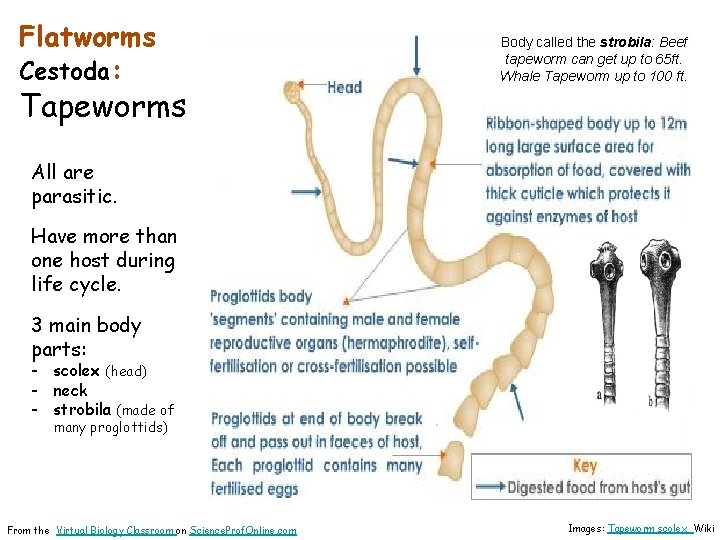
Flatworms Cestoda: Tapeworms Body called the strobila: Beef tapeworm can get up to 65 ft. Whale Tapeworm up to 100 ft. All are parasitic. Have more than one host during life cycle. 3 main body parts: - scolex (head) - neck - strobila (made of many proglottids) From the Virtual Biology Classroom on Science. Prof. Online. com Images: Tapeworm scolex Wiki
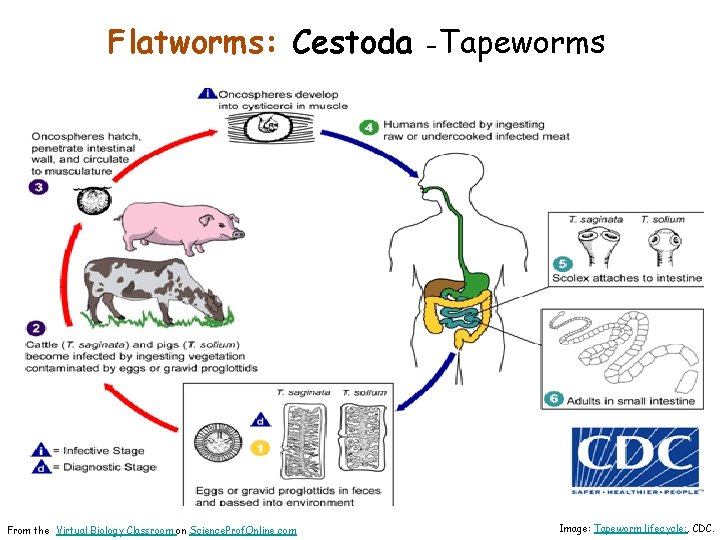
Flatworms: Cestoda -Tapeworms From the Virtual Biology Classroom on Science. Prof. Online. com Image: Tapeworm lifecycle; , CDC.
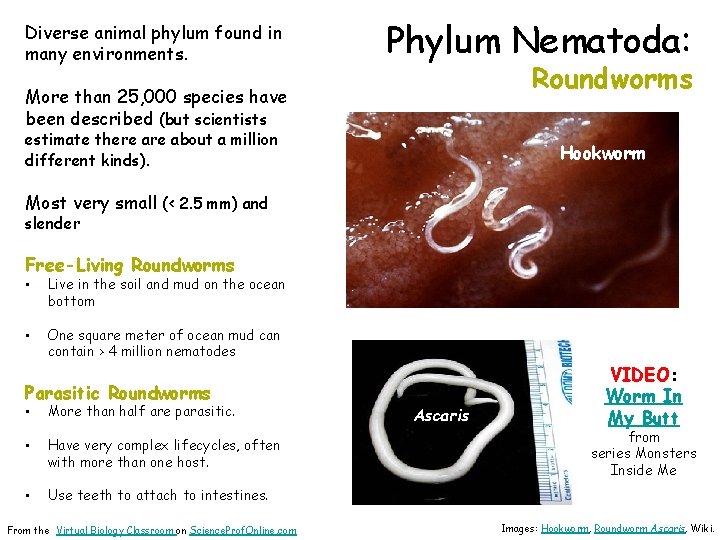
Diverse animal phylum found in many environments. Phylum Nematoda: Roundworms More than 25, 000 species have been described (but scientists estimate there about a million different kinds). Hookworm Most very small (< 2. 5 mm) and slender Free-Living Roundworms • Live in the soil and mud on the ocean bottom • One square meter of ocean mud can contain > 4 million nematodes Parasitic Roundworms • More than half are parasitic. • Have very complex lifecycles, often with more than one host. • Use teeth to attach to intestines. From the Virtual Biology Classroom on Science. Prof. Online. com Ascaris VIDEO: Worm In My Butt from series Monsters Inside Me Images: Hookworm, Roundworm Ascaris, Wiki.
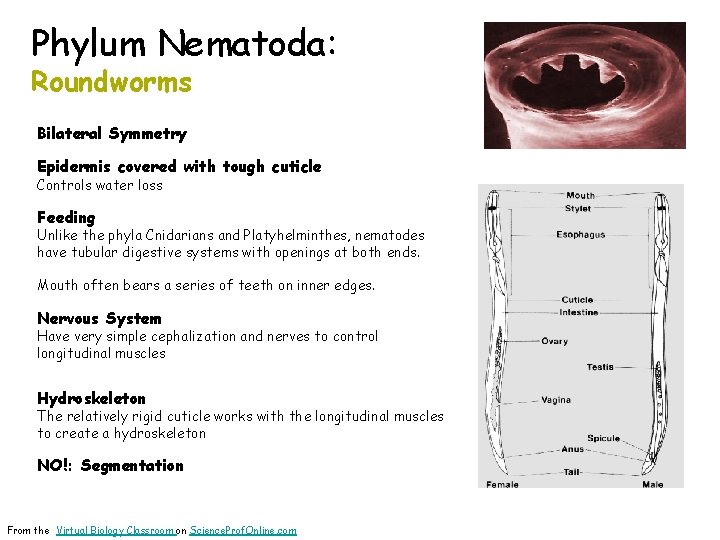
Phylum Nematoda: Roundworms Bilateral Symmetry Epidermis covered with tough cuticle Controls water loss Feeding Unlike the phyla Cnidarians and Platyhelminthes, nematodes have tubular digestive systems with openings at both ends. Mouth often bears a series of teeth on inner edges. Nervous System Have very simple cephalization and nerves to control longitudinal muscles Hydroskeleton The relatively rigid cuticle works with the longitudinal muscles to create a hydroskeleton NO!: Segmentation From the Virtual Biology Classroom on Science. Prof. Online. com
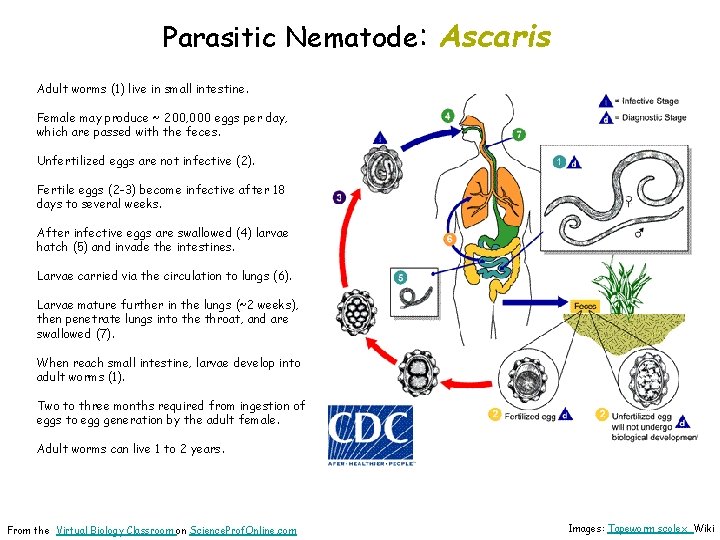
Parasitic Nematode: Ascaris Adult worms (1) live in small intestine. Female may produce ~ 200, 000 eggs per day, which are passed with the feces. Unfertilized eggs are not infective (2). Fertile eggs (2 -3) become infective after 18 days to several weeks. After infective eggs are swallowed (4) larvae hatch (5) and invade the intestines. Larvae carried via the circulation to lungs (6). Larvae mature further in the lungs (~2 weeks), then penetrate lungs into the throat, and are swallowed (7). When reach small intestine, larvae develop into adult worms (1). Two to three months required from ingestion of eggs to egg generation by the adult female. Adult worms can live 1 to 2 years. From the Virtual Biology Classroom on Science. Prof. Online. com Images: Tapeworm scolex Wiki
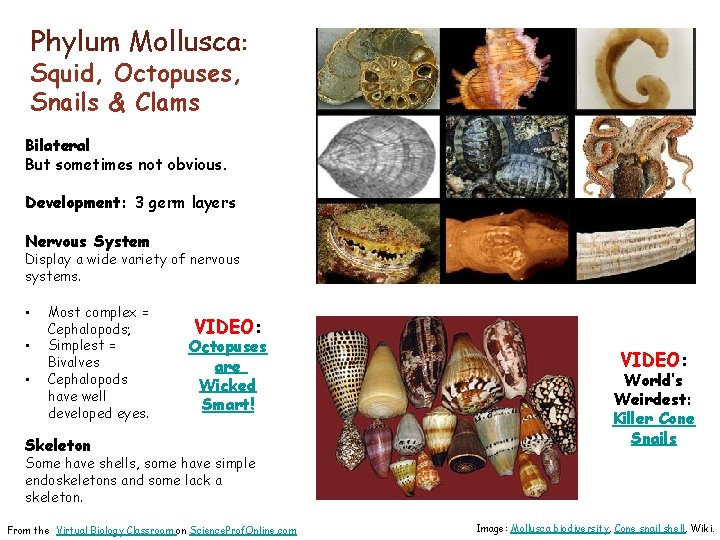
Phylum Mollusca: Squid, Octopuses, Snails & Clams Bilateral But sometimes not obvious. Development: 3 germ layers Nervous System Display a wide variety of nervous systems. • • • Most complex = Cephalopods; Simplest = Bivalves Cephalopods have well developed eyes. VIDEO: Octopuses are Wicked Smart! Skeleton VIDEO: World’s Weirdest: Killer Cone Snails Some have shells, some have simple endoskeletons and some lack a skeleton. From the Virtual Biology Classroom on Science. Prof. Online. com Image: Mollusca biodiversity, Cone snail shell, Wiki.
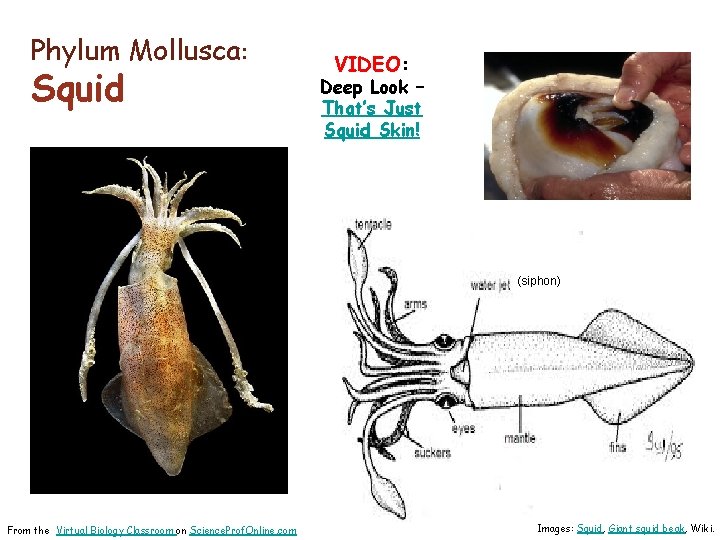
Phylum Mollusca: Squid VIDEO: Deep Look – That’s Just Squid Skin! (siphon) From the Virtual Biology Classroom on Science. Prof. Online. com Images: Squid, Giant squid beak, Wiki.
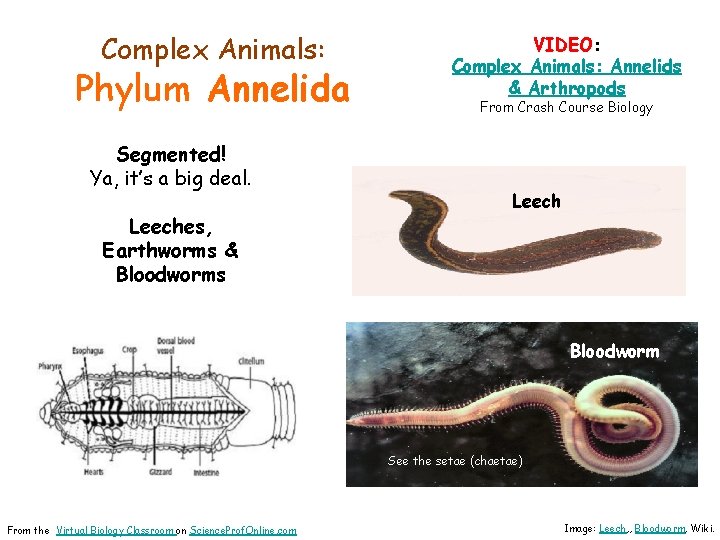
Complex Animals: Phylum Annelida Segmented! Ya, it’s a big deal. Leeches, Earthworms & Bloodworms VIDEO: Complex Animals: Annelids & Arthropods From Crash Course Biology Leech Bloodworm See the setae (chaetae) From the Virtual Biology Classroom on Science. Prof. Online. com Image: Leech, , Bloodworm, Wiki.
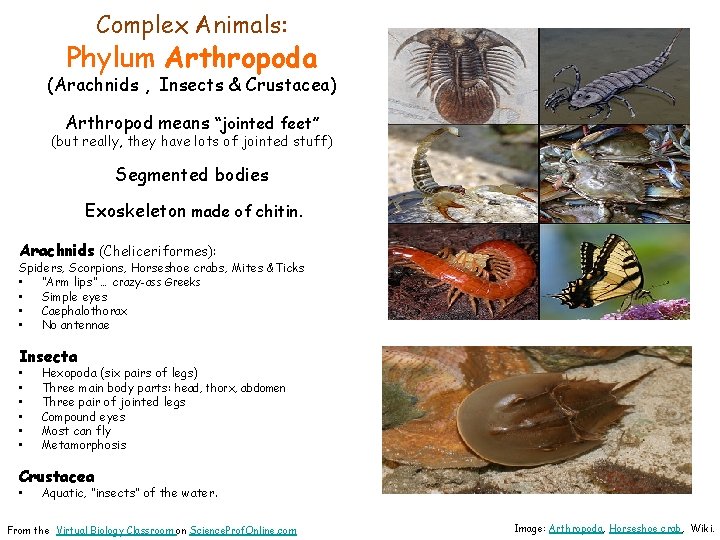
Complex Animals: Phylum Arthropoda (Arachnids , Insects & Crustacea) Arthropod means “jointed feet” (but really, they have lots of jointed stuff) Segmented bodies Exoskeleton made of chitin. Arachnids (Cheliceriformes): Spiders, Scorpions, Horseshoe crabs, Mites &Ticks • “Arm lips” … crazy-ass Greeks • Simple eyes • Caephalothorax • No antennae Insecta • • • Hexopoda (six pairs of legs) Three main body parts: head, thorx, abdomen Three pair of jointed legs Compound eyes Most can fly Metamorphosis Crustacea • Aquatic, “insects” of the water. From the Virtual Biology Classroom on Science. Prof. Online. com Image: Arthropoda, Horseshoe crab, Wiki.
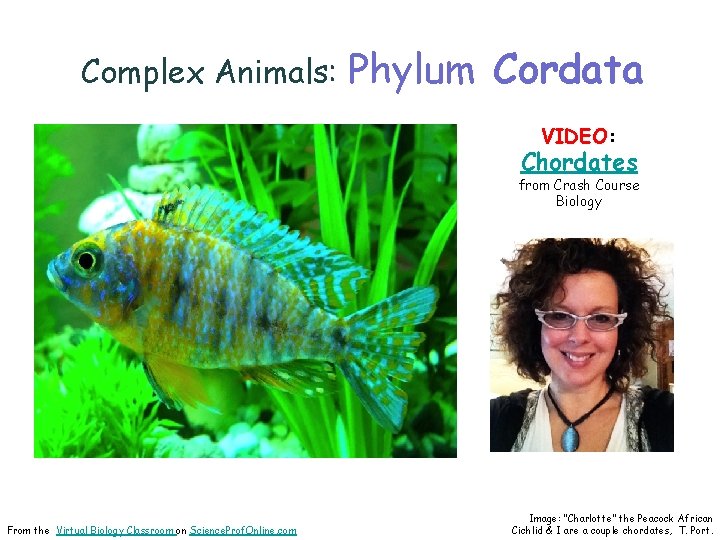
Complex Animals: Phylum Cordata VIDEO: Chordates from Crash Course Biology From the Virtual Biology Classroom on Science. Prof. Online. com Image: “Charlotte” the Peacock African Cichlid & I are a couple chordates, T. Port.
Confused? Here are some links to fun resources that further explain Cell Biology: • Eukaryotic Cells Main Page on the Virtual Cell Biology Classroom of • Eukaryopolis: The City of Animal Cells, video from Crash Course • Comparative Anatomy What Makes Us Animals, video from • Simple Animals: Sponges, Jellies & Octopuses, videofrom • • • Anemone Feeding on Fish video. Poriferans & Cnidarians Up-Close beautiful video. World’s Weirdest: Flatworm Penis Fencing! video. Worm In My Butt video from series Monsters Inside Me. Octopuses are Wicked Smart! video of octopus learning • • • Killer Cone Snails video from series World’s Weirdest. That’s Just Squid Skin! video from Deep Look. Complex Animals: Annelids & Arthropods video from Crash • Chordates video from Crash Course Biology. Science Prof Online. Biology. Crash Course Biology. experiment. Course Biology From the Virtual Biology Classroom on Science. Prof. Online. com
- Slides: 25