
About Science Prof Online Power Point Resources Science
About Science Prof Online Power. Point Resources • Science Prof Online (SPO) is a free science education website that provides fully-developed Virtual Science Classrooms, science-related Power. Points, articles and images. The site is designed to be a helpful resource for students, educators, and anyone interested in learning about science. • The SPO Virtual Classrooms offer many educational resources, including practice test questions, review questions, lecture Power. Points, video tutorials, sample assignments and course syllabi. New materials are continually being developed, so check back frequently, or follow us on Facebook (Science Prof Online) or Twitter (Science. Prof. SPO) for updates. • Many SPO Power. Points are available in a variety of formats, such as fully editable Power. Point files, as well as uneditable versions in smaller file sizes, such as Power. Point Shows and Portable Document Format (. pdf), for ease of printing. • Images used on this resource, and on the SPO website are, wherever possible, credited and linked to their source. Any words underlined and appearing in blue are links that can be clicked on for more information. Power. Points must be viewed in slide show mode to use the hyperlinks directly. • Several helpful links to fun and interactive learning tools are included throughout the PPT and on the Smart Links slide, near the end of each presentation. You must be in slide show mode to utilize hyperlinks and animations. • This digital resource is licensed under Creative Commons Attribution-Share. Alike 3. 0: http: //creativecommons. org/licenses/by-sa/3. 0/ Alicia Cepaitis, MS Chief Creative Nerd Science Prof Online Education Resources, LLC alicia@scienceprofonline. com From the Virtual Cell Biology Classroom on Science. Prof. Online. com Tami Port, MS Creator of Science Prof Online Chief Executive Nerd Science Prof Online Education Resources, LLC info@scienceprofonline. com Image: Compound microscope objectives, T. Port
Scientific Method For additional resources on this lecture topic, see the Scientific Method Main Page on SPO. Image: Compound microscope objectives, T. Port
What is science ? Science is a tool for answering questions. What Is Science? from Patuxent Wildlife Research Center, US Gov
What is Science? or Here a few statements to test your current understanding of science! (You are thinking … Wow! This instructor is HARSH! A test the first time we meet. ) What Is Science? from Patuxent Wildlife Research Center, US Gov

Science can prove anything, solve any problem or answer any question. True or False? False • Science actually attempts to disprove ideas (hypotheses). • Science is limited strictly to solving problems about the physical and natural world. • Explanations based on supernatural forces, values or ethics can never be disproved and thus do not fall under the realm of science. What Is Science? from Patuxent Wildlife Research Center, US Gov

Any study done carefully and based on observation is scientific. False • • Science must follow certain rules. • • The rules of science make the scientific process as objective as is possible. Objective = Not influenced by feelings, interests and prejudices; UNBIASED vs. Subjective = Influenced by feelings, interests and prejudices; BIASED What Is Science? from Patuxent Wildlife Research Center, US Gov
Science can be done poorly. What Is Science? from Patuxent Wildlife Research Center, US Gov

Different scientists may get different solutions to the same problem. What Is Science? from Patuxent Wildlife Research Center, US Gov
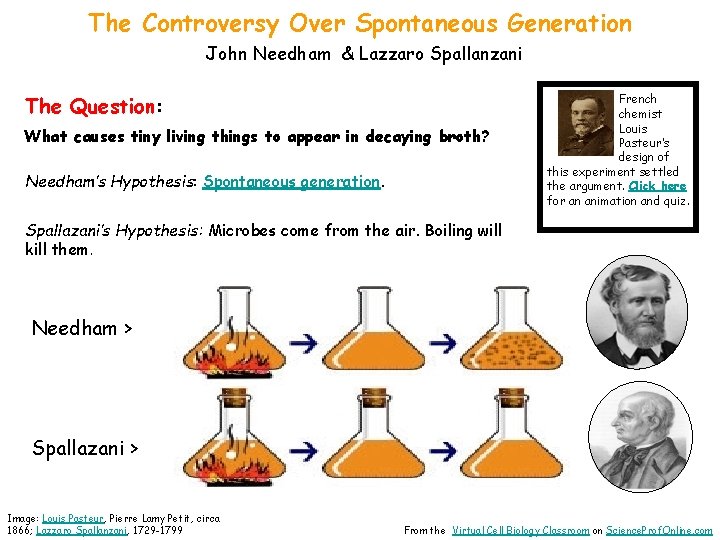
The Controversy Over Spontaneous Generation John Needham & Lazzaro Spallanzani The Question: What causes tiny living things to appear in decaying broth? Needham’s Hypothesis: Spontaneous generation. French chemist Louis Pasteur’s design of this experiment settled the argument. Click here for an animation and quiz. Spallazani’s Hypothesis: Microbes come from the air. Boiling will kill them. Needham > Spallazani > Image: Louis Pasteur, Pierre Lamy Petit, circa 1866; Lazzaro Spallanzani, 1729 -1799 From the Virtual Cell Biology Classroom on Science. Prof. Online. com

What is good science? Objectivity is the key to good science. To be objective, experiments must be designed and conducted in a way that does not introduce bias into the study. Scientists use the Scientific Method From the Virtual Cell Biology Classroom on Science. Prof. Online. com
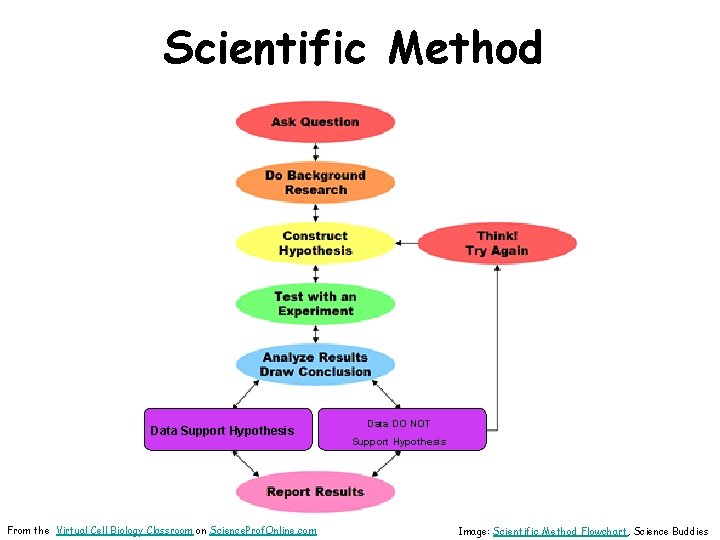
Scientific Method Data Support Hypothesis From the Virtual Cell Biology Classroom on Science. Prof. Online. com Data DO NOT Support Hypothesis Image: Scientific Method Flowchart, Science Buddies
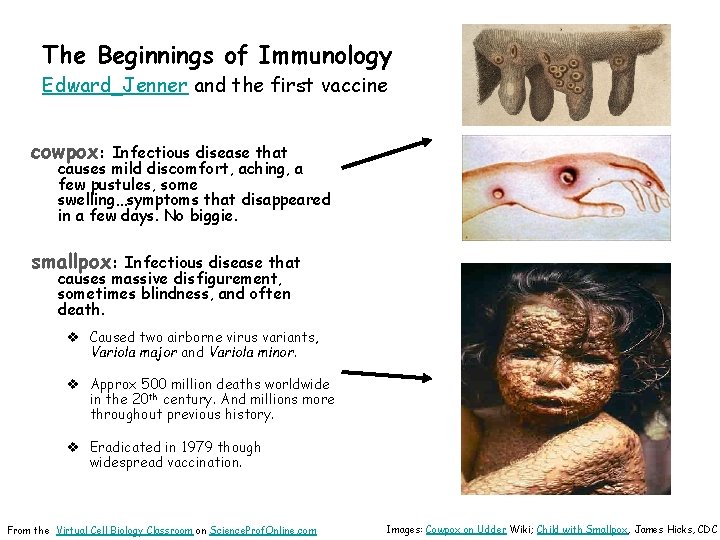
The Beginnings of Immunology Edward Jenner and the first vaccine cowpox: Infectious disease that causes mild discomfort, aching, a few pustules, some swelling…symptoms that disappeared in a few days. No biggie. smallpox: Infectious disease that causes massive disfigurement, sometimes blindness, and often death. v Caused two airborne virus variants, Variola major and Variola minor. v Approx 500 million deaths worldwide in the 20 th century. And millions more throughout previous history. v Eradicated in 1979 though widespread vaccination. From the Virtual Cell Biology Classroom on Science. Prof. Online. com Images: Cowpox on Udder Wiki; Child with Smallpox, James Hicks, CDC
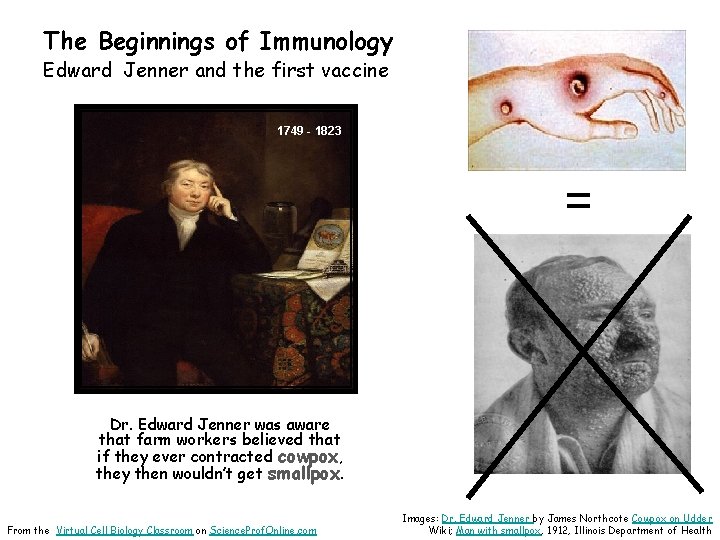
The Beginnings of Immunology Edward Jenner and the first vaccine 1749 - 1823 = Dr. Edward Jenner was aware that farm workers believed that if they ever contracted cowpox, they then wouldn’t get smallpox. From the Virtual Cell Biology Classroom on Science. Prof. Online. com Images: Dr. Edward Jenner by James Northcote Cowpox on Udder Wiki; Man with smallpox, 1912, Illinois Department of Health
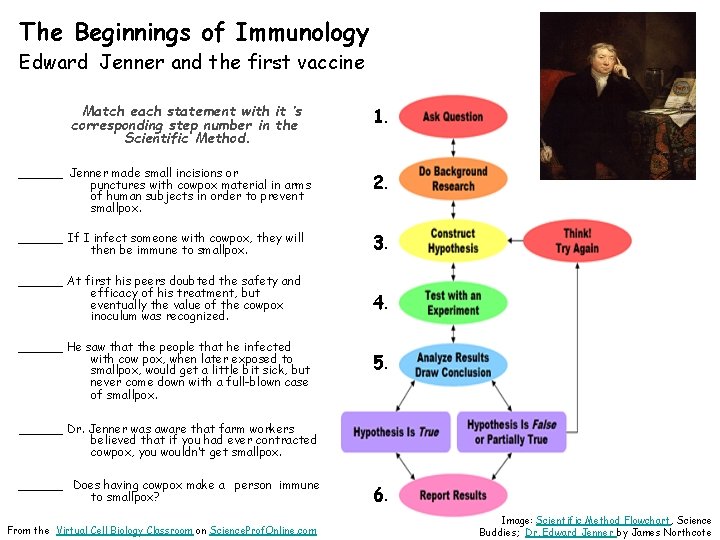
The Beginnings of Immunology Edward Jenner and the first vaccine Match each statement with it ’s corresponding step number in the Scientific Method. _____ Jenner made small incisions or punctures with cowpox material in arms of human subjects in order to prevent smallpox. _____ If I infect someone with cowpox, they will then be immune to smallpox. _____ At first his peers doubted the safety and efficacy of his treatment, but eventually the value of the cowpox inoculum was recognized. _____ He saw that the people that he infected with cow pox, when later exposed to smallpox, would get a little bit sick, but never come down with a full-blown case of smallpox. 1. 2. 3. 4. 5. _____ Dr. Jenner was aware that farm workers believed that if you had ever contracted cowpox, you wouldn’t get smallpox. _____ Does having cowpox make a person immune to smallpox? From the Virtual Cell Biology Classroom on Science. Prof. Online. com 6. Image: Scientific Method Flowchart, Science Buddies; Dr. Edward Jenner by James Northcote
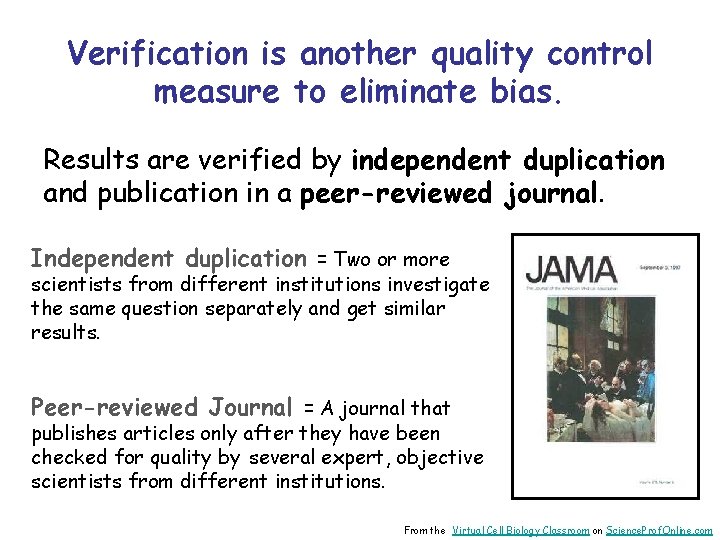
Verification is another quality control measure to eliminate bias. Results are verified by independent duplication and publication in a peer-reviewed journal. Independent duplication = Two or more scientists from different institutions investigate the same question separately and get similar results. Peer-reviewed Journal = A journal that publishes articles only after they have been checked for quality by several expert, objective scientists from different institutions. From the Virtual Cell Biology Classroom on Science. Prof. Online. com
So that’s Science… Now, what’s the difference between: 1. Science 2. Non-science 3. Pseudoscience ? From the Virtual Cell Biology Classroom on Science. Prof. Online. com
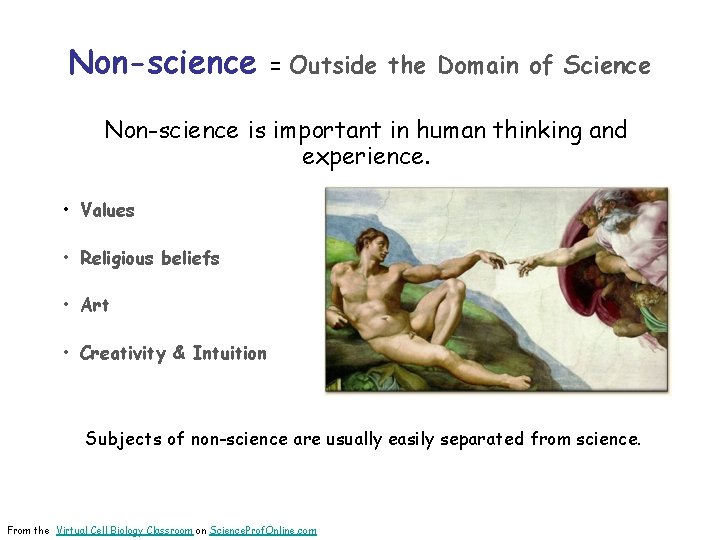
Non-science = Outside the Domain of Science Non-science is important in human thinking and experience. • Values • Religious beliefs • Art • Creativity & Intuition Subjects of non-science are usually easily separated from science. From the Virtual Cell Biology Classroom on Science. Prof. Online. com
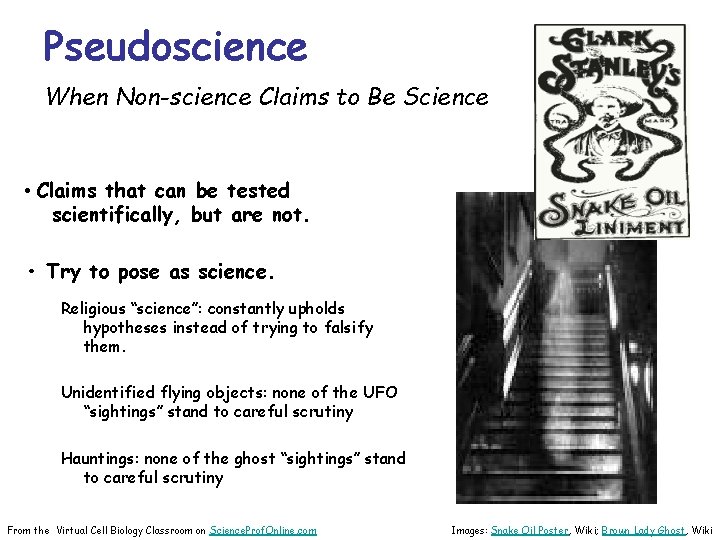
Pseudoscience When Non-science Claims to Be Science • Claims that can be tested scientifically, but are not. • Try to pose as science. Religious “science”: constantly upholds hypotheses instead of trying to falsify them. Unidentified flying objects: none of the UFO “sightings” stand to careful scrutiny Hauntings: none of the ghost “sightings” stand to careful scrutiny From the Virtual Cell Biology Classroom on Science. Prof. Online. com Images: Snake Oil Poster, Wiki; Brown Lady Ghost, Wiki
Confused? Here are some links to fun resources that further explain the Scientific Method: • Scientific Method Main Page • “Science Is Real” • Scientific Method Cartoon & Quizzes • “Put It To The Test” • Scene from Monty Python’s Holy Grail used to • Pasteur’s Experiment interactive science tutorial. • “She Blinded Me With Science” Biology Classroom at Science Prof Online. from the Virtual Cell music video by They Might Be Giants. Brain. Pop. from music video by They Might Be Giants. explain Scientific Method. Dolby. music video Thomas (You must be in PPT slideshow view to click on links. ) From the Virtual Cell Biology Classroom on Science. Prof. Online. com
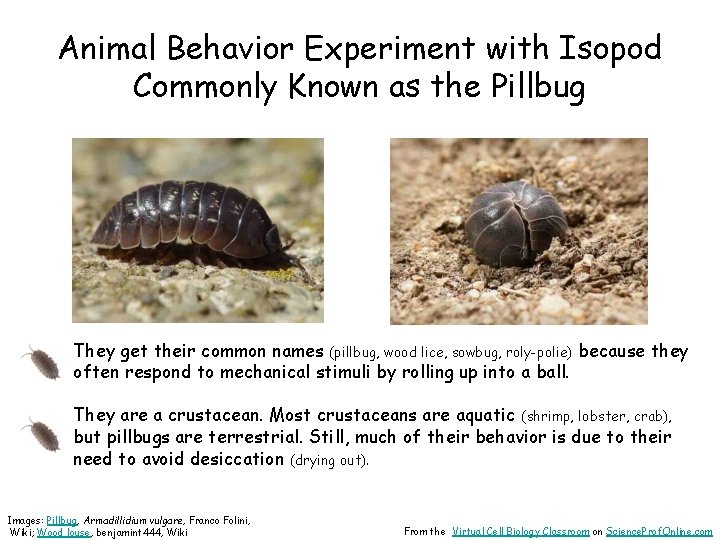
Animal Behavior Experiment with Isopod Commonly Known as the Pillbug They get their common names (pillbug, wood lice, sowbug, roly-polie) because they often respond to mechanical stimuli by rolling up into a ball. They are a crustacean. Most crustaceans are aquatic (shrimp, lobster, crab), but pillbugs are terrestrial. Still, much of their behavior is due to their need to avoid desiccation (drying out). Images: Pillbug, Armadillidium vulgare, Franco Folini, Wiki; Wood louse, benjamint 444, Wiki From the Virtual Cell Biology Classroom on Science. Prof. Online. com
Pillbug Experiment See the Science. Prof. Online Virtual Cell Biology Classroom: Scientific Method Lecture for a printable Word. doc of this assignment. • You will be designing an experiment to help you understand the scientific method. • Break up into groups (of 3 to 5 members) and design an experiment to investigate the pillbugs’ response to light, p. H, food hiding place or background color. • Choose only one variable to manipulate. • You will must work through all of the steps of the scientific method: – – better ask a question develop a hypothesis state the objectives of your experiment design your experiment (list materials that you will use, and outline your procedure in detail, determine what data you will collect) – analyze your data – draw a conclusion (was your hypothesis supported or not? ) • I will need to approve your experiment before you begin. From the Virtual Cell Biology Classroom on Science. Prof. Online. com
Are you feeling blinded by science? Do yourself a favor. Use the… Virtual Cell Biology Classroom (VCBC) ! The VCBC is full of resources to help you succeed, including: • practice test questions • • • review questions study guides and learning objectives Power. Points on other topics You can access the VCBC by going to the Science Prof Online website www. Science. Prof. Online. com Images: Blinded With Science album, Thomas Dolby; Endomembrane system, Mariana Ruiz, Wiki
- Slides: 22