
About Science Prof Online Power Point Resources Science
About Science Prof Online Power. Point Resources • Science Prof Online (SPO) is a free science education website that provides fully-developed Virtual Science Classrooms, science-related Power. Points, articles and images. The site is designed to be a helpful resource for students, educators, and anyone interested in learning about science. • The SPO Virtual Classrooms offer many educational resources, including practice test questions, review questions, lecture Power. Points, video tutorials, sample assignments and course syllabi. New materials are continually being developed, so check back frequently, or follow us on Facebook (Science Prof Online) or Twitter (Science. Prof. SPO) for updates. • Many SPO Power. Points are available in a variety of formats, such as fully editable Power. Point files, as well as uneditable versions in smaller file sizes, such as Power. Point Shows and Portable Document Format (. pdf), for ease of printing. • Images used on this resource, and on the SPO website are, wherever possible, credited and linked to their source. Any words underlined and appearing in blue are links that can be clicked on for more information. Power. Points must be viewed in slide show mode to use the hyperlinks directly. • Several helpful links to fun and interactive learning tools are included throughout the PPT and on the Smart Links slide, near the end of each presentation. You must be in slide show mode to utilize hyperlinks and animations. • This digital resource is licensed under Creative Commons Attribution-Share. Alike 3. 0: http: //creativecommons. org/licenses/by-sa/3. 0/ Alicia Cepaitis, MS Chief Creative Nerd Science Prof Online Education Resources, LLC alicia@scienceprofonline. com From the Virtual Biology Classroom on Science. Prof. Online. com Tami Port, MS Creator of Science Prof Online Chief Executive Nerd Science Prof Online Education Resources, LLC info@scienceprofonline. com Image: Compound microscope objectives, T. Port
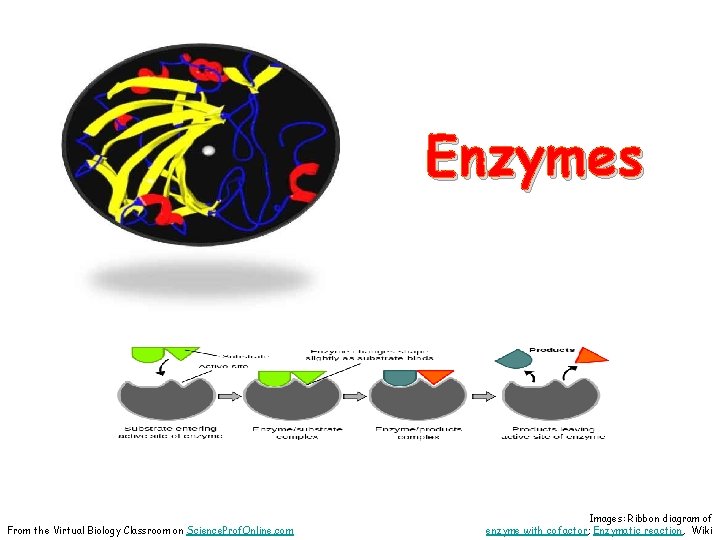
Enzymes From the Virtual Biology Classroom on Science. Prof. Online. com Images: Ribbon diagram of enzyme with cofactor; Enzymatic reaction, Wiki
Apple Experiment Come up and get an apple and a slice of lemon. When you get back to your seat: 1. Take a big bite of your delicious apple. 2. Immediately squeeze lemon juice over the apple flesh that is now exposed from the bite. 3. IMPORTANT! Don’t get lemon juice all over the apple. Make sure that it is ONLY on the area that you just bit! 4. Set the lemon aside and wipe any lemon juice off of your hands with a napkin. 5. Take another bite from the opposite side of your apple. 6. Set your apple aside. From the Virtual Biology Classroom on Science. Prof. Online. com
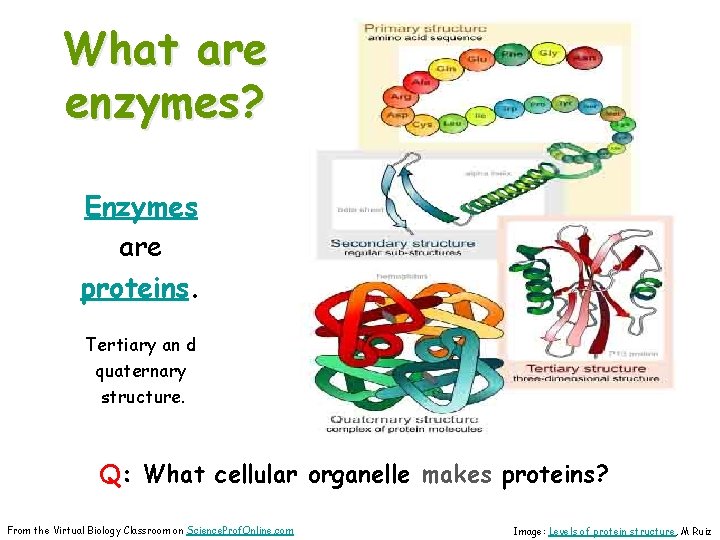
What are enzymes? Enzymes are proteins. Tertiary an d quaternary structure. Q: What cellular organelle makes proteins? From the Virtual Biology Classroom on Science. Prof. Online. com Image: Levels of protein structure, M Ruiz
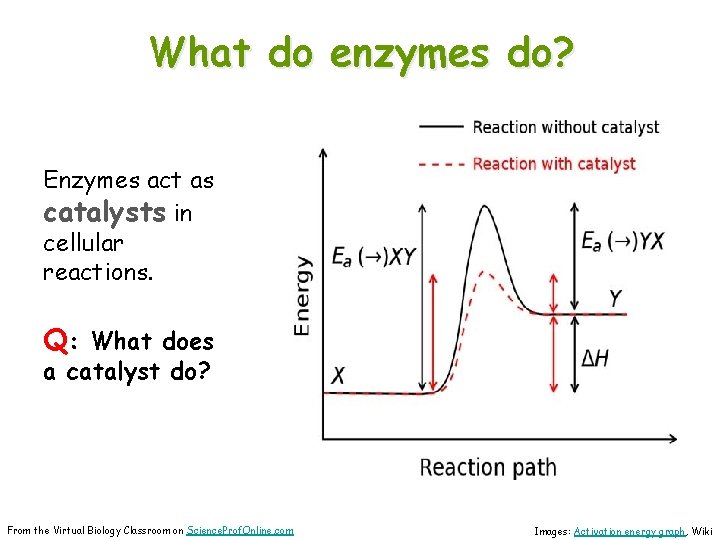
What do enzymes do? Enzymes act as catalysts in cellular reactions. Q: What does a catalyst do? From the Virtual Biology Classroom on Science. Prof. Online. com Images: Activation energy graph, Wiki
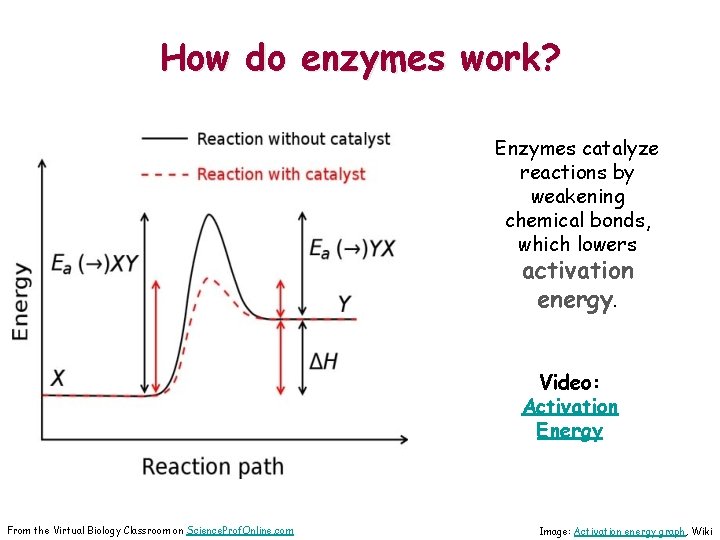
How do enzymes work? Enzymes catalyze reactions by weakening chemical bonds, which lowers activation energy. Video: Activation Energy From the Virtual Biology Classroom on Science. Prof. Online. com Image: Activation energy graph, Wiki
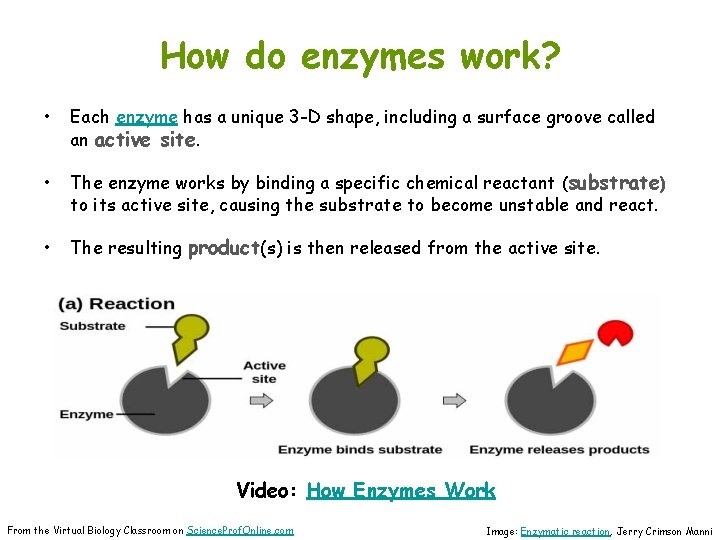
How do enzymes work? • Each enzyme has a unique 3 -D shape, including a surface groove called an active site. • The enzyme works by binding a specific chemical reactant (substrate) to its active site, causing the substrate to become unstable and react. • The resulting product(s) is then released from the active site. Video: How Enzymes Work From the Virtual Biology Classroom on Science. Prof. Online. com Image: Enzymatic reaction, Jerry Crimson Manni
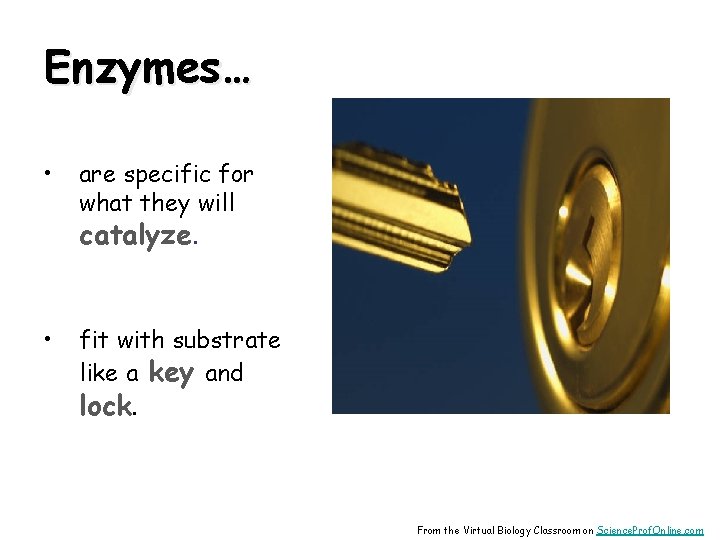
Enzymes… • are specific for what they will catalyze. • fit with substrate like a key and lock. From the Virtual Biology Classroom on Science. Prof. Online. com
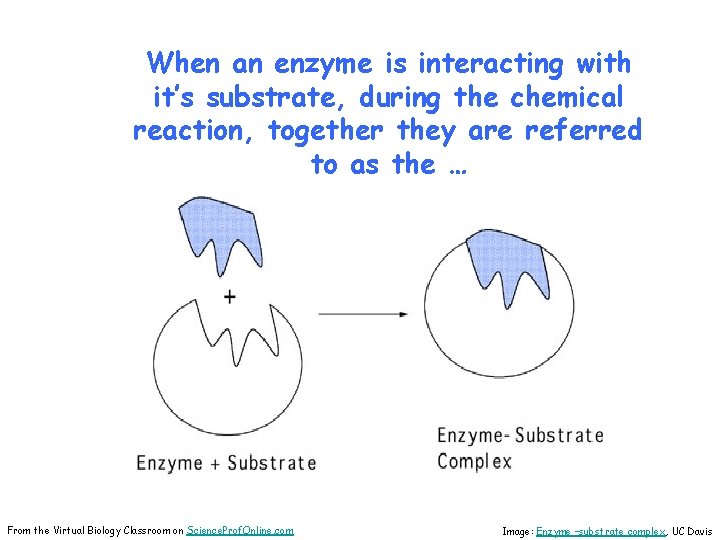
When an enzyme is interacting with it’s substrate, during the chemical reaction, together they are referred to as the … From the Virtual Biology Classroom on Science. Prof. Online. com Image: Enzyme –substrate complex, UC Davis
Enzymes… …are reusable. They are not consumed (used up) in the reactions they catalyze. May perform thousands of reactions per second. Video: Enzyme Hydrolysis of Sucrose From the Virtual Biology Classroom on Science. Prof. Online. com
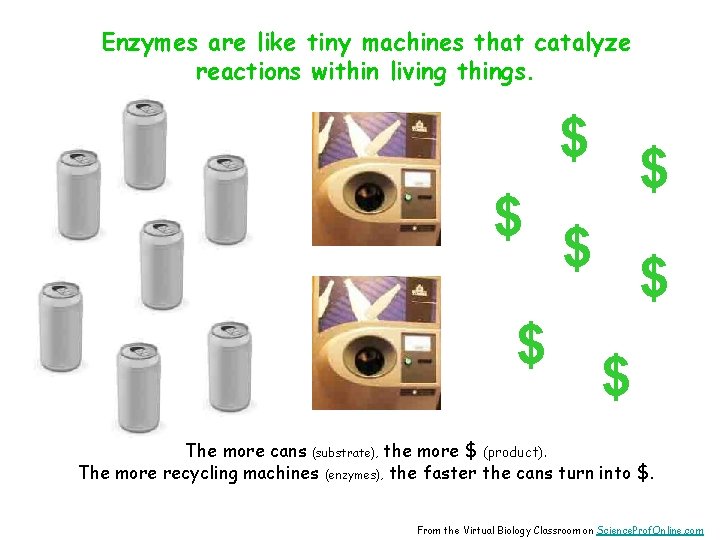
Enzymes are like tiny machines that catalyze reactions within living things. $ $ $ $ The more cans (substrate), the more $ (product). The more recycling machines (enzymes), the faster the cans turn into $. From the Virtual Biology Classroom on Science. Prof. Online. com
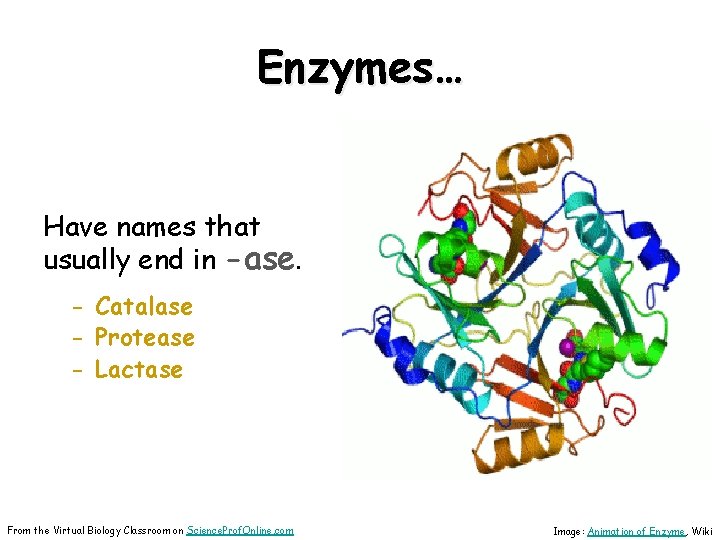
Enzymes… Have names that usually end in -ase. - Catalase - Protease - Lactase From the Virtual Biology Classroom on Science. Prof. Online. com Image: Animation of Enzyme, Wiki
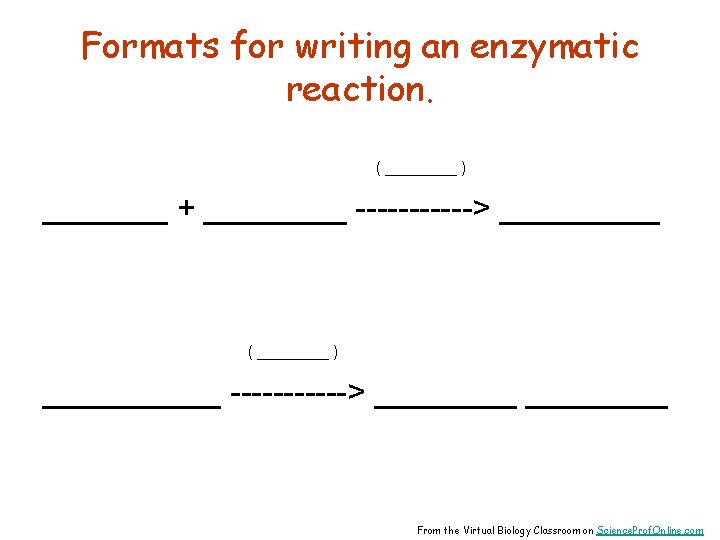
Formats for writing an enzymatic reaction. ( ____ ) _______ + ____ ------> _____ ( ____ ) _____ ------> ________ From the Virtual Biology Classroom on Science. Prof. Online. com
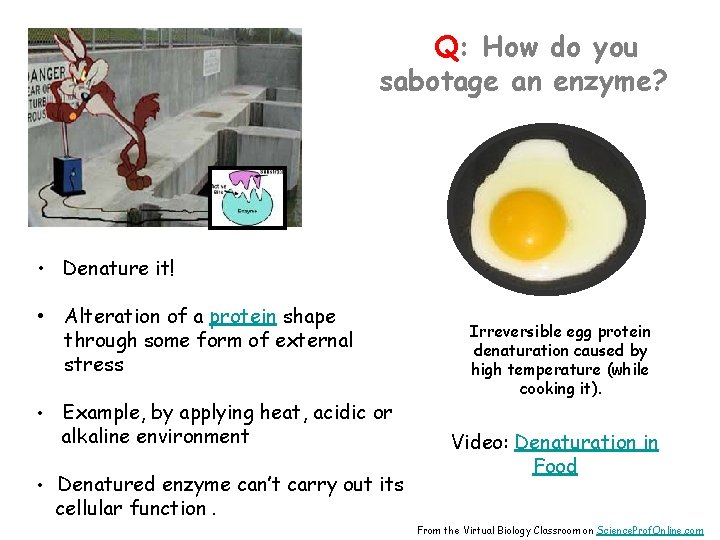
Q: How do you sabotage an enzyme? • Denature it! • Alteration of a protein shape through some form of external stress • • Example, by applying heat, acidic or alkaline environment Denatured enzyme can’t carry out its cellular function. Irreversible egg protein denaturation caused by high temperature (while cooking it). Video: Denaturation in Food From the Virtual Biology Classroom on Science. Prof. Online. com
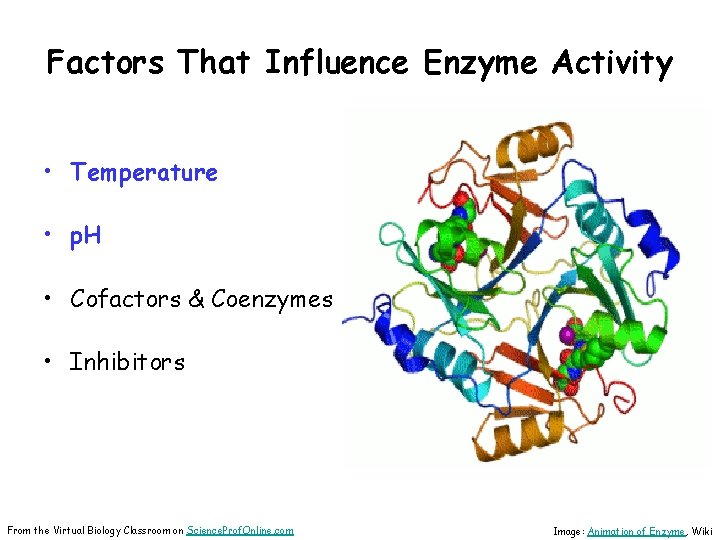
Factors That Influence Enzyme Activity • Temperature • p. H • Cofactors & Coenzymes • Inhibitors From the Virtual Biology Classroom on Science. Prof. Online. com Image: Animation of Enzyme, Wiki
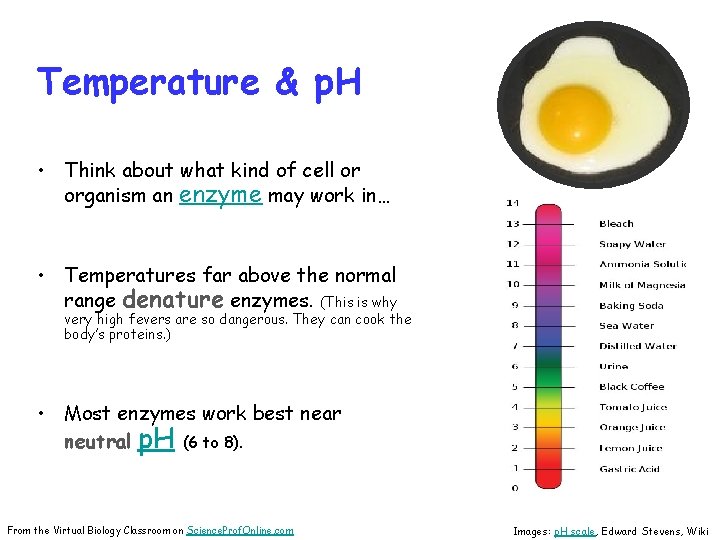
Temperature & p. H • Think about what kind of cell or organism an enzyme may work in… • Temperatures far above the normal range denature enzymes. (This is why very high fevers are so dangerous. They can cook the body’s proteins. ) • Most enzymes work best near neutral p. H (6 to 8). From the Virtual Biology Classroom on Science. Prof. Online. com Images: p. H scale, Edward Stevens, Wiki
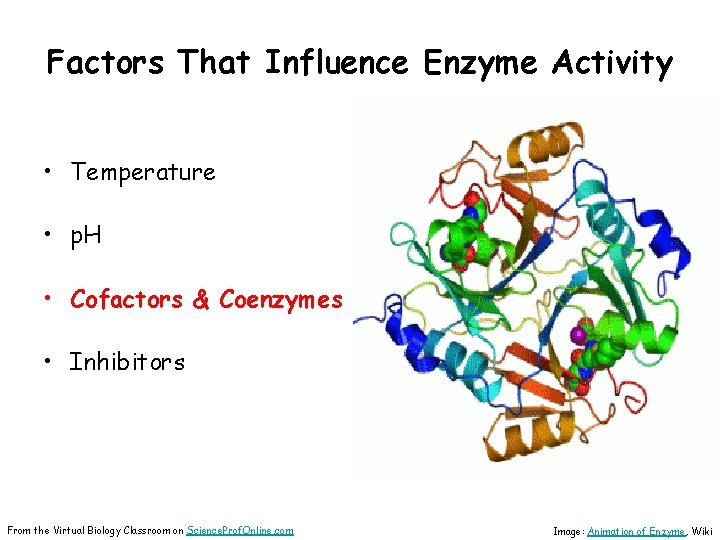
Factors That Influence Enzyme Activity • Temperature • p. H • Cofactors & Coenzymes • Inhibitors From the Virtual Biology Classroom on Science. Prof. Online. com Image: Animation of Enzyme, Wiki
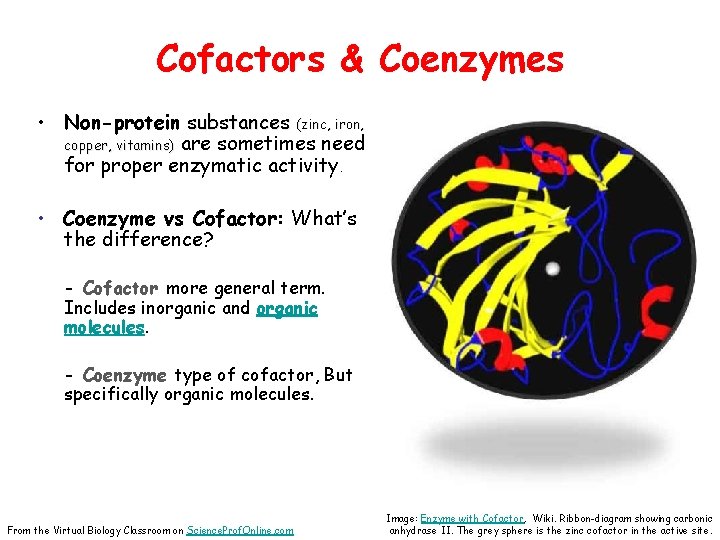
Cofactors & Coenzymes • Non-protein substances (zinc, iron, copper, vitamins) are sometimes need for proper enzymatic activity. • Coenzyme vs Cofactor: What’s the difference? - Cofactor more general term. Includes inorganic and organic molecules. - Coenzyme type of cofactor, But specifically organic molecules. From the Virtual Biology Classroom on Science. Prof. Online. com Image: Enzyme with Cofactor, Wiki. Ribbon-diagram showing carbonic anhydrase II. The grey sphere is the zinc cofactor in the active site.
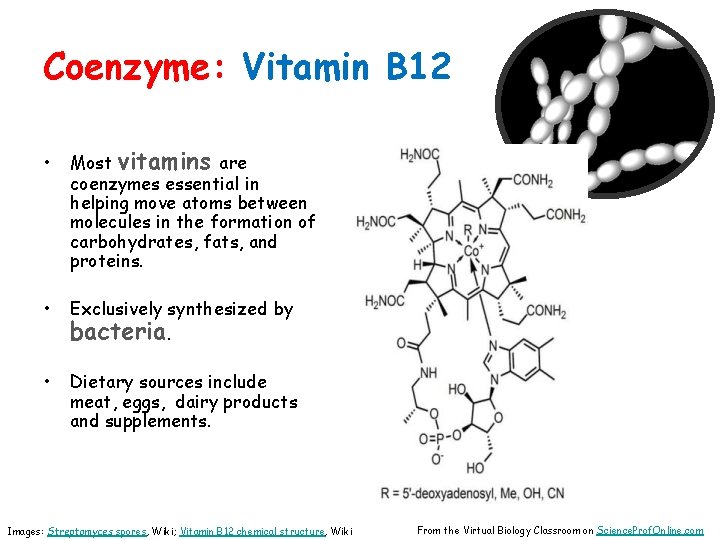
Coenzyme: Vitamin B 12 • Most vitamins are coenzymes essential in helping move atoms between molecules in the formation of carbohydrates, fats, and proteins. • Exclusively synthesized by bacteria. • Dietary sources include meat, eggs, dairy products and supplements. Images: Streptomyces spores, Wiki; Vitamin B 12 chemical structure, Wiki From the Virtual Biology Classroom on Science. Prof. Online. com
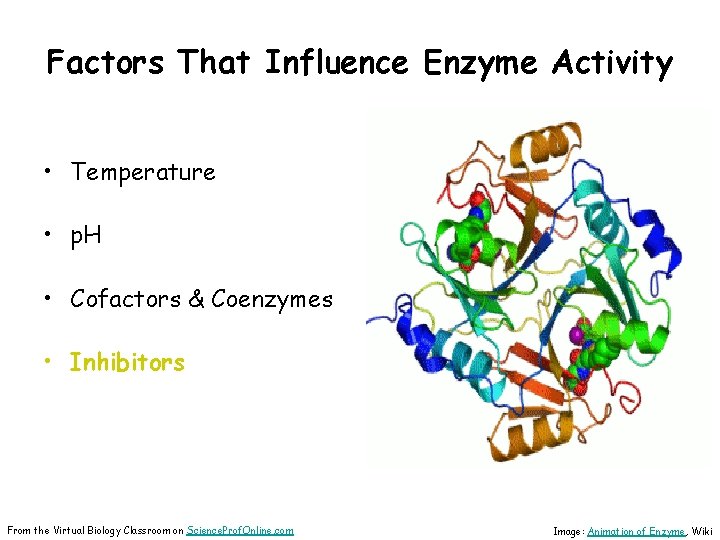
Factors That Influence Enzyme Activity • Temperature • p. H • Cofactors & Coenzymes • Inhibitors From the Virtual Biology Classroom on Science. Prof. Online. com Image: Animation of Enzyme, Wiki
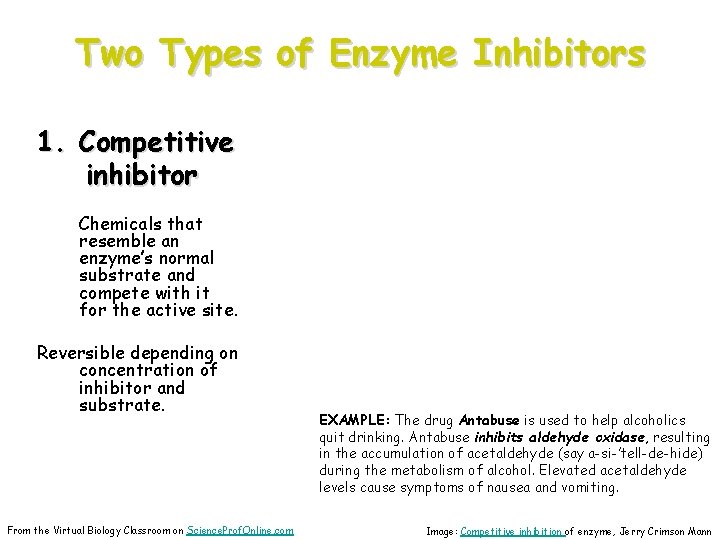
Two Types of Enzyme Inhibitors 1. Competitive inhibitor Chemicals that resemble an enzyme’s normal substrate and compete with it for the active site. Reversible depending on concentration of inhibitor and substrate. From the Virtual Biology Classroom on Science. Prof. Online. com EXAMPLE: The drug Antabuse is used to help alcoholics quit drinking. Antabuse inhibits aldehyde oxidase, resulting in the accumulation of acetaldehyde (say a-si-’tell-de-hide) during the metabolism of alcohol. Elevated acetaldehyde levels cause symptoms of nausea and vomiting. Image: Competitive inhibition of enzyme, Jerry Crimson Mann
Two Types of Enzyme Inhibitors 2. Noncompetitive inhibitor Do not enter active site, but bind to another part of the enzyme, causing the enzyme & active site to change shape. Usually reversible, depending on concentration of inhibitor & substrate. Video Feedback Inhibition of a Metabolic Pathway From the Virtual Biology Classroom on Science. Prof. Online. com EXAMPLE: You may know that compounds containing heavy metals such as lead, mercury, copper or silver are poisonous. This is because ions of these metals are non-competitive inhibitors for several enzymes. Image: Pouring liquid mercury, Bionerd
Enzyme Inhibitors Blocking an enzyme's activity can kill a pathogen or correct a metabolic imbalance. Many medications are enzyme inhibitors. Enzyme inhibitors are also used as herbicides and pesticides. From the Virtual Biology Classroom on Science. Prof. Online. com EXAMPLE: • Another example of competitive inhibition is protease inhibitors. • They are a class of antiretroviral drugs used to treat HIV. • The structure of the drug ritonavir (say ri-TAHN-a-veer) resembles the substrate of HIV protease, an enzyme required for HIV to be made. Images: Prescription bottle, T. Port; Dead cockroach, Wiki
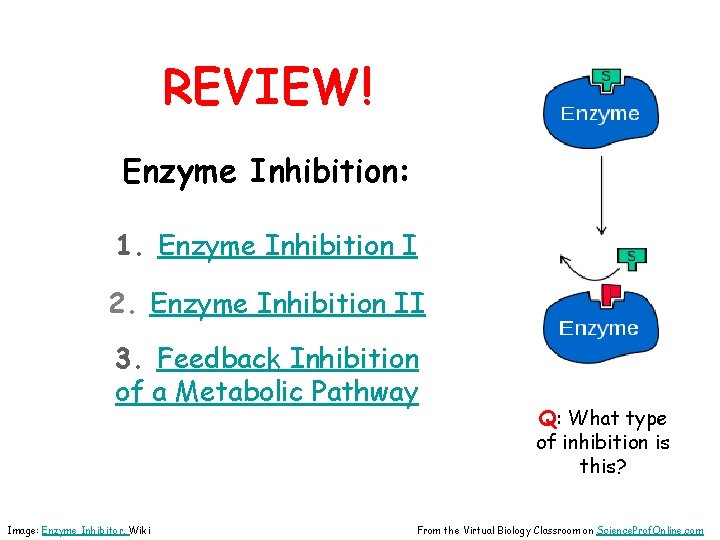
REVIEW! Enzyme Inhibition: 1. Enzyme Inhibition I 2. Enzyme Inhibition II 3. Feedback Inhibition of a Metabolic Pathway Image: Enzyme Inhibitor, Wiki Q: What type of inhibition is this? From the Virtual Biology Classroom on Science. Prof. Online. com
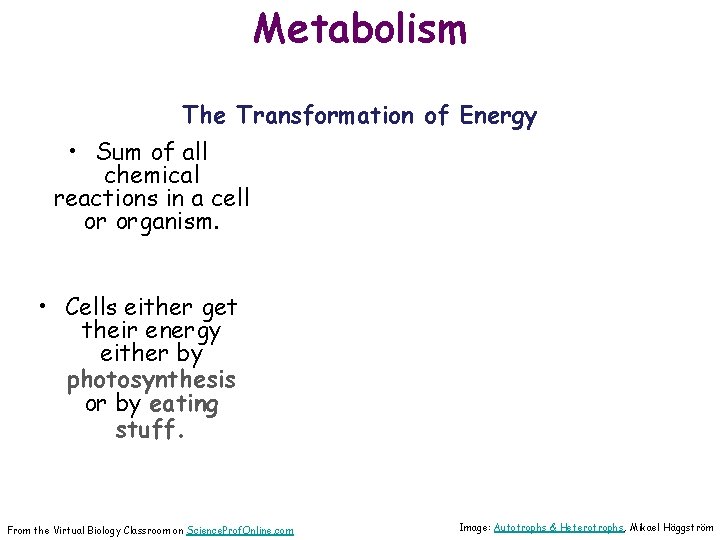
Metabolism The Transformation of Energy • Sum of all chemical reactions in a cell or organism. • Cells either get their energy either by photosynthesis or by eating stuff. From the Virtual Biology Classroom on Science. Prof. Online. com Image: Autotrophs & Heterotrophs, Mikael Häggström
Metabolic Pathways Series of chemical reactions that regulate the concentration of substances within the organism. • Has order, like an assembly line. • Molecules are altered in a series of steps. • Use many smaller steps rather than one big step. • Enzymes are workers that control each station along the pathway. • May be turned on and off as needed. From the Virtual Biology Classroom on Science. Prof. Online. com Video: Biochemical Pathways Image: Metabolism Pathways, Wiki
Why Are Enzymes So Important? Why are we devoting one whole lecture topic to a protein molecule? Nearly all chemical reactions in biological cells need enzymes to make the reaction occur fast enough to support life. From the Virtual Biology Classroom on Science. Prof. Online. com Image: Jumping rope, Meagan E. Klein
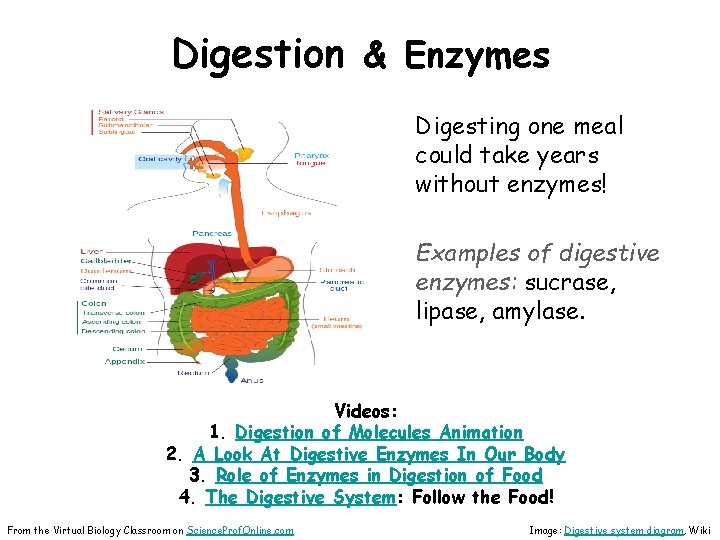
Digestion & Enzymes Digesting one meal could take years without enzymes! Examples of digestive enzymes: sucrase, lipase, amylase. Videos: 1. Digestion of Molecules Animation 2. A Look At Digestive Enzymes In Our Body 3. Role of Enzymes in Digestion of Food 4. The Digestive System: Follow the Food! From the Virtual Biology Classroom on Science. Prof. Online. com Image: Digestive system diagram, Wiki
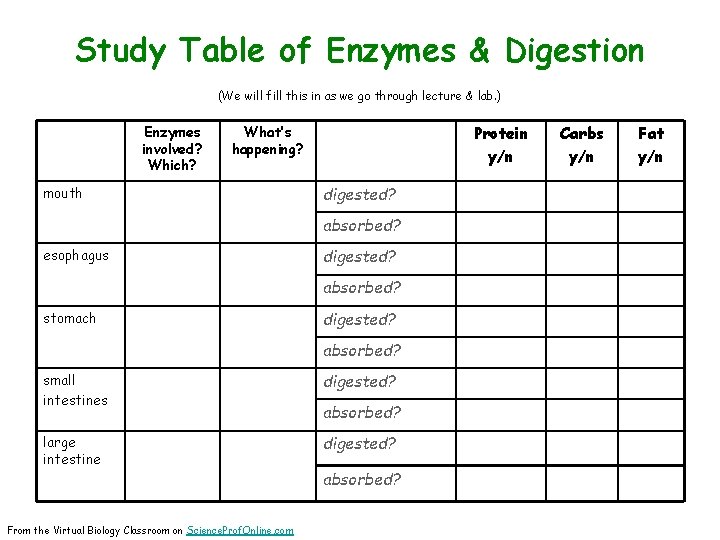
Study Table of Enzymes & Digestion (We will fill this in as we go through lecture & lab. ) Enzymes involved? Which? Protein y/n What’s happening? mouth digested? absorbed? esophagus digested? absorbed? stomach digested? absorbed? small intestines digested? large intestine digested? From the Virtual Biology Classroom on Science. Prof. Online. com absorbed? Carbs y/n Fat y/n
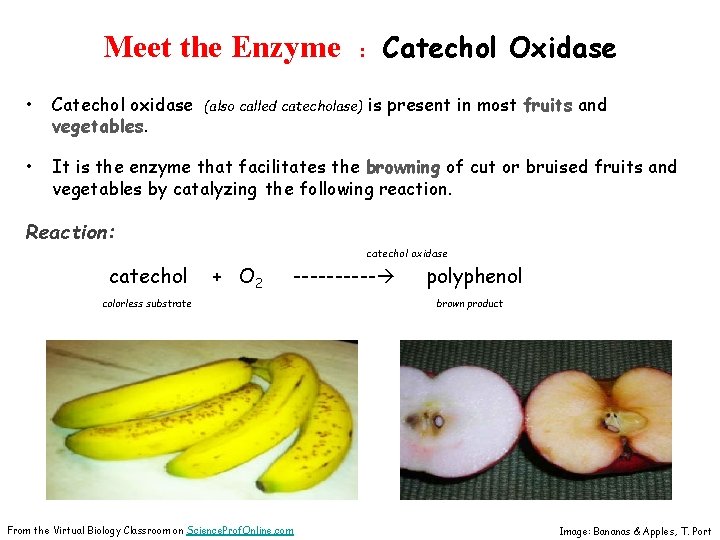
Meet the Enzyme : Catechol Oxidase • Catechol oxidase vegetables. • It is the enzyme that facilitates the browning of cut or bruised fruits and vegetables by catalyzing the following reaction. (also called catecholase) is present in most fruits and Reaction: catechol oxidase catechol + O 2 ----- colorless substrate From the Virtual Biology Classroom on Science. Prof. Online. com polyphenol brown product Image: Bananas & Apples, T. Port
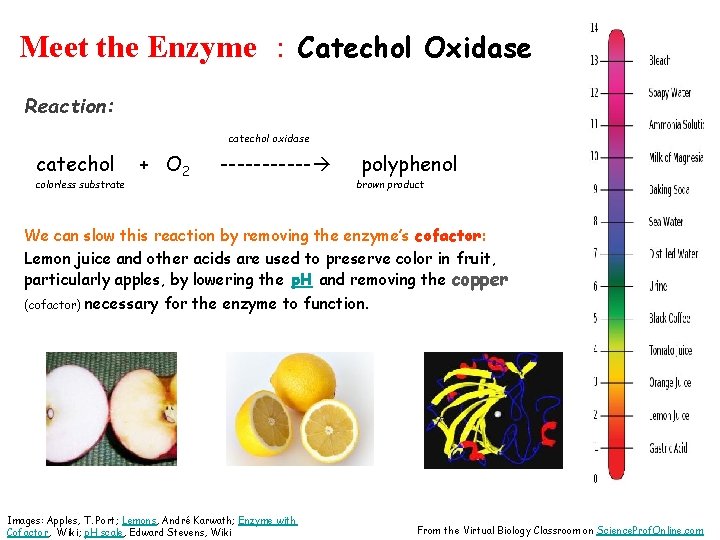
Meet the Enzyme : Catechol Oxidase Reaction: catechol oxidase catechol colorless substrate + O 2 ------ polyphenol brown product We can slow this reaction by removing the enzyme’s cofactor: Lemon juice and other acids are used to preserve color in fruit, particularly apples, by lowering the p. H and removing the copper (cofactor) necessary for the enzyme to function. Images: Apples, T. Port; Lemons, André Karwath; Enzyme with Cofactor, Wiki; p. H scale, Edward Stevens, Wiki From the Virtual Biology Classroom on Science. Prof. Online. com
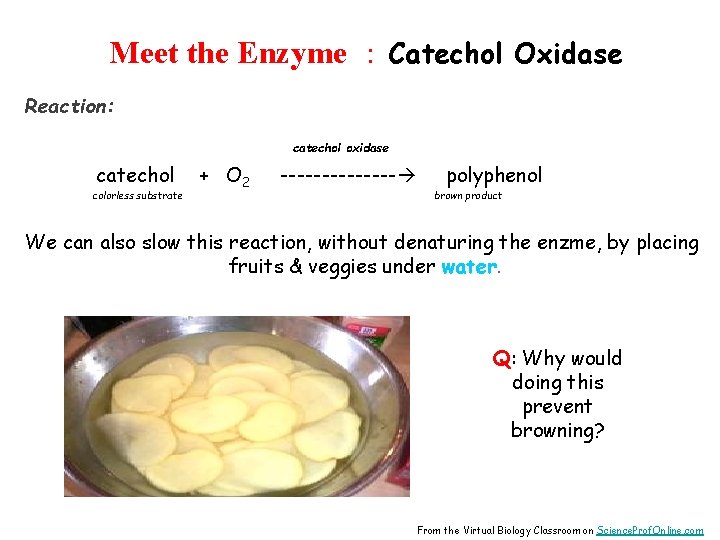
Meet the Enzyme : Catechol Oxidase Reaction: catechol oxidase catechol colorless substrate + O 2 ------- polyphenol brown product We can also slow this reaction, without denaturing the enzme, by placing fruits & veggies under water. Q: Why would doing this prevent browning? From the Virtual Biology Classroom on Science. Prof. Online. com
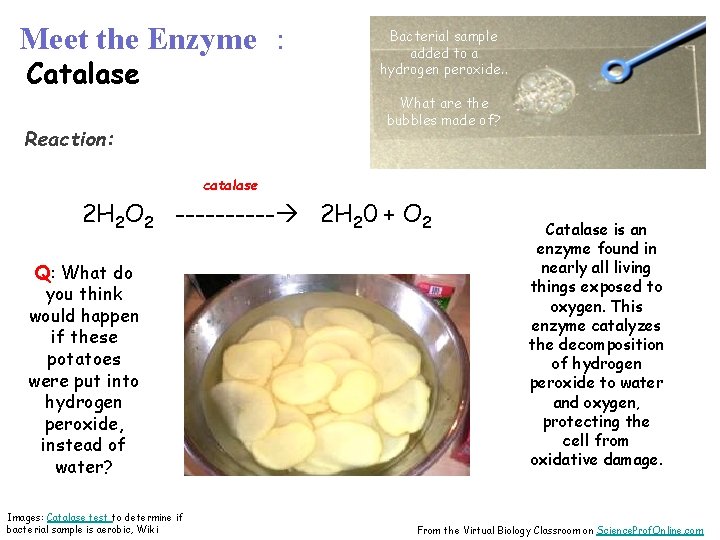
Meet the Enzyme : Catalase Bacterial sample added to a hydrogen peroxide. . What are the bubbles made of? Reaction: catalase 2 H 2 O 2 ----- 2 H 20 + O 2 Q: What do you think would happen if these potatoes were put into hydrogen peroxide, instead of water? Images: Catalase test to determine if bacterial sample is aerobic, Wiki Catalase is an enzyme found in nearly all living things exposed to oxygen. This enzyme catalyzes the decomposition of hydrogen peroxide to water and oxygen, protecting the cell from oxidative damage. From the Virtual Biology Classroom on Science. Prof. Online. com
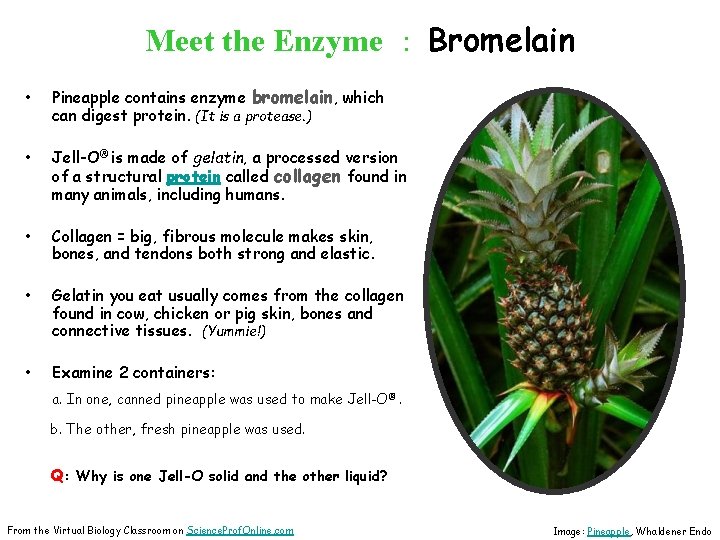
Meet the Enzyme : Bromelain • Pineapple contains enzyme bromelain, which can digest protein. (It is a protease. ) • Jell-O® is made of gelatin, a processed version of a structural protein called collagen found in many animals, including humans. • Collagen = big, fibrous molecule makes skin, bones, and tendons both strong and elastic. • Gelatin you eat usually comes from the collagen found in cow, chicken or pig skin, bones and connective tissues. (Yummie!) • Examine 2 containers: a. In one, canned pineapple was used to make Jell-O ®. b. The other, fresh pineapple was used. Q: Why is one Jell-O solid and the other liquid? From the Virtual Biology Classroom on Science. Prof. Online. com Image: Pineapple, Whaldener Endo
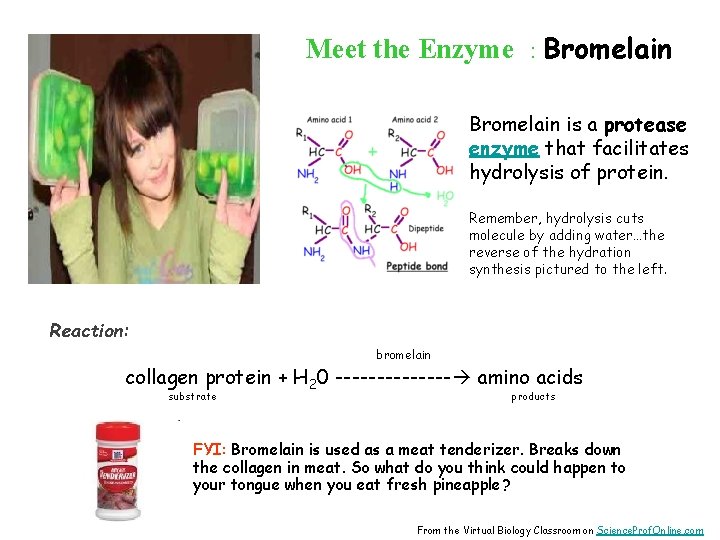
Meet the Enzyme : Bromelain is a protease enzyme that facilitates hydrolysis of protein. Remember, hydrolysis cuts molecule by adding water…the reverse of the hydration synthesis pictured to the left. Reaction: bromelain collagen protein + H 20 ------- amino acids substrate products FYI: Bromelain is used as a meat tenderizer. Breaks down the collagen in meat. So what do you think could happen to your tongue when you eat fresh pineapple? From the Virtual Biology Classroom on Science. Prof. Online. com
Confused? Here are some links to fun resources that further explain enzymes: • Enzymes Main Page on the Virtual Cell Biology Classroom of Science Prof Online. • “How Enzymes Work” an animation from Mc. Graw-Hill. • “The Role Enzymes Play in the Body” from Enzymedica. • Enzyme Substrate Interactions • “Enzymes and Digestion” from About. com. • “Bio These guys are selling supplements. I don’t endorse the supplement, but their video is very instructive regarding enzymes and digestion. from Pearson Education. Rad GTCA Song” musical advertisement for Sso. Fast™. (You must be in PPT slideshow view to click on links. ) From the Virtual Biology Classroom on Science. Prof. Online. com
- Slides: 36