
About Salary Continuation Plans Presentation for Employers Topics
About Salary Continuation Plans Presentation for Employers
Topics • Tough Decision: Do you continue to pay key employees who are unable to work while they recover from a disability? • Discontinue compensation • Continue compensation • Ad hoc payments • Salary continuation plans • Self-funded plans • Insured plans • Who pays? 2 10844 PPT (1/19) SI/SNY
Topics (cont’d) • Chism Ice Cream Company vs. IRS • Considerations • Relevant Laws • Getting Started with a Salary Continuation Plan • Sample Board of Directors Resolution • Sample Salary Continuation Plan Resolution 3 10844 PPT (1/19) SI/SNY
Tough Decision Just over one in four of today’s twenty year-olds will become disabled before reaching age 67. * If one of your key employees was unable to work for an extended period of time, would you continue to pay compensation to that employee? *Social Security Administration 2018 Fact Sheet 4 10844 PPT (1/19) SI/SNY
Discontinue Compensation If you choose to discontinue your key employee’s compensation, • How do you communicate your decision? • What impact will your decision have on employee morale? • What is the net effect on your business? 5 10844 PPT (1/19) SI/SNY

Continue Compensation If you choose to continue your employee’s compensation, • How soon will payments start? • How much will payments be? • Who defines disability? • Who do you pay? • Will you provide purely ad hoc (discretionary) payments? 6 10844 PPT (1/19) SI/SNY
Ad Hoc Payments • Ad hoc payments are those made by employers to sick or injured employees on a discretionary basis and not according to any pre-existing plan. • Ad hoc payments can create serious income tax issues. • If the IRS determines that payments to a disabled employee are ad hoc payments, any employer deductions for these payments will almost certainly be denied. • If the disabled employee is also a stockholder in the employer’s business, the payments may be recharacterized as dividends, with dramatic results. 7 10844 PPT (1/19) SI/SNY
Ad Hoc Payments Consider the case of Chism Ice Cream Company vs. Commissioner* A long line of Federal Court decisions support the IRS position on ad hoc payments. The underlying message of these rulings is clear: If you intend to deduct payments made to a disabled employee, you must have a salary continuation plan in place before the payments begin. *TC Memo 1962 -6, aff’d 322 F. 2 d 956 (9 th Cir. 1963) 8 10844 PPT (1/19) SI/SNY
Salary Continuation Plan You can avoid the problems associated with ad hoc payments and resolve all of the issues with a salary continuation plan, if the plan is • in writing, • in place “before the fact”, • communicated to employees, and • authorized in writing by a company resolution or other documentation. 9 10844 PPT (1/19) SI/SNY

Funding Your Plan: Self-Funded or Insured? 10 10844 PPT (1/19) SI/SNY
Self-Funded Plan To fund your own plan, consider: • Liability • • • Timing Budgeting (FAS 112*) Reporting Rules Definition of Disability Fiduciary Responsibility Claim and Rehabilitation. Administration *Financial Accounting Standards Board Statement No. 112 (FAS 112) requires employers who provide selffunded benefits, including salary continuation benefits to disabled employees, to recognize and account for those benefits. 11 10844 PPT (1/19) SI/SNY
Insured Plan The same considerations exist with an insured plan as with a selffunded plan. • Timing • Budgeting (FAS 112) • Reporting Rules • Definition of Disability • Fiduciary Responsibility • Claim and Rehabilitation. Administration When you fund the plan with an individual disability insurance contract, all of the above considerations are addressed. 12 10844 PPT (1/19) SI/SNY
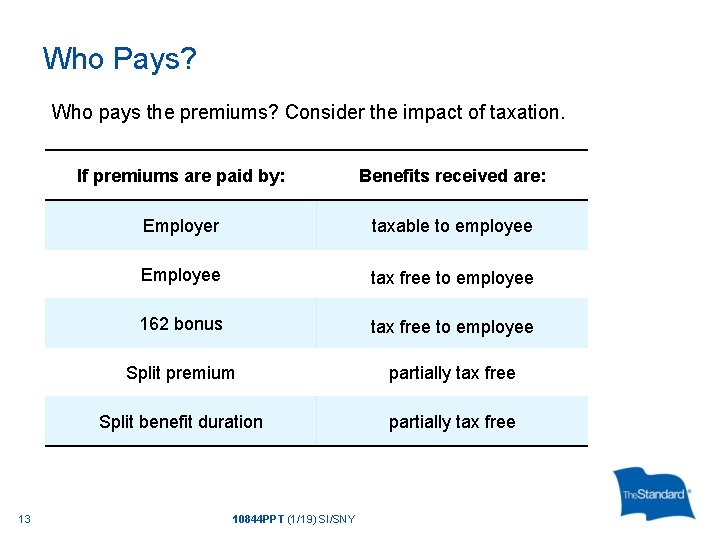
Who Pays? Who pays the premiums? Consider the impact of taxation. 13 If premiums are paid by: Benefits received are: Employer taxable to employee Employee tax free to employee 162 bonus tax free to employee Split premium partially tax free Split benefit duration partially tax free 10844 PPT (1/19) SI/SNY
Chism Ice Cream Company v. Commission of Internal Revenue 14 10844 PPT (1/19) SI/SNY
Chism Ice Cream Company v. Commission of Internal Revenue Chism Ice Cream Company v. Commissioner Chism v. CIR, T. C. Memo. 1962 -6, aff’d 322 F. 2 d 956 (9 th Cir. 1963) is just one of many federal tax court rulings that show ad hoc payments do not work. E. W. Chism founded Chism Ice Cream Company in 1905 and was the driving force behind the business throughout his life. Mr. Chism became the primary shareholder of the company when it was incorporated in 1933, and served as president of the company until his death in 1956. 15 10844 PPT (1/19) SI/SNY
Chism (cont’d) Mr. Chism was seriously incapacitated in 1952 and was no longer able to run the day-to-day operations of the company. Despite his incapacity, the company continued to pay Mr. Chism either the same or increased amounts of salary. Because Chism Ice Cream Company had an informal policy of paying employees while they recovered from illnesses and injuries, the company’s management assumed there was a sick-pay plan in place. The company continued to deduct the payments to Mr. Chism as a legitimate business expense, and these payments were treated by the company as “salary” on its books and in its corporate income tax returns. 16 10844 PPT (1/19) SI/SNY
Chism (cont’d) The IRS did not agree. Rather, the service denied the deductions claimed by the company for salary paid to Mr. Chism. The company took the case to the Tax Court, which held in favor of the IRS. The Tax Court ruled that no sick-pay plan had ever been put in place, no employees had been notified or advised of the existence of any such plan, nor did they have the right to demand benefits under such a plan. In other words, a portion of the “salary” paid to Mr. Chism represented excessive compensation for services rendered, which is not deductible by the company. 17 10844 PPT (1/19) SI/SNY
Chism (cont’d) The end result? Instead of deductible salary, the company had paid Mr. Chism nondeductible excessive compensation and dividends from 1952 to 1956. As a result of these non-deductible payments, the IRS collected a combined total of $45, 000 in back taxes, penalties and interest. 18 10844 PPT (1/19) SI/SNY
Case Considerations 19 10844 PPT (1/19) SI/SNY
Case Considerations Chism Ice Cream v. Commissioner, T. C. Memo 19626, affirmed 322 F. 2 d 956 (9 th Cir. 1963) USCA 1963 income continued during disability was considered dividends instead of salary and not deductible because there was no evidence of a formal plan and nothing had been communicated to the employees. 20 10844 PPT (1/19) SI/SNY
Case Considerations (cont’d) Larkin v. Commissioner, 48 T. C. 629, affirmed 394 F. 2 d 494 (1 st Cir. 1968) The court held that payments were not deductible to the employer as payments under a sick-pay plan. The court found that no plan had been communicated to employees and the ad hoc payments made by the company benefited shareholders rather than employees. Occhipinti v. Commissioner, T. C. Memo 1969 -191. The court denied any tax exclusion for payments to an employee under a company accident or health plan. The court found that there was a complete absence of evidence of a plan, formal or informal, maintained by the company for paying its employees during an illness. 21 10844 PPT (1/19) SI/SNY
Relevant Laws IRC, section 105 - Describes rules for taxation of amounts received by an employee under accident and health plans. IRC, section 106 - Provides that gross income of an employee does not include employer-provided coverage under an accident or health plan. IRC, section 162 - Describes ordinary and necessary business expenses, which may include bonus payments used to fund an accident and sickness plan. Employee Retirement Security Act of 1974 (ERISA) - Written plan must adhere to plan document requirements, reporting and disclosure rules, and fiduciary standards. Financial Accounting Standards Board Statement No. 112 (FAS 112) Requires self-funded accident and sickness plans to recognize and account for salary continuation benefits. 22 10844 PPT (1/19) SI/SNY
How to Get Started 23 1 Obtain census information 2 Make decisions about who to insure, for how much, and when to start and stop benefits 3 Consider premium and benefits tax considerations 4 See sample resolution and sample plan to attorney on following slides 10844 PPT (1/19) SI/SNY

Sample Resolution 24 10844 PPT (1/19) SI/SNY
Sample Resolution of Board of Directors A special meeting of the Board of Directors of _______was held at ____on ____at ______ o’clock. The following directors, constituting a quorum, were present: ______ The president of the corporation acted as chairman of the meeting, and the secretary of the corporation acted as secretary of the meeting. The chairman stated that the purpose of the meeting was to consider the adoption of Sick Pay Plans for certain key employees. After due discussion and upon motion made, seconded and approved, the following resolution was duly adopted: WHEREAS it is the desire of the corporation to establish Sick Pay Plans for certain key employees by providing any such employee with an income during disability due to sickness or injury, and thereby providing any such employee with an added incentive to continue his or her services to the corporation, and 25 10844 PPT (1/19) SI/SNY
Sample Resolution (cont’d) WHEREAS a method for accomplishing this purpose is provided for under Sections 105, 106 and 162 of the Internal Revenue Code, the Employee Retirement Income Security Act of 1974 (ERISA), the Tax Reform Act of 1976, the Social Security Amendments of 1983, and all rules, regulations and amendments pertaining to the aforesaid Code and Acts, partially tax free BE IT RESOLVED that Sick Pay Plans for certain key employees are hereby adopted in accordance with the aforesaid Code, Acts, rules, regulations and amendments, subject to the terms of the forms exhibited to the meeting, attached to these minutes, incorporated herein by this reference and made part hereof as if fully set out herein, and covering the following key employees: 26 10844 PPT (1/19) SI/SNY
Sample Resolution (cont’d) BE IT FURTHER RESOLVED that the appropriate officers of the corporation be, and they hereby are authorized and directed to take such steps as they deem necessary to establish said Sick Pay Plans and to make payments from the funds of the corporation each year as may be required thereunder. There being no further business before the meeting, the same was, upon motion made, seconded and carried, duly adjourned. Date Secretary This is a sample document only. The legal and tax consequences of any business resolution should be reviewed by the client’s legal and tax counsel. 27 10844 PPT (1/19) SI/SNY
Sample Salary Continuation Plan Resolution 28 10844 PPT (1/19) SI/SNY
Sample Salary Continuation Plan Resolution The undersigned secretary of _______ , does hereby certify that: A special meeting of the Board of Directors of ____ , was held at the office of the corporation at ____, on ____, ______ at ______ o’clock for the purpose of acting upon a proposal that the corporation establish a Salary Continuation Plan for certain employees of the firm. ______ was Chairperson of the meeting and ______ acted as Secretary. The meeting was called to order by the Chairperson and minutes were recorded by the Secretary. A waiver of notice of the meeting, duly executed and dated ____, ___ was presented. A quorum of Directors was present. 29 10844 PPT (1/19) SI/SNY
Sample Salary Continuation Plan Resolution (cont’d) The Chairperson stated that the purpose of the meeting was to authorize and direct that the necessary steps be taken to place in operation a Salary Continuation Plan for certain valuable employees. Discussion followed, and thereafter, upon motion duly made and seconded, the following resolution was adopted by unanimous vote. RESOLVED, that the Corporation establish a Salary Continuation Plan to pay the following benefits to the following eligible employees: Group I Employees: [list employee names] The Corporation will pay all employees in Group I full (100%) salary for the initial_____ weeks/months of total disability and three-fourths (75%) salary for the next _____ weeks/months of continuing total disability and one-half (50%) salary for the next _____ weeks/months of continuing total disability. 30 10844 PPT (1/19) SI/SNY
![Sample Salary Continuation Plan Resolution (cont’d) Group II Employees: [list employee names] The Corporation](http://slidetodoc.com/presentation_image_h2/a6d6fafdf0cfda1b2f3522970191bd89/image-31.jpg "Sample Salary Continuation Plan Resolution (cont’d) Group II Employees: [list employee names] The Corporation")
Sample Salary Continuation Plan Resolution (cont’d) Group II Employees: [list employee names] The Corporation will pay all employees in Group II full (100%) salary for the initial_____ weeks/months of total disability and one-half (50%) salary for the next _____ weeks/months of continuing total disability. Group III Employees: [list employee names] The Corporation will pay all employees in Group III full (100%) salary for the initial_____ weeks/months of total disability and ____ % salary for the next _____ weeks/months of continuing total disability. This is a sample document only. The legal and tax consequences of any business resolution should be reviewed by the client’s legal and tax counsel. 31 10844 PPT (1/19) SI/SNY
Sample Salary Continuation Plan Resolution (cont’d) BE IT FURTHER RESOLVED, that the Corporation shall satisfy these obligations by purchasing appropriate disability income insurance policies from The Standard, on the lives of all eligible employees who are insurable at rates not exceeding ___ % of standard premiums. If an eligible employee is not so insurable, the Corporation shall create a sinking fund for future use by periodically contributing an amount equal to ____% of standard premiums on that employee. Corporate officers are authorized and instructed to pay the premium on all policies as they become due. 32 10844 PPT (1/19) SI/SNY
Sample Salary Continuation Plan Resolution (cont’d) Also, any insured employee shall be notified that he or she has the option of having all, or part, of the cost of any such policies on his or her life treated as additional compensation. Should this option not be selected by the employee, it shall be made clear that all premium payments will be made as part of this plan and not treated as additional compensation. Benefits paid to the employee in this case will be taxable. For purposes of this plan, the definition of total disability shall be as defined in the above policies. 33 10844 PPT (1/19) SI/SNY
Sample Salary Continuation Plan Resolution (cont’d) The funds necessary to pay benefits under this plan shall come from disability income insurance contracts and the general assets of the Corporation, as necessary. Each insured employee shall be the Owner and Loss Payee of all insurance contracts purchased under this plan. Dated Secretary On this date I have read and understand the above plan and the benefits provided for me. Dated Employee This is a sample document only. The legal and tax consequences of any business resolution should be reviewed by the client’s legal and tax counsel. 34 10844 PPT (1/19) SI/SNY
The Standard is a marketing name for Stan. Corp Financial Group, Inc. and subsidiaries. Insurance products are offered by Standard Insurance Company of 1100 SW Sixth Avenue, Portland, Oregon, in all states except New York, where insurance products are offered by The Standard Life Insurance Company of New York of 333 Westchester Avenue, West Building, Suite 300, White Plains, New York. Product features and availability vary by state and company, and are solely the responsibility of each subsidiary. Each company is solely responsible for its own financial condition. Standard Insurance Company is licensed to solicit insurance business in all states except New York. The Standard Life Insurance Company of New York is licensed to solicit insurance business in only the state of New York.
- Slides: 35