
About Position Descriptions TREY TRAINUM What is a
About Position Descriptions TREY TRAINUM
What is a Position Description? ◦ Structured document that gives an overview of a job position, which includes: ◦ The details of essential duties of a position ◦ The frequency those duties are performed ◦ The requirements a candidate must meet in order to successfully fill that position ◦ (experiential, educational, certifications, as well as internal compliance requirements)
Why are PD’s important? ◦ They are a written record for what employees are personally responsible for ◦ What the supervisor should reasonably expect from the employee ◦ Better candidate pool for hiring ◦ the better the position description, the more “on base” those that apply for the position are going to be ◦ In case any legal issues arise, there is documentation ◦ Lawsuits do happen, and the more documentation the better
Who writes PDs? o ANY hiring manager in ANY department. o If you are requesting the creation of a new position, you are the one writing the position description
Who writes PDs? ◦ But wait, writing position descriptions sounds like administrative work. Isn’t that what HR is for? ◦ You’re right, writing PDs is administrative work! But, as a hiring manager, you are going to be the person who best knows how to fulfill your own needs. ◦ how much time a position takes to do certain tasks ◦ what those tasks will be ◦ qualifications to complete those tasks.

Classification o The designation of a new position to an appropriate class based upon overall duties, complexity, and responsibility of assigned work. o Classification Title o Regular/Temp o Pay Group o Full-time/Part-time o Job Code o Standard Hours o Salary Plan o Pay Grade o FLSA Status o Compensation Frequency
Sections of a Job Description ◦ Position Title ◦ Should be short, descriptive and follow naming patterns ◦ Electrician I / Electrician II ◦ Academic Advisor / Senior Academic Advisor ◦ Public Safety Officer / Public Safety Sergeant ◦ Systems Services Assistant / Systems Services Coordinator
Sections of a Job Description ◦ Position Number ◦ Generated by budget ◦ Reference to the account string that pays the individual ◦ There may be more than one identical positions, and in several different departments, but are funded by different account strings
Sections of a Job Description ◦ Salary ◦ Based upon pre-set pay grade hierarchy ◦ Can be found on HR website under the Classification and Compensation page. ◦ During the creation of new positions where a predecessor does not exist, how do we know how much this position gets paid? ◦ HR looks up salaries for same positions in comparable universities ◦ Ernest Smith (Class & Compensation) ◦ Maximum 10% increase from base pay for exceptionally qualified candidates for staff ◦ For faculty we do not advertise salary ◦ “commensurate with experience”
Sections of a Job Description ◦ General Summary of Responsibilities ◦ Overview of position, usually about a paragraph ◦ Describes scope of duties and responsibilities ◦ Not a daily breakdown of every minute detail of position, but rather a “big picture” view. ◦ Should still be descriptive enough to convey to applicants if they are qualified or not
Sections of a Job Description ◦ Required Qualifications ◦ Means exactly that—any kind of experience, education, certifications or credentials that a candidate must have to be considered for a position. ◦ Not meant to be flexible, these are minimum requirements ◦ Disqualifier in the application process
Sections of a Job Description ◦ Preferred Qualifications ◦ Any experience/education/certifications/credentials that a candidate should have to be considered for a position, but does not necessarily disqualify them if they do not have. ◦ Meant to be flexible whereas required qualifications are not.
Sections of a Job Description ◦ Data Involvement ◦ Describes what type of data the employee works with ◦ Can be administrative or technical ◦ Data collection, evaluation or analysis ◦ Statistical processes, or general mathematical calculations ◦ Utilization of numerical systems ◦ Inventory system, library catalogue systems
Sections of a Job Description ◦ Knowledge, Skills, and Abilities ◦ The attributes required to perform a job and are generally demonstrated through qualifying service, education, or training ◦ Knowledge: A body of information applied directly to the performance of a function. ◦ Skills: An observable competence used to perform duties. ◦ Abilities: Competence and potential to perform duties.
Sections of a Job Description ◦ Knowledge, Skills, and Abilities ◦ Knowledge: Knowledge of Library policies and procedures. Knowledge of card catalog system. ◦ Skills: Operate, assess, and troubleshoot hardware and software. And technical equipment issues. Develop, implement, and/or use tools. Perform repairs. ◦ Abilities: Able to give and receive verbal and written information and instructions. Able to perform mathematical calculations related to cash transaction duties.
Sections of a Job Description ◦ Supervisory and Leadership Responsibilities ◦ Description of people, projects, or systems it will be that will be the in the responsibility of the employee. ◦ Communication of instructions, disseminate information regarding policy and procedures, give performance feedback, coordinate work activities ◦ Not necessarily just for employees in positions of management ◦ For example, a full-time non-supervisory staff employee at the library may also work with student workers for example, or need to help train new hires as they come along.
Sections of a Job Description ◦ Decision Making ◦ Conveys how fluid, complex and dynamic the environment is for those in the position, if at all ◦ What will those decisions be and how often will they need to make them? ◦ Example: interpretation of procedures (, problem solving, financial decisions ◦ What is the impact of that position’s decision making? ◦ How much its hurts/helps the university if they made a wrong/right decision
Sections of a Job Description o Financial Authority o What financial responsibility does this position have? o Handling cash transactions o Preparing or processing purchase orders o Management of inventory, property or loss control o Purchasing authority o Access to university funds o Contract procurement
Sections of a Job Description ◦ Tools and Equipment Usage ◦ What tools and equipment the position requires use of ◦ Can be from office equipment to machinery ◦ ◦ ◦ Office machines such as copiers or calculators Computers for data entry, word processing, spreadsheets, etc Large shop equipment and machines Repair of any tools and equipment Supervision of others using tools and equipment

Sections of a Job Description Education, Experience, and Certification/License qualifications ◦ May be redundant to “required qualifications”, but can be more in depth. ◦ Masters degree may be listed as a “required qualification” ◦ “Masters degree in psychology with a focus on clinical/counseling and Marriage, Family & Child Counseling (MFCC) license” is an example of what to put in Education, Experience and Cert qualifications
Sections of a Job Description ◦ Physical Requirements ◦ What physical capabilities a candidate absolutely must have in order to successfully perform essential job functions. ◦ Think about what you actually are requiring for the position, and if it makes sense. ◦ A disabled person’s inability to perform a nonessential function is not a valid basis for disqualifying that person from employment. Therefore it is best to stay away from discriminating statements in the Physical Requirements section of the position description.
Sections of a Job Description ◦ Why is it such a big deal? ◦ American Disabilities Act prohibits discrimination against people with disabilities in employment. ◦ Infringing on the right to equal employment is a violation of federal law. ◦ Must provide those with disabilities reasonable accommodation and cannot exclude them from the hiring process if reasonable accommodation allows them to perform.
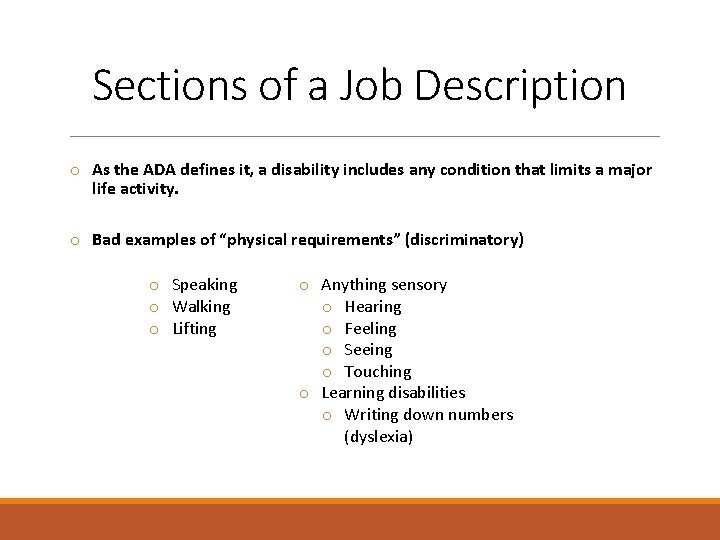
Sections of a Job Description o As the ADA defines it, a disability includes any condition that limits a major life activity. o Bad examples of “physical requirements” (discriminatory) o Speaking o Walking o Lifting o Anything sensory o Hearing o Feeling o Seeing o Touching o Learning disabilities o Writing down numbers (dyslexia)
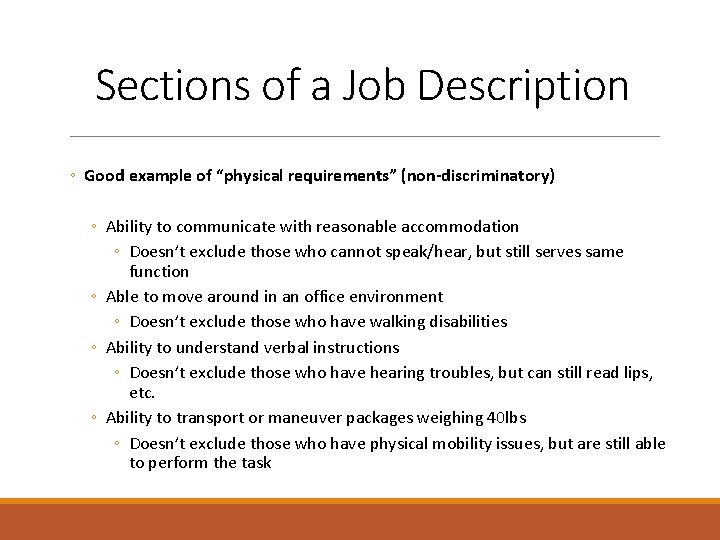
Sections of a Job Description ◦ Good example of “physical requirements” (non-discriminatory) ◦ Ability to communicate with reasonable accommodation ◦ Doesn’t exclude those who cannot speak/hear, but still serves same function ◦ Able to move around in an office environment ◦ Doesn’t exclude those who have walking disabilities ◦ Ability to understand verbal instructions ◦ Doesn’t exclude those who have hearing troubles, but can still read lips, etc. ◦ Ability to transport or maneuver packages weighing 40 lbs ◦ Doesn’t exclude those who have physical mobility issues, but are still able to perform the task
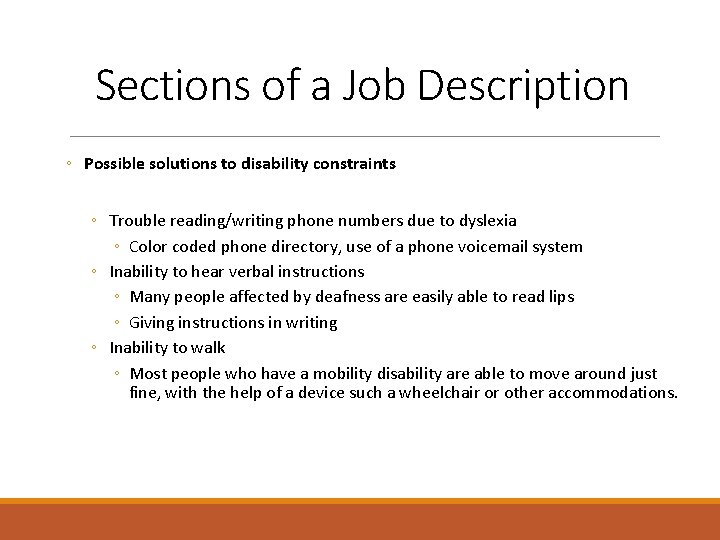
Sections of a Job Description ◦ Possible solutions to disability constraints ◦ Trouble reading/writing phone numbers due to dyslexia ◦ Color coded phone directory, use of a phone voicemail system ◦ Inability to hear verbal instructions ◦ Many people affected by deafness are easily able to read lips ◦ Giving instructions in writing ◦ Inability to walk ◦ Most people who have a mobility disability are able to move around just fine, with the help of a device such a wheelchair or other accommodations.
Sections of a Job Description ◦ If you are unsure if your language is discriminatory there are plenty of resources for you to use: ◦ Department of Labor, Office of Disability Employment Policy ◦ www. dol. gov/odep/pubs/misc/job. htm ◦ VSU’s Office of Social Equity ◦ VSU’s HR Department
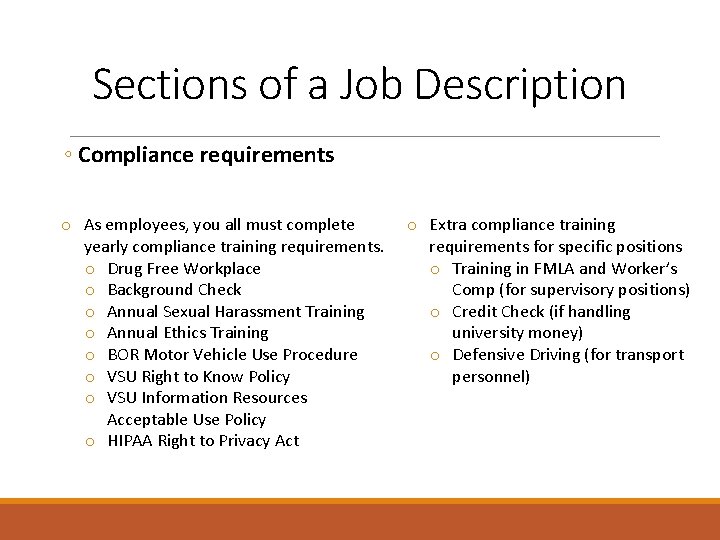
Sections of a Job Description ◦ Compliance requirements o As employees, you all must complete yearly compliance training requirements. o Drug Free Workplace o Background Check o Annual Sexual Harassment Training o Annual Ethics Training o BOR Motor Vehicle Use Procedure o VSU Right to Know Policy o VSU Information Resources Acceptable Use Policy o HIPAA Right to Privacy Act o Extra compliance training requirements for specific positions o Training in FMLA and Worker’s Comp (for supervisory positions) o Credit Check (if handling university money) o Defensive Driving (for transport personnel)
Sections of a Job Description ◦ Information Technology ◦ What kind of information technology will this position require use of? ◦ Everyone should require at least two: ◦ Banner access ◦ ADP Self-Service
Sections of a Job Description ◦ Essential Duties ◦ Key Responsibilities of the position, showing the frequency of each duty ◦ Important to applicants, so they understand how much of their time will be dedicated to specific duties ◦ Big difference between answering phones 10% of the time and 90% of the time
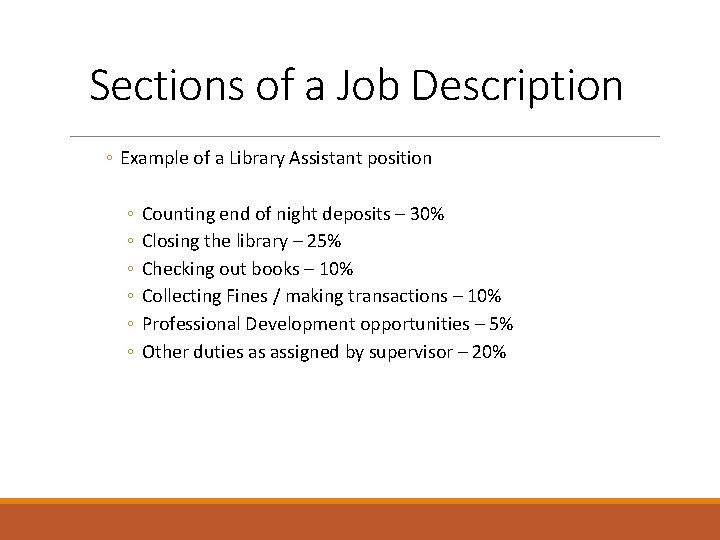
Sections of a Job Description ◦ Example of a Library Assistant position ◦ ◦ ◦ Counting end of night deposits – 30% Closing the library – 25% Checking out books – 10% Collecting Fines / making transactions – 10% Professional Development opportunities – 5% Other duties as assigned by supervisor – 20%
- Slides: 30