
About OMICS Group International is an amalgamation of
About OMICS Group International is an amalgamation of Open Access publications and worldwide international science conferences and events. Established in the year 2007 with the sole aim of making the information on Sciences and technology ‘Open Access’, OMICS Group publishes 400 online open access scholarly journals in all aspects of Science, Engineering, Management and Technology journals. OMICS Group has been instrumental in taking the knowledge on Science & technology to the doorsteps of ordinary men and women. Research Scholars, Students, Libraries, Educational Institutions, Research centers and the industry are main stakeholders that benefitted greatly from this knowledge dissemination. OMICS Group also organizes 300 International conferences annually across the globe, where knowledge transfer takes place through debates, round table discussions, poster presentations, workshops, symposia and exhibitions.
About OMICS Group Conferences OMICS Group International is a pioneer and leading science event organizer, which publishes around 400 open access journals and conducts over 300 Medical, Clinical, Engineering, Life Sciences, Phrama scientific conferences all over the globe annually with the support of more than 1000 scientific associations and 30, 000 editorial board members and 3. 5 million followers to its credit. OMICS Group has organized 500 conferences, workshops and national symposiums across the major cities including San Francisco, Las Vegas, San Antonio, Omaha, Orlando, Raleigh, Santa Clara, Chicago, Philadelphia, Baltimore, United Kingdom, Valencia, Dubai, Beijing, Hyderabad, Bengaluru and Mumbai.
High-Performance Nonaqueous Li-Organic Hybrid Redox Flow Batteries: A Pursuit of High Energy Density Xiaoliang Wei, Wu Xu, Lelia Cosimbescu, Tianbiao Liu, M. Vijayakumar, Jianzhi Hu, Jun Liu, Wei Wang, Vincent Sprenkle Pacific Northwest National Laboratory, Richland, WA 99354 Third International Conference and Exhibition on Materials Science & Engineering San Antonio, USA October 06, 2014
Outline of This Talk Ø Background of redox flow battery § Aqueous vs non-aqueous § Our Strategy Ø Flow cell performance and analysis Ø Conclusion and future work 4
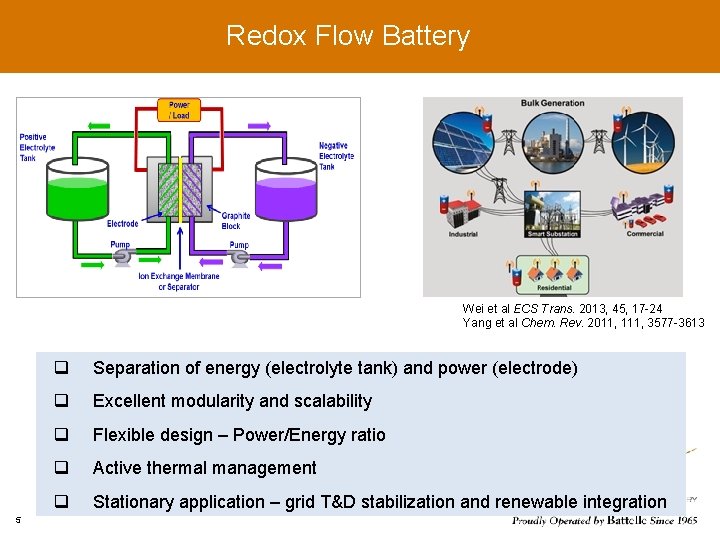
Redox Flow Battery Wei et al ECS Trans. 2013, 45, 17 -24 Yang et al Chem. Rev. 2011, 111, 3577 -3613 5 q Separation of energy (electrolyte tank) and power (electrode) q Excellent modularity and scalability q Flexible design – Power/Energy ratio q Active thermal management q Stationary application – grid T&D stabilization and renewable integration
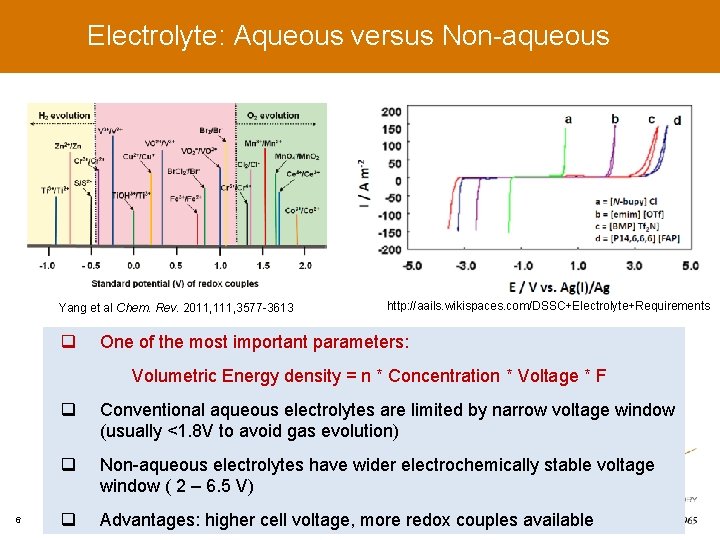
Electrolyte: Aqueous versus Non-aqueous Yang et al Chem. Rev. 2011, 111, 3577 -3613 q http: //aails. wikispaces. com/DSSC+Electrolyte+Requirements One of the most important parameters: Volumetric Energy density = n * Concentration * Voltage * F 6 q Conventional aqueous electrolytes are limited by narrow voltage window (usually <1. 8 V to avoid gas evolution) q Non-aqueous electrolytes have wider electrochemically stable voltage window ( 2 – 6. 5 V) q Advantages: higher cell voltage, more redox couples available
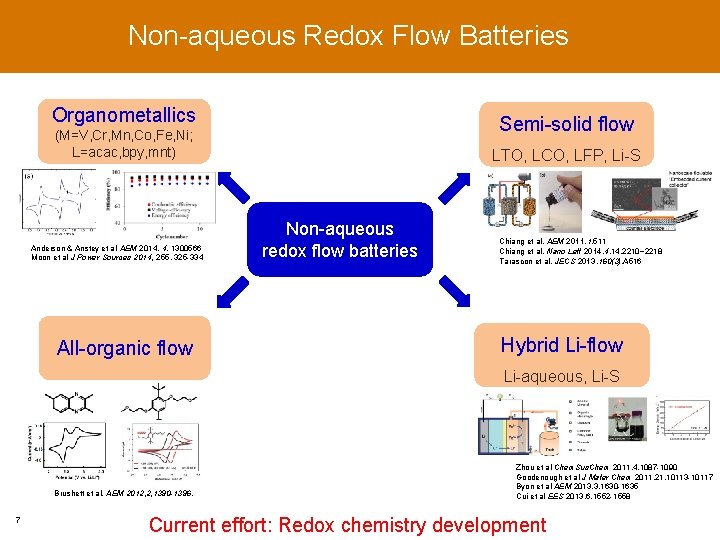
Non-aqueous Redox Flow Batteries Organometallics Semi-solid flow (M=V, Cr, Mn, Co, Fe, Ni; L=acac, bpy, mnt) Anderson & Anstey et al AEM 2014, 4, 1300566 Moon et al J Power Sources 2014, 255, 325 -334 All-organic flow LTO, LCO, LFP, Li-S Non-aqueous redox flow batteries Chiang et al, AEM 2011, 1, 511 Chiang et al, Nano Lett 2014, 4, 14, 2210− 2218 Tarascon et al, JECS 2013, 160(3), A 516 Hybrid Li-flow Li-aqueous, Li-S Brushett et al. AEM 2012, 2, 1390 -1396. 7 Zhou et al Chem. Sus. Chem 2011, 4, 1087 -1090 Goodenough et al J Mater Chem 2011, 21, 10113 -10117 Byon et al AEM 2013, 3, 1630 -1635 Cui et al EES 2013, 6, 1552 -1558 Current effort: Redox chemistry development
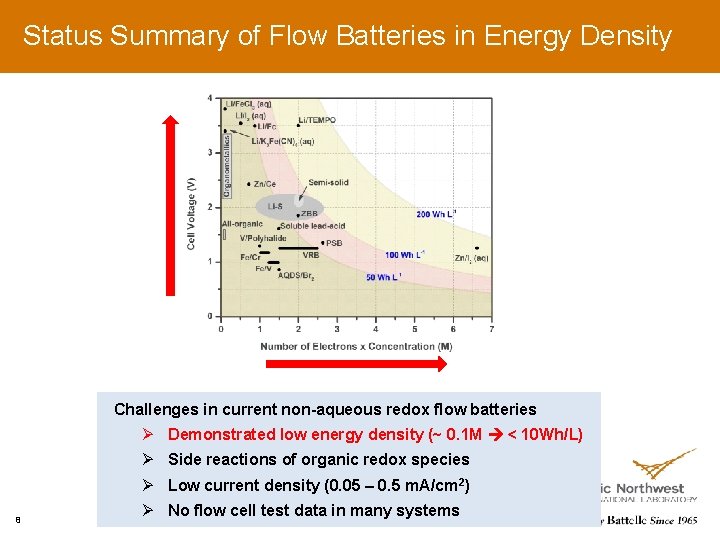
Status Summary of Flow Batteries in Energy Density Challenges in current non-aqueous redox flow batteries Ø Demonstrated low energy density (~ 0. 1 M < 10 Wh/L) Ø Side reactions of organic redox species Ø Low current density (0. 05 – 0. 5 m. A/cm 2) 8 Ø No flow cell test data in many systems
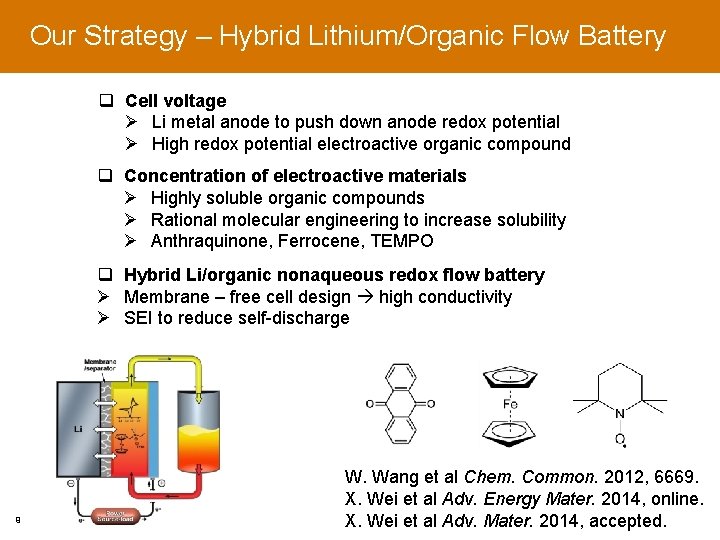
Our Strategy – Hybrid Lithium/Organic Flow Battery q Cell voltage Ø Li metal anode to push down anode redox potential Ø High redox potential electroactive organic compound q Concentration of electroactive materials Ø Highly soluble organic compounds Ø Rational molecular engineering to increase solubility Ø Anthraquinone, Ferrocene, TEMPO q Hybrid Li/organic nonaqueous redox flow battery Ø Membrane – free cell design high conductivity Ø SEI to reduce self-discharge 9 W. Wang et al Chem. Common. 2012, 6669. X. Wei et al Adv. Energy Mater. 2014, online. X. Wei et al Adv. Mater. 2014, accepted.
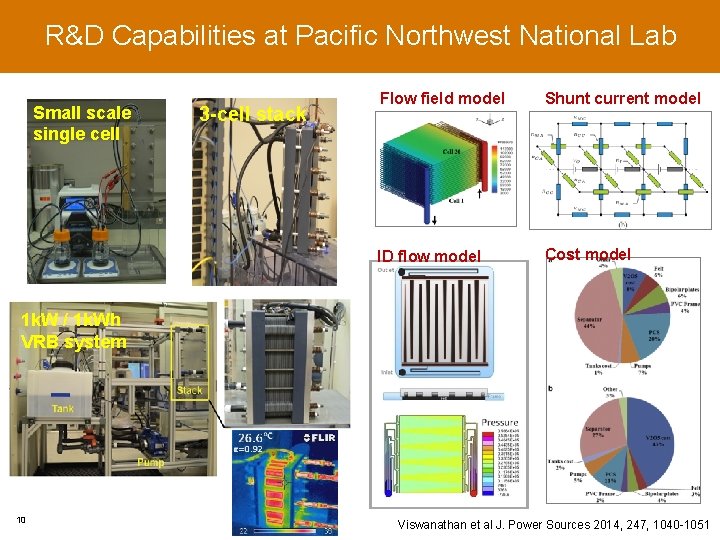
R&D Capabilities at Pacific Northwest National Lab Small scale single cell 3 -cell stack Flow field model Shunt current model ID flow model Cost model 1 k. W / 1 k. Wh VRB system 10 Viswanathan et al J. Power Sources 2014, 247, 1040 -1051
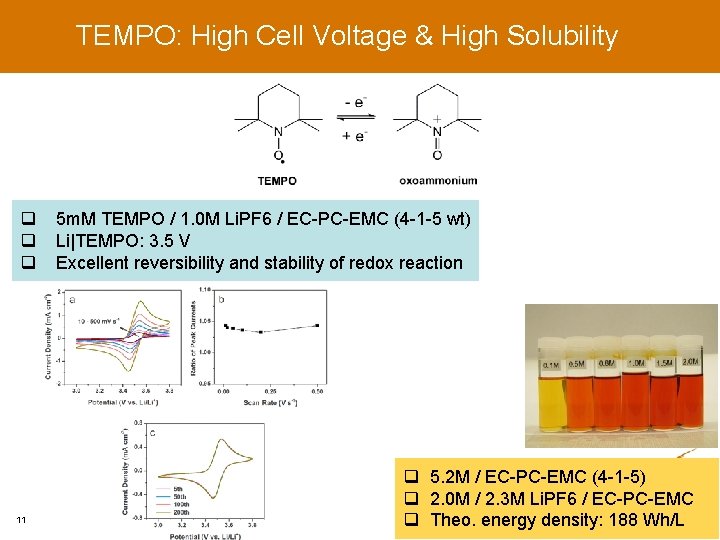
TEMPO: High Cell Voltage & High Solubility q q q 11 5 m. M TEMPO / 1. 0 M Li. PF 6 / EC-PC-EMC (4 -1 -5 wt) Li|TEMPO: 3. 5 V Excellent reversibility and stability of redox reaction q 5. 2 M / EC-PC-EMC (4 -1 -5) q 2. 0 M / 2. 3 M Li. PF 6 / EC-PC-EMC q Theo. energy density: 188 Wh/L
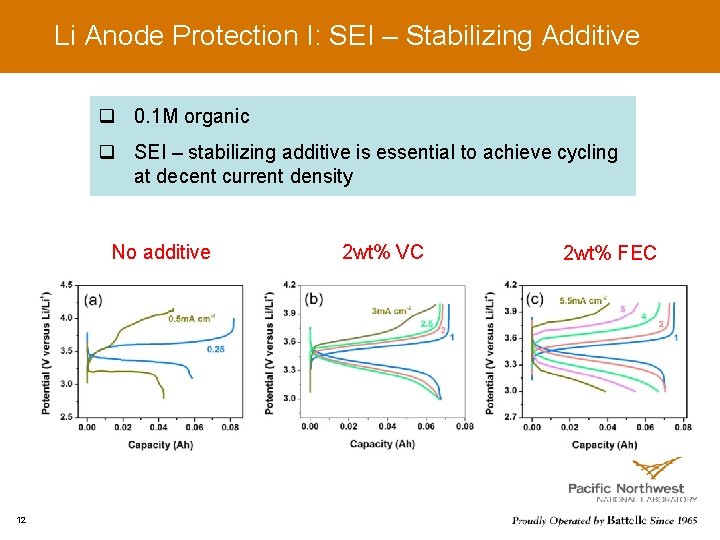
Li Anode Protection I: SEI – Stabilizing Additive q 0. 1 M organic q SEI – stabilizing additive is essential to achieve cycling at decent current density No additive 12 2 wt% VC 2 wt% FEC
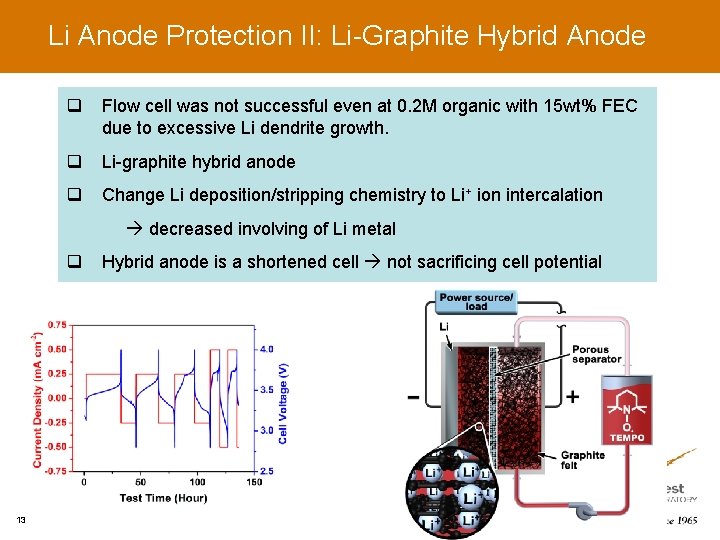
Li Anode Protection II: Li-Graphite Hybrid Anode q Flow cell was not successful even at 0. 2 M organic with 15 wt% FEC due to excessive Li dendrite growth. q Li-graphite hybrid anode q Change Li deposition/stripping chemistry to Li+ ion intercalation decreased involving of Li metal q 13 Hybrid anode is a shortened cell not sacrificing cell potential
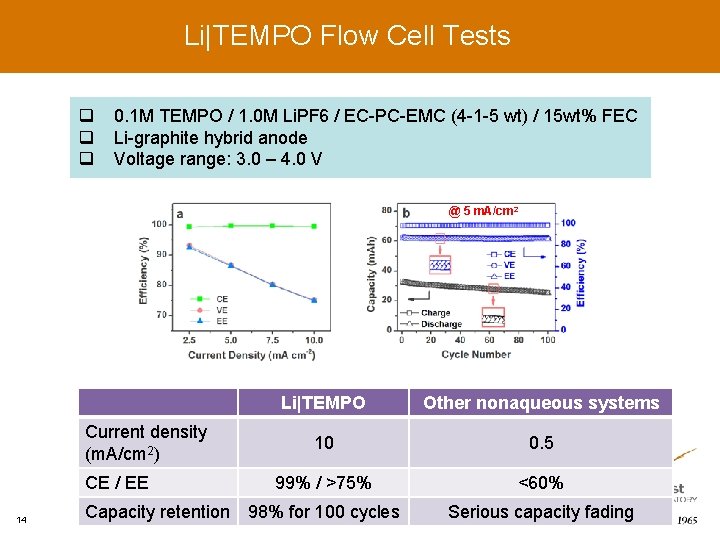
Li|TEMPO Flow Cell Tests q q q 0. 1 M TEMPO / 1. 0 M Li. PF 6 / EC-PC-EMC (4 -1 -5 wt) / 15 wt% FEC Li-graphite hybrid anode Voltage range: 3. 0 – 4. 0 V @ 5 m. A/cm 2 Current density (m. A/cm 2) CE / EE 14 Li|TEMPO Other nonaqueous systems 10 0. 5 99% / >75% <60% Capacity retention 98% for 100 cycles Serious capacity fading
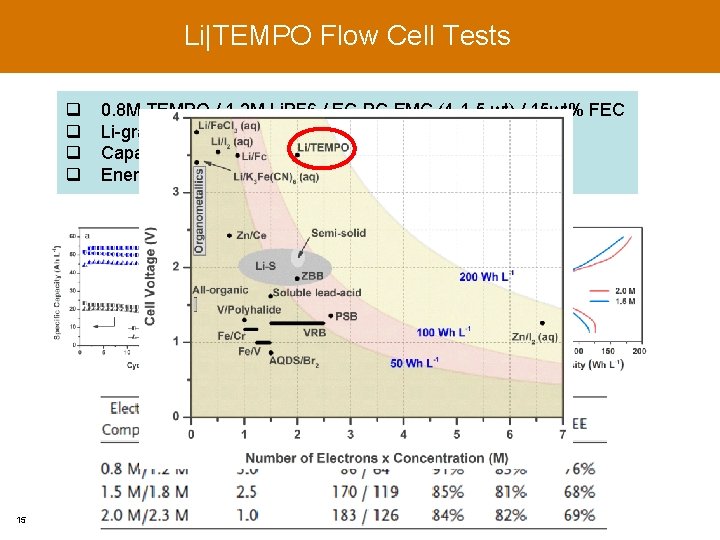
Li|TEMPO Flow Cell Tests q q 15 0. 8 M TEMPO / 1. 2 M Li. PF 6 / EC-PC-EMC (4 -1 -5 wt) / 15 wt% FEC Li-graphite hybrid anode Capacity decay due to increased cell overpotential Energy density delivery: 126 Wh/L
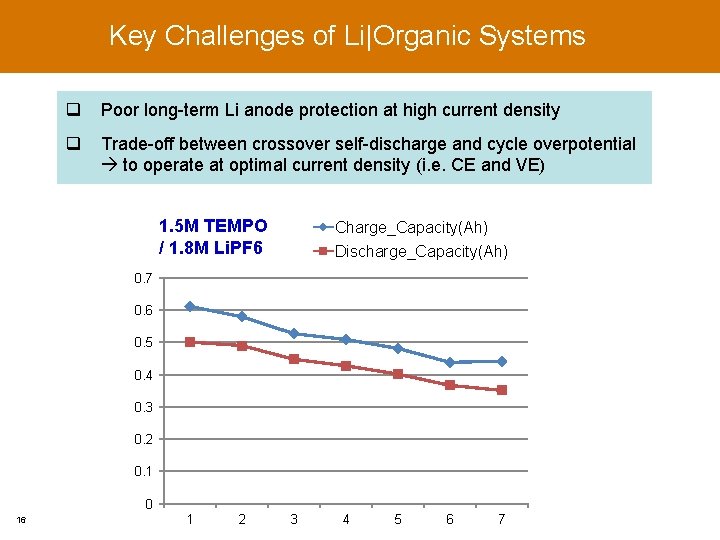
Key Challenges of Li|Organic Systems q Poor long-term Li anode protection at high current density q Trade-off between crossover self-discharge and cycle overpotential to operate at optimal current density (i. e. CE and VE) 1. 5 M TEMPO / 1. 8 M Li. PF 6 Charge_Capacity(Ah) Discharge_Capacity(Ah) 0. 7 0. 6 0. 5 0. 4 0. 3 0. 2 0. 1 0 16 1 2 3 4 5 6 7
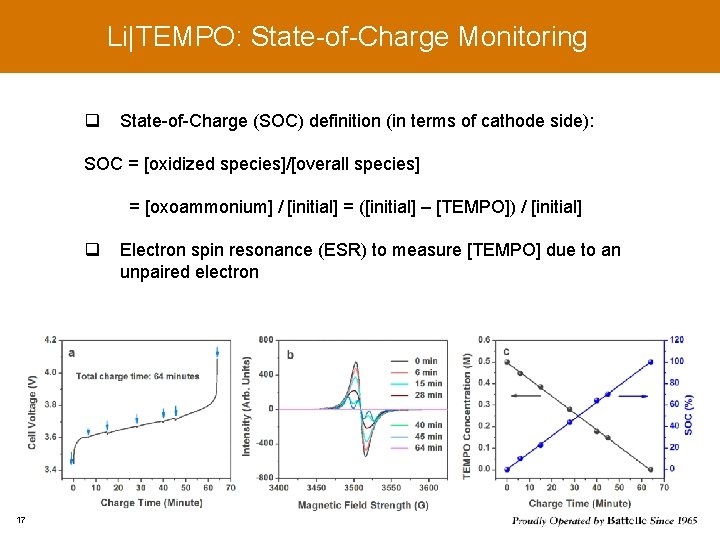
Li|TEMPO: State-of-Charge Monitoring q State-of-Charge (SOC) definition (in terms of cathode side): SOC = [oxidized species]/[overall species] = [oxoammonium] / [initial] = ([initial] – [TEMPO]) / [initial] q 17 Electron spin resonance (ESR) to measure [TEMPO] due to an unpaired electron
Conclusions 18 q We have successfully demonstrated hybrid Li-organic redox flow batteries based on several organic candidates. q Hybrid anode and electrolyte additive provide synergistic protection to the Li metal anode, making flow cell tests at high catholyte concentrations feasible. q Li|TEMPO delivers an energy density of 126 Wh/L, an order of magnitude higher than other nonaqueous flow chemistries. q Key challenge is long-term anode protection. Alternative anode candidates are being studied.
Acknowledgements q Financial Support from financial support from the U. S. DOE’s Office of Electricity Delivery & Energy Reliability (OE): Dr. Imre Gyuk. q PNNL’s William R. Wiley Environmental Molecular Sciences Laboratory (EMSL) for ESR measurement. q Team members: Vincent Sprenkle, Wei Wang, Wu Xu, Jun Liu, Tianbiao Liu, Bin Li, M. Vijayakumar, Yuyan Shao, Jie Xiao, etc. 19

Let Us Meet Again We welcome you all to our future conferences of OMICS Group International Please Visit: http: //materialsscience. conferenceseries. com/ Contact us at materialsscience. conference@omicsgroup. us materialsscience@omicsgroup. com
- Slides: 20