
About OMICS Group International is an amalgamation of
About OMICS Group International is an amalgamation of Open Access publications and worldwide international science conferences and events. Established in the year 2007 with the sole aim of making the information on Sciences and technology ‘Open Access’, OMICS Group publishes 400 online open access scholarly journals in all aspects of Science, Engineering, Management and Technology journals. OMICS Group has been instrumental in taking the knowledge on Science & technology to the doorsteps of ordinary men and women. Research Scholars, Students, Libraries, Educational Institutions, Research centers and the industry are main stakeholders that benefitted greatly from this knowledge dissemination. OMICS Group also organizes 300 International conferences annually across the globe, where knowledge transfer takes place through debates, round table discussions, poster presentations, workshops, symposia and exhibitions.
About OMICS Group Conferences OMICS Group International is a pioneer and leading science event organizer, which publishes around 400 open access journals and conducts over 300 Medical, Clinical, Engineering, Life Sciences, Pharma scientific conferences all over the globe annually with the support of more than 1000 scientific associations and 30, 000 editorial board members and 3. 5 million followers to its credit. OMICS Group has organized 500 conferences, workshops and national symposiums across the major cities including San Francisco, Las Vegas, San Antonio, Omaha, Orlando, Raleigh, Santa Clara, Chicago, Philadelphia, Baltimore, United Kingdom, Valencia, Dubai, Beijing, Hyderabad, Bengaluru and Mumbai.
3 An integrated model for dendrite growth simulation in selective laser melting CHEN Wenhao TILITA, George Alexandru KWAN, Charles C. F. ; YUEN, Matthew M. F. Department of Mechanical and Aerospace Engineering The Hong Kong University of Science and Technology
OUTLINE • Background and objective • Model description • Model validation with literature • Conclusion 4
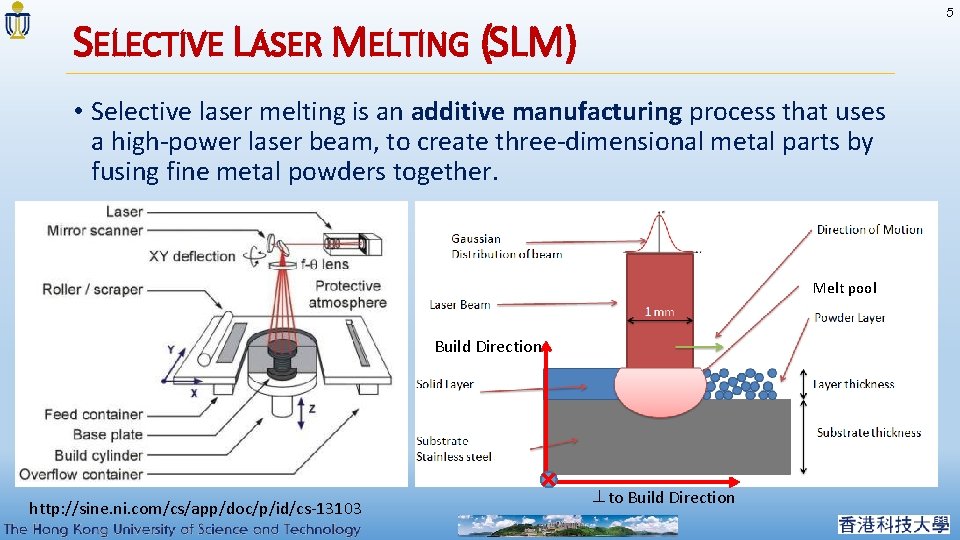
5 SELECTIVE LASER MELTING (SLM) • Selective laser melting is an additive manufacturing process that uses a high-power laser beam, to create three-dimensional metal parts by fusing fine metal powders together. Melt pool Build Direction http: //sine. ni. com/cs/app/doc/p/id/cs-13103 ⊥to Build Direction
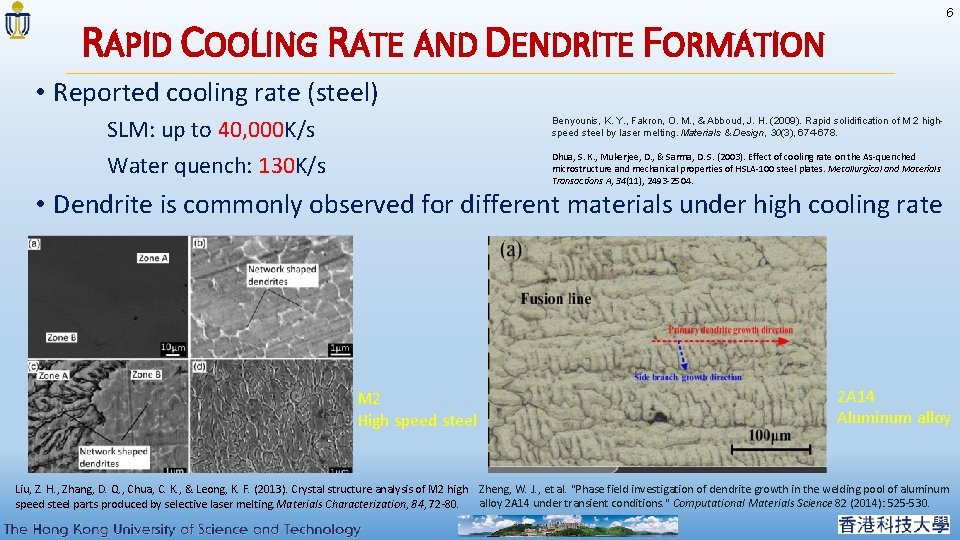
6 RAPID COOLING RATE AND DENDRITE FORMATION • Reported cooling rate (steel) SLM: up to 40, 000 K/s Water quench: 130 K/s Benyounis, K. Y. , Fakron, O. M. , & Abboud, J. H. (2009). Rapid solidification of M 2 highspeed steel by laser melting. Materials & Design, 30(3), 674 -678. Dhua, S. K. , Mukerjee, D. , & Sarma, D. S. (2003). Effect of cooling rate on the As-quenched microstructure and mechanical properties of HSLA-100 steel plates. Metallurgical and Materials Transactions A, 34(11), 2493 -2504. • Dendrite is commonly observed for different materials under high cooling rate M 2 High speed steel 2 A 14 Aluminum alloy Liu, Z. H. , Zhang, D. Q. , Chua, C. K. , & Leong, K. F. (2013). Crystal structure analysis of M 2 high Zheng, W. J. , et al. "Phase field investigation of dendrite growth in the welding pool of aluminum alloy 2 A 14 under transient conditions. " Computational Materials Science 82 (2014): 525 -530. speed steel parts produced by selective laser melting. Materials Characterization, 84, 72 -80.
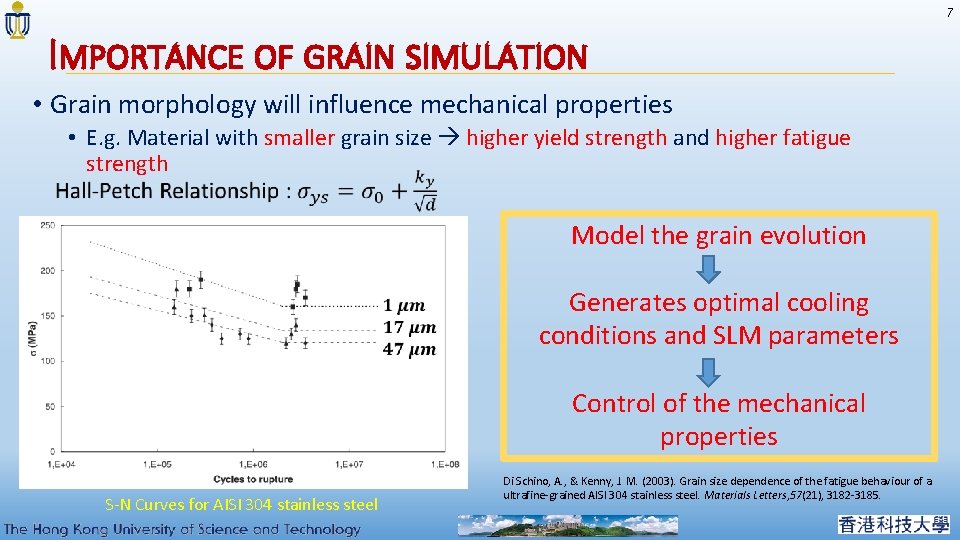
7 IMPORTANCE OF GRAIN SIMULATION • Grain morphology will influence mechanical properties • E. g. Material with smaller grain size higher yield strength and higher fatigue strength Model the grain evolution Generates optimal cooling conditions and SLM parameters S-N of steel S-N Curves for AISI 304 stainless steel Control of the mechanical properties Di Schino, A. , & Kenny, J. M. (2003). Grain size dependence of the fatigue behaviour of a ultrafine-grained AISI 304 stainless steel. Materials Letters, 57(21), 3182 -3185.
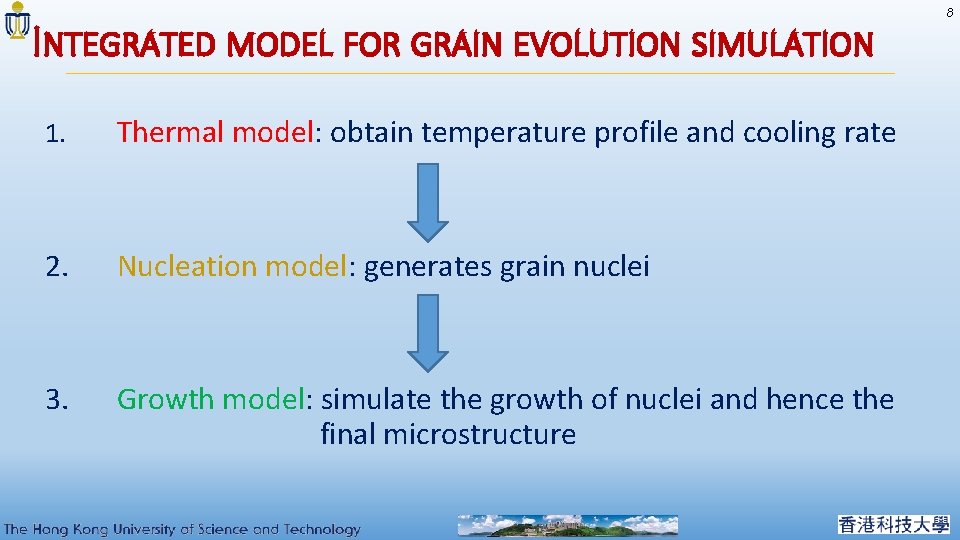
INTEGRATED MODEL FOR GRAIN EVOLUTION SIMULATION 1. Thermal model: obtain temperature profile and cooling rate 2. Nucleation model: generates grain nuclei 3. Growth model: simulate the growth of nuclei and hence the final microstructure 8
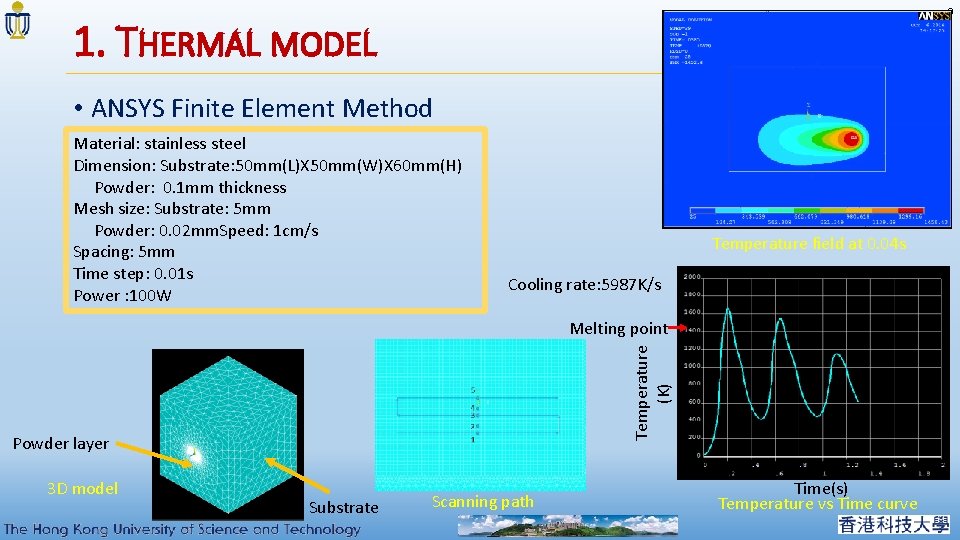
9 1. THERMAL MODEL • ANSYS Finite Element Method Material: stainless steel Dimension: Substrate: 50 mm(L)X 50 mm(W)X 60 mm(H) Powder: 0. 1 mm thickness Mesh size: Substrate: 5 mm Powder: 0. 02 mm. Speed: 1 cm/s Spacing: 5 mm Time step: 0. 01 s Power : 100 W Temperature field at 0. 04 s Cooling rate: 5987 K/s Temperature (K) Melting point Powder layer 3 D model Substrate Scanning path Time(s) Temperature vs Time curve
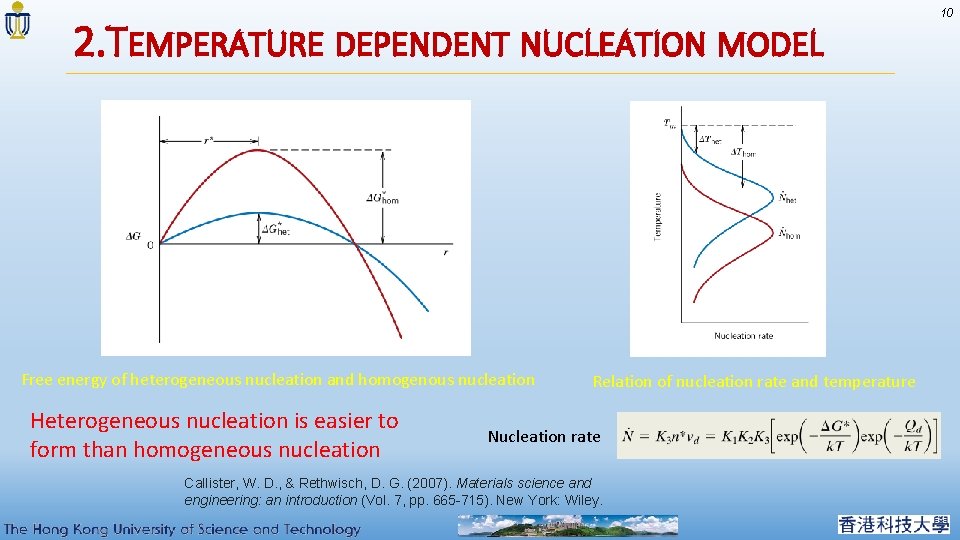
2. TEMPERATURE DEPENDENT NUCLEATION MODEL Free energy of heterogeneous nucleation and homogenous nucleation Heterogeneous nucleation is easier to form than homogeneous nucleation Relation of nucleation rate and temperature Nucleation rate Callister, W. D. , & Rethwisch, D. G. (2007). Materials science and engineering: an introduction (Vol. 7, pp. 665 -715). New York: Wiley. 10
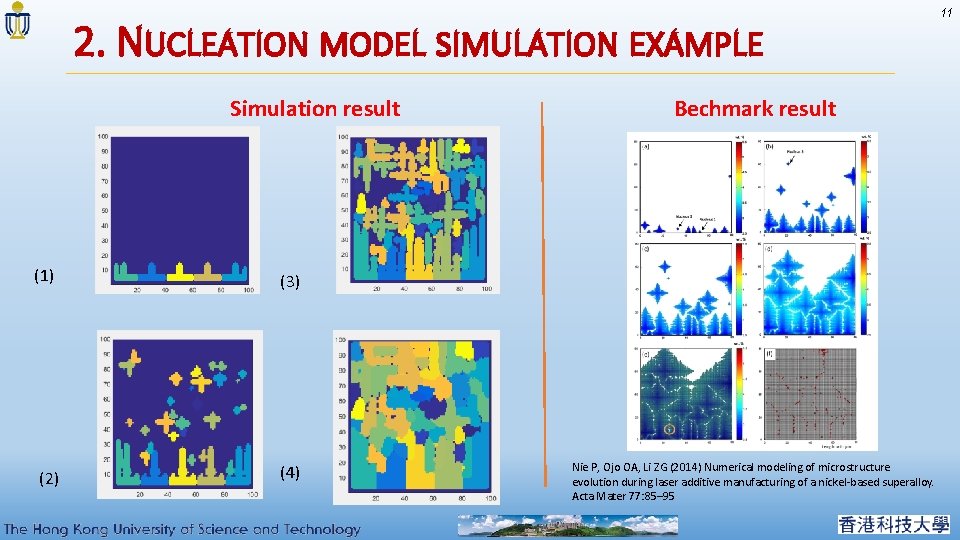
2. NUCLEATION MODEL SIMULATION EXAMPLE Simulation result (1) (3) (2) (4) Bechmark result Nie P, Ojo OA, Li ZG (2014) Numerical modeling of microstructure evolution during laser additive manufacturing of a nickel-based superalloy. Acta Mater 77: 85– 95 11
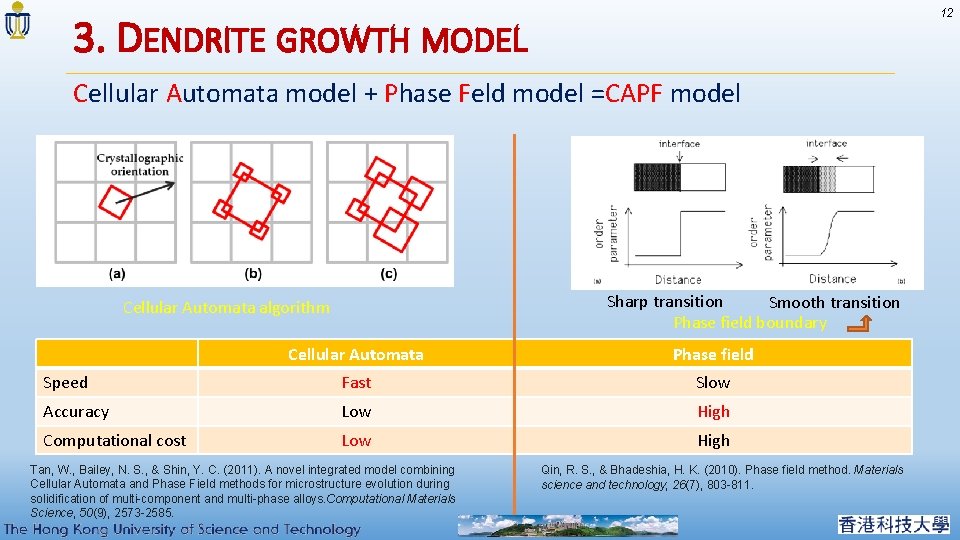
12 3. DENDRITE GROWTH MODEL Cellular Automata model + Phase Feld model =CAPF model Sharp transition Smooth transition Phase field boundary Cellular Automata algorithm Cellular Automata Phase field Speed Fast Slow Accuracy Low High Computational cost Low High Tan, W. , Bailey, N. S. , & Shin, Y. C. (2011). A novel integrated model combining Cellular Automata and Phase Field methods for microstructure evolution during solidification of multi-component and multi-phase alloys. Computational Materials Science, 50(9), 2573 -2585. Qin, R. S. , & Bhadeshia, H. K. (2010). Phase field method. Materials science and technology, 26(7), 803 -811.
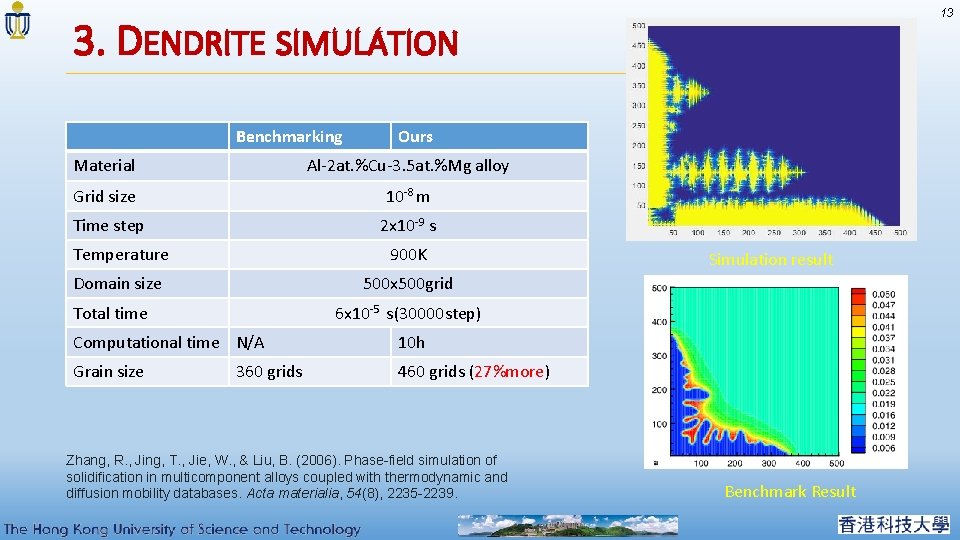
13 3. DENDRITE SIMULATION Benchmarking Ours Material Al-2 at. %Cu-3. 5 at. %Mg alloy Grid size 10 -8 m Time step 2 x 10 -9 s Temperature 900 K Domain size 500 x 500 grid Total time Simulation result 6 x 10 -5 s(30000 step) Computational time N/A 10 h Grain size 460 grids (27%more) 360 grids Zhang, R. , Jing, T. , Jie, W. , & Liu, B. (2006). Phase-field simulation of solidification in multicomponent alloys coupled with thermodynamic and diffusion mobility databases. Acta materialia, 54(8), 2235 -2239. Benchmark Result
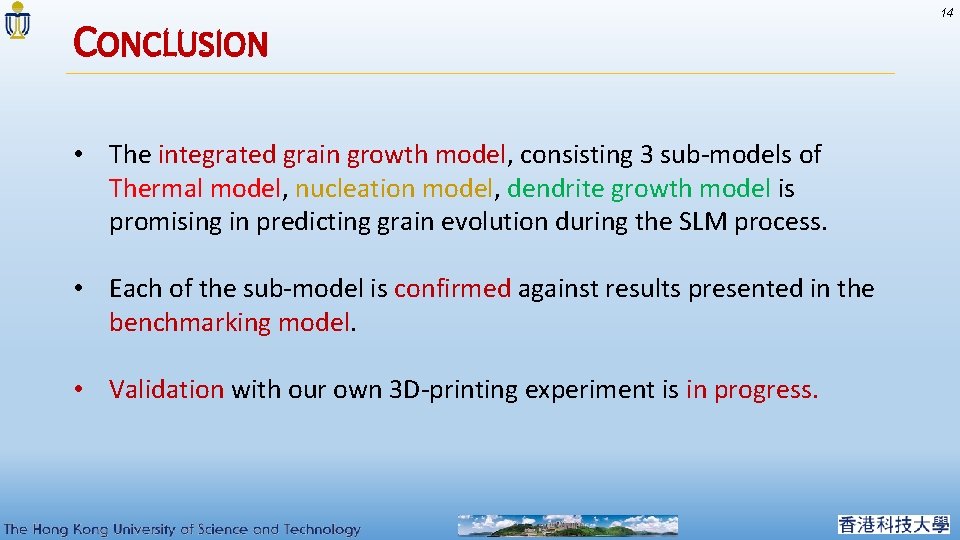
CONCLUSION • The integrated grain growth model, consisting 3 sub-models of Thermal model, nucleation model, dendrite growth model is promising in predicting grain evolution during the SLM process. • Each of the sub-model is confirmed against results presented in the benchmarking model. • Validation with our own 3 D-printing experiment is in progress. 14

15 THANK YOU Q&A
- Slides: 15