
About OMICS Group International is an amalgamation of
About OMICS Group International is an amalgamation of Open Access publications and worldwide international science conferences and events. Established in the year 2007 with the sole aim of making the information on Sciences and technology ‘Open Access’, OMICS Group publishes 500 online open access scholarly journals in all aspects of Science, Engineering, Management and Technology journals. OMICS Group has been instrumental in taking the knowledge on Science & technology to the doorsteps of ordinary men and women. Research Scholars, Students, Libraries, Educational Institutions, Research centers and the industry are main stakeholders that benefitted greatly from this knowledge dissemination. OMICS International also organizes 500 International conferences annually across the globe, where knowledge transfer takes place through debates, round table discussions, poster presentations, workshops, symposia and exhibitions.
About OMICS Group About OMICS International Conferences OMICS International is a pioneer and leading science event organizer, which publishes around 500 open access journals and conducts over 300 Medical, Clinical, Engineering, Life Sciences, Pharma scientific conferences all over the globe annually with the support of more than 1000 scientific associations and 30, 000 editorial board members and 3. 5 million followers to its credit. OMICS International has organized 500 conferences, workshops and national symposiums across the major cities including San Francisco, Las Vegas, San Antonio, Omaha, Orlando, Raleigh, Santa Clara, Chicago, Philadelphia, Baltimore, United Kingdom, Valencia, Dubai, Beijing, Hyderabad, Bengaluru and Mumbai.
Isolation, Identification and Evaluation of Highly Cellulases Producing Trichoderma Isolates from Egypt A. I. Fahmi 1, R. A. Eissa 1, K. A. El-Halfawi 2, H. A. Hamza 2 and M. S. Helwa 1 1 - Genetics Department, Faculty of Agriculture, Menoufia University 2. Institute of Genetic Engineering and Biotechnology Research, University of Sadat City
Introduction Lignocellulosic materials are cheap renewable resources available in large quantities including various agricultural residues, fruit and vegetable wastes, woods, municipal solid wastes, wastes from the pulp and paper industry.
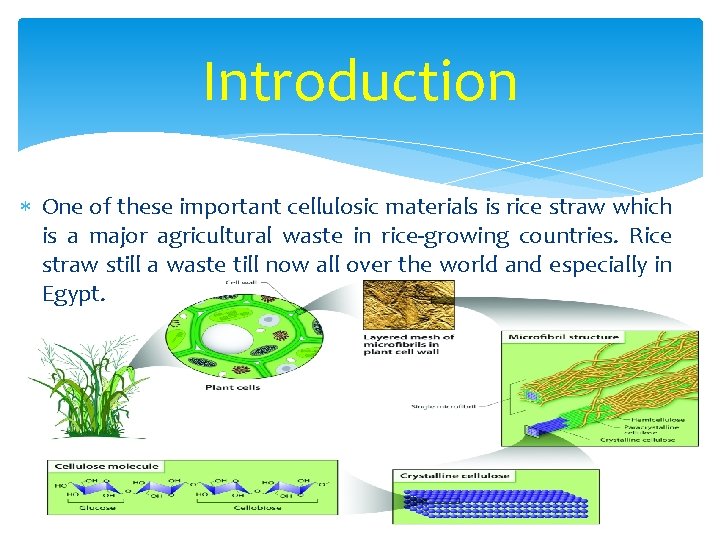
Introduction One of these important cellulosic materials is rice straw which is a major agricultural waste in rice-growing countries. Rice straw still a waste till now all over the world and especially in Egypt.
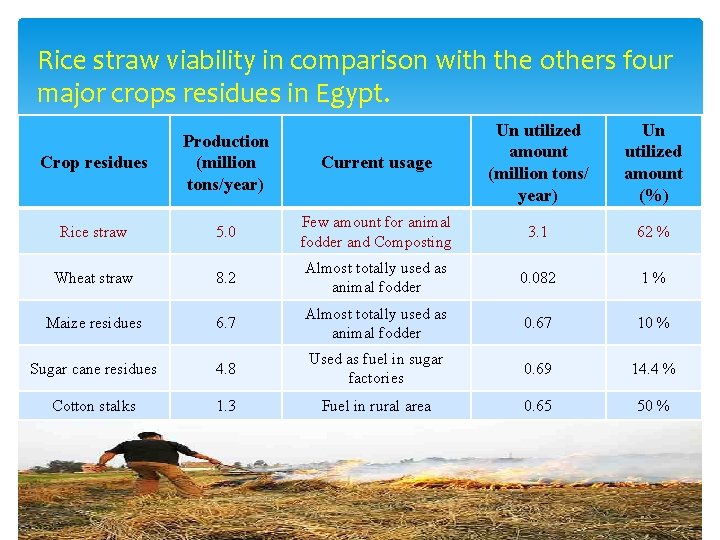
Rice straw viability in comparison with the others four major crops residues in Egypt. Current usage Un utilized amount (million tons/ year) Un utilized amount (%) 5. 0 Few amount for animal fodder and Composting 3. 1 62 % Wheat straw 8. 2 Almost totally used as animal fodder 0. 082 1% Maize residues 6. 7 Almost totally used as animal fodder 0. 67 10 % Sugar cane residues 4. 8 Used as fuel in sugar factories 0. 69 14. 4 % Cotton stalks 1. 3 Fuel in rural area 0. 65 50 % Crop residues Production (million tons/year) Rice straw
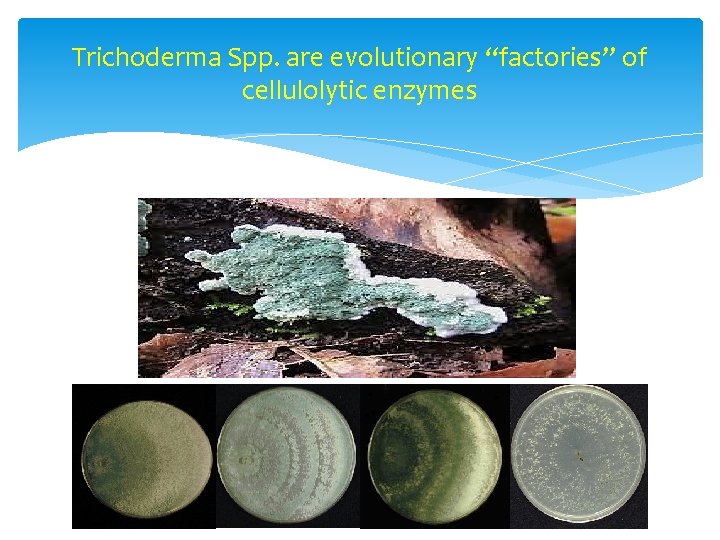
Trichoderma Spp. are evolutionary “factories” of cellulolytic enzymes
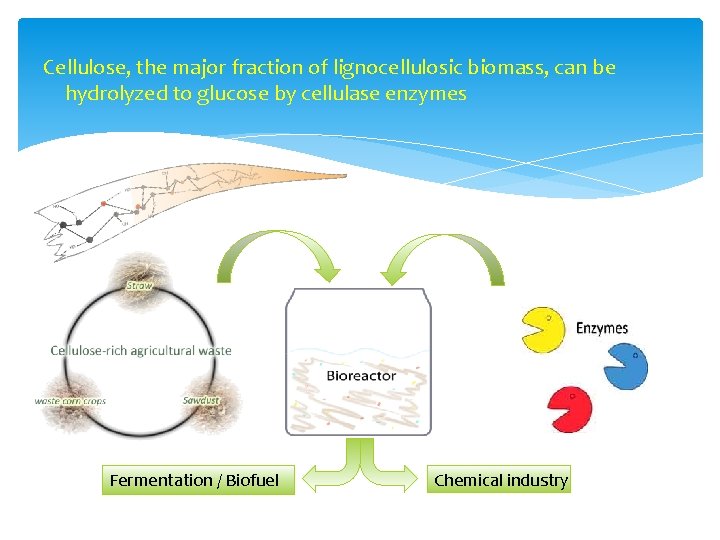
Cellulose, the major fraction of lignocellulosic biomass, can be hydrolyzed to glucose by cellulase enzymes Fermentation / Biofuel Chemical industry
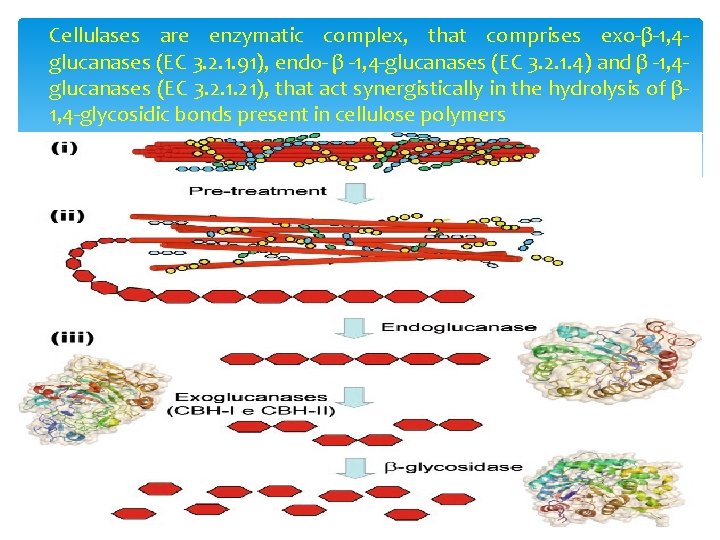
Cellulases are enzymatic complex, that comprises exo-β-1, 4 glucanases (EC 3. 2. 1. 91), endo- β -1, 4 -glucanases (EC 3. 2. 1. 4) and β -1, 4 glucanases (EC 3. 2. 1. 21), that act synergistically in the hydrolysis of β 1, 4 -glycosidic bonds present in cellulose polymers
Objectives 1) Characterization of some Trichoderma isolates morphologically and molecularly. 2) Evaluation and selection of the best isolates for producing cellulases enzymes.
Samples collection * Samples were Collected from six governorates of Egypt * Samples type : - Decomposed rice straw - Decomposed Wheat straw - Decomposed tree leaves - Garden soil - Field soil
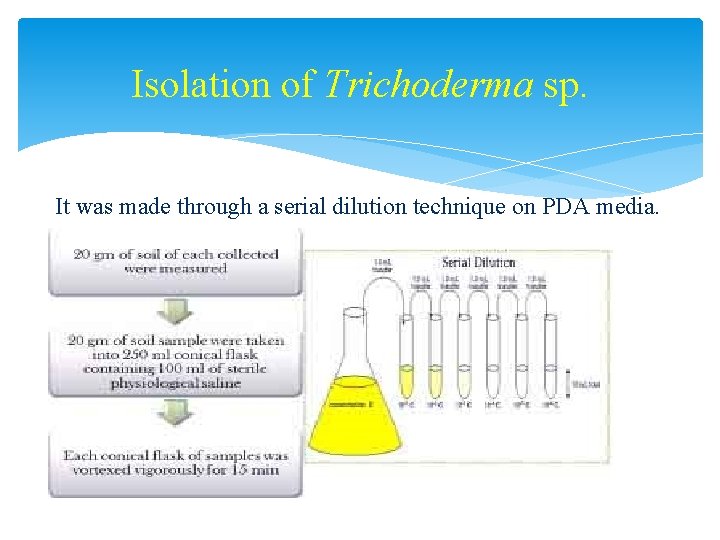
Isolation of Trichoderma sp. It was made through a serial dilution technique on PDA media.
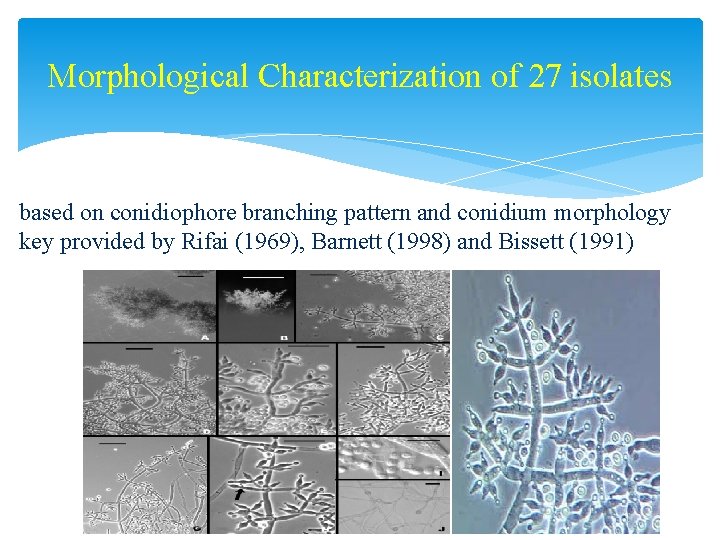
Morphological Characterization of 27 isolates based on conidiophore branching pattern and conidium morphology key provided by Rifai (1969), Barnett (1998) and Bissett (1991)
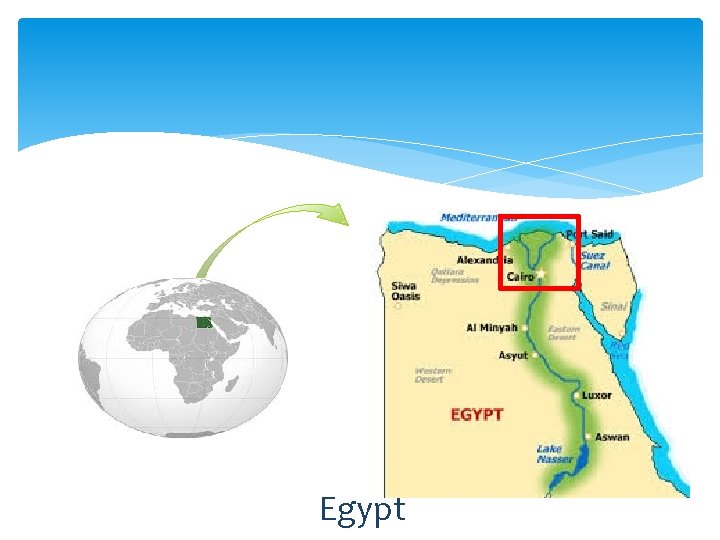
Egypt
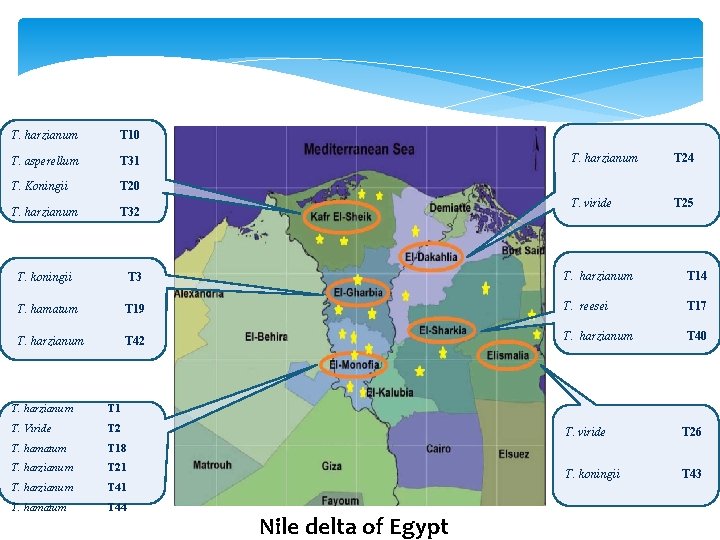
T. harzianum T 10 T. asperellum T 31 T. Koningii T 20 T. harzianum T 32 T. harzianum T 24 T. viride T 25 T. koningii T 3 T. harzianum T 14 T. hamatum T 19 T. reesei T 17 T. harzianum T 42 T. harzianum T 40 T. harzianum T 1 T. Viride T 2 T. hamatum T 18 T. harzianum T 21 T. harzianum T 41 T. hamatum T 44 Nile delta of Egypt T. viride T 26 T. koningii T 43
Molecular identification of 11 isolates Analysis of the internal transcribed spacer (ITS) 1 and 2 of ribosomal DNA (r. DNA) 1. DNA extraction 2. PCR amplification of ITS 1 -5. 8 S- ITS 2 r. DNA region using the primer pair: ITS-1 (5'-TCC GTA GGT GAA CCT GCG G-3') ITS-4 (5'-TCC GCT TAT TGA TAT GC-3') 3. Sequencing of amplified DNA fragments 4. The sequences of ITS 1 -5. 8 S-ITS 2 regions were manually aligned using Molecular Evolutionary Genetics Analysis (MEGA 4 version 5. 10. ) 5. The sequencing data were compared against the Gene Bank database (http: //www. ncbi. nlm. nih. gov/BLAST/) 6. Sequences were will submitted to Gen. Bank
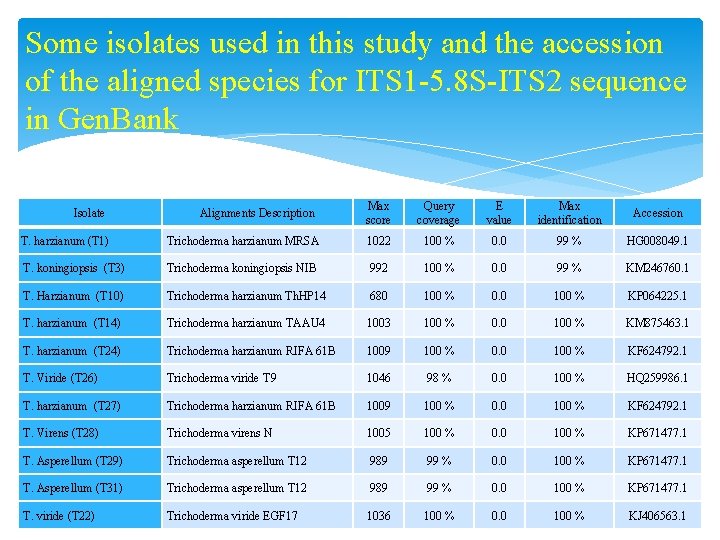
Some isolates used in this study and the accession of the aligned species for ITS 1 -5. 8 S-ITS 2 sequence in Gen. Bank Isolate Alignments Description Max score Query coverage E value Max identification Accession T. harzianum (T 1) Trichoderma harzianum MRSA 1022 100 % 0. 0 99 % HG 008049. 1 T. koningiopsis (T 3) Trichoderma koningiopsis NIB 992 100 % 0. 0 99 % KM 246760. 1 T. Harzianum (T 10) Trichoderma harzianum Th. HP 14 680 100 % 0. 0 100 % KP 064225. 1 T. harzianum (T 14) Trichoderma harzianum TAAU 4 1003 100 % 0. 0 100 % KM 875463. 1 T. harzianum (T 24) Trichoderma harzianum RIFA 61 B 1009 100 % 0. 0 100 % KF 624792. 1 T. Viride (T 26) Trichoderma viride T 9 1046 98 % 0. 0 100 % HQ 259986. 1 T. harzianum (T 27) Trichoderma harzianum RIFA 61 B 1009 100 % 0. 0 100 % KF 624792. 1 T. Virens (T 28) Trichoderma virens N 1005 100 % 0. 0 100 % KP 671477. 1 T. Asperellum (T 29) Trichoderma asperellum T 12 989 99 % 0. 0 100 % KP 671477. 1 T. Asperellum (T 31) Trichoderma asperellum T 12 989 99 % 0. 0 100 % KP 671477. 1 T. viride (T 22) Trichoderma viride EGF 17 1036 100 % 0. 0 100 % KJ 406563. 1
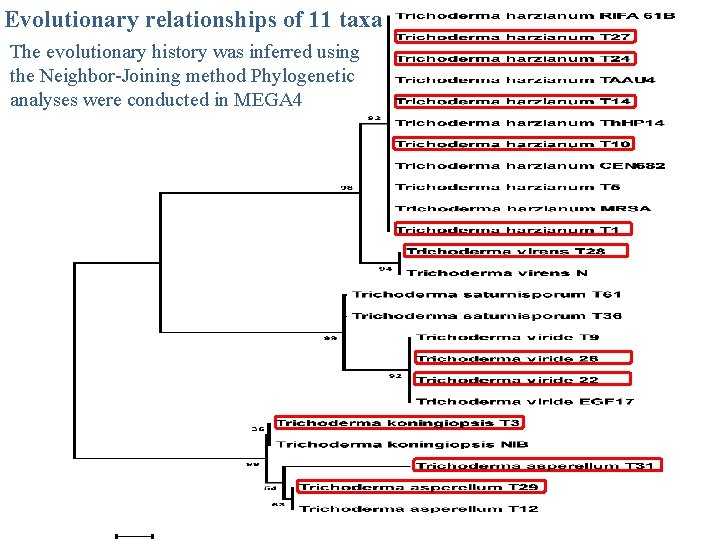
Evolutionary relationships of 11 taxa The evolutionary history was inferred using the Neighbor-Joining method Phylogenetic analyses were conducted in MEGA 4
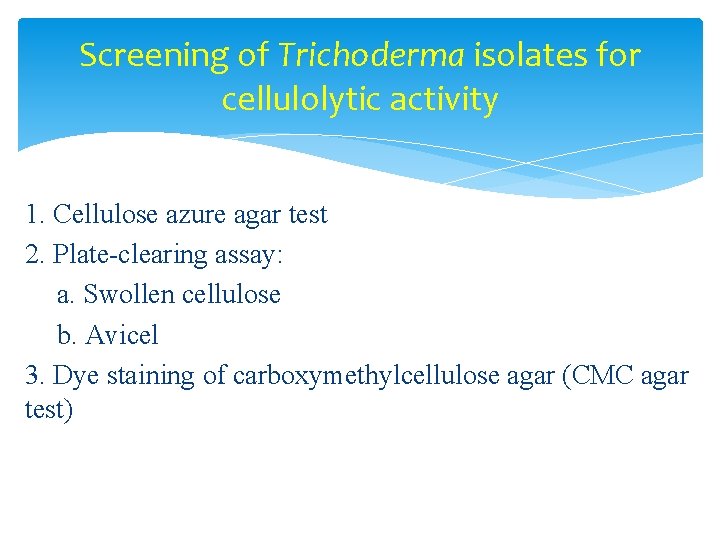
Screening of Trichoderma isolates for cellulolytic activity 1. Cellulose azure agar test 2. Plate-clearing assay: a. Swollen cellulose b. Avicel 3. Dye staining of carboxymethylcellulose agar (CMC agar test)
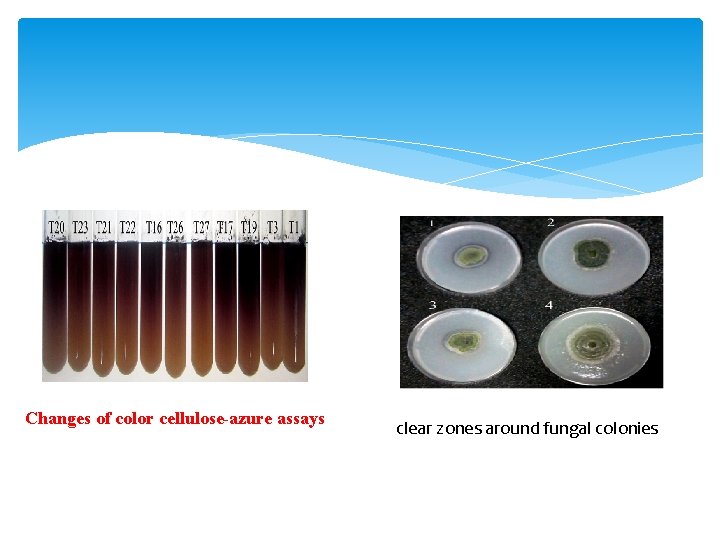
Changes of color cellulose-azure assays clear zones around fungal colonies
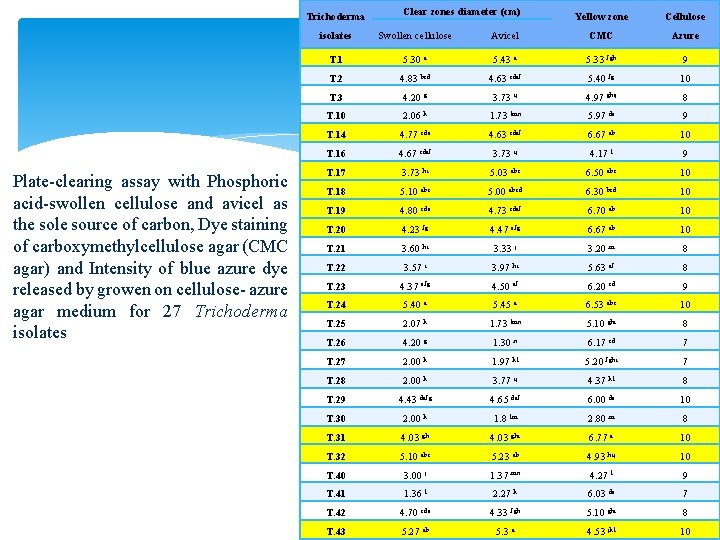
Trichoderma Plate-clearing assay with Phosphoric acid-swollen cellulose and avicel as the sole source of carbon, Dye staining of carboxymethylcellulose agar (CMC agar) and Intensity of blue azure dye released by growen on cellulose- azure agar medium for 27 Trichoderma isolates Clear zones diameter (cm) Yellow zone Cellulose isolates Swollen cellulose Avicel CMC Azure T. 1 5. 30 a 5. 43 a 5. 33 fgh 9 T. 2 4. 83 bcd 4. 63 cdef 5. 40 fg 10 T. 3 4. 20 g 3. 73 ij 4. 97 ghij 8 T. 10 2. 06 k 1. 73 lmn 5. 97 de 9 T. 14 4. 77 cde 4. 63 cdef 6. 67 ab 10 T. 16 4. 67 cdef 3. 73 ij 4. 17 l 9 T. 17 3. 73 hi 5. 03 abc 6. 50 abc 10 T. 18 5. 10 5. 00 6. 30 bcd 10 T. 19 4. 80 cde 4. 73 cdef 6. 70 ab 10 T. 20 4. 23 fg 4. 47 efg 6. 67 ab 10 T. 21 3. 60 hi 3. 33 j 3. 20 m 8 T. 22 3. 57 i 3. 97 hi 5. 63 ef 8 T. 23 4. 37 efg 4. 50 ef 6. 20 cd 9 T. 24 5. 40 a 5. 45 a 6. 53 abc 10 T. 25 2. 07 k 1. 73 lmn 5. 10 ghi 8 T. 26 4. 20 g 1. 30 n 6. 17 cd 7 T. 27 2. 00 k 1. 97 kl 5. 20 fghi 7 T. 28 2. 00 k 3. 77 ij 4. 37 kl 8 4. 65 6. 00 10 T. 29 4. 43 abc defg abcd def de T. 30 2. 00 k 1. 8 lm 2. 80 m 8 T. 31 4. 03 ghi 6. 77 a 10 T. 32 5. 10 abc 5. 23 ab 4. 93 hij 10 T. 40 3. 00 j 1. 37 mn 4. 27 l 9 T. 41 1. 36 l 2. 27 k 6. 03 de 7 T. 42 4. 70 cde 4. 33 fgh 5. 10 ghi 8 T. 43 5. 27 ab 5. 3 a 4. 53 jkl 10
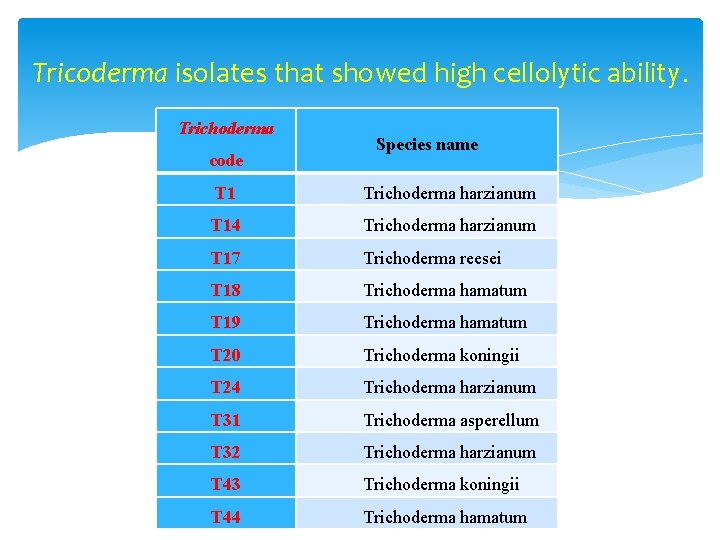
Tricoderma isolates that showed high cellolytic ability. Trichoderma code Species name T 1 Trichoderma harzianum T 14 Trichoderma harzianum T 17 Trichoderma reesei T 18 Trichoderma hamatum T 19 Trichoderma hamatum T 20 Trichoderma koningii T 24 Trichoderma harzianum T 31 Trichoderma asperellum T 32 Trichoderma harzianum T 43 Trichoderma koningii T 44 Trichoderma hamatum
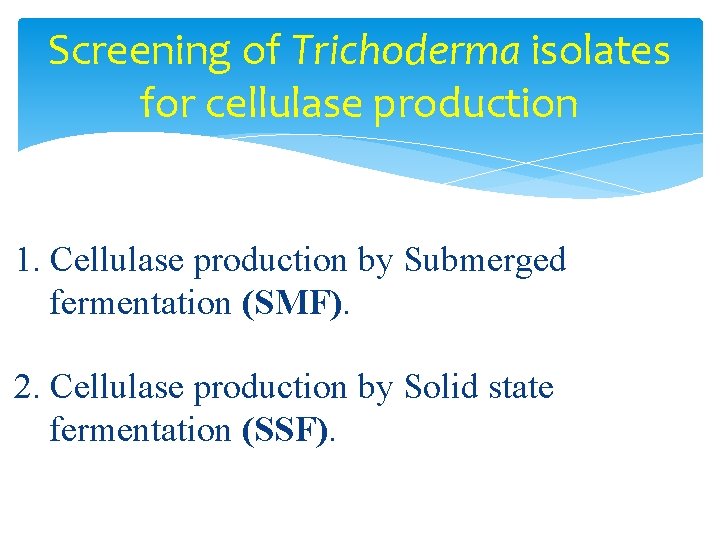
Screening of Trichoderma isolates for cellulase production 1. Cellulase production by Submerged fermentation (SMF). 2. Cellulase production by Solid state fermentation (SSF).
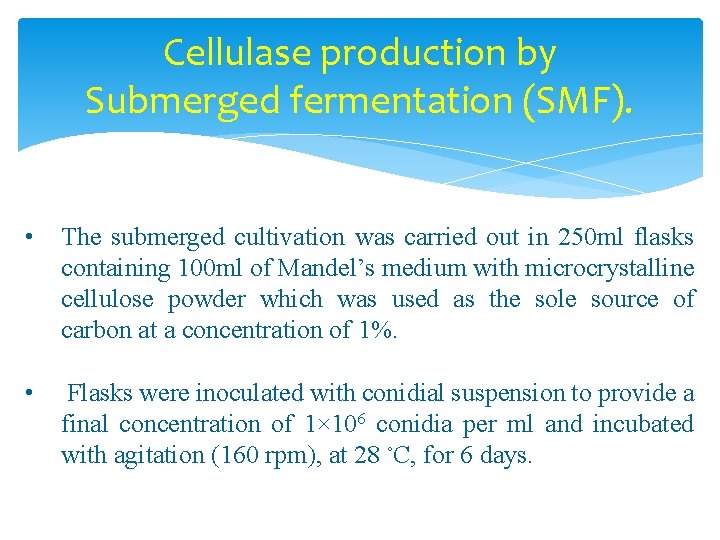
Cellulase production by Submerged fermentation (SMF). • The submerged cultivation was carried out in 250 ml flasks containing 100 ml of Mandel’s medium with microcrystalline cellulose powder which was used as the sole source of carbon at a concentration of 1%. • Flasks were inoculated with conidial suspension to provide a final concentration of 1× 10⁶ conidia per ml and incubated with agitation (160 rpm), at 28 ◦C, for 6 days.
Determining of cellulase activity 1. Total cellulase activity by FPase activity (DNS method). 2. Activity of individual cellulases: a. β-Glucosidase using cellobiose substrate (GOD method). b. Carboxymethyl cellulase (CMCase) using CMC substrate. 3. Free sugar determination in culture filtrate. 4. Total protein concentration determination in culture filtrate.
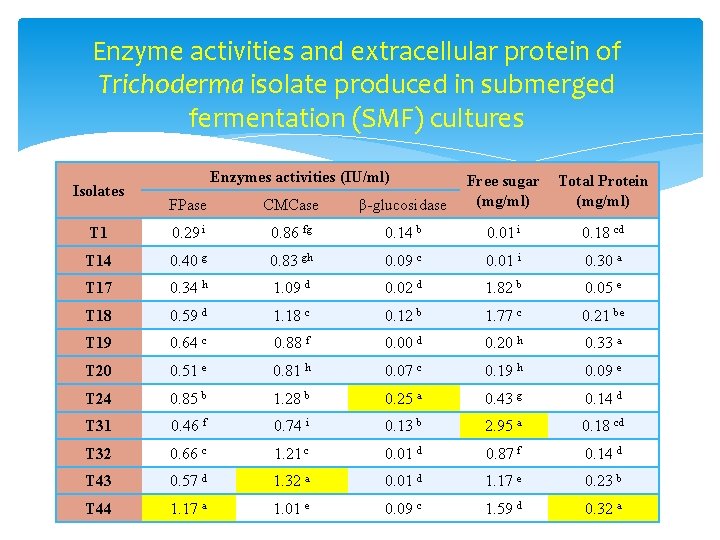
Enzyme activities and extracellular protein of Trichoderma isolate produced in submerged fermentation (SMF) cultures Enzymes activities (IU/ml) FPase CMCase β-glucosidase Free sugar (mg/ml) T 1 0. 29 i 0. 86 fg 0. 14 b 0. 01 i 0. 18 cd T 14 0. 40 g 0. 83 gh 0. 09 c 0. 01 i 0. 30 a T 17 0. 34 h 1. 09 d 0. 02 d 1. 82 b 0. 05 e T 18 0. 59 d 1. 18 c 0. 12 b 1. 77 c 0. 21 be T 19 0. 64 c 0. 88 f 0. 00 d 0. 20 h 0. 33 a T 20 0. 51 e 0. 81 h 0. 07 c 0. 19 h 0. 09 e T 24 0. 85 b 1. 28 b 0. 25 a 0. 43 g 0. 14 d T 31 0. 46 f 0. 74 i 0. 13 b 2. 95 a 0. 18 cd T 32 0. 66 c 1. 21 c 0. 01 d 0. 87 f 0. 14 d T 43 0. 57 d 1. 32 a 0. 01 d 1. 17 e 0. 23 b T 44 1. 17 a 1. 01 e 0. 09 c 1. 59 d 0. 32 a Isolates Total Protein (mg/ml)
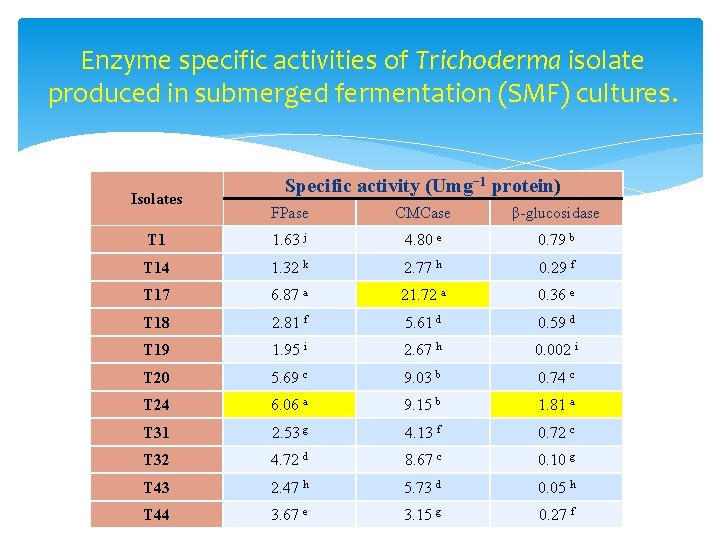
Enzyme specific activities of Trichoderma isolate produced in submerged fermentation (SMF) cultures. Isolates Specific activity (Umg− 1 protein) FPase CMCase β-glucosidase T 1 1. 63 j 4. 80 e 0. 79 b T 14 1. 32 k 2. 77 h 0. 29 f T 17 6. 87 a 21. 72 a 0. 36 e T 18 2. 81 f 5. 61 d 0. 59 d T 19 1. 95 i 2. 67 h 0. 002 i T 20 5. 69 c 9. 03 b 0. 74 c T 24 6. 06 a 9. 15 b 1. 81 a T 31 2. 53 g 4. 13 f 0. 72 c T 32 4. 72 d 8. 67 c 0. 10 g T 43 2. 47 h 5. 73 d 0. 05 h T 44 3. 67 e 3. 15 g 0. 27 f
Cellulase production by Solid state fermentation (SSF). • Pretreatment of rice straw. • Solid-state fermentation cultures. 28
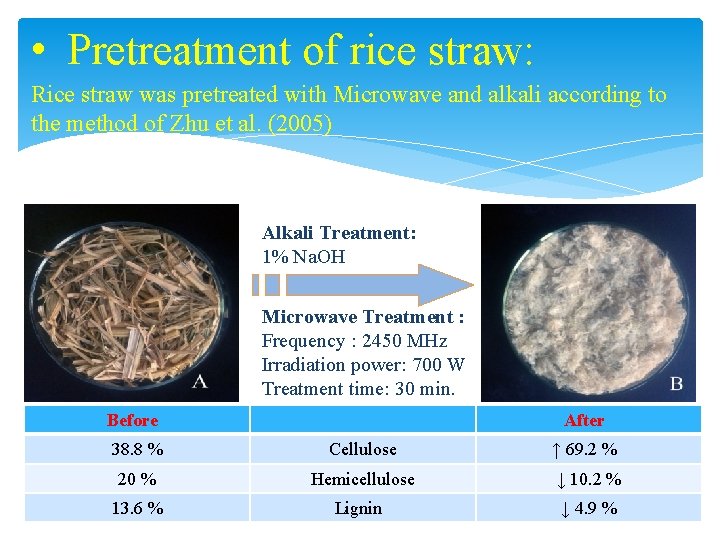
• Pretreatment of rice straw: Rice straw was pretreated with Microwave and alkali according to the method of Zhu et al. (2005) Alkali Treatment: 1% Na. OH Microwave Treatment : Frequency : 2450 MHz Irradiation power: 700 W Treatment time: 30 min. Before After 38. 8 % Cellulose ↑ 69. 2 % 20 % Hemicellulose ↓ 10. 2 % 13. 6 % Lignin ↓ 4. 9 %
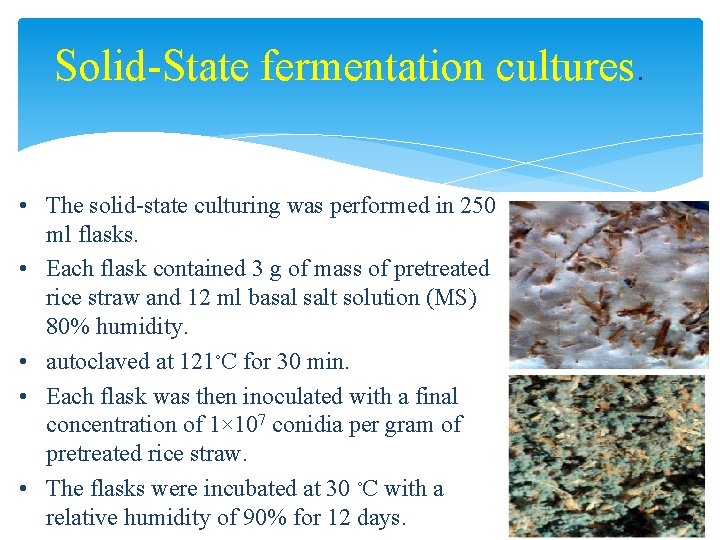
Solid-State fermentation cultures. • The solid-state culturing was performed in 250 ml flasks. • Each flask contained 3 g of mass of pretreated rice straw and 12 ml basal salt solution (MS) 80% humidity. • autoclaved at 121◦C for 30 min. • Each flask was then inoculated with a final concentration of 1× 10⁷ conidia per gram of pretreated rice straw. • The flasks were incubated at 30 ◦C with a relative humidity of 90% for 12 days.
Extraction of the enzymes after incubation • • 50 ml of distilled water were added, mixed. incubated under agitation for 1 h at 30 ◦C, at 150 rpm. filtered, using dampened cheese cloth. The filtrates were centrifuged at 5000 rpm (4◦C) for 15 min to remove spores of the organism. • the clear supernatant were used as crude enzyme extracts for enzyme assay. • The filtrate was stored at 4 ◦C until assay for enzymes activities. 31
Determining of cellulase activity 1. Total cellulase activity by FPase activity (DNS method). 2. Activity of individual cellulases: a. β-Glucosidase using cellobiose substrate (GOD method). b. Carboxymethyl cellulase (CMCase) using CMC substrate. 3. Free sugar determination in culture filtrate.
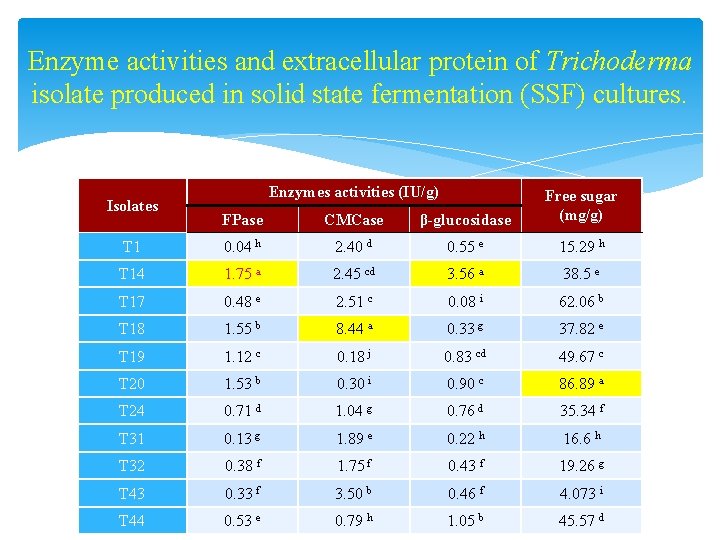
Enzyme activities and extracellular protein of Trichoderma isolate produced in solid state fermentation (SSF) cultures. Enzymes activities (IU/g) FPase CMCase β-glucosidase Free sugar (mg/g) T 1 0. 04 h 2. 40 d 0. 55 e 15. 29 h T 14 1. 75 a 2. 45 cd 3. 56 a 38. 5 e T 17 0. 48 e 2. 51 c 0. 08 i 62. 06 b T 18 1. 55 b 8. 44 a 0. 33 g 37. 82 e T 19 1. 12 c 0. 18 j 0. 83 cd 49. 67 c T 20 1. 53 b 0. 30 i 0. 90 c 86. 89 a T 24 0. 71 d 1. 04 g 0. 76 d 35. 34 f T 31 0. 13 g 1. 89 e 0. 22 h 16. 6 h T 32 0. 38 f 1. 75 f 0. 43 f 19. 26 g T 43 0. 33 f 3. 50 b 0. 46 f 4. 073 i T 44 0. 53 e 0. 79 h 1. 05 b 45. 57 d Isolates
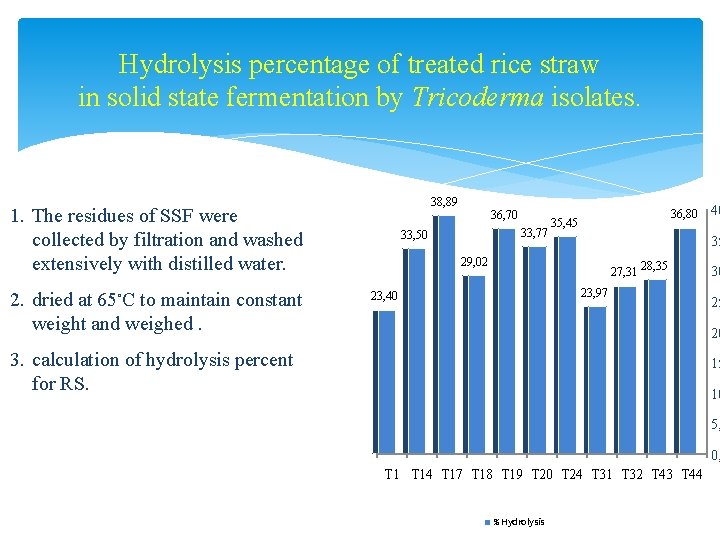
Hydrolysis percentage of treated rice straw in solid state fermentation by Tricoderma isolates. 38, 89 1. The residues of SSF were collected by filtration and washed extensively with distilled water. 2. dried at 65◦C to maintain constant weight and weighed. 36, 70 33, 77 33, 50 36, 80 35, 45 35 29, 02 27, 31 28, 35 23, 97 23, 40 40 30 25 20 3. calculation of hydrolysis percent for RS. 15 10 5, 0, T 14 T 17 T 18 T 19 T 20 T 24 T 31 T 32 T 43 T 44 % Hydrolysis
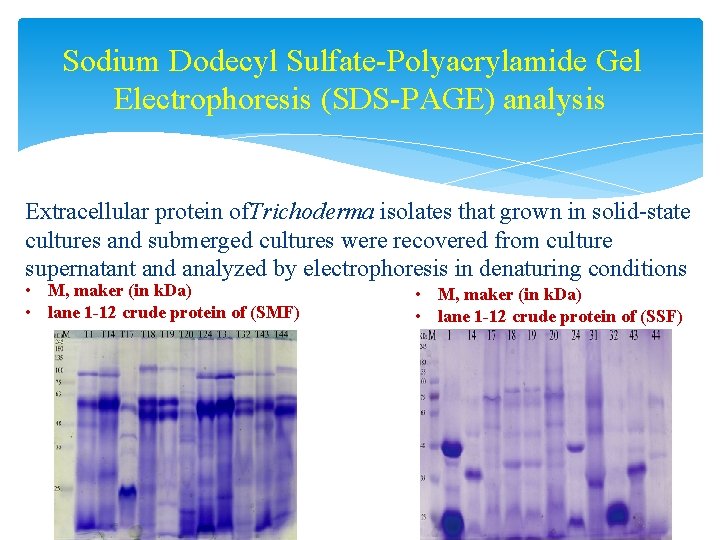
Sodium Dodecyl Sulfate-Polyacrylamide Gel Electrophoresis (SDS-PAGE) analysis Extracellular protein of. Trichoderma isolates that grown in solid-state cultures and submerged cultures were recovered from culture supernatant and analyzed by electrophoresis in denaturing conditions • M, maker (in k. Da) • lane 1 -12 crude protein of (SMF) • M, maker (in k. Da) • lane 1 -12 crude protein of (SSF)
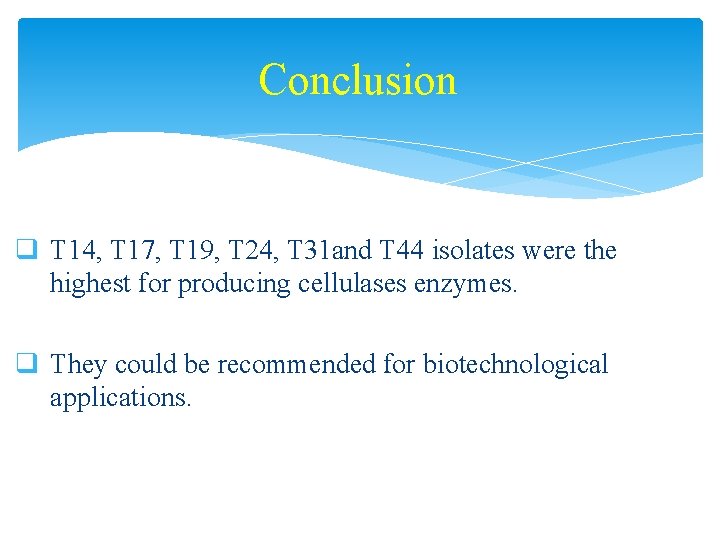
Conclusion q T 14, T 17, T 19, T 24, T 31 and T 44 isolates were the highest for producing cellulases enzymes. q They could be recommended for biotechnological applications.

THANK YOU

Let Us Meet Again We welcome you all to our future conferences of OMICS International Please Visit: www. metabolomicsconference. com www. conferenceseries. com http: //www. conferenceseries. com/clinical-researchconferences. php
- Slides: 38