
About Amateur Radio Repeaters VE 4 WPG The

About Amateur Radio Repeaters (VE 4 WPG) The operating (receive) frequency is 147. 390 MHz. The repeater offset is “+”, which means your transmitting frequency is 147. 390 +600 k. Hz = 147. 990 MHz. The CTCSS frequency is 127. 3 Hz.
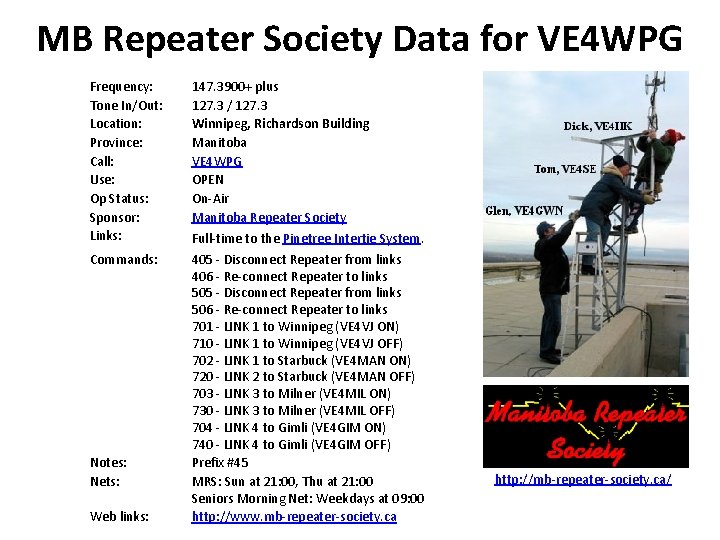
MB Repeater Society Data for VE 4 WPG Frequency: Tone In/Out: Location: Province: Call: Use: Op Status: Sponsor: Links: 147. 3900+ plus 127. 3 / 127. 3 Winnipeg, Richardson Building Manitoba VE 4 WPG OPEN On-Air Manitoba Repeater Society Commands: 405 - Disconnect Repeater from links 406 - Re-connect Repeater to links 505 - Disconnect Repeater from links 506 - Re-connect Repeater to links 701 - LINK 1 to Winnipeg (VE 4 VJ ON) 710 - LINK 1 to Winnipeg (VE 4 VJ OFF) 702 - LINK 1 to Starbuck (VE 4 MAN ON) 720 - LINK 2 to Starbuck (VE 4 MAN OFF) 703 - LINK 3 to Milner (VE 4 MIL ON) 730 - LINK 3 to Milner (VE 4 MIL OFF) 704 - LINK 4 to Gimli (VE 4 GIM ON) 740 - LINK 4 to Gimli (VE 4 GIM OFF) Prefix #45 MRS: Sun at 21: 00, Thu at 21: 00 Seniors Morning Net: Weekdays at 09: 00 http: //www. mb-repeater-society. ca Notes: Nets: Web links: Full-time to the Pinetree Intertie System. http: //mb-repeater-society. ca/
Squelch (muting audio) In telecommunications, squelch is a circuit function that acts to suppress the audio (or video) output of a receiver in the absence of a sufficiently strong desired input signal. Squelch is widely used in twoway radios and radio scanners to suppress the sound of channel noise when the radio is not receiving a transmission. Squelch can be 'opened', which allows all signals entering the receiver's discriminator tap to be heard. This can be useful when trying to hear distant, or otherwise weak signals (also known as DXing). A carrier squelch or noise squelch is the most simple variant of all. It operates strictly on the signal strength, such as when a television mutes the audio or blanks the video on "empty" channels, or when a walkie talkie mutes the audio when no signal is present. In some designs, the squelch threshold is preset.
CTCSS Continuous Tone-Coded Squelch System or CTCSS is a circuit that is used to reduce the annoyance of listening to other users on a shared two-way radio communications channel. Instead of turning on the repeater’s receive audio for any signal, the two-way radio receiver's audio turns on only in the presence of a signal AND the correct “sub-audible” or low pitch tone. This is akin to the use of a lock on a door. A carrier squelch or noise squelch receiver is unlocked and will let any signal in. Many repeater receivers with CTCSS lock out all signals except ones encoded with the correct tone. Radio system using CTCSS always transmit their own tone code whenever the transmit button is pressed (simultaneously with the voice). This is called CTCSS encoding. CTCSS continuously superimposes any one of 32, 38 or 40 (depending on which "standard" is used) precise, low distortion, low-pitch audio tones on the transmitted signal, ranging from 67 to 257 Hz to access the repeater receiver.
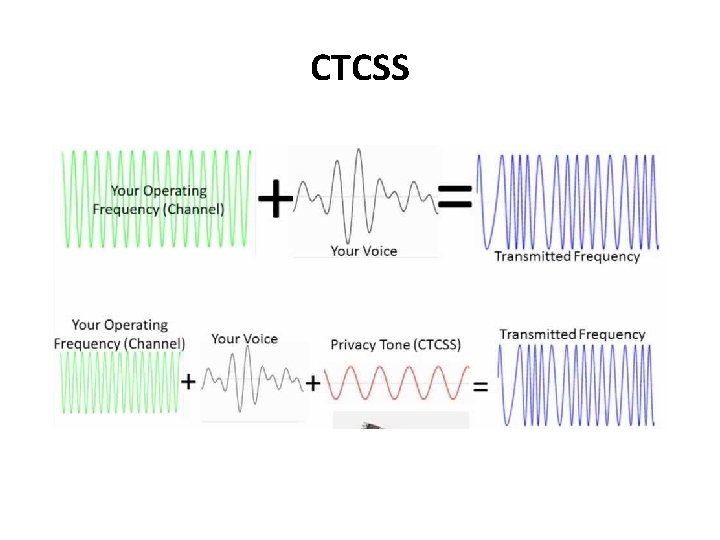
CTCSS
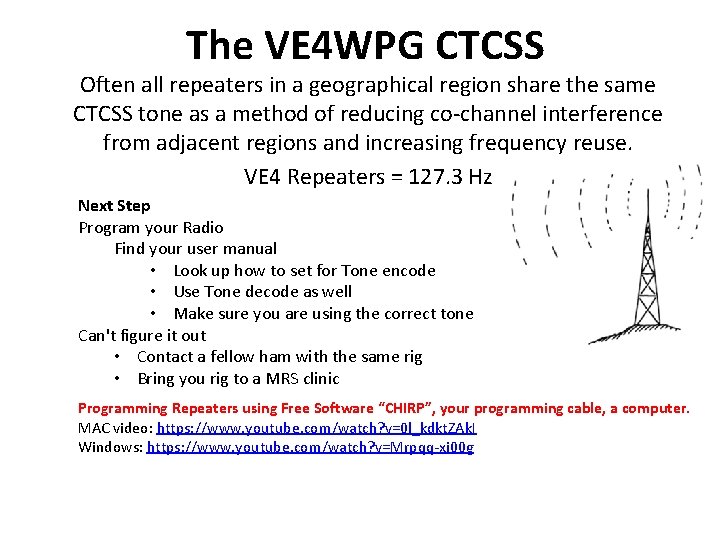
The VE 4 WPG CTCSS Often all repeaters in a geographical region share the same CTCSS tone as a method of reducing co-channel interference from adjacent regions and increasing frequency reuse. VE 4 Repeaters = 127. 3 Hz Next Step Program your Radio Find your user manual • Look up how to set for Tone encode • Use Tone decode as well • Make sure you are using the correct tone Can't figure it out • Contact a fellow ham with the same rig • Bring you rig to a MRS clinic Programming Repeaters using Free Software “CHIRP”, your programming cable, a computer. MAC video: https: //www. youtube. com/watch? v=0 l_kdkt. ZAk. I Windows: https: //www. youtube. com/watch? v=Mrpqq-xi 00 g
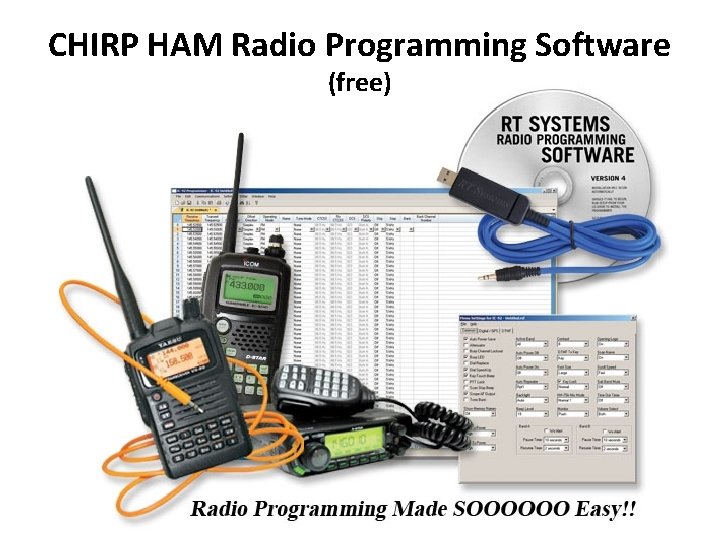
CHIRP HAM Radio Programming Software (free)
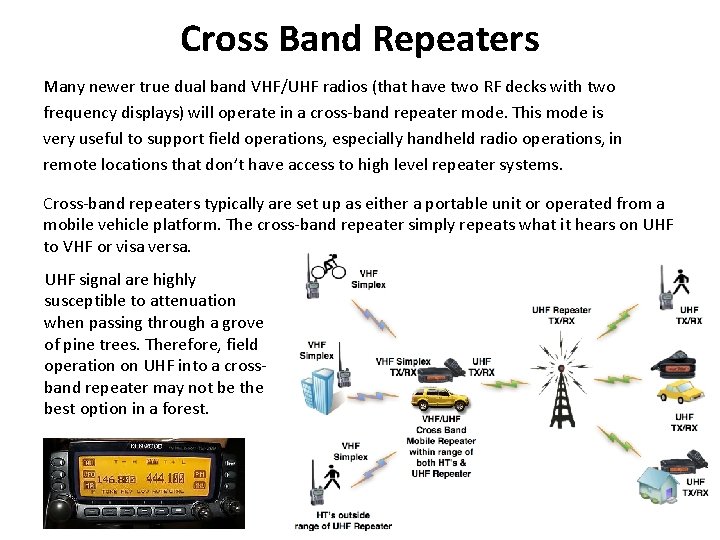
Cross Band Repeaters Many newer true dual band VHF/UHF radios (that have two RF decks with two frequency displays) will operate in a cross-band repeater mode. This mode is very useful to support field operations, especially handheld radio operations, in remote locations that don’t have access to high level repeater systems. Cross-band repeaters typically are set up as either a portable unit or operated from a mobile vehicle platform. The cross-band repeater simply repeats what it hears on UHF to VHF or visa versa. UHF signal are highly susceptible to attenuation when passing through a grove of pine trees. Therefore, field operation on UHF into a crossband repeater may not be the best option in a forest.
Shopping for a Radio • • • Manitoba Repeater Society “Swap-n-Shop” Radio. World (all makes) Durham Radio Sales and Service (all makes) Baofeng Tech (South Dakota Baofeng Dealer) Micro-High. Tech Communications (Icom) Prairie Mobile Communications (Commercial) • HRO – Ham Radio Outlet (all makes – USA)
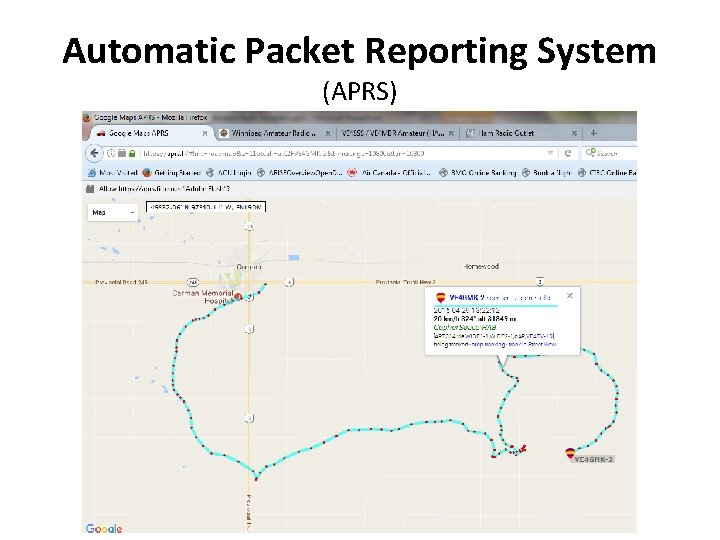
Automatic Packet Reporting System (APRS)
- Slides: 10