
About 80 reasons human failures History of Railway
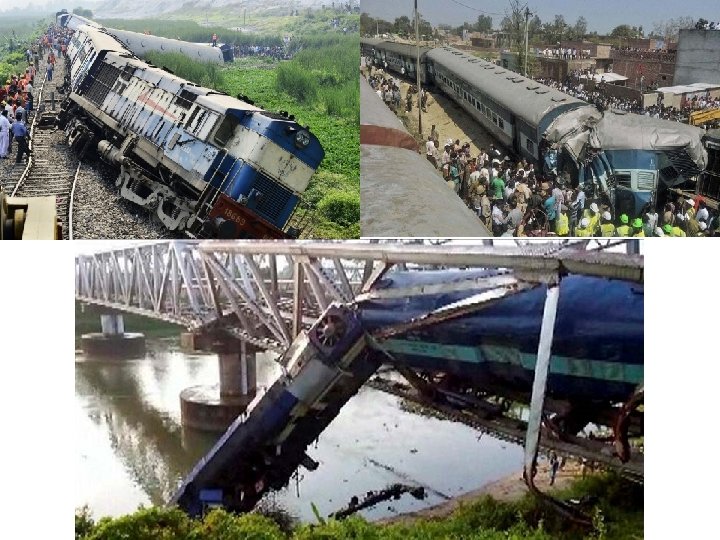
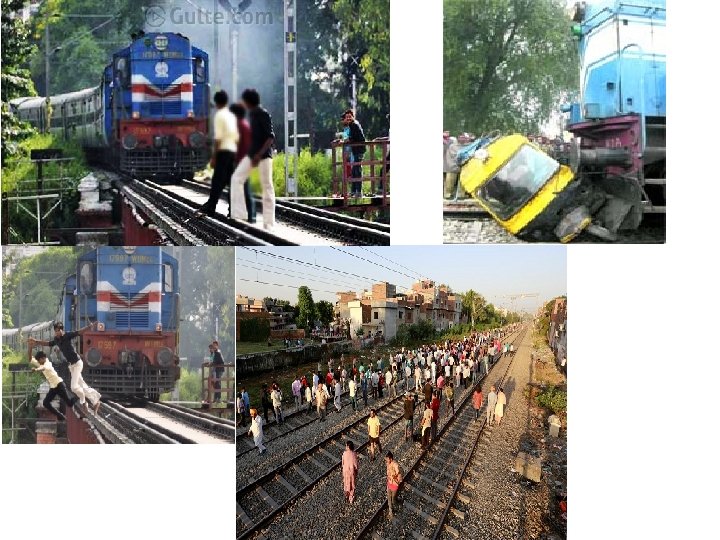

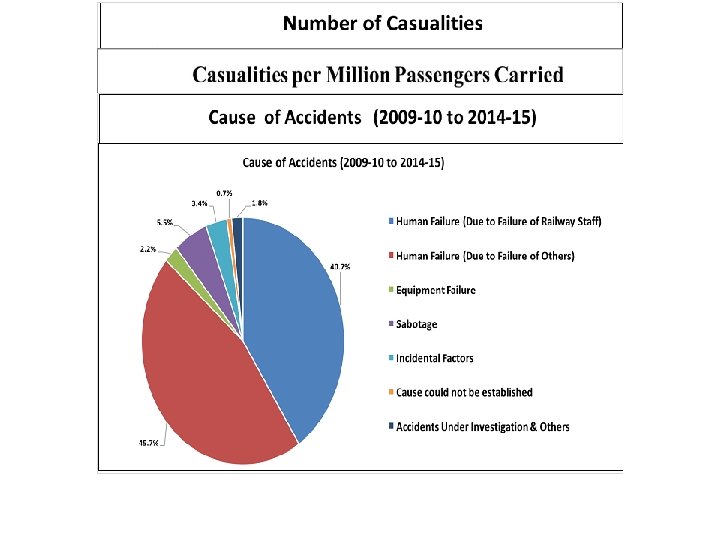
About 80% reasons - human failures
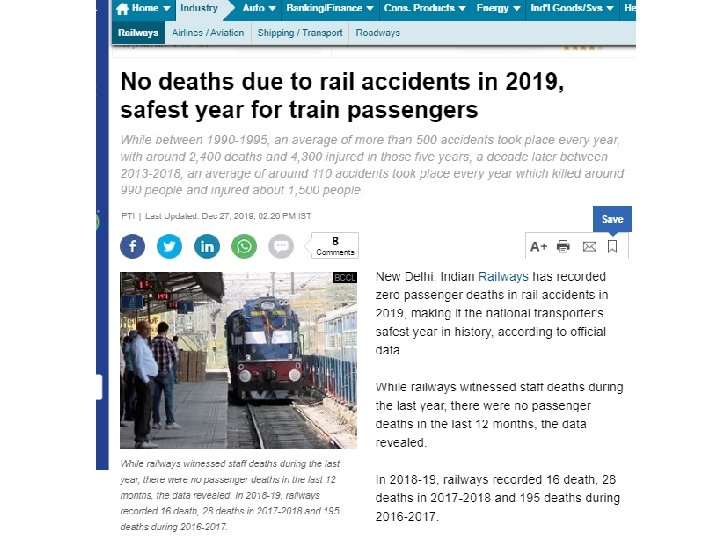
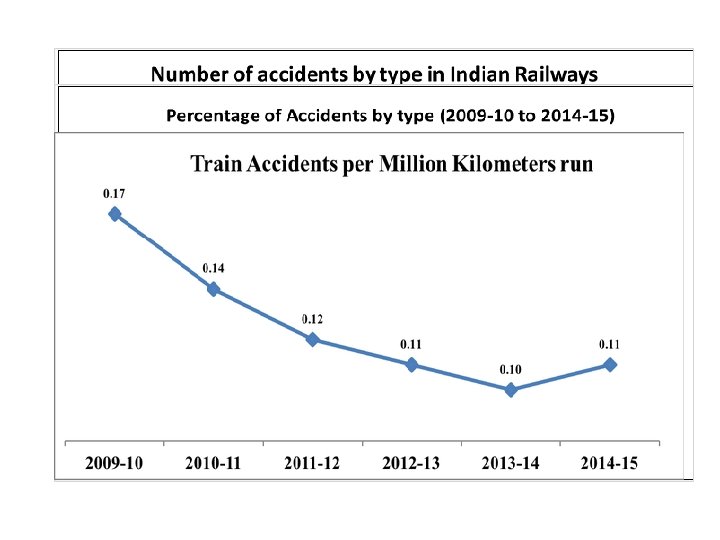
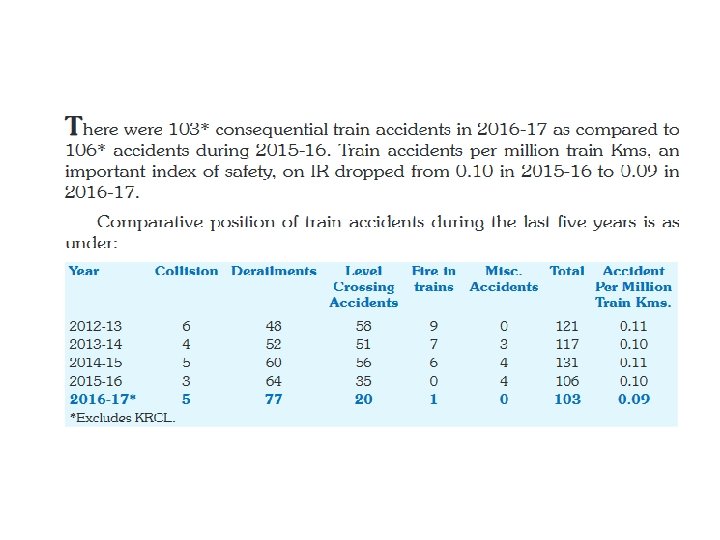
History of Railway Accidents • 1650, – United Kingdom – Whickham, County Durham. Two boys die when they are run down by a wagon on a wooden coal tramway. This is sometimes cited as the earliest known railway accident. • 5 November 1891 – A mail train derailed near Nagpur, killing 10 passengers and injuring 34 others. • In the 6 -year period between 2009 -10 and 2014 -15, there were a total of 803 accidents in Indian Railways killing 620 people and injuring 1855 people. 47% of these accidents were due to derailment of trains.
ACCIDENT MANUAL
ACCIDENT MANUAL ØIssued by each Zonal Railway ØProvisions in accident manual are in conformity with G & SR of Zonal Railway. ØEvery Railway servant should be in possession of this manual & be conversant. ØRules are numbered in 3 digit code. 1 st denotes the No. of chapter and last 2 digit indicate the No. of the paragraph. e. g. No. 213 denotes para 13 of chapter II
PROVISIONS OF ACCIDENT MANUAL • Chapter I – Definitions (Definition of Train, passenger train, other train, Accident, serious accident etc. ) • Chapter II – Classification of Accidents • Chapter III –Reporting of Accidents and other unusual occurrences. • Chapter IV –Duties of Railway officials in case of an accident and General instructions.
PROVISIONS OF ACCIDENT MANUAL • Chapter V – Rescue & Relief Measures • Chapter VI –Procedure for dealing with cases of sabotage or train wrecking. • Chapter VII - Unusual occurrences- Action to be taken • Chapter VIII - Investigation & Inquiries. • Chapter IX– Disposal of Inquiry Reports.
ACCIDENT • Any occurrence in the course of working of railway which does or may affect the safety of the Railway, its engine, rolling stock, permanent way and works, fixed installations, passengers or servants or which affects the safety of others or which does or may cause delay to a train or loss to the Railways is termed an Accident.
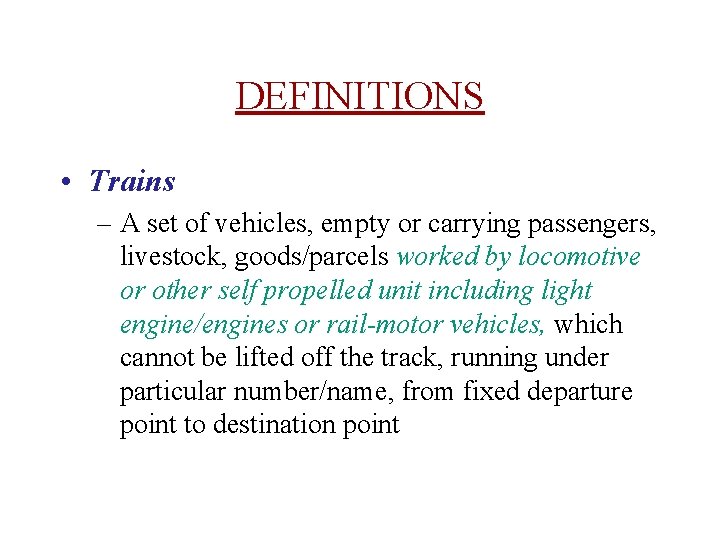
DEFINITIONS • Trains – A set of vehicles, empty or carrying passengers, livestock, goods/parcels worked by locomotive or other self propelled unit including light engine/engines or rail-motor vehicles, which cannot be lifted off the track, running under particular number/name, from fixed departure point to destination point
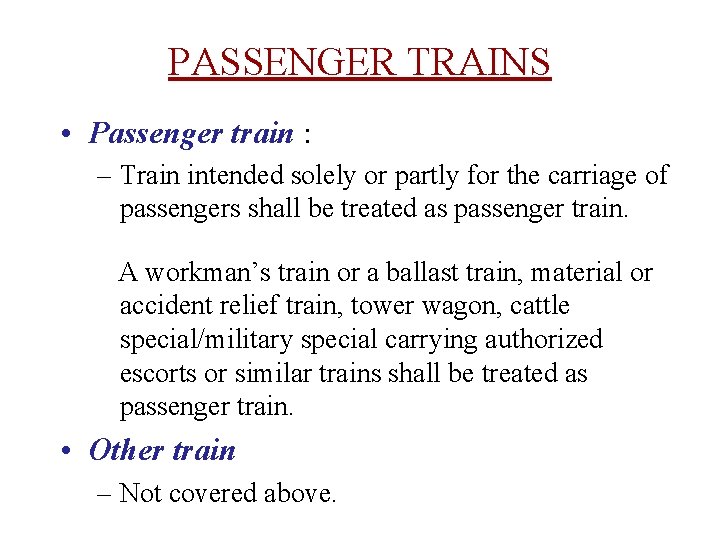
PASSENGER TRAINS • Passenger train : – Train intended solely or partly for the carriage of passengers shall be treated as passenger train. A workman’s train or a ballast train, material or accident relief train, tower wagon, cattle special/military special carrying authorized escorts or similar trains shall be treated as passenger train. • Other train – Not covered above.
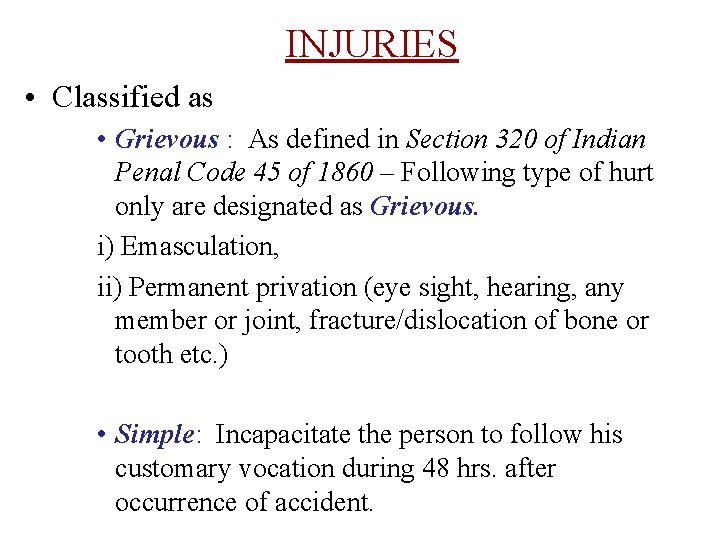
INJURIES • Classified as • Grievous : As defined in Section 320 of Indian Penal Code 45 of 1860 – Following type of hurt only are designated as Grievous. i) Emasculation, ii) Permanent privation (eye sight, hearing, any member or joint, fracture/dislocation of bone or tooth etc. ) • Simple: Incapacitate the person to follow his customary vocation during 48 hrs. after occurrence of accident.
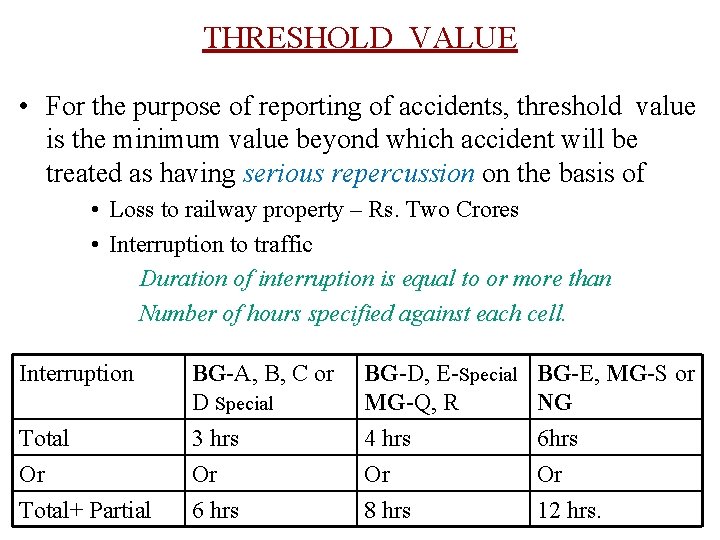
THRESHOLD VALUE • For the purpose of reporting of accidents, threshold value is the minimum value beyond which accident will be treated as having serious repercussion on the basis of • Loss to railway property – Rs. Two Crores • Interruption to traffic Duration of interruption is equal to or more than Number of hours specified against each cell. Interruption Total Or Total+ Partial BG-A, B, C or D Special 3 hrs Or 6 hrs BG-D, E-Special MG-Q, R 4 hrs Or 8 hrs BG-E, MG-S or NG 6 hrs Or 12 hrs.
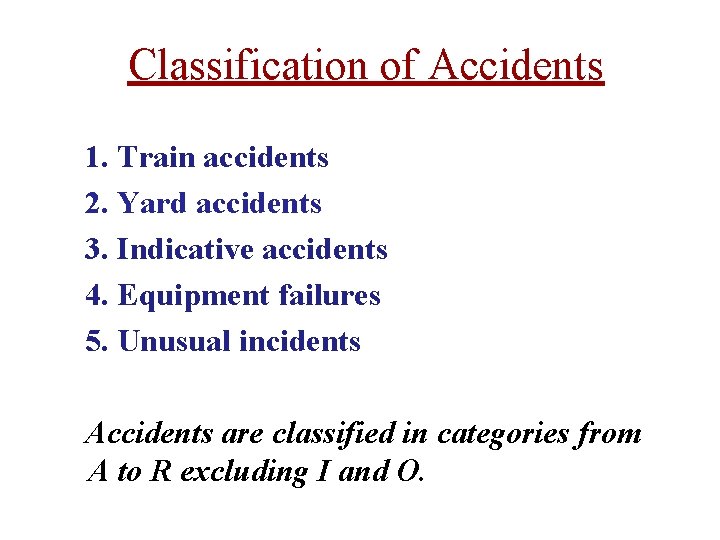
Classification of Accidents 1. Train accidents 2. Yard accidents 3. Indicative accidents 4. Equipment failures 5. Unusual incidents Accidents are classified in categories from A to R excluding I and O.
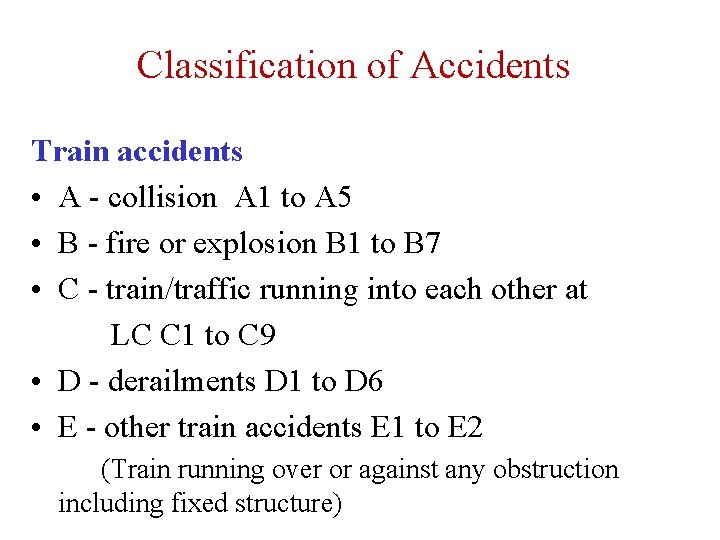
Classification of Accidents Train accidents • A - collision A 1 to A 5 • B - fire or explosion B 1 to B 7 • C - train/traffic running into each other at LC C 1 to C 9 • D - derailments D 1 to D 6 • E - other train accidents E 1 to E 2 (Train running over or against any obstruction including fixed structure)
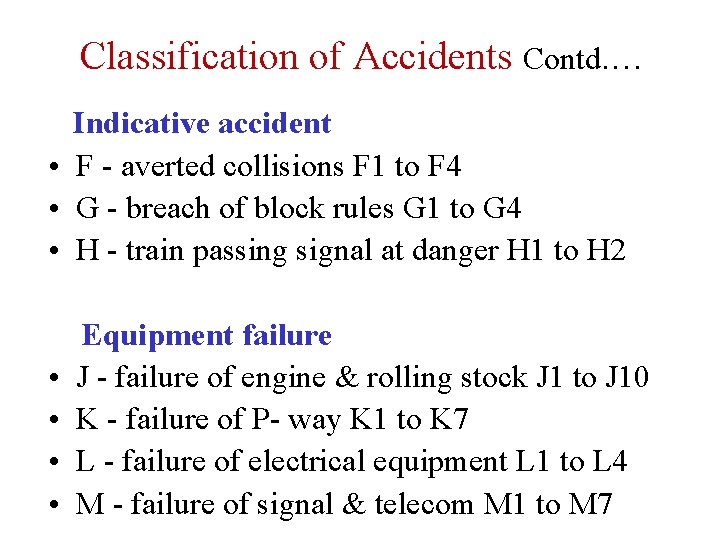
Classification of Accidents Contd. … Indicative accident • F - averted collisions F 1 to F 4 • G - breach of block rules G 1 to G 4 • H - train passing signal at danger H 1 to H 2 • • Equipment failure J - failure of engine & rolling stock J 1 to J 10 K - failure of P- way K 1 to K 7 L - failure of electrical equipment L 1 to L 4 M - failure of signal & telecom M 1 to M 7
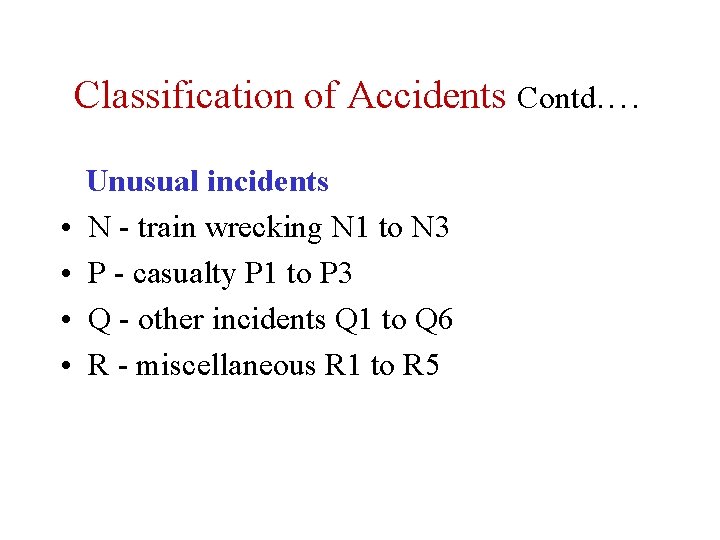
Classification of Accidents Contd. … • • Unusual incidents N - train wrecking N 1 to N 3 P - casualty P 1 to P 3 Q - other incidents Q 1 to Q 6 R - miscellaneous R 1 to R 5
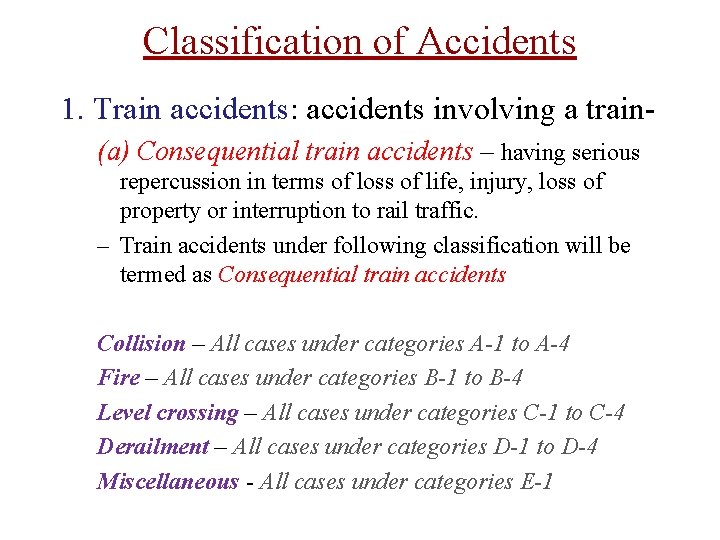
Classification of Accidents 1. Train accidents: accidents involving a train(a) Consequential train accidents – having serious repercussion in terms of loss of life, injury, loss of property or interruption to rail traffic. – Train accidents under following classification will be termed as Consequential train accidents Collision – All cases under categories A-1 to A-4 Fire – All cases under categories B-1 to B-4 Level crossing – All cases under categories C-1 to C-4 Derailment – All cases under categories D-1 to D-4 Miscellaneous - All cases under categories E-1
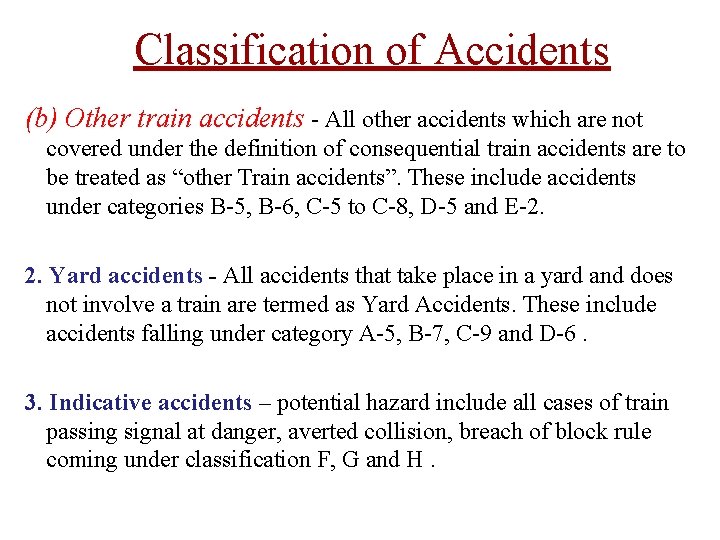
Classification of Accidents (b) Other train accidents - All other accidents which are not covered under the definition of consequential train accidents are to be treated as “other Train accidents”. These include accidents under categories B-5, B-6, C-5 to C-8, D-5 and E-2. 2. Yard accidents - All accidents that take place in a yard and does not involve a train are termed as Yard Accidents. These include accidents falling under category A-5, B-7, C-9 and D-6. 3. Indicative accidents – potential hazard include all cases of train passing signal at danger, averted collision, breach of block rule coming under classification F, G and H.
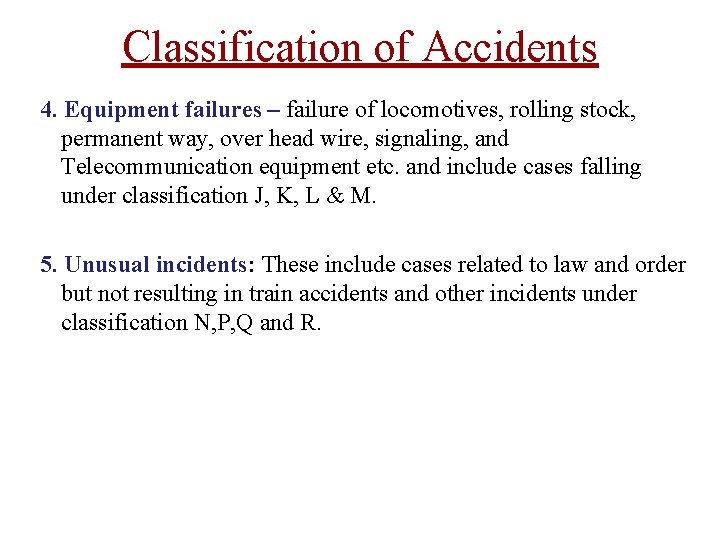
Classification of Accidents 4. Equipment failures – failure of locomotives, rolling stock, permanent way, over head wire, signaling, and Telecommunication equipment etc. and include cases falling under classification J, K, L & M. 5. Unusual incidents: These include cases related to law and order but not resulting in train accidents and other incidents under classification N, P, Q and R.
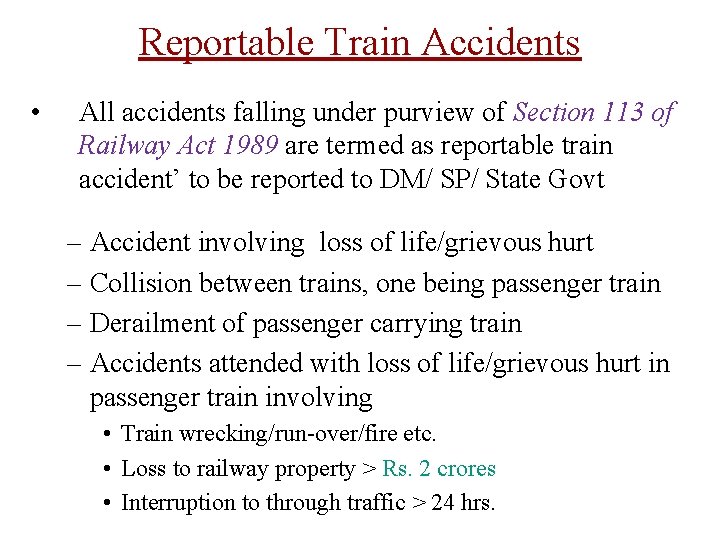
Reportable Train Accidents • All accidents falling under purview of Section 113 of Railway Act 1989 are termed as reportable train accident’ to be reported to DM/ SP/ State Govt – Accident involving loss of life/grievous hurt – Collision between trains, one being passenger train – Derailment of passenger carrying train – Accidents attended with loss of life/grievous hurt in passenger train involving • Train wrecking/run-over/fire etc. • Loss to railway property > Rs. 2 crores • Interruption to through traffic > 24 hrs.
Serious Accidents • Passenger train accident attended with – Loss of life – Grievous hurt to passenger – Serious damage to railway property > Rs. 2 crores – Excluding • Trespassers/passengers through their own carelessness. • Rly servants/travelling outside rolling stock/runover • LC accidents not involving death/grievous hurt • Any other accident which in the opinion of CCRS/CRS requires CRS enquiry.
Reporting of Accidents • To Railway Board : – All consequential train accidents – Yard accident with dislocation above threshold – Land slides etc. with dislocation above threshold • Periodic statement of all categories (monthly) to be submitted to RB • To Zonal Railway – All train accidents – Yard accident with dislocation above threshold – Land slides etc with dislocation above threshold • Periodic statement of all categories (monthly) to be submitted to Zonal Rly
Sounding of hooters. (alarm siren be repeated twice with interval of 5 min bet each code) Circumstances Code For accidents in loco sheds/traffic yards at home station requiring only breakdown train Two long blasts of 45 second duration with 5 seconds break in between For accidents outside home station requiring only breakdown train Three long blasts of 45 sec. duration with 5 sec. break in between
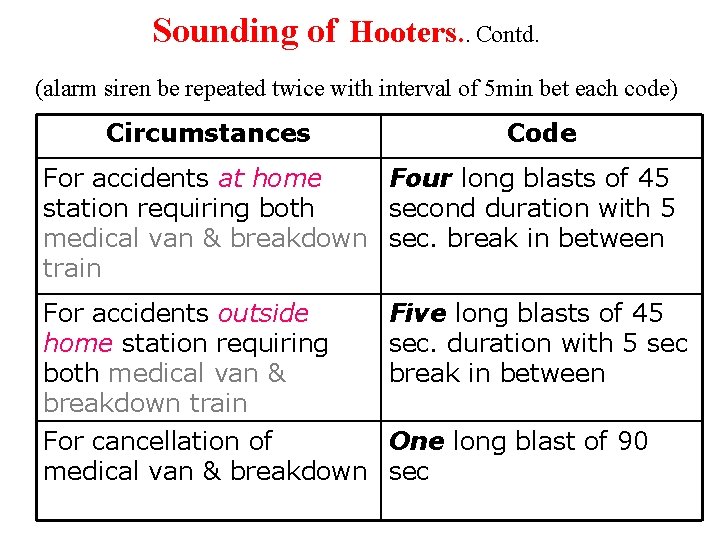
Sounding of Hooters. . Contd. (alarm siren be repeated twice with interval of 5 min bet each code) Circumstances Code For accidents at home Four long blasts of 45 station requiring both second duration with 5 medical van & breakdown sec. break in between train For accidents outside home station requiring both medical van & breakdown train For cancellation of medical van & breakdown Five long blasts of 45 sec. duration with 5 sec break in between One long blast of 90 sec
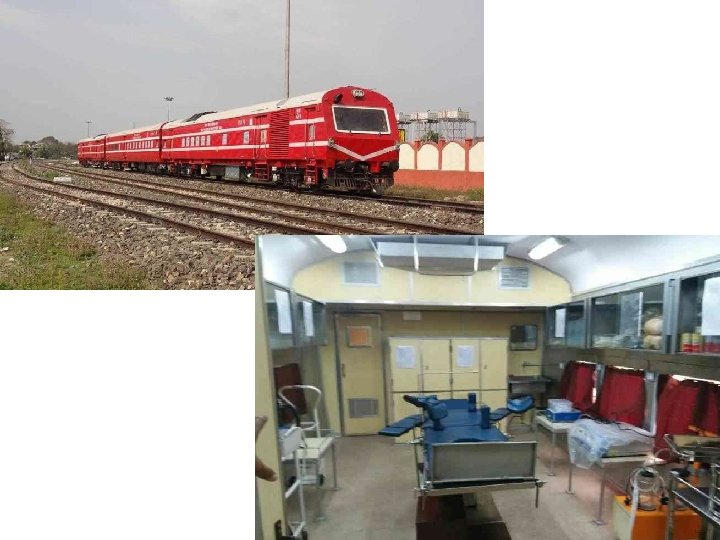

Target time for Turning out Medical van/ Breakdown train Medical van Double exit siding Single exit siding 15 minutes 20 minutes During day During night 30 minutes 45 minutes B/down train
ACCIDENT ENQUIRY
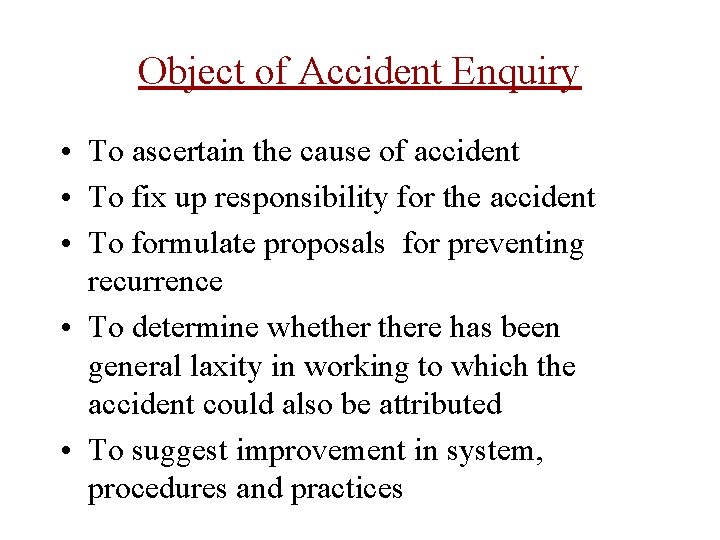
Object of Accident Enquiry • To ascertain the cause of accident • To fix up responsibility for the accident • To formulate proposals for preventing recurrence • To determine whethere has been general laxity in working to which the accident could also be attributed • To suggest improvement in system, procedures and practices
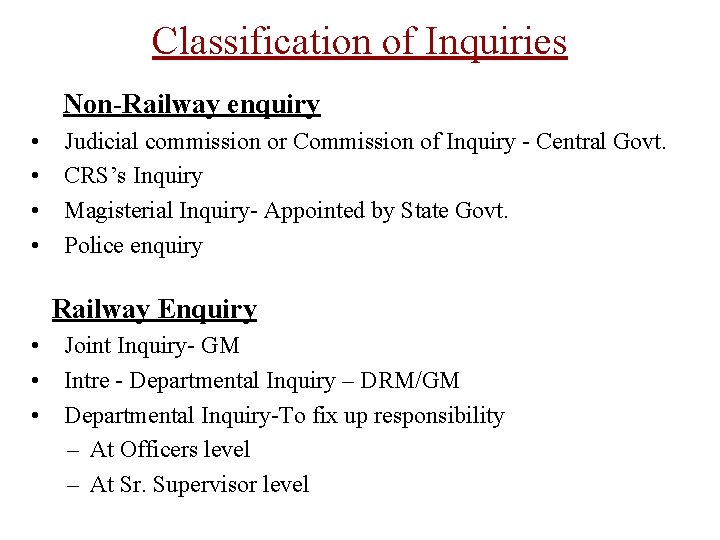
Classification of Inquiries Non-Railway enquiry • • Judicial commission or Commission of Inquiry - Central Govt. CRS’s Inquiry Magisterial Inquiry- Appointed by State Govt. Police enquiry Railway Enquiry • Joint Inquiry- GM • Intre - Departmental Inquiry – DRM/GM • Departmental Inquiry-To fix up responsibility – At Officers level – At Sr. Supervisor level
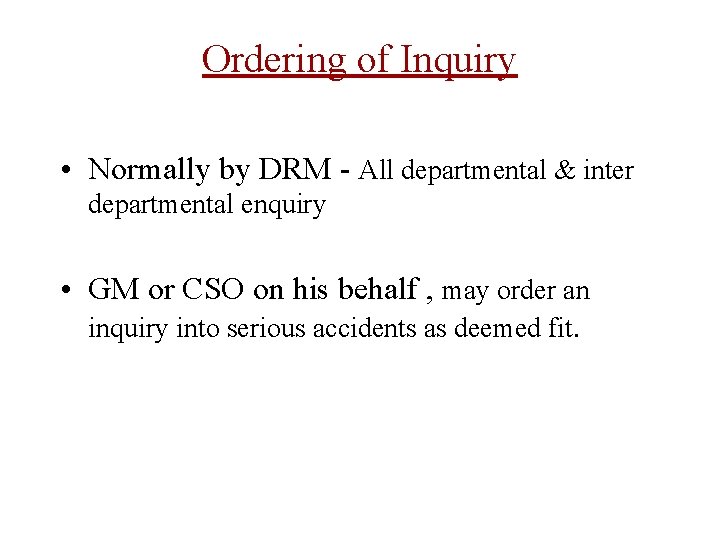
Ordering of Inquiry • Normally by DRM - All departmental & inter departmental enquiry • GM or CSO on his behalf , may order an inquiry into serious accidents as deemed fit.
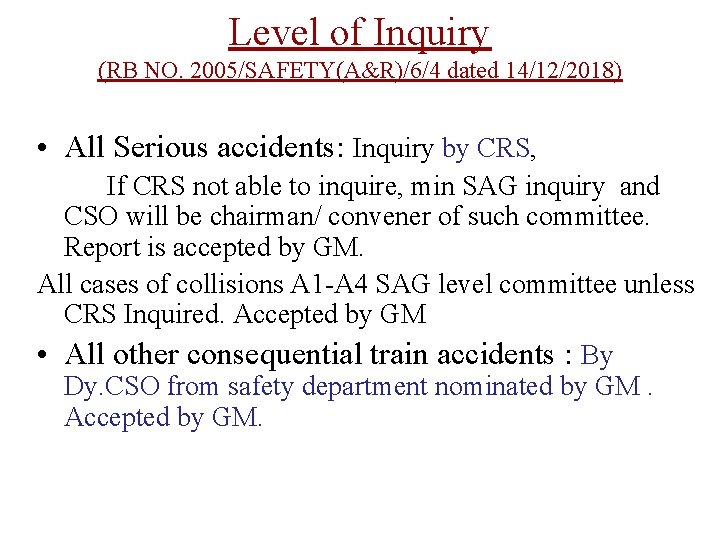
Level of Inquiry (RB NO. 2005/SAFETY(A&R)/6/4 dated 14/12/2018) • All Serious accidents: Inquiry by CRS, If CRS not able to inquire, min SAG inquiry and CSO will be chairman/ convener of such committee. Report is accepted by GM. All cases of collisions A 1 -A 4 SAG level committee unless CRS Inquired. Accepted by GM • All other consequential train accidents : By Dy. CSO from safety department nominated by GM. Accepted by GM.
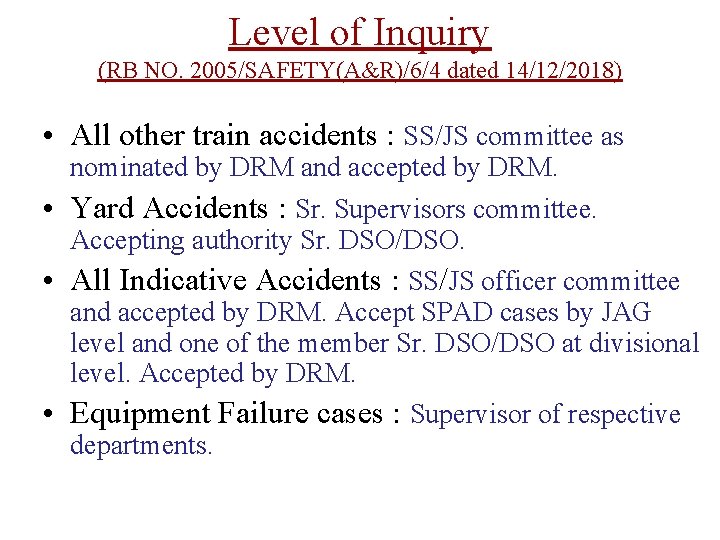
Level of Inquiry (RB NO. 2005/SAFETY(A&R)/6/4 dated 14/12/2018) • All other train accidents : SS/JS committee as nominated by DRM and accepted by DRM. • Yard Accidents : Sr. Supervisors committee. Accepting authority Sr. DSO/DSO. • All Indicative Accidents : SS/JS officer committee and accepted by DRM. Accept SPAD cases by JAG level and one of the member Sr. DSO/DSO at divisional level. Accepted by DRM. • Equipment Failure cases : Supervisor of respective departments.
TIME LIMIT for completion of Enquiry • D - Date of accident, Telephonic advice to HQ, Reporting of Prima-facie cause • D+1 - Ordering of inquiry • D+3 - Holding of enquiry • D+10 - Inquiry proceedings from DRM to CSO • D+27 - Finalization and submission of enquiry report to RB by CSO
JOINT ENQUIRY • Can be dispensed with if – An enquiry is to be held by CRS – There is no reasonable doubt as to the cause of accident – One department accepts the responsibility
ACCIDENT PROCEEDINGS TO CONSIST OF • • A list of members composing the Committee A description and summary of accident A list of witnesses in the order examined The evidence of each witness The finding arrived at by the Committee The Reasons for the Findings Nature & extent of damage
ACCIDENT PROCEEDINGS TO CONSIST OF (contd. . ) • • List of persons killed or injured Extract of relevant Documents Rules violated Service particulars of staff held responsible A sketch of site of accident Recommendations Suggestions for system improvement Other matters brought to light
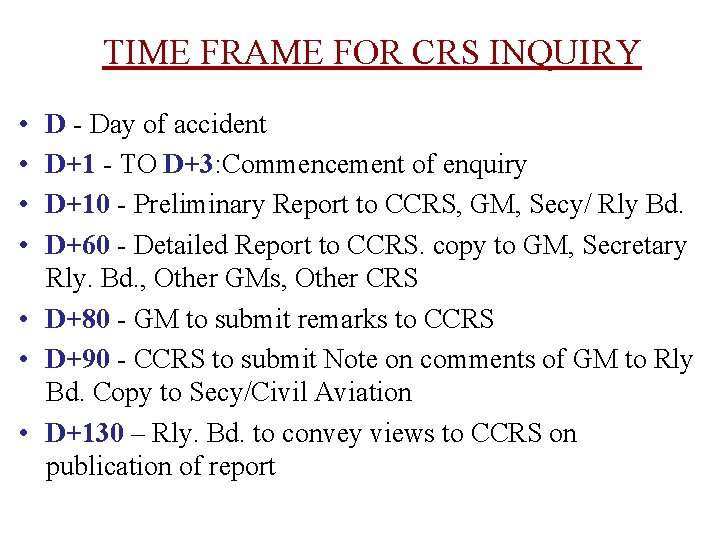
TIME FRAME FOR CRS INQUIRY • • D - Day of accident D+1 - TO D+3: Commencement of enquiry D+10 - Preliminary Report to CCRS, GM, Secy/ Rly Bd. D+60 - Detailed Report to CCRS. copy to GM, Secretary Rly. Bd. , Other GMs, Other CRS • D+80 - GM to submit remarks to CCRS • D+90 - CCRS to submit Note on comments of GM to Rly Bd. Copy to Secy/Civil Aviation • D+130 – Rly. Bd. to convey views to CCRS on publication of report
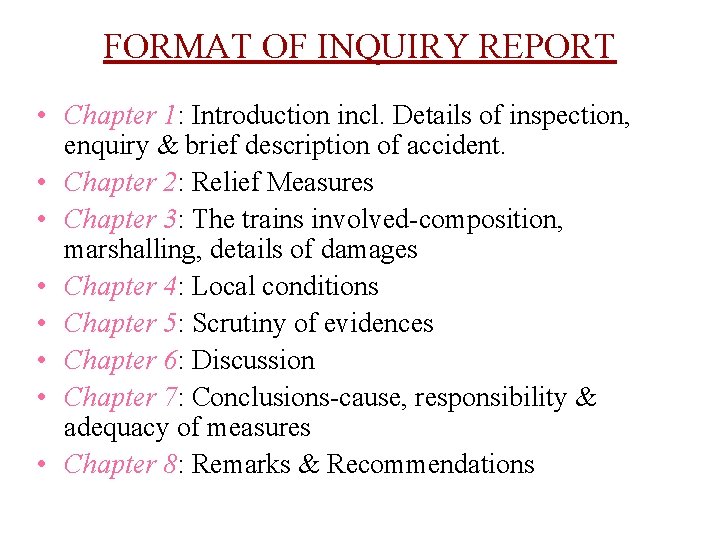
FORMAT OF INQUIRY REPORT • Chapter 1: Introduction incl. Details of inspection, enquiry & brief description of accident. • Chapter 2: Relief Measures • Chapter 3: The trains involved-composition, marshalling, details of damages • Chapter 4: Local conditions • Chapter 5: Scrutiny of evidences • Chapter 6: Discussion • Chapter 7: Conclusions-cause, responsibility & adequacy of measures • Chapter 8: Remarks & Recommendations
ACTION TO BE TAKEN IN CASE OF ACCIDENT
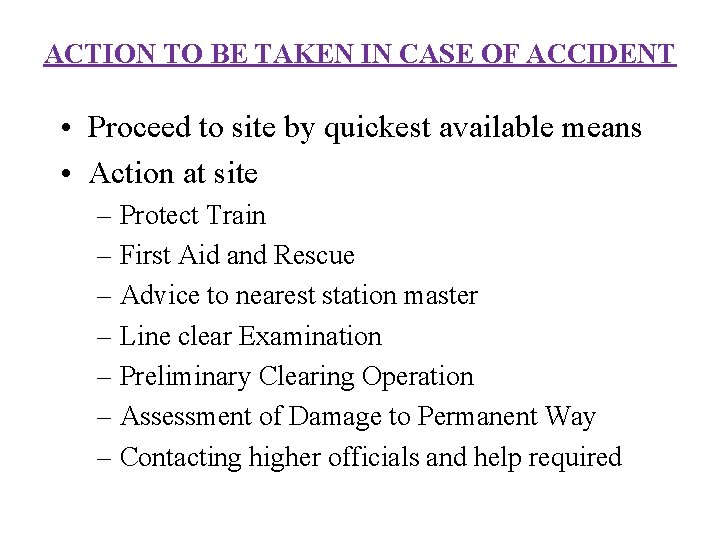
ACTION TO BE TAKEN IN CASE OF ACCIDENT • Proceed to site by quickest available means • Action at site – Protect Train – First Aid and Rescue – Advice to nearest station master – Line clear Examination – Preliminary Clearing Operation – Assessment of Damage to Permanent Way – Contacting higher officials and help required
ACTION TO BE TAKEN IN CASE OF ACCIDENT • Action at site (continued) – Advice Restoration Time – Recording of statements – Recording of details (Sketch etc) – Arranging Photograph of Accident site – Preservation of Clues. • Recording of Track Reading, Wagon Reading and other relevant details • Preliminary Report • Police clearance • Restoration.
Details to be given in First Information • • • Time & date of accident Train no/description of train(s) involved in acc Block section/station Location-kilometerage of acc site Gen description of acc site inc. Track structure, curve, gradient, speed restriction, visibility, weather or any other spl feature. • Whether medical van & B/D train required • Nature of accident • Whether any casualty/injury, nos persons injures/killed, any injury to passengers , Rly staff or others.
Details to be given in First Information • Any derailment occurred? in case of wagon derailed/capsized, whether loaded or empty, whether fouling to adjacent track or not? Whether any speed restriction required to traffic on adjacent line, any other inf. readily available. • Track condition: - appx. Track length damaged (from km to km). Extent of damage i. e. damage to sleepers, track fittings, bridge, tunnel, fixtures etc. • OHE - Damage to Mast/Portal cantilever, wires, insulation etc.
Details to be given. . . Contd. . • S&T - Damage to signal posts, S&T gears, signals, pts & xings, track circuits etc. • Rolling Stock - Damage to loco, wagons, coaches/vehicle. • LC acc - type of road vehicle : Tractor/Bus etc. involved & nos of persons injured / dead, nature of injuries. Whether the engine disabled & whether any derailment taken place. Whether road vehicle is entangled /obstructing the track. • Prima facie cause of the accident, if known. • Any other relevant information.
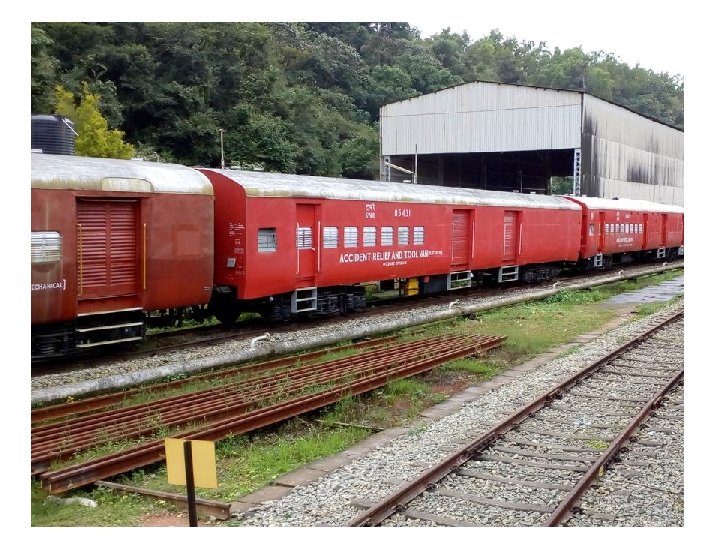
RESTORATION : PREPAREDNESS • ART with full compliment of material • Additional emergency material at suitable location • Tools for emergencies – Rail cutting, rail drilling, dip-lorries, lighting arrangement • Man power for emergencies • Communication arrangement • List of available resources, contacts.
DUTIES OF OFFICER-IN-CHARGE AT SITE • Make assessment of casualties, damage, detention time, assistance required, prima facie cause • Arrange rescue relief, restoration & preservation of clues • Arrange for Ex-Gratia payment. • Arrange for mobile control office. • Catering arrangement to passengers • Security of luggage of passengers • Clearing stranded passengers.
RESCUE AND RELIEF • • • Top priority Contact Local authorities, hospitals All available staff to be involved Medicos available on train to be approached Arrange locally available medical facility Stranded passengers to be given chance to talk to relatives • Stranded passengers to be moved quickly
RESTORATION : SITE ACTIVITIES • Assessment of damage • Working scheme • Requirement of men and equipment • Sectional Inspectors and labour • Contractors artisan and labour • Shift system • Sectional Inspector to take care of Stores; diet allowance etc.
RESTORATION- Other activities • Offices of AEN and SE (P. Way) to be suitably manned • Inspectors to be skilled in taking reading • Duties of Sr. DEN, AEN, SE(P. Way) given in accident manual • Photographs / sketch of site.
Sabotage and Train Wrecking Sabotage : Criminal interference with any part of the machinery to make it inoperative or any activity to cause damage to Rly property. Train Wrecking : Tempering with P. way, works or rolling stock, resulting in an accident.
Sabotage /train wrecking Precautions by Engg supervisors • Do not allow labour to carry tools • Do not allow labour to touch portion of track within the area of suspected sabotage • Do not allow the tool boxes to be opened till police check is over • Joint examination by civil police and Rly. official • Detailed investigation of the cause including thorough survey for at least 800 m in the rear jointly
Sabotage /train wrecking Contd. … • Position of vehicle/track fitting not to be disturbed as far as possible • Preserve clues jointly • Arrangements must be made for videography/ photography of all essential features. Site in charge may call reliable local photographer /videographer till arrival of Rly photographer
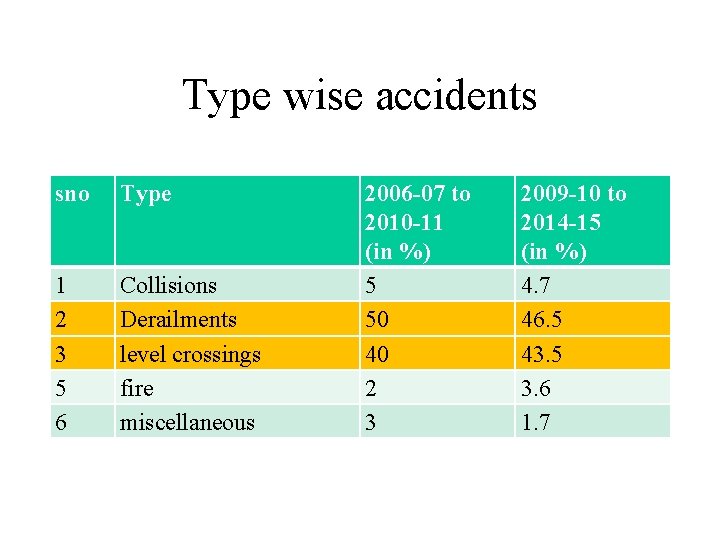
Type wise accidents sno Type 1 2 3 5 6 Collisions Derailments level crossings fire miscellaneous 2006 -07 to 2010 -11 (in %) 5 50 40 2 3 2009 -10 to 2014 -15 (in %) 4. 7 46. 5 43. 5 3. 6 1. 7
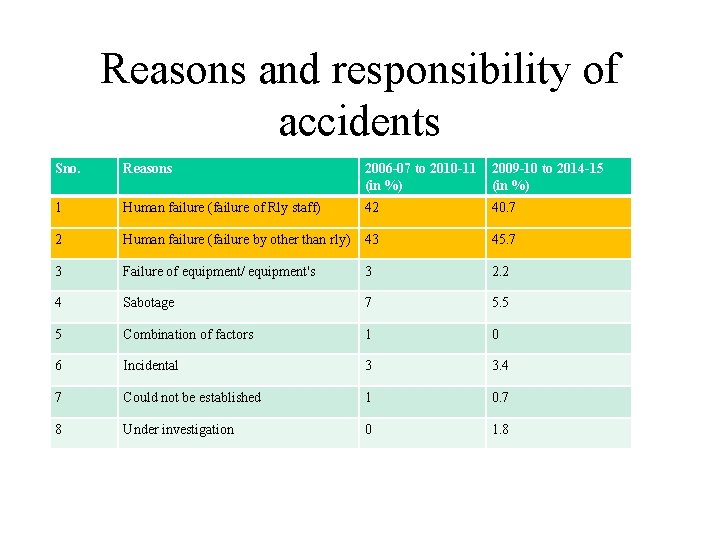
Reasons and responsibility of accidents Sno. Reasons 2006 -07 to 2010 -11 (in %) 2009 -10 to 2014 -15 (in %) 1 Human failure (failure of Rly staff) 42 40. 7 2 Human failure (failure by other than rly) 43 45. 7 3 Failure of equipment/ equipment's 3 2. 2 4 Sabotage 7 5. 5 5 Combination of factors 1 0 6 Incidental 3 3. 4 7 Could not be established 1 0. 7 8 Under investigation 0 1. 8
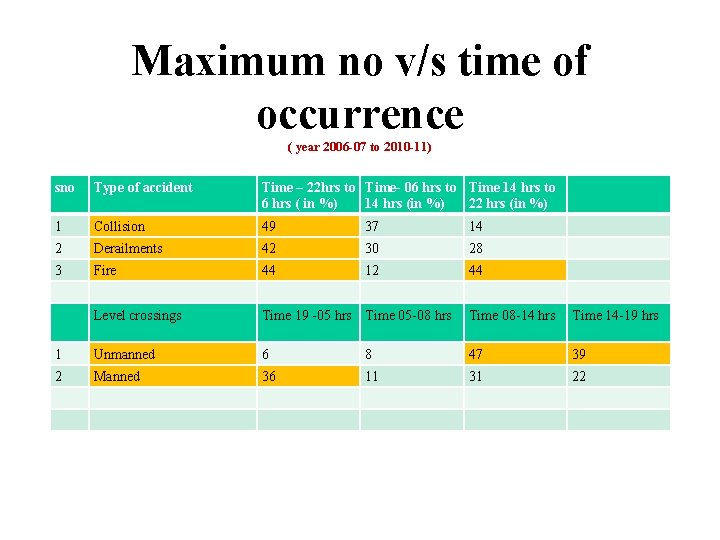
Maximum no v/s time of occurrence ( year 2006 -07 to 2010 -11) sno Type of accident Time – 22 hrs to Time- 06 hrs to Time 14 hrs to 6 hrs ( in %) 14 hrs (in %) 22 hrs (in %) 1 Collision 49 37 14 2 Derailments 42 30 28 3 Fire 44 12 44 Level crossings Time 19 -05 hrs Time 05 -08 hrs Time 08 -14 hrs Time 14 -19 hrs 1 Unmanned 6 8 47 39 2 Manned 36 11 31 22
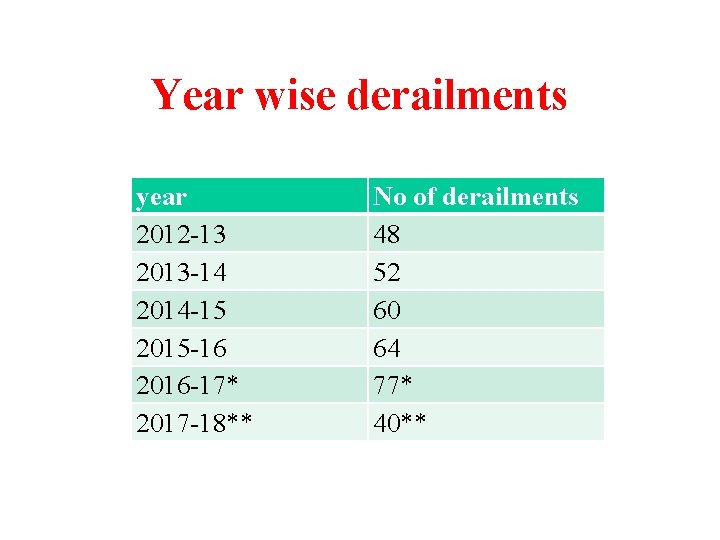
Year wise derailments year 2012 -13 2013 -14 2014 -15 2015 -16 2016 -17* 2017 -18** No of derailments 48 52 60 64 77* 40**
Thanks…
- Slides: 64