
Abortion INTRODUCTIONDEFINITION Termination or loss of pregnancy before
Abortion
INTRODUCTION/DEFINITION • Termination or loss of pregnancy before the age of viability( 28, 24 , 22 wks or <500 g) • WHO-24 wks or 500 g • In our environment- Officially still 28 wks • UK- 24 wks • USA-22 wks
�Abortion is a significant public health problem and an important cause of maternal mortality in the developing world � An estimated 70, 000 women die from complications of induced abortion annually in the world � A large number of these deaths (over 99%) are due to unsafe procedures carried out in developing countries � Preventing maternal deaths is an important Millennium Development Goal

DEFINITION Abortion is the expulsion or extraction of an embryo or fetus weighing 500 g or less from its mother when it is not capable of independent survival (i. e. before the period of viability)
Incidence • 10– 20% of all clinical pregnancies • 75% abortions occur before the 16 th week • Rates vary with maternal age; also high in women with past miscarriages
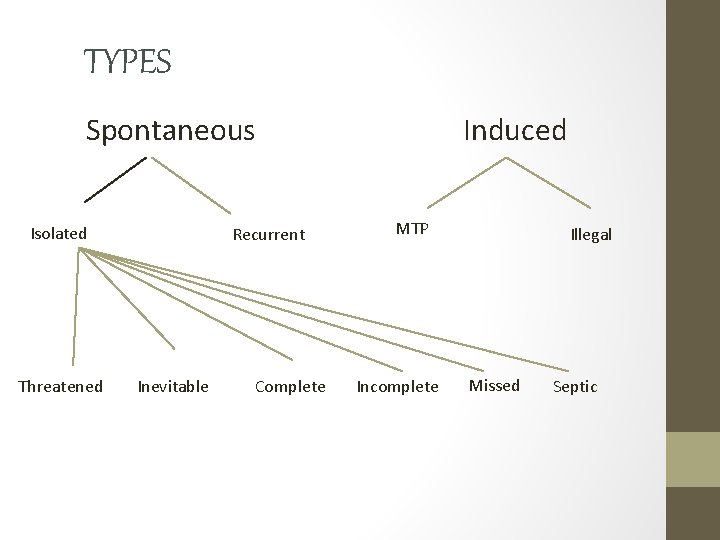
TYPES Spontaneous Isolated Threatened Recurrent Inevitable Complete Induced MTP Incomplete Illegal Missed Septic
Etiology • Fetal Factors • Maternal Factors
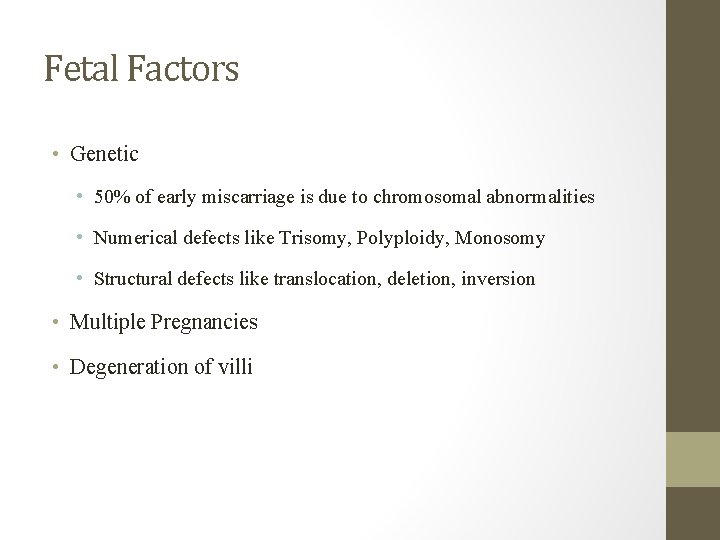
Fetal Factors • Genetic • 50% of early miscarriage is due to chromosomal abnormalities • Numerical defects like Trisomy, Polyploidy, Monosomy • Structural defects like translocation, deletion, inversion • Multiple Pregnancies • Degeneration of villi
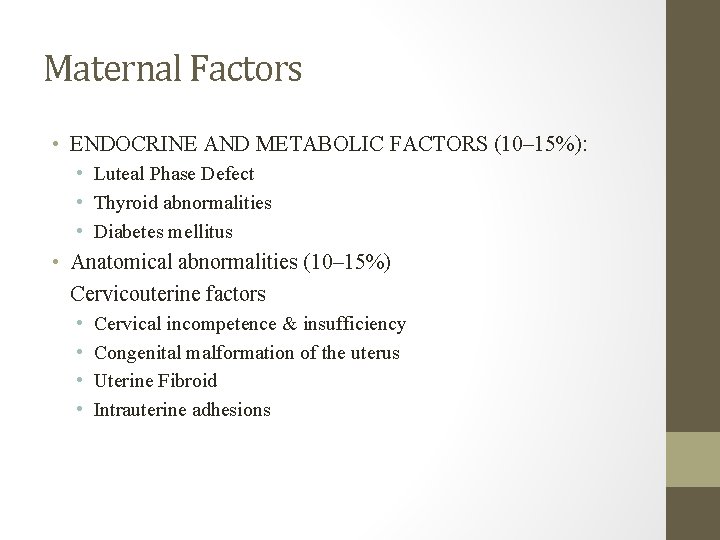
Maternal Factors • ENDOCRINE AND METABOLIC FACTORS (10– 15%): • Luteal Phase Defect • Thyroid abnormalities • Diabetes mellitus • Anatomical abnormalities (10– 15%) Cervicouterine factors • • Cervical incompetence & insufficiency Congenital malformation of the uterus Uterine Fibroid Intrauterine adhesions
• Infections (5%) • Viral: rubella, cytomegalo, HIV, . . • Parasitic: toxoplasma, malaria, . . • Bacterial: ureaplasma, chlamydia, . . • IMMUNOLOGICAL DISORDERS (5– 10%)— • • Autoimmune disease • • Alloimmune disease • • Antifetal antibodies
• Environmental Factors • Cigarette smoking • Alcohol consumption • Contraceptive agents • Maternal medical illness • Cyanotic heart disease • Hemoglobinopathies • Unexplained (40 -60%) – In majority, the exact cause is not known.
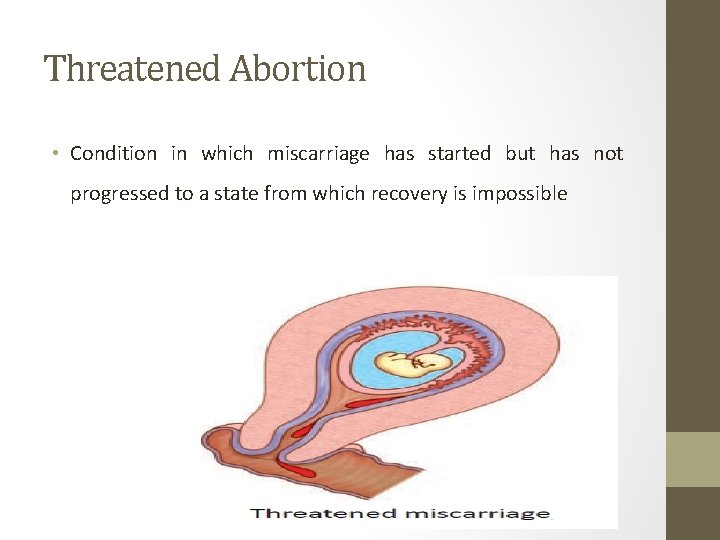
Threatened Abortion • Condition in which miscarriage has started but has not progressed to a state from which recovery is impossible
CLINICAL FEATURES: • The patient, having amenorrhea, complains of: (1) Slight bleeding per vaginam (2) Pain: Usually painless; there may be mild backache or dull pain in lower abdomen
CONTD • The uterus and cervix feel soft. • Digital examination reveals closed external os • Differential diagnosis includes • • cervical ectopy polyps or carcinoma ectopic pregnancy molar pregnancy • Ultrasound is diagnostic; Pelvic examination is avoided when USG is available
Management & Prognosis • Rest: Patient should be in bed for few days until bleeding stops • Relief of pain: Diazepam 5 mg BD • 80% of pregnancies with threatened abortions go on until term • If a live fetus is seen on USG, pregnancy is likely to continue in over 95% cases. • If pregnancy continues, there is increased frequency of preterm labor, placenta praevia & IUGR
Inevitable Abortion It is the clinical type of abortion where the changes have progressed to a state from where continuation of pregnancy is impossible.
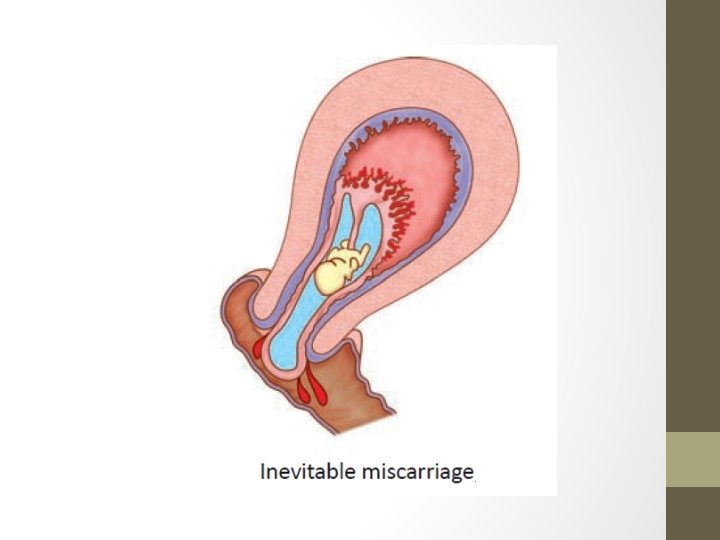
CLINICAL FEATURES: • The patient, having the features of threatened miscarriage, presents with • vaginal bleeding • Aggravation of colicky pain in the lower abdomen • Sometimes, the features may develop quickly without prior clinical evidence of threatened miscarriage • Internal examination reveals dilated internal os through which the products of conception are felt
Management • Management is aimed: • To accelerate the process of expulsion • To maintain strict asepsis • If pregnancy < 12 weeks, suction evacuation is done • If pregnancy > 12 weeks, expulsion by oxytocin infusion • General measures: • Excessive bleeding is controlled by administering methergin 0. 2 mg • Blood loss is corrected by IV fluid therapy and blood transfusion
Incomplete abortion The process of abortion has already taken place, but the entire products of conception are not expelled & a part of it is left inside the uterine cavity
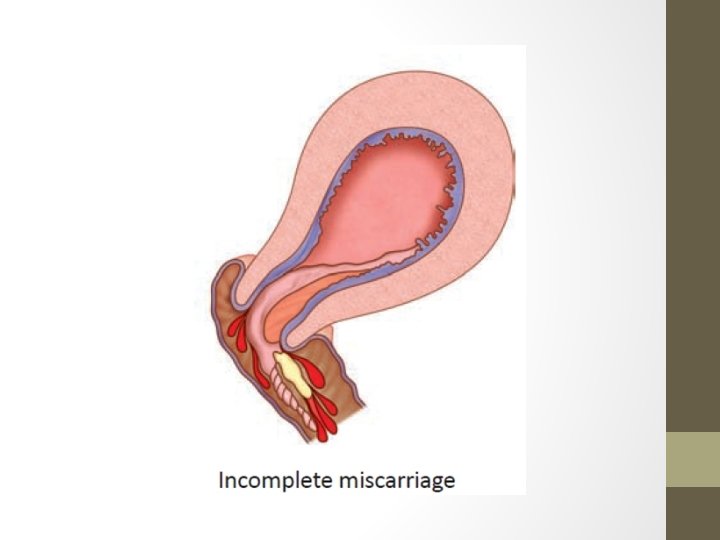
Clinical features: • History of expulsion of a fleshy mass per vaginam; • Continuation of pain in lower abdomen • Persistence of vaginal bleeding • Internal examination reveals • uterus smaller than the period of amenorrhea • Open internal os • varying amount of bleeding • On examination, the expelled mass is found incomplete Complications: • The retained products may cause: (a) bleeding (b) sepsis or (c) placental polyp.
MANAGEMENT: • Evacuation of the retained products of conception (ERCP) • Early abortion: Dilatation and evacuation under analgesia or general anesthesia is to be done. • Late abortion: Uterus is evacuated under general anesthesia and the products are removed by ovum forceps or by blunt curette. In late cases, D&C is to be done to remove the bits of tissues left behind. • Prophylactic antibiotics are given; removed materials are subjected to a histological examination. • Medical management - Tab. Misoprostol 200 μg is used vaginally every 4 hours
Complete Abortion • When the products of conception are completely expelled from the uterus, it is called complete miscarriage.
Clinical features • There is history of expulsion of a fleshy mass per vaginam followed by • Subsidence of abdominal pain • Vaginal bleeding becomes trace or absent • Internal examination reveals: • Uterus smaller than the period of amenorrhea • Cervical os is closed • Bleeding is trace. • Transvaginal sonography confirms that uterus is empty
Missed Abortion • The fetus is dead and retained passively inside the uterus for a variable period • It is diagnosed when there is a fetus with a crown rump length of 5 mm without a fetal heart.
CLINICAL FEATURES: The patient usually presents with features of threatened miscarriage followed by: • Subsidence of pregnancy symptoms • Uterus becomes smaller in size • Cervix feels firm with closed internal os • Nonaudibility of the fetal heart sound even with Doppler ultrasound • Immunological test for pregnancy becomes negative
Complications • Retaining the products for long time can lead to sepsis • DIC [Disseminated Intravascular Coagulation] – (very rare) in gestations exceeding 16 weeks
Management Uterus is less than 12 weeks: • Prostaglandin E 1 (Misoprostol) 800 mg is given vaginally and repeated after 24 hours if needed. Expulsion usually occurs within 48 hours • Suction evacuation is done when the medical method fails Uterus more than 12 weeks • 6 th or 12 th hourly misoprostol tablets given vaginally • If this fails, extraamniotic instillation of ethacridine lactate is used • Antibiotics are given
Septic Abortion • Any abortion associated with clinical evidences of infection of the uterus and its contents • Most common cause – Attempt at induced abortion by an untrained person without the use of aseptic precautions
Clinical Grading: • Grade–I: The infection is localized in the uterus. • Grade–II: The infection spreads beyond the uterus to the parametrium, tubes and ovaries or pelvic peritoneum. • Grade–III: Generalized peritonitis and/or endotoxic shock or jaundice or acute renal failure. Grade-I is the commonest and is usually associated with spontaneous abortion
Clinical Features • Fever, abdominal pain and vomiting or diarrhoea • A rising pulse rate of 100– 120/min or more is a significant finding than even pyrexia. It indicates spread of infection beyond the uterus. • Examination shows abdominal tenderness, guarding, rigidity • Internal examination reveals: • offensive purulent vaginal discharge • tender uterus usually with patulous os or a boggy feel • Soft cervix with open internal os
Investigations • CBC • Serum urea, creatinine, electrolytes • High vaginal swab • Blood culture in suspected septicaemia • Pelvic USG to detect retained products of conception • X-ray abdomen in suspected bowel injury • X-ray chest if there is difficulty in respiration
Complications Immediate: • Hemorrhage • Injury may to uterus & adjacent structures • Spread of infection leads to: • • • Generalized peritonitis Endotoxic shock—mostly due to E. Coli DIC Acute renal failure Thrombophlebitis • All these lead to increased maternal deaths
Management • Mild cases • Broad spectrum antibiotics started • Uterus is evacuated • Severe Cases • Vigorous IV infusion with crystalloid • Oxygen given by nasal catheter • Broad spectrum antibiotics – combination of ampicillin, gentamycin, metronidazole is started • Uterus is evacuated in 4 -6 hrs of commencing therapy.
Recurrent Miscarriage/ Pregnancy loss
Recurrent Abortion • Recurrent miscarriage is defined as a sequence of three or more consecutive spontaneous abortion • Seen in ~ 1% of all women • Risk increases with each successive abortion • No underlying cause is found for 50% of recurrent pregnancy loss
Etiology FIRST TRIMESTER ABORTION: • Genetic factors (3– 5%): § Parental chromosomal abnormalities § The most common abnormality is a balanced translocation. § This leads to unbalanced translocation in the fetus, causing early miscarriage or a live birth with congenital malformations § Risk of miscarriage in couples with a balanced translocation is > 25%. § This is the most common cause for 1 st trimester loss
• Endocrine and Metabolic: • Poorly controlled diabetic patients • Presence of thyroid autoantibodies • Luteal phase defect • Hypersecretion of luteinizing hormone (e. g. in PCOS). • Infection: • Infection in the genital tract - (Transplacental fetal infection) • Syphilis • Inherited thrombophilia • Protein C deficiency, Protein S deficiency, factor V Leiden mutation, prothrombin gene mutation
• Immunological cause: Autoimmunity – Antiphospholipid antibody syndrome(15%). • Antiphospholipid antibodies present in mother produce adverse fetal outcome • Diagnosis by presence of lupus anticoagulant/Ig. G/Ig. M anticardiolipin antibodies Alloimmune factors • Immune response against paternal antigens in the fetus • This is a result of lack of production of blocking antibodies by the mother due to failure of recognition of TLX (trophoblast-lymphocyte crossreactive antigens)
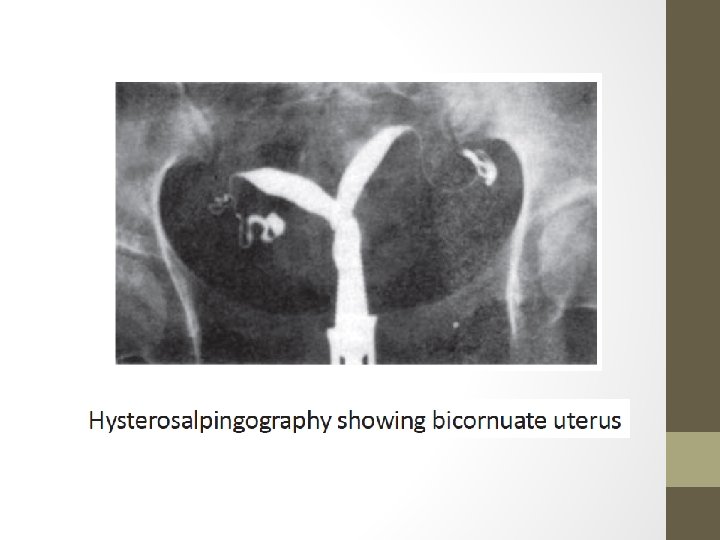
SECOND TRIMESTER MISCARRIAGE: • Anatomic abnormalities - responsible for 10– 15% of recurrent abortion. • Causes may be (a) Congenital - defects in the mullerian duct fusion (e. g. unicornuate, bicornuate, septate or double uterus) (b) Acquired - intrauterine adhesions, uterine fibroids and endometriosis, cervical incompetence
Uterine Causes • Defects of mullerian fusion • Double uterus, septate or bicornuate uterus • About 12% cases of recurrent abortion. • Implantation on the septum leads to defective placentation • Asherman syndrome – Intrauterine adhesions due to previous curettage – can lead to early miscarriage • Transvaginal ultrasound is used for diagnosis; • Hysteroscopic resection for septum or division of adhesions in Asherman’s syndrome. • Submucous fibroids - managed by myomectomy
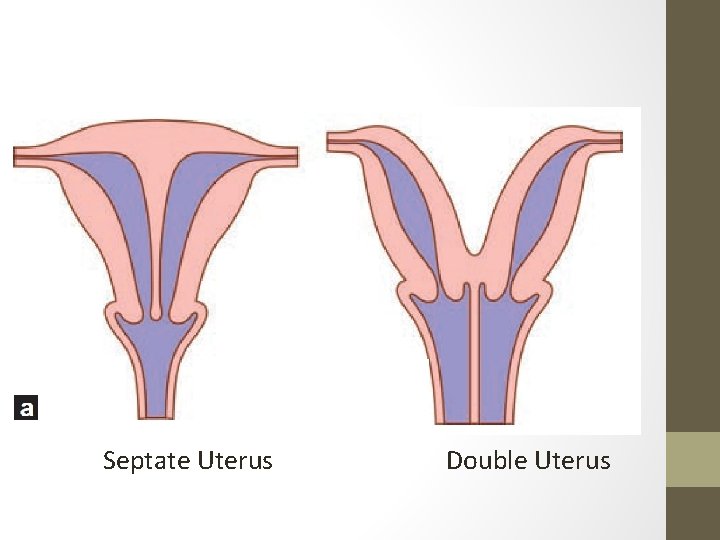
Septate Uterus Double Uterus
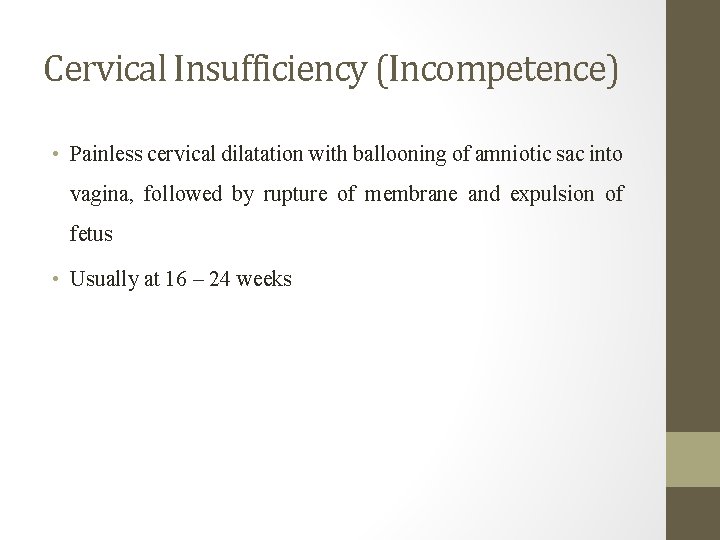
Cervical Insufficiency (Incompetence) • Painless cervical dilatation with ballooning of amniotic sac into vagina, followed by rupture of membrane and expulsion of fetus • Usually at 16 – 24 weeks
Etiology • Congenital • Developmental weakness of cervix • Uterine anomalies • Acquired (iatrogenic)—common, following: (i) (iii) (iv) D&C operation Induced abortion by D and E vaginal operative delivery through an undilated cervix amputation of the cervix or cone biopsy. • Multiple gestations, prior preterm birth.
Diagnosis • History - Repeated mid trimester painless cervical dilatation and escape of liquor amnii followed by painless expulsion of the products of conception • Internal examination: Interconceptual period: • Passage of no. 6– 8 Hegar dilator beyond the internal os without any resistance or pain • Funnelling of internal os seen in hysterosalpingography
During pregnancy • Clinical digital – Painless cervical shortening and dilatation • Sonography: Trans vaginal ultrasound is performed. Short cervix < 25 mm; Funnelling of the internal Os > 1 cm.
Management • Surgical management – Cervical circlage • Usually at 12 -14 weeks • The procedure reinforces the weak cervix by a non-absorbable tape, placed around the cervix at the level of internal os.
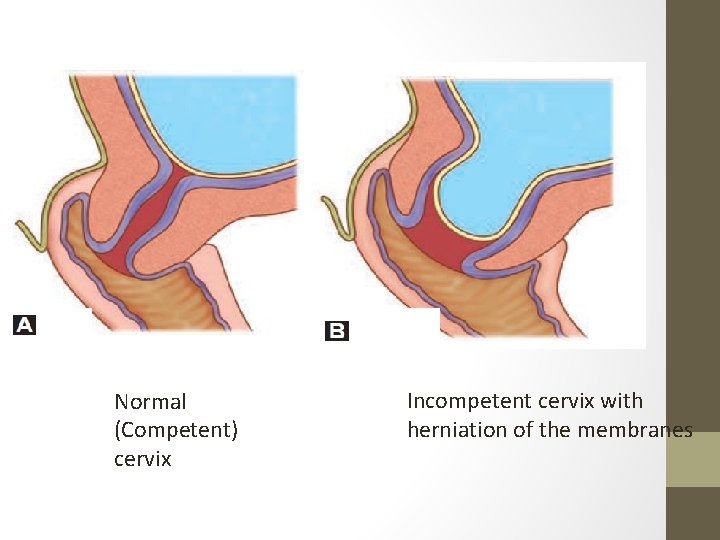
Normal (Competent) cervix Incompetent cervix with herniation of the membranes
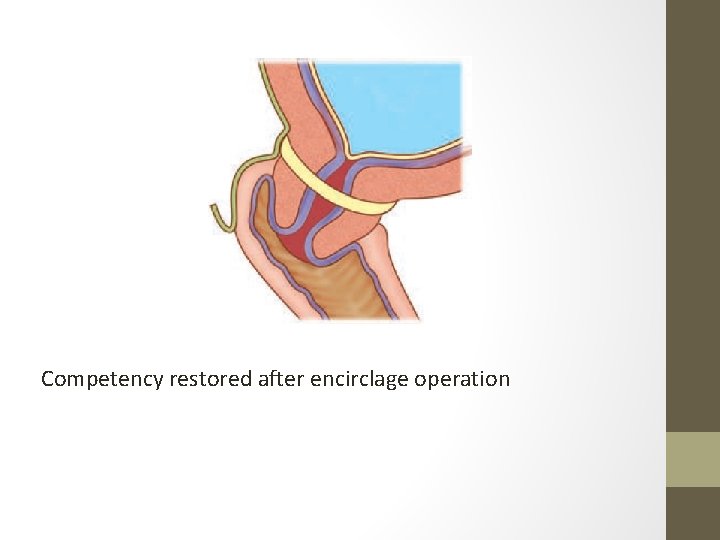
Competency restored after encirclage operation
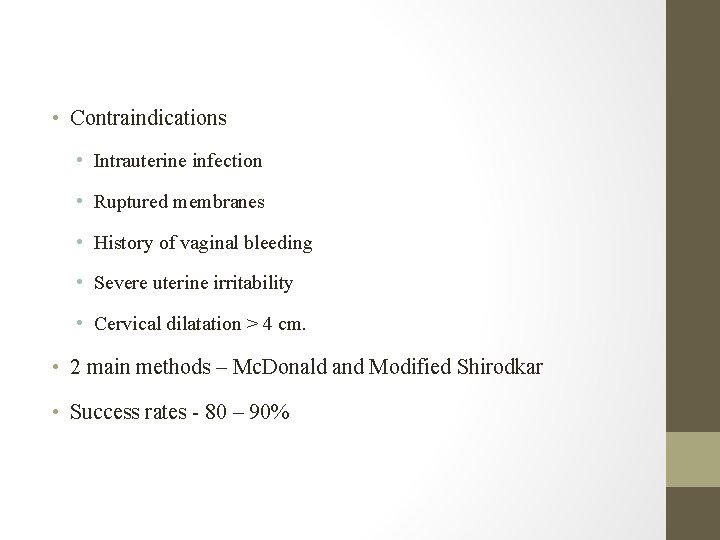
• Contraindications • Intrauterine infection • Ruptured membranes • History of vaginal bleeding • Severe uterine irritability • Cervical dilatation > 4 cm. • 2 main methods – Mc. Donald and Modified Shirodkar • Success rates - 80 – 90%
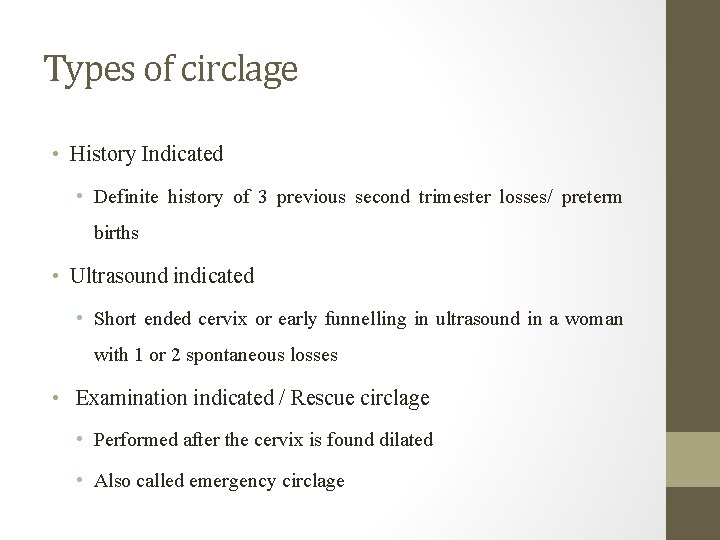
Types of circlage • History Indicated • Definite history of 3 previous second trimester losses/ preterm births • Ultrasound indicated • Short ended cervix or early funnelling in ultrasound in a woman with 1 or 2 spontaneous losses • Examination indicated / Rescue circlage • Performed after the cervix is found dilated • Also called emergency circlage
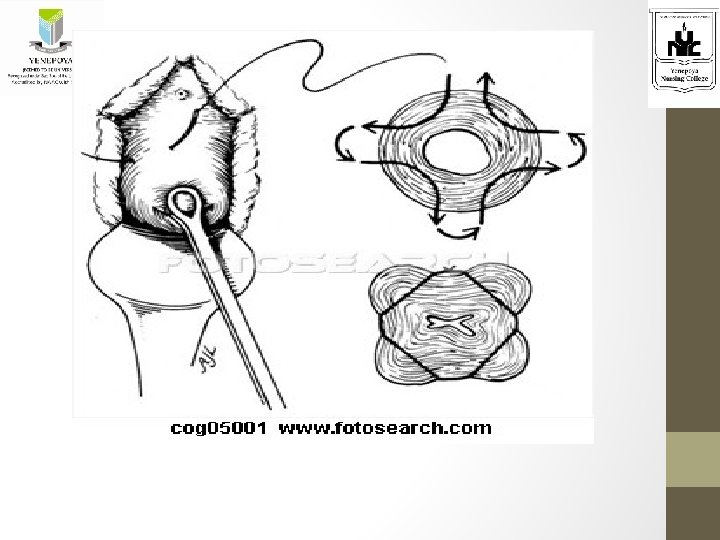
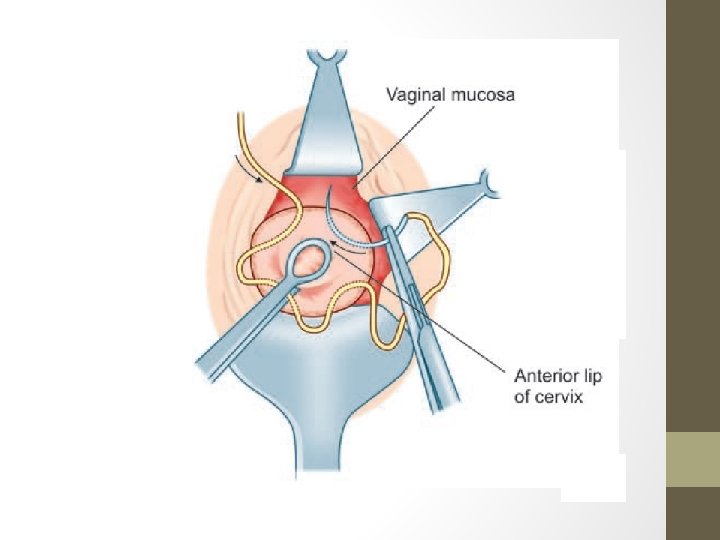
Methods I. Mc. DONALD’S OPERATION • The non-absorbable suture material (Mersilene) is placed as a purse string suture, as high as possible (level of internal os) • The suture starts at the anterior wall of the cervix. Taking successive deep bites (4– 5 sites) it is carried around the lateral and posterior walls back to the anterior wall again where the two ends of the suture are tied. • Commonly performed method nowadays.
Patient is in lithotomy position and cervix is exposed with Sim’s speculum. The cervical lips are held with sponge holding forceps and a purse string suture with a non absorbable material like black silk is taken all around the cervix. Disadvantage –suture may be below internal os.
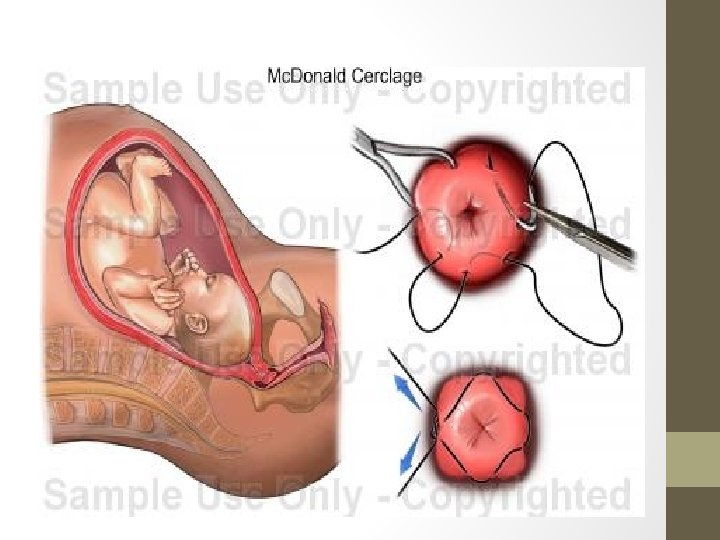
Mc. Donald’s cerclage
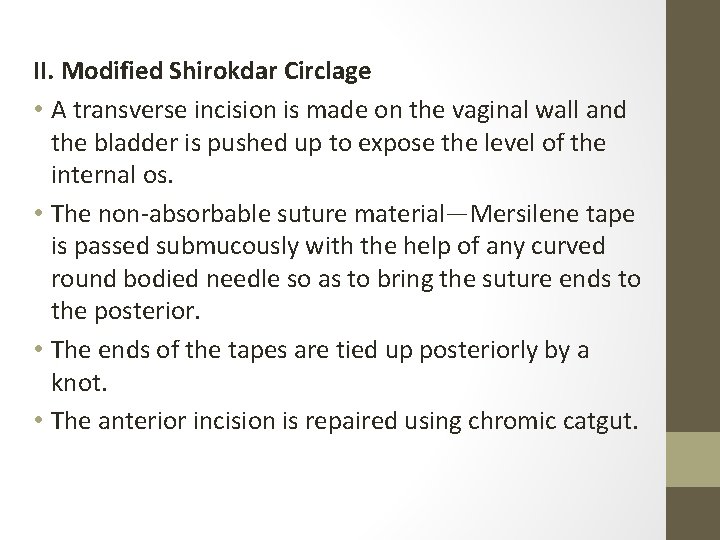
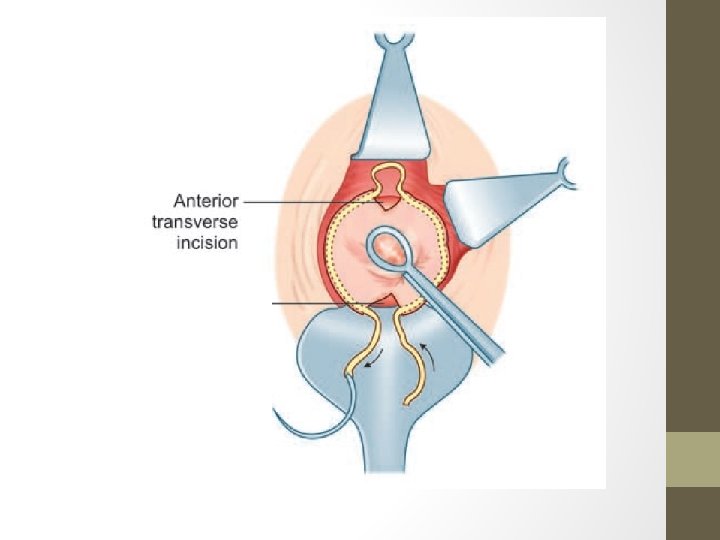
II. Modified Shirokdar Circlage • A transverse incision is made on the vaginal wall and the bladder is pushed up to expose the level of the internal os. • The non-absorbable suture material—Mersilene tape is passed submucously with the help of any curved round bodied needle so as to bring the suture ends to the posterior. • The ends of the tapes are tied up posteriorly by a knot. • The anterior incision is repaired using chromic catgut.
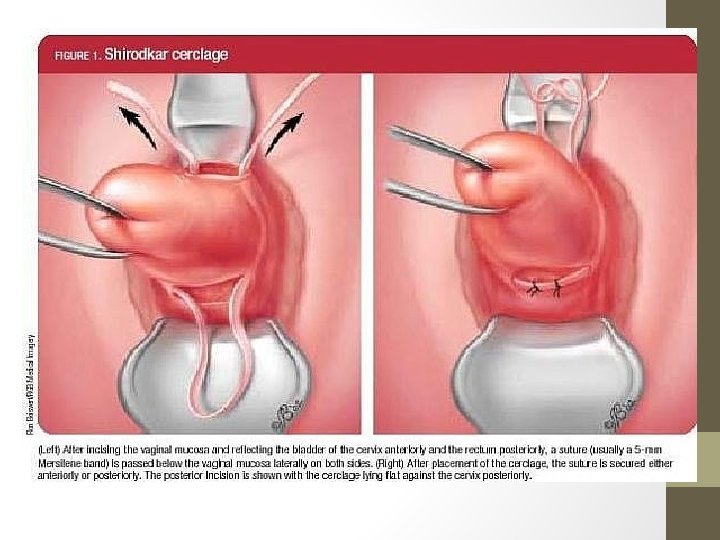
Shirodkar’s cerclage
III. Transabdominal Cerclage • Rarely done in cases of repeated failure of vaginal approach • Cerclage is placed at the level of isthmus • Delivery by CS
• Postoperative care: • The patient should be in bed for at least 2– 3 days • Progesterone supplementation - Weekly injections of 17 α hydroxy progesterone caproate 500 mg IM • Patient is asked to avoid sexual inercourse • Antibiotic cover • Cerclage is removed at 37 weeks or at the onset of labour, if not it can result in rupture uterus. • Removal of stitch: • The stitch should be removed at 37 th week, or earlier if labor pain starts or features of abortion appear. • If the stitch is not cut in time, uterine rupture or cervical tear may occur.
• Complications: • • Slipping or cutting through the suture Chorioamnionitis Rupture of the membranes Cervical scarring and dystocia requiring cesarean delivery.
Prognosis of recurrent miscarriage • The overall risk of recurrent miscarriage is about 25– 30% irrespective of the number of previous spontaneous miscarriage. • The overall prognosis is good even without therapy. • The chance of successful pregnancy is about 70– 80% with an effective therapy.
Other cases of recurrent miscarriage Chromosomal abnormalities-karyotyping of both parents and prenatal diagnosis in the next pregnancy. Uterine factors-hysteroscopic resection in case of a septum or division of the adhesion in Asherman’s syndrome. Myomectomy in case of fibroid. APLA Syndrome-Combination of low dose aspirin and low MW heparin as soon as pregnancy is confirmed. preconceptionally. Inherited thrombophilia-Low dose aspirin and heparin. Aspirin

- Slides: 67