
Aboriginal Working Group AWG Community Mental Health Common
Aboriginal Working Group (AWG) Community Mental Health Common Assessment Project (CMH CAP) OCAN Aboriginal Support Validation Information for Board Members <Insert Date>
What you need to know • What is Ontario Common Assessment of Need (OCAN? • What is happening with OCAN today? • What is the OCAN Aboriginal Support Validation? • What is happening with the validation today? • What does it mean to participate in the validation? Note: Slides with gray background are provided for your reference, but can be presented as needed.
What is Ontario Common Assessment of Need (OCAN? )
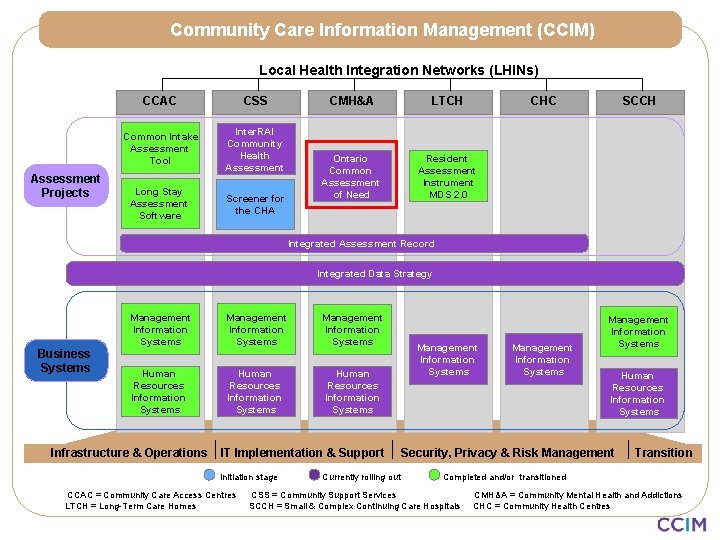
Community Care Information Management (CCIM) Local Health Integration Networks (LHINs) Assessment Projects CCAC CSS Common Intake Assessment Tool Inter. RAI Community Health Assessment Long Stay Assessment Software Screener for the CHA CMH&A LTCH CHC Ontario Common Assessment of Need Resident Assessment Instrument MDS 2. 0 SCCH Integrated Assessment Record Integrated Data Strategy Business Systems Management Information Systems Human Resources Information Systems Management Information Systems Human Resources Information Systems Infrastructure & Operations IT Implementation & Support Security, Privacy & Risk Management Transition Initiation stage Currently rolling out Completed and/or transitioned CCAC = Community Care Access Centres CSS = Community Support Services LTCH = Long-Term Care Homes SCCH = Small & Complex Continuing Care Hospitals CMH&A = Community Mental Health and Addictions CHC = Community Health Centres
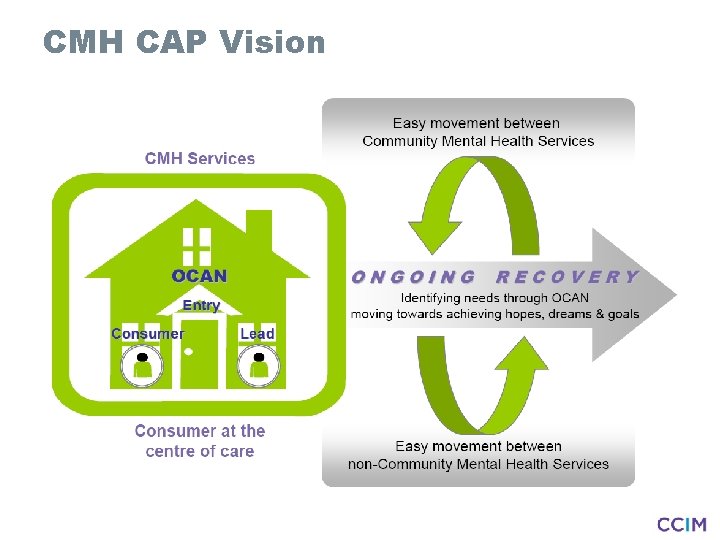
CMH CAP Vision
What is OCAN? Ontario Common Assessment of Need (OCAN) is a standardized, consumer-led decision making tool that allows key information to be electronically gathered in a secure and efficient manner. • Assists client-led decision-making at an individual level • Identifies individual needs and helps match these to existing services and identifies service gaps • Provides aggregate data to inform organizational, regional and provincial level planning and decision making that is consistent with a recovery approach • Further facilitates inter-agency communication through common data standards
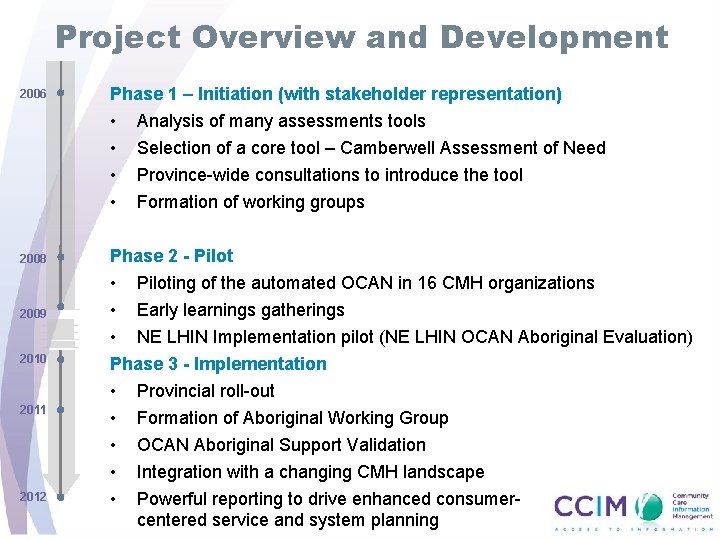
Project Overview and Development 2006 Phase 1 – Initiation (with stakeholder representation) • • 2008 2009 2010 2011 2012 Analysis of many assessments tools Selection of a core tool – Camberwell Assessment of Need Province-wide consultations to introduce the tool Formation of working groups Phase 2 - Pilot • Piloting of the automated OCAN in 16 CMH organizations • Early learnings gatherings • NE LHIN Implementation pilot (NE LHIN OCAN Aboriginal Evaluation) Phase 3 - Implementation • Provincial roll-out • Formation of Aboriginal Working Group • OCAN Aboriginal Support Validation • Integration with a changing CMH landscape • Powerful reporting to drive enhanced consumercentered service and system planning
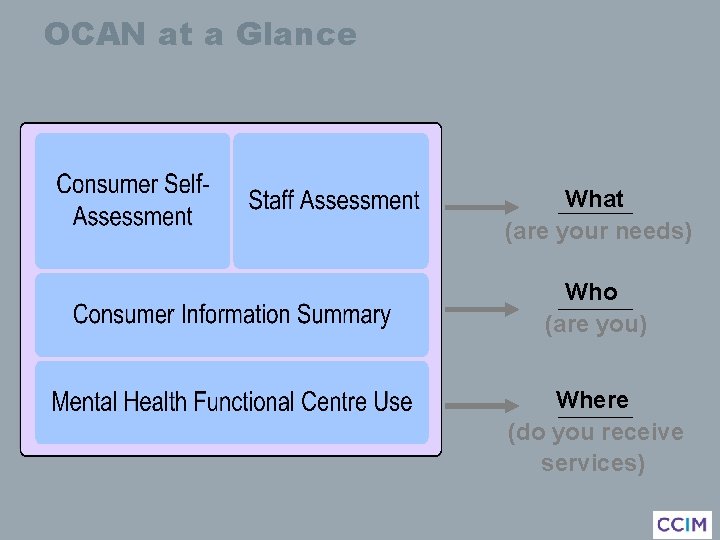
OCAN at a Glance What (are your needs) Who (are you) Where (do you receive services)
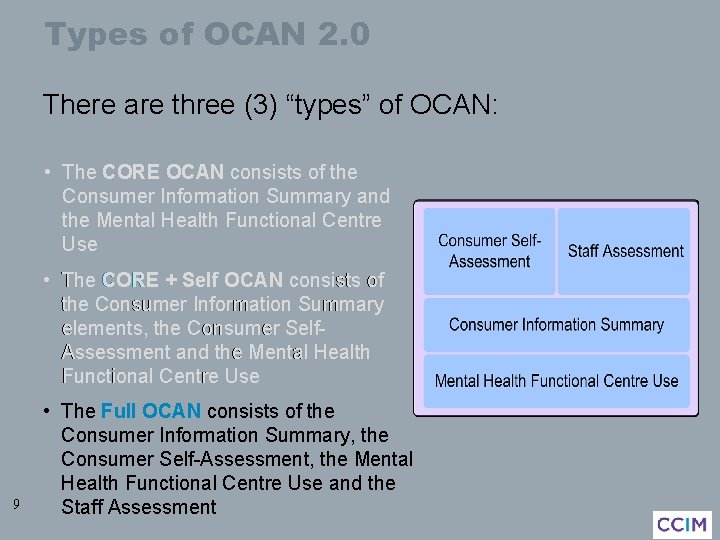
Types of OCAN 2. 0 There are three (3) “types” of OCAN: • The CORE OCAN consists of the Consumer Information Summary and the Mental Health Functional Centre Use • The CORE + Self OCAN consists of the Consumer Information Summary elements, the Consumer Self. Assessment and the Mental Health Functional Centre Use 9 • The Full OCAN consists of the Consumer Information Summary, the Consumer Self-Assessment, the Mental Health Functional Centre Use and the Staff Assessment
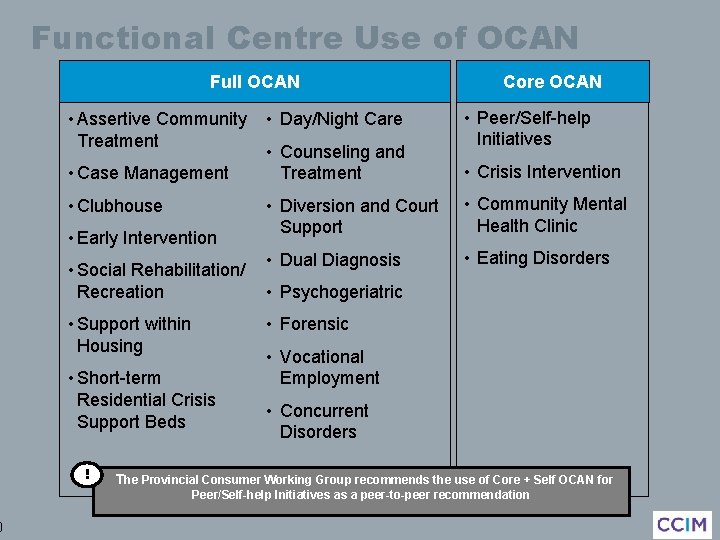
0 Functional Centre Use of OCAN Full OCAN • Assertive Community Treatment • Case Management • Clubhouse • Early Intervention • Social Rehabilitation/ Recreation • Support within Housing • Counseling and Treatment • Peer/Self-help Initiatives • Crisis Intervention • Diversion and Court Support • Community Mental Health Clinic • Dual Diagnosis • Eating Disorders • Psychogeriatric • Forensic • Short-term Residential Crisis Support Beds ! • Day/Night Care Core OCAN • Vocational Employment • Concurrent Disorders The Provincial Consumer Working Group recommends the use of Core + Self OCAN for Peer/Self-help Initiatives as a peer-to-peer recommendation
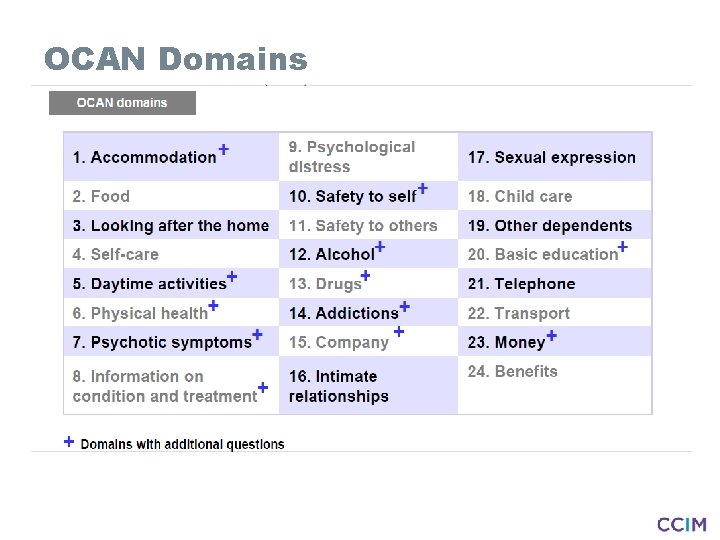
1 OCAN Domains
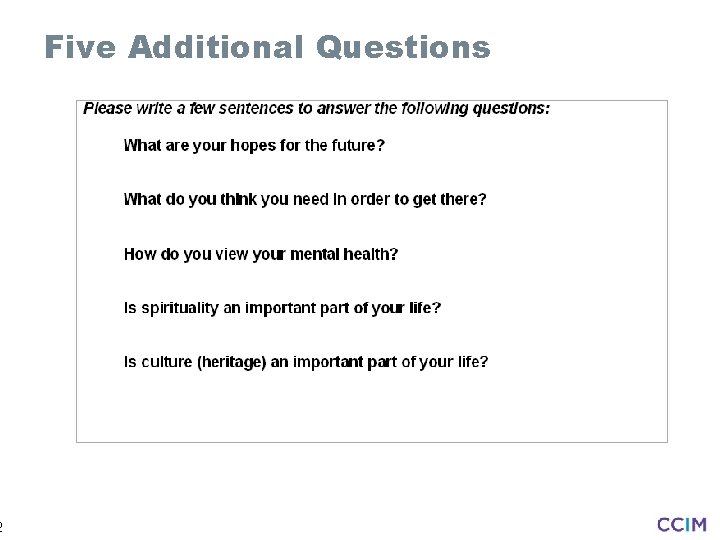
2 Five Additional Questions
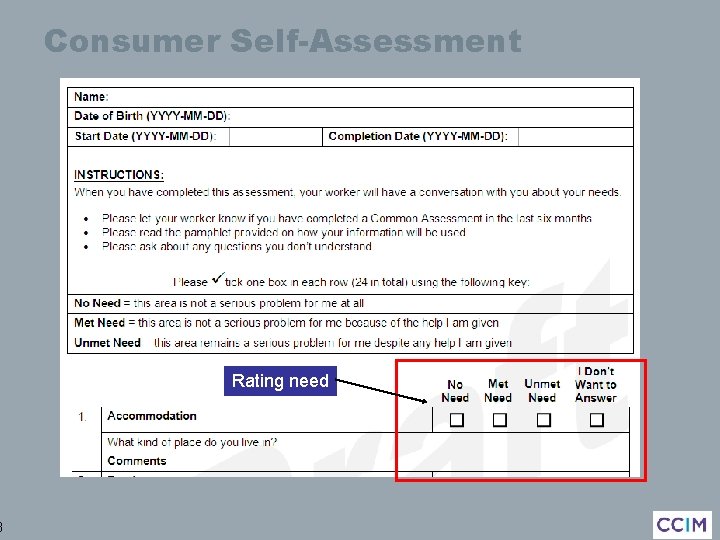
3 Consumer Self-Assessment Rating need
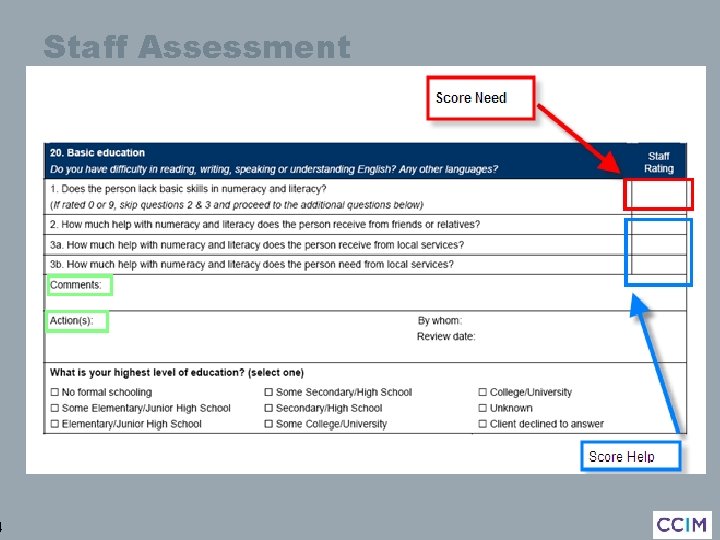
4 Staff Assessment
What is happening with OCAN today?
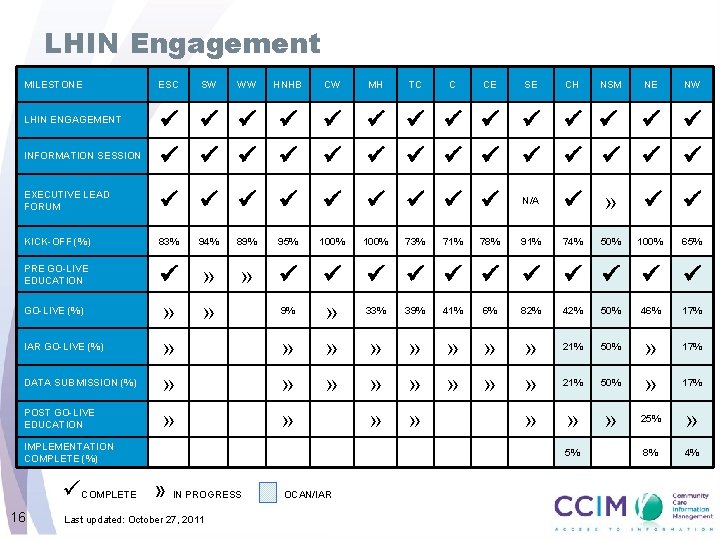
LHIN Engagement MILESTONE CW MH EXECUTIVE LEAD FORUM KICK-OFF (%) 83% 94% 89% 95% 100% PRE GO-LIVE EDUCATION » » » LHIN ENGAGEMENT INFORMATION SESSION GO-LIVE (%) IAR GO-LIVE (%) DATA SUBMISSION (%) POST GO-LIVE EDUCATION ESC SW WW HNHB 9% 73% C 71% CE 78% SE 91% 74% NW 100% 65% 33% 39% 41% 6% 82% 42% 50% 46% 17% 21% 50% » 17% » » 25% » 8% 4% » » » » » » Last updated: October 27, 2011 50% NE » 5% OCAN/IAR NSM » » COMPLETE » IN PROGRESS CH N/A » IMPLEMENTATION COMPLETE (%) 16 100% TC
What is the OCAN Aboriginal Support Validation?
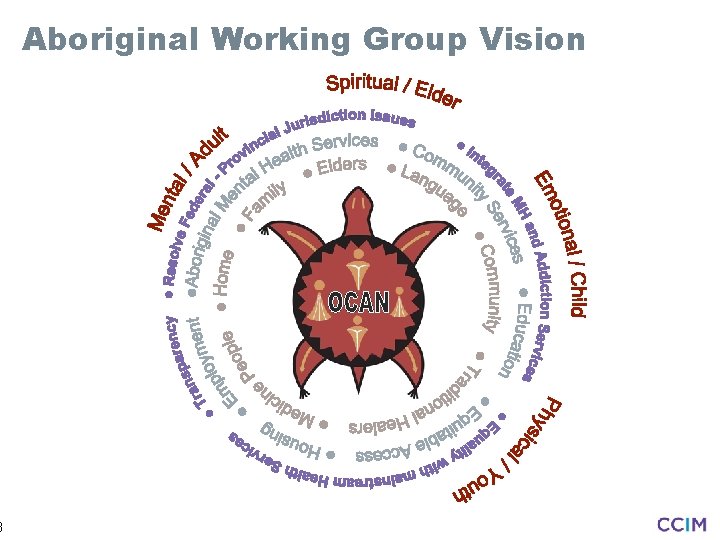
8 Aboriginal Working Group Vision
9 OCAN Benefits in Aboriginal Settings • Recognizes Aboriginal cultures, values and beliefs by incorporating “wholistic” approaches to wellness and recovery, while allowing consumers to participate in the process • Assists with better continuity of services through integrated data collection and reporting across community mental health • Encourages ownership of OCAN and its related processes through engagement with Aboriginal representatives • Potential to help address jurisdictional issues (federal and provincial)
0 Why the OCAN Aboriginal Support Validation? • The Evaluation of OCAN in Aboriginal Programs in the North East LHIN (Sutherland/Maar) recommended improvements to the use of OCAN in Aboriginal settings. • An Aboriginal Working Group was formed to address the evaluation findings. ! The Evaluation of OCAN in Aboriginal Programs in the North East LHIN is available online at www. ccim. on. ca
1 Recommendations • The Aboriginal Working Group developed recommendations related to the following categories*: – Aboriginal Engagement – Education and Training – Administrative Supports and Processes ! The Aboriginal Working Group Report is available online at www. ccim. on. ca
2 Recommended OCAN Aboriginal Supports • The OCAN Aboriginal supports include: – Aboriginal-specific training materials, such as case studies, training binders, consumer pamphlet, etc – Aboriginal Education Specialist to deliver training and support to validation participants – Aboriginal Subject Matter Expert to address questions pertaining to Aboriginal landscape and issues
3 What is the OCAN Aboriginal Support Validation? • The purpose of the OCAN Aboriginal Support Validation is to evaluate the recommended OCAN Aboriginal supports to determine their impact on the cultural appropriateness of OCAN delivery within Aboriginal populations
Guiding Principles for the Validation • Culturally appropriate – Respects Aboriginal culture and incorporates the principles of cultural competency and cultural safety • Consumer-centred – Acknowledges the Aboriginal consumer’s role in the assessment process; takes a ‘wholistic’ approach • Flexible to accommodate cultural diversity – Aware of the distinctiveness of each Aboriginal population (e. g. , First Nations, Inuit and Métis; on-reserve and off-reserve; urban, rural and remote) • Collaborative – Guided by Aboriginal Health Service Providers and transparent to the Aboriginal population in general; respects the spirit of principles related to ownership, control, access and possession of data (OCAP) 24
What is happening with the validation today?
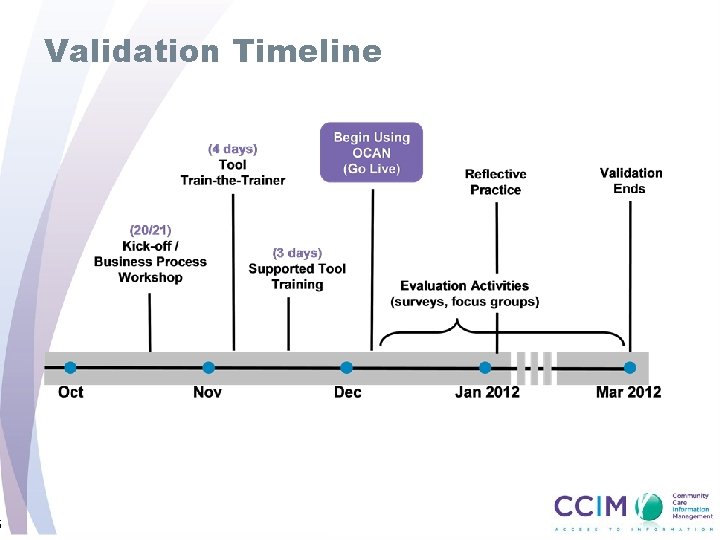
6 Validation Timeline
What does it mean to participate in the validation?
8 As participants in the validation, you will… • Contribute to the development of Aboriginal-specific training materials and supports for OCAN • Guide recommendations for future OCAN implementation in Aboriginal settings • Network with other community mental health organizations providing service to the Aboriginal community • Take advantage of the implementation supports available through CMH CAP
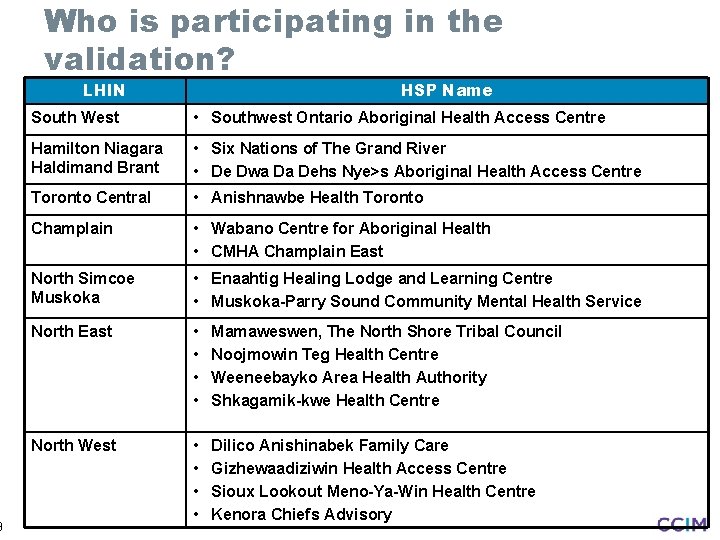
9 Who is participating in the validation? LHIN HSP Name South West • Southwest Ontario Aboriginal Health Access Centre Hamilton Niagara Haldimand Brant • Six Nations of The Grand River • De Dwa Da Dehs Nye>s Aboriginal Health Access Centre Toronto Central • Anishnawbe Health Toronto Champlain • Wabano Centre for Aboriginal Health • CMHA Champlain East North Simcoe Muskoka • Enaahtig Healing Lodge and Learning Centre • Muskoka-Parry Sound Community Mental Health Service North East • • Mamaweswen, The North Shore Tribal Council Noojmowin Teg Health Centre Weeneebayko Area Health Authority Shkagamik-kwe Health Centre North West • • Dilico Anishinabek Family Care Gizhewaadiziwin Health Access Centre Sioux Lookout Meno-Ya-Win Health Centre Kenora Chiefs Advisory
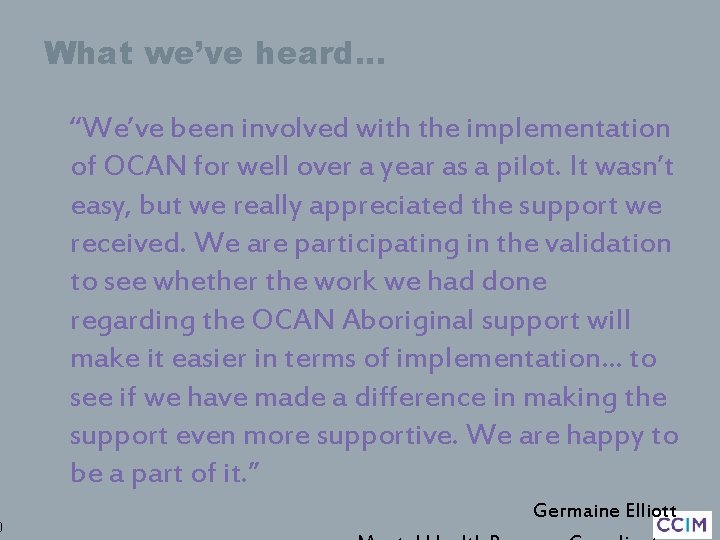
0 What we’ve heard. . . “We’ve been involved with the implementation of OCAN for well over a year as a pilot. It wasn’t easy, but we really appreciated the support we received. We are participating in the validation to see whether the work we had done regarding the OCAN Aboriginal support will make it easier in terms of implementation… to see if we have made a difference in making the support even more supportive. We are happy to be a part of it. ” Germaine Elliott
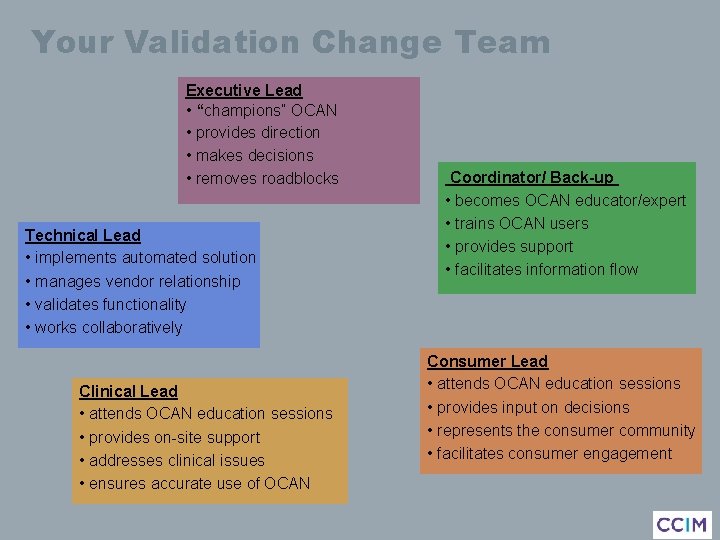
1 Your Validation Change Team Executive Lead • “champions” OCAN • provides direction • makes decisions • removes roadblocks Technical Lead • implements automated solution • manages vendor relationship • validates functionality • works collaboratively Clinical Lead • attends OCAN education sessions • provides on-site support • addresses clinical issues • ensures accurate use of OCAN Coordinator/ Back-up • becomes OCAN educator/expert • trains OCAN users • provides support • facilitates information flow Consumer Lead • attends OCAN education sessions • provides input on decisions • represents the consumer community • facilitates consumer engagement
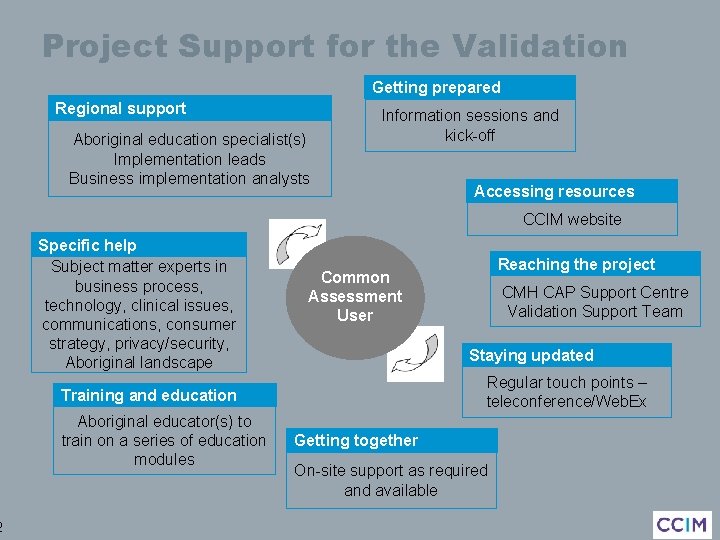
2 Project Support for the Validation Getting prepared Regional support Aboriginal education specialist(s) Implementation leads Business implementation analysts Information sessions and kick-off Accessing resources CCIM website Specific help Subject matter experts in business process, technology, clinical issues, communications, consumer strategy, privacy/security, Aboriginal landscape CMH CAP Support Centre Validation Support Team Staying updated Regular touch points – teleconference/Web. Ex Training and education Aboriginal educator(s) to train on a series of education modules Reaching the project Common Assessment User Getting together On-site support as required and available

3
Thank you! Project Support Centre Telephone: 1 -866 -909 -5600 Hours: 8: 30 a. m. -4: 30 p. m. weekdays Email: cmhcap@ccim. on. ca Website: www. ccim. on. ca
- Slides: 34