
Aboriginal Spirituality Common Rituals Your Task Read page
Aboriginal Spirituality: Common Rituals

Your Task: • Read page 79 – 84 in the textbook and make notes on the following Aboriginal rituals using the handout: Ø Smudging Ø Sacred Pipe Ceremony Ø The Sweat Lodge Ø Birth and naming rituals Ø Vision Quest Ø Death rituals Ø Harvest Feast Ø The Powwow Ø Giveaways and the Potlatch
An Overview of Aboriginal Rituals *Instructions: Please take out the notes you made on the Aboriginal rituals that were listed during our previous class.
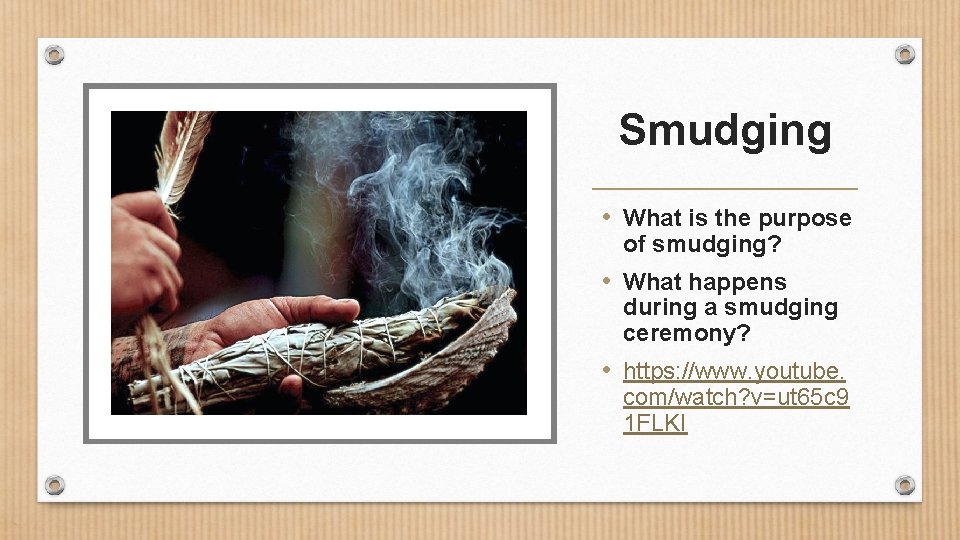
Smudging • What is the purpose of smudging? • What happens during a smudging ceremony? • https: //www. youtube. com/watch? v=ut 65 c 9 1 FLKI
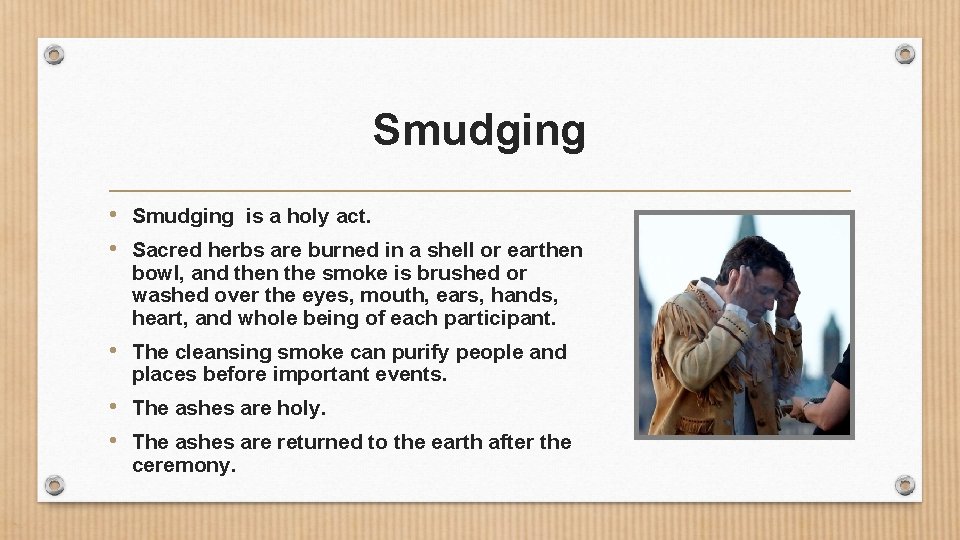
Smudging • Smudging is a holy act. • Sacred herbs are burned in a shell or earthen bowl, and then the smoke is brushed or washed over the eyes, mouth, ears, hands, heart, and whole being of each participant. • The cleansing smoke can purify people and places before important events. • The ashes are holy. • The ashes are returned to the earth after the ceremony.
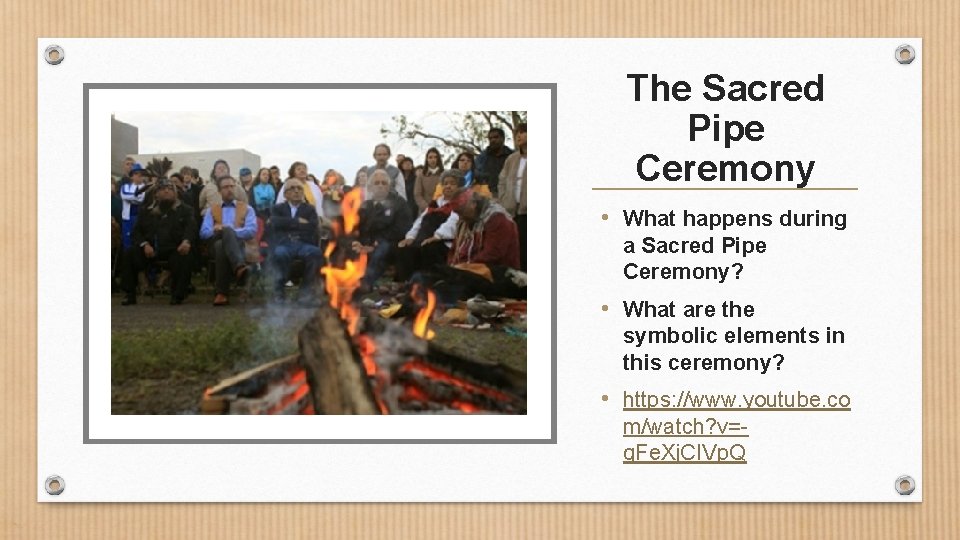
The Sacred Pipe Ceremony • What happens during a Sacred Pipe Ceremony? • What are the symbolic elements in this ceremony? • https: //www. youtube. co m/watch? v=g. Fe. Xj. CIVp. Q
The Sacred Pipe Ceremony • It is one of the most powerful and sacred spirituals for Aboriginal. • Pipe symbolizes unity and harmony of the world. • Pipe carrier will pray that the whole universe and all it contains will be transferred to the pipe. • • • The Great Spirit is all that the pipe contains when it is lit. Stone bowl of the pipe represents truth. Stem represents the way we are to live (eg. In harmony with nature) Bowl represents the woman and stem represents the man. Joining the bowl to the stem symbolizes unity and balance between man and woman.
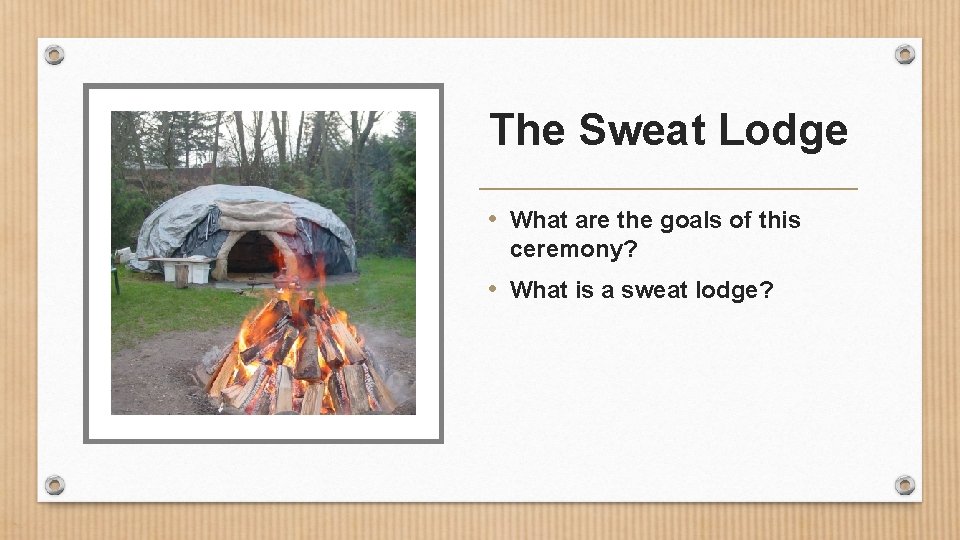
The Sweat Lodge • What are the goals of this ceremony? • What is a sweat lodge?
The Sweat Lodge • The goals of this ceremony are to purify the body, mind, spirit, and heart, and to restore right relationships with self, others, the Creator, and all of creation. • A sweat lodge is a closed structure built around a pit into which rocks are placed during the ceremony. • The sweat leader pours water onto the hot rocks to create steam. • Participants return to the womb and the innocence of childhood.
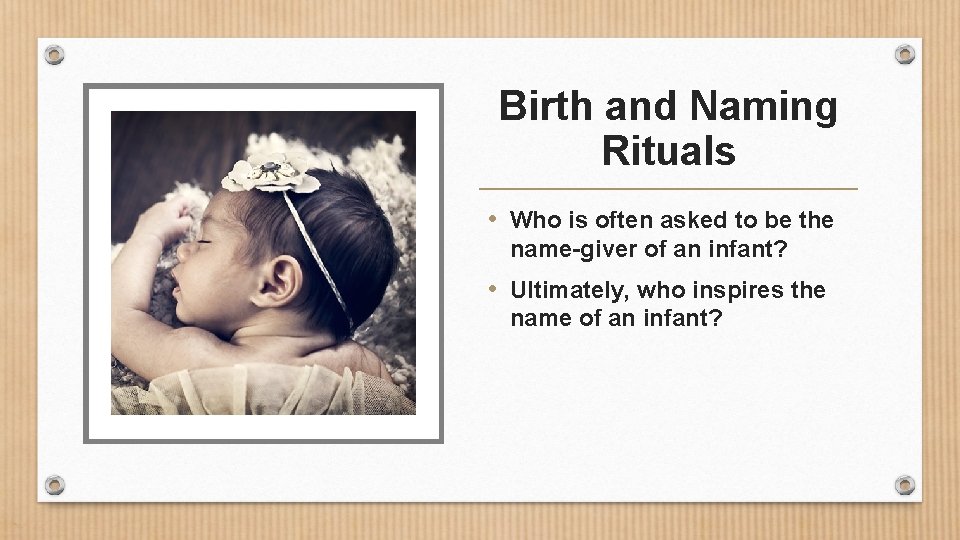
Birth and Naming Rituals • Who is often asked to be the name-giver of an infant? • Ultimately, who inspires the name of an infant?
Birth and Naming Rituals • Usually a grandparent or elder will name a child. • The name-giver will often go into a period of fasting, meditation, prayer, or dreaming for inspiration. • The name that the name-giver is inspired to give the child is the name the Great Spirit selected.
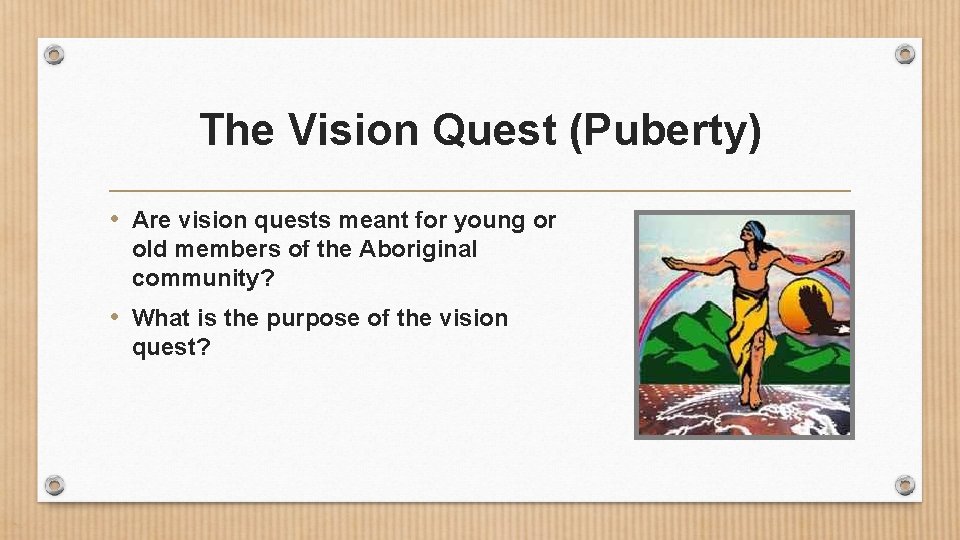
The Vision Quest (Puberty) • Are vision quests meant for young or old members of the Aboriginal community? • What is the purpose of the vision quest?
The Vision Quest • A vision quest is a journey that is undertaken by a young person. • It is a journey that allows a young person to come of age and be accepted as an adult in the community. • It has been described as an intense, solitary, and spiritual experience. • Traditionally the young person who is on the quest prays and deprives themselves of food and sleep until they encounter a spirit helper who gives them guidance for the future. • The spirit helper usually appears through a dream, vision, or phenomenon of nature.
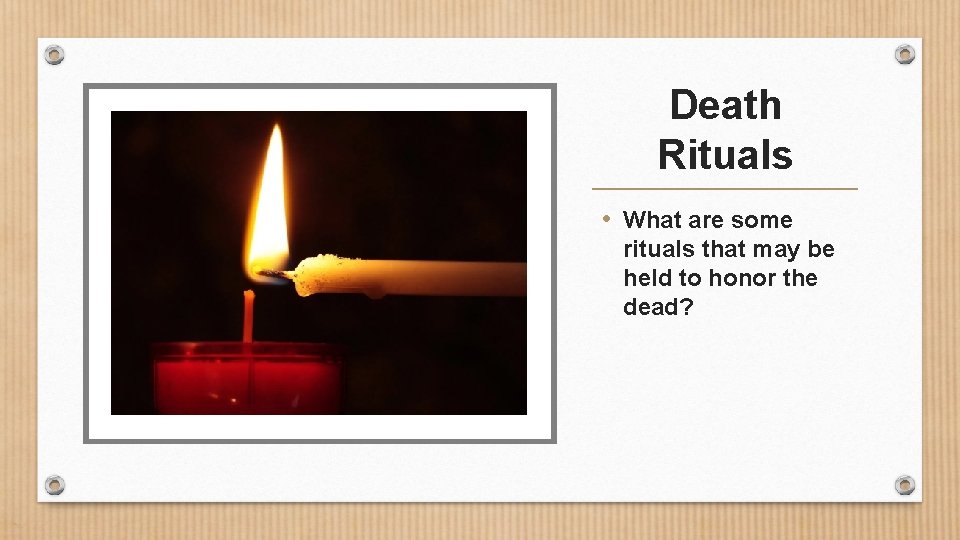
Death Rituals • What are some rituals that may be held to honor the dead?
Death Rituals • A Death Feast may be held for the spirit of the person who has passed away (after the individual has been given a suitable amount of time to become refamiliarized with being a spirit). • A wake may be held to help someone who has died return to the body of mother earth. This may involve a round dance. A round dance is a ceremony to commune with spirits who have passed to the spirit world.
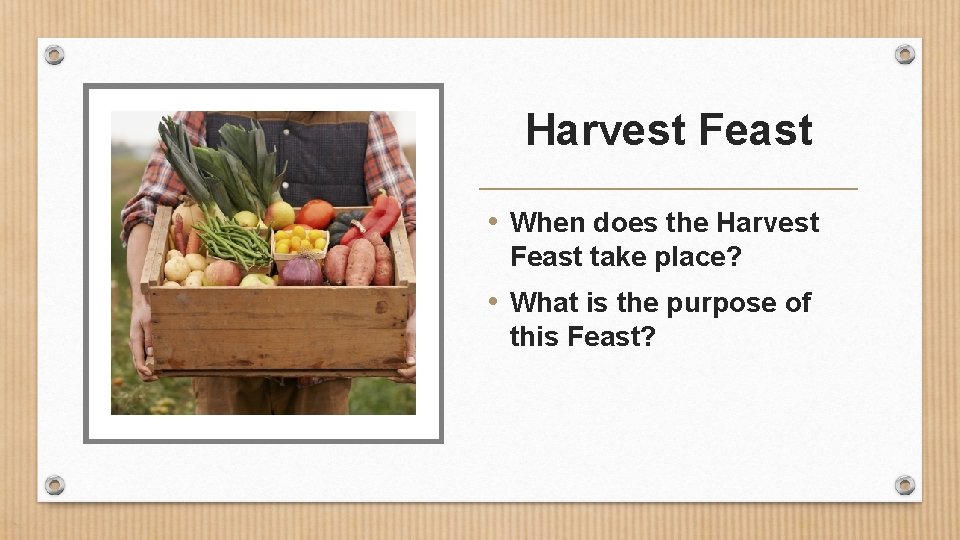
Harvest Feast • When does the Harvest Feast take place? • What is the purpose of this Feast?
Harvest Feast • The Harvest Feast occurs during harvest time. • This is a time for Aboriginals, especially farmers, to celebrate the harvest from the field and forest. • Aboriginals believe that the spirits must be credited with providing them with food. • It is also a time to renew the earth with prayers, chants, and dances.
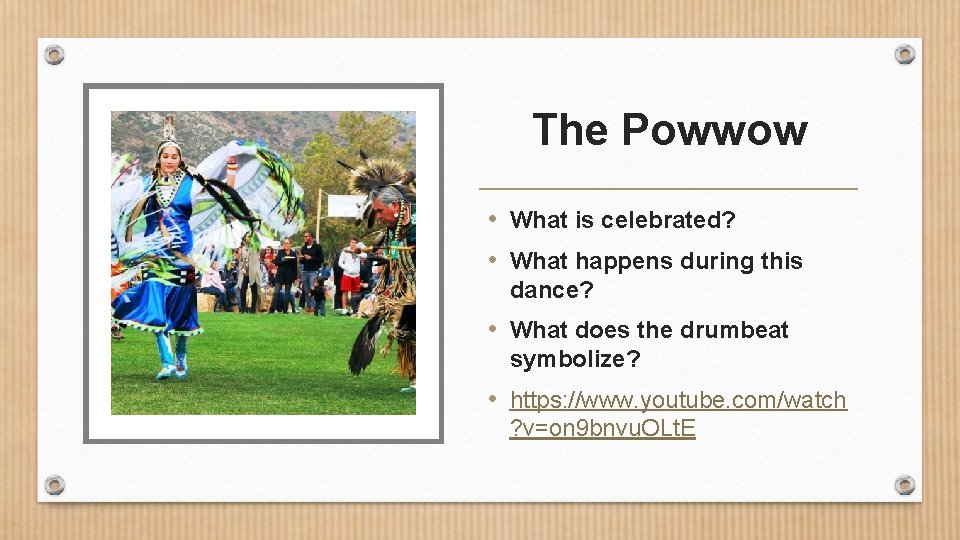
The Powwow • What is celebrated? • What happens during this dance? • What does the drumbeat symbolize? • https: //www. youtube. com/watch ? v=on 9 bnvu. OLt. E
The Powwow • This is a special Aboriginal dance that promotes the renewal and restoration of right relationships and the healing of all creation. • Community members come together to sing, dance, and celebrate their identity, heritage, and language. • Powwows occur in a circle formation. • Dancers and singers enter the circle from the direction the sun rises (east) and then move in a clockwise direction (the same direction the sun moves). • A drum will be beaten to symbolize the solemn rhythm of creation, the heartbeat of Mother Earth, and the heartbeat that all hear in their mother's womb.
Giveaways and Potlatches • What are potlatches like in mainstream society? • How are Native potlatches different than those experienced in mainstream society?
Giveaways and Potlatches • The Giveaway: This is a ritual that may be held in honor of a special event (ex. A birth or wedding) or in honor of someone who has died. Gifts are commonly given out during giveaways. Dancing and singing may also accompany these rituals. • Potlatches: These rituals may also commemorate important events. The individual who hosts a potlatch may see their social status increase. Members of the community may use the opportunity to recognize the generosity, wealth, and power of the person hosting the potlatch.
Source • World Religions: A Canadian Catholic Perspective. Nelson Education.
- Slides: 22