
ABORIGINAL SELFGOVERNMENT Shape of the Class Housekeeping Finish
ABORIGINAL SELF-GOVERNMENT

Shape of the Class • • • Housekeeping Finish up last day’s class Moves to self-government Truth & Reconciliation Meet in groups re: Friday’s papers and debate
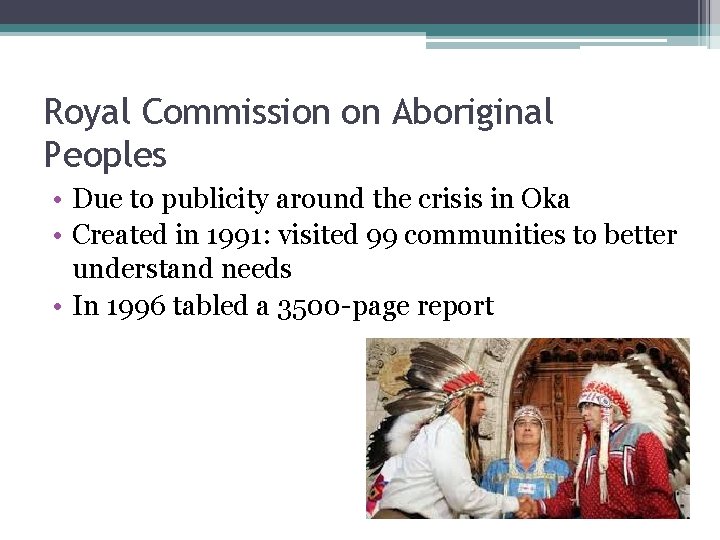
Royal Commission on Aboriginal Peoples • Due to publicity around the crisis in Oka • Created in 1991: visited 99 communities to better understand needs • In 1996 tabled a 3500 -page report
Royal Commission (cont’d) • Recommendations: ▫ Relationships needed restructuring between the federal government and aboriginal peoples ▫ Need for self-determination through selfgovernment ▫ Economic self-sufficiency ▫ Healing for Aboriginal peoples and communities
Government’s Response • 1998: For the most part, the government accepted the main points of the Commission, although slightly watered-down: ▫ Accepted responsibility for working towards treaties ▫ More stable fiscal relationship ▫ Help prepare aboriginals for self-government ▫ Pledged $350 million to support healing
Delgamuukw decision (1997) • Ruling by the Supreme Court of Canada • Recognized that land title could extend over large areas of traditional land • Recognized oral history and elder testimony as valid when defining those lands
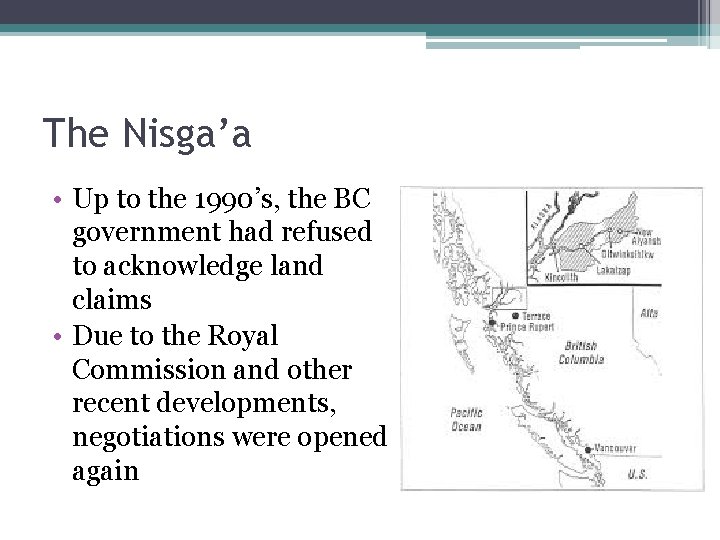
The Nisga’a • Up to the 1990’s, the BC government had refused to acknowledge land claims • Due to the Royal Commission and other recent developments, negotiations were opened again
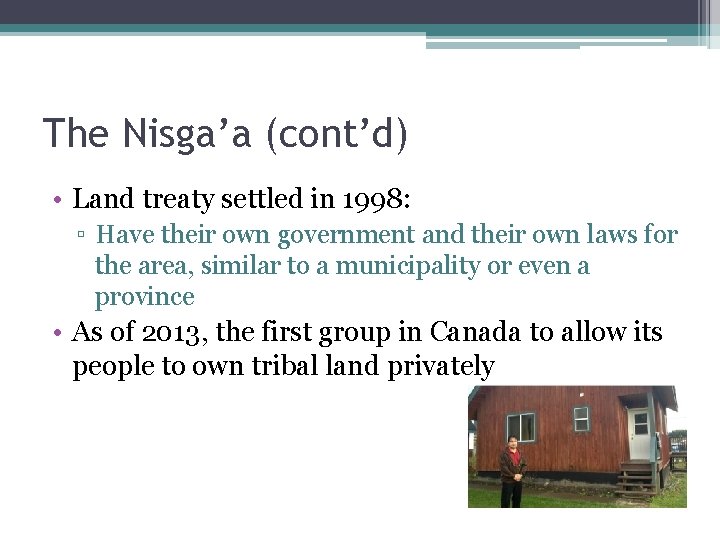
The Nisga’a (cont’d) • Land treaty settled in 1998: ▫ Have their own government and their own laws for the area, similar to a municipality or even a province • As of 2013, the first group in Canada to allow its people to own tribal land privately
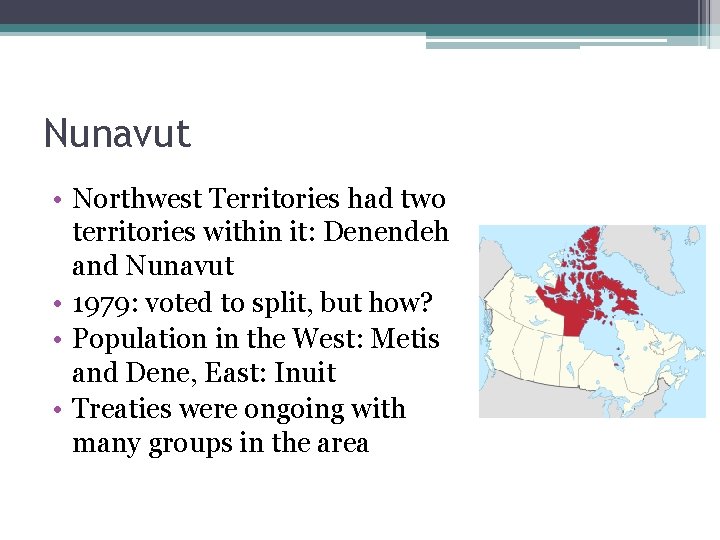
Nunavut • Northwest Territories had two territories within it: Denendeh and Nunavut • 1979: voted to split, but how? • Population in the West: Metis and Dene, East: Inuit • Treaties were ongoing with many groups in the area
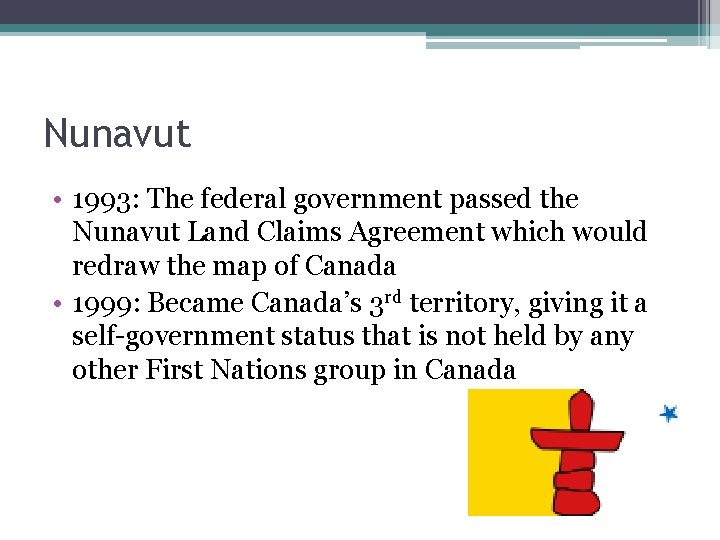
Nunavut • 1993: The federal government passed the Nunavut Land Claims Agreement which would redraw the map of Canada • 1999: Became Canada’s 3 rd territory, giving it a self-government status that is not held by any other First Nations group in Canada
Self-government • 34 aboriginal communities across Canada now have self-government • For the most part (treaties vary), this means: ▫ They either have public government (elected and sent to the federal legislature) or land regime management (similar to municipalities) ▫ Have a structure that allows them to relate with nearby governments ▫ They are accountable to their own citizens
Videos: Residential Schools • Reconciling to a hard truth: https: //www. youtube. com/watch? v=Z 1 h 9 dj. ZOg. Gc • Stolen children: https: //www. youtube. com/watch? v=vd. R 9 Hcmi. XLA • Apology: https: //www. youtube. com/watch? v=-ry. C 74 bbr. EE
Truth & Reconciliation • A National Event that has been taking place over the past 4 years • By telling the truth about the treatment of Aboriginal people under the Indian Act, there is the hope that the past can be left behind and reconciliation (rehabilitation) can begin
Group Question • With Truth can we gain Reconciliation? ▫ Half of the class will argue that yes, we can succeed in gaining reconciliation ▫ The other half will argue that no, more needs to be done
- Slides: 14