
Aboriginal Peoples after Confederation Cluster 3 Becoming a
Aboriginal Peoples after Confederation Cluster 3: Becoming a Sovereign Nation
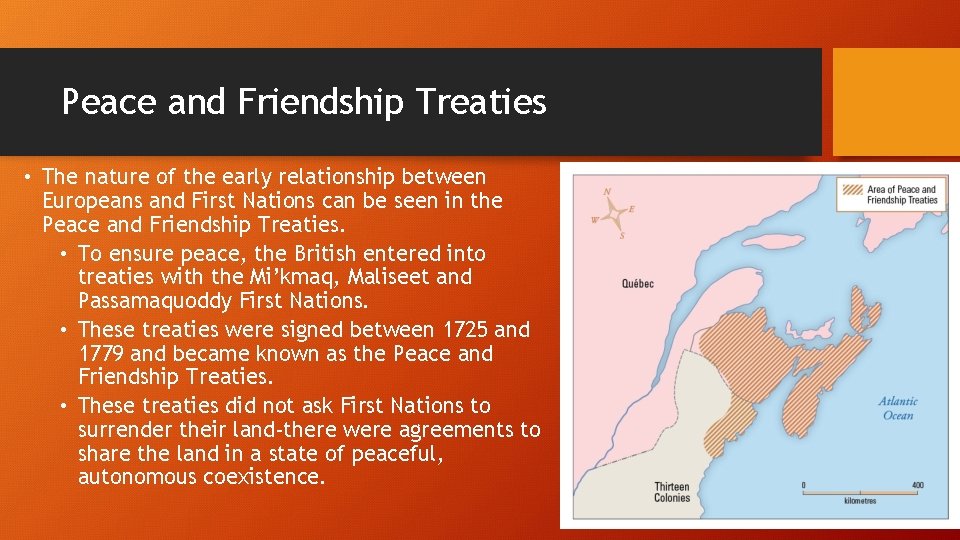
Peace and Friendship Treaties • The nature of the early relationship between Europeans and First Nations can be seen in the Peace and Friendship Treaties. • To ensure peace, the British entered into treaties with the Mi’kmaq, Maliseet and Passamaquoddy First Nations. • These treaties were signed between 1725 and 1779 and became known as the Peace and Friendship Treaties. • These treaties did not ask First Nations to surrender their land-there were agreements to share the land in a state of peaceful, autonomous coexistence.
Aboriginal Title and Immigration • The decline of the fur trade in the 19 th century, along with increasing European settlement, fundamentally changed the relationship between First Nations, Métis, and Inuit peoples and Europeans. • As a result of new settlement and colonial policies, First Nations in post-Confederation Canada became increasingly marginalized and were no longer treated as equals and allies, but as inferiors, dependents, and impediments to civilization.
• With the changing relationship came a change in the type of treaties negotiated with First Nations. • Unlike the Peace and Friendship Treaties, which were mutually beneficial, treaties in the 19 th century became unbalanced in favour of immigrants and the Canadian government. • With the goal of opening more land for immigrant farmers, the Canadian government began to use treaties to extinguish First Nations title to the land resources upon which they had traditionally lived.
Métis and Inuit Peoples • The Canadian government focused its treaty negotiations and legislation on First Nations, in part because First Nations people were the majority of the population across the West. • Inuit land was not in demand for agricultural settlements, so Inuit peoples were not part of the treaty process or many other government policies until the 1940 s.
• The government tended to treat Metis people as though they would either assimilate into Euro-Canadian culture or join First Nations. • After the conflict at Red River during the Confederation of Manitoba, the government recognized that it needed to somehow address Metis claims to territory. • However, government policies generally dealt with Metis people's claims as individuals, not as communities or as a nation.
Why do you think the Canadian government did not want to continue to create treaties that were similar to the Peace and Friendship Treaties?
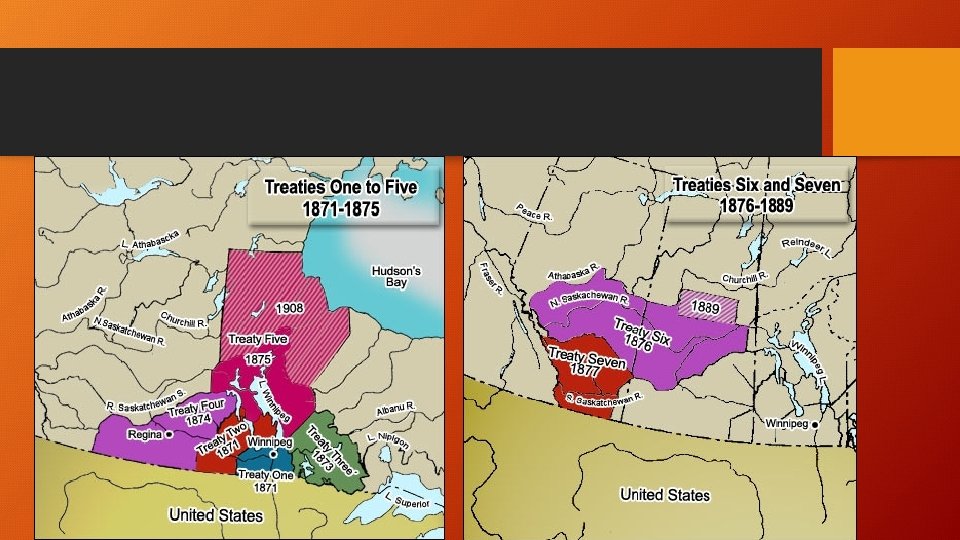
The Numbered Treaties • Between 1871 and 1921, the Government of Canada entered into eleven treaties with First Nations across the West. • These treaties, known as the Numbered Treaties, covered vast areas of present-day northern Ontario, Manitoba, Saskatchewan, Alberta, and parts of British Columbia, Yukon, and the Northwest Territories. • Over time, First Nations that were not present at the original treaty signings or that initially refused to sign a treaty were added at a later date. This type of change is known as a treaty adhesion.
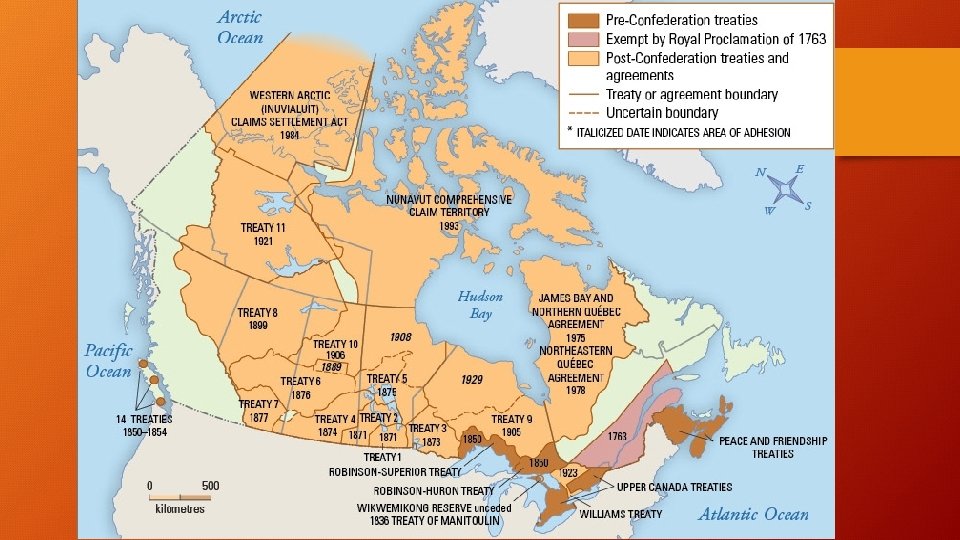
• The government's purpose for negotiating the Numbered Treaties was to open up land for immigrant settlement and ensure peaceful relations between First Nations and the newcomers. • During this time period, the United States had been spending millions of dollars on wars with Native Americans of the Great Plains. Prime Minister Macdonald wanted to avoid such wars with First Nations in Canada and decided that treaties would be the solution.
• As the government negotiated the treaties, Métis people were sometimes offered the opportunity to "take treaty" and be considered as First Nations people by the government. • In 1883, the government amended the Dominion Lands Act to include provision for Métis claims to land in the Northwest Territories. • Beginning in 1885, scrip commissions travelled through areas in which treaties had been concluded to offer scrip to Métis people. • However, land speculators often travelled with the scrip commissions, and many Metis people sold or were defrauded of their scrip.
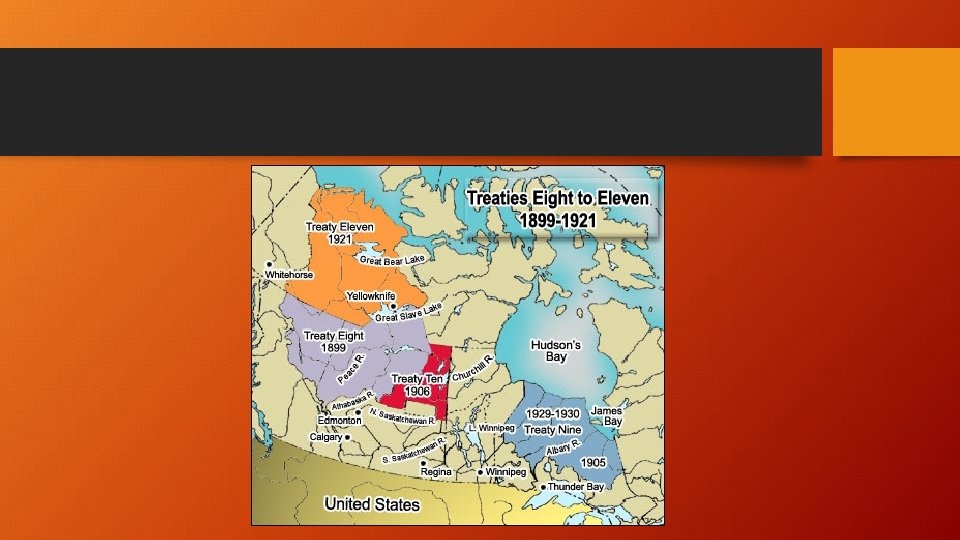
Terms of the Numbered Treaties § Payment upon signing the treating (amounts varied $3 -$12) § Annual payment of $3 -$5 § Reserve land to live on § Establishment of schools on reserve land § Continued hunting/fishing rights on land not ceded for settlement, lumber or mining § Suit of clothing for chiefs every 3 years plus a payment of $25 § Medal and flag for each chief § Basic agricultural equipment and supplies
Why did the First Nations sign the Treaties? • As hunting and food supplies became scarce, Aboriginal peoples became more dependent on food rations from the government, trade with the new immigrants, and agriculture. • Treaties promised reserve lands, hunting and fishing rights, money, annual payments, and assistance with education, medical care, and agricultural machinery. • Not all promises were respected.
Creation of Reserves • The concept of giving First Nations a parcel, or reserve, of land was introduced by Europeans during the early years of colonization in North America. • The Jesuits attempted to encourage First Nations people to settle on parcels of land in the hopes that they would adopt European ways of life, such as farming. • Many years later, when the Numbered Treaties were signed, the basic purpose of the reserve remained the same: for First Nations to adopt a more European style of living.
Relevance of the Numbered Treaties Today • The Numbered Treaties are still legally binding under the Canadian Constitution. Although the Treaty Relations Commission of Manitoba states that "Treaties are the building blocks for the future of the relationship between First Nations and the rest of Canada, " the Numbered Treaties had a number of problems:
• Most reserves were too small to continue traditional ways of life and the reserve lands were often poor for agriculture, which made it difficult for First Nations to create a strong economic base for their communities.
• Oral promises made by the government during treaty negotiations were not always recorded on the treaty documents. According to First Nations oral traditions, these oral promises should have been honoured, but European traditions of treaty making upheld only written treaty terms.
• Today, because of lack of clarity and different understandings of the terms, many First Nations have ongoing disputes with the federal government over treaty rights, land-use rights, fishing and hunting rights, use of natural resources, and respect for traditional territories.
• Although there have been many negative effects from the Numbered Treaties, the process of negotiating treaties with First Nations continues. • A number of First Nations are currently in negotiations with the federal government to create modern-day treaties known as land claim agreements. • Land-claim agreements occur between specific Aboriginal communities, the Government of Canada, and the provincial governments in areas where Aboriginal rights have not been addressed by treaty or other legal means.
Why might First Nations’ understanding of the Numbered Treaties differ from the Canadian government’s understanding?
What ethical questions arise concerning the fact that the Numbered Treaties were written in English and many First Nations chiefs could not speak or write English?
The Indian Act, 1876 • Although it was presented as a simple consolidation of existing legislation, the Indian Act in fact added many powers to the federal government and its ability to control First Nations people. • The goal of assimilation was highly Eurocentric: it reflected a worldview in which European-based cultures and traditions are viewed as superior to other cultures and traditions.
• Colonial governments, as well as most Canadians at the time, believed that the best future for First Nations, Metis, and Inuit people would be one in which they gave up their own cultures in favour of European-based traditions. • However, in the view of William Lathlin of the Opaskwayak Cree Nation, "assimilation is legislated genocide. Assimilation is the Indian Act, the Indian Act is government legislation, and government policies from this act are used to keep First Nations people from advancing and being part of Canada. "
• The Indian Act's powers were so far-reaching that the Canadian government could make changes to the act without consultation with or obtaining permission from First Nations. • These far-reaching powers contrasted sharply with the spirit and intent with which the Numbered Treaties were being negotiated. In its approach to dealing with First Nations, the Indian Act is paternalistic.
For much of its history, the act had three main goals: • to assimilate First Nations people through enfranchisement • to manage First Nations communities and their reserves • to define who could and could not be classified as a First Nations person Video: The Indian Act Explained (2 min)
Main Provisions of the Indian Act • First Nations became wards of the government (children or minors) do not have the same rights as Canadian citizens. • First Nations government and leadership were discouraged instead band councils were encouraged • Women and Elders were not allowed to participate in band councils • Defined who had “Indian Status”, they were eligible for the provisions under the act • Women who married non-First Nations or non-Status men lost their status as did their children • People who obtained a University Degree, joined the military or the clergy gave up their status
• Government controlled the financial institutions on reserves especially the sale and rent of reserve lands. • could not be mortgaged or taxed • could also not be sold without the majority approval of band members and could be sold only to the government. • Children were required to attend residential schools • Manufacture, sale and consumption of alcohol was banned • Some traditional First Nations ceremonies were banned • Indian Agents, who were federal government employees, had authority to manage reserves and enforce provisons.
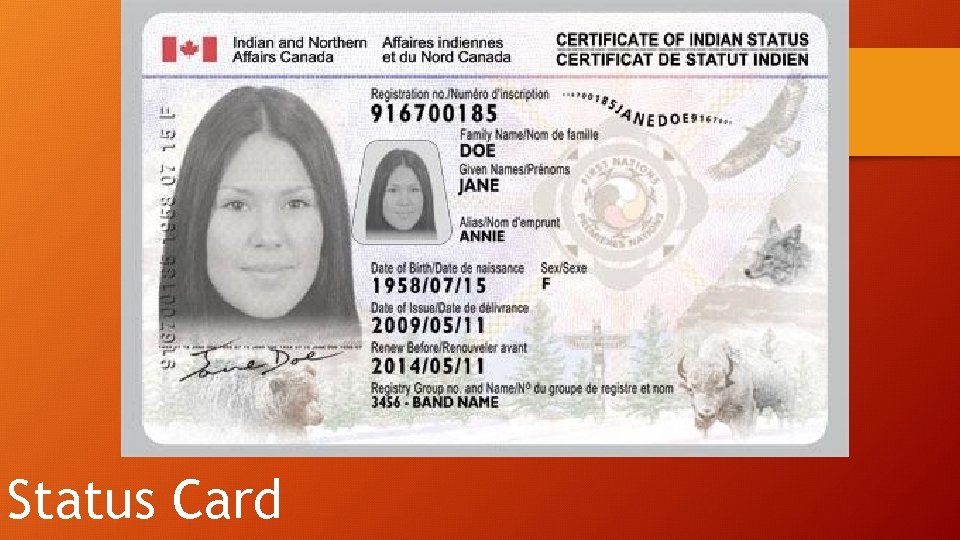
Status Card
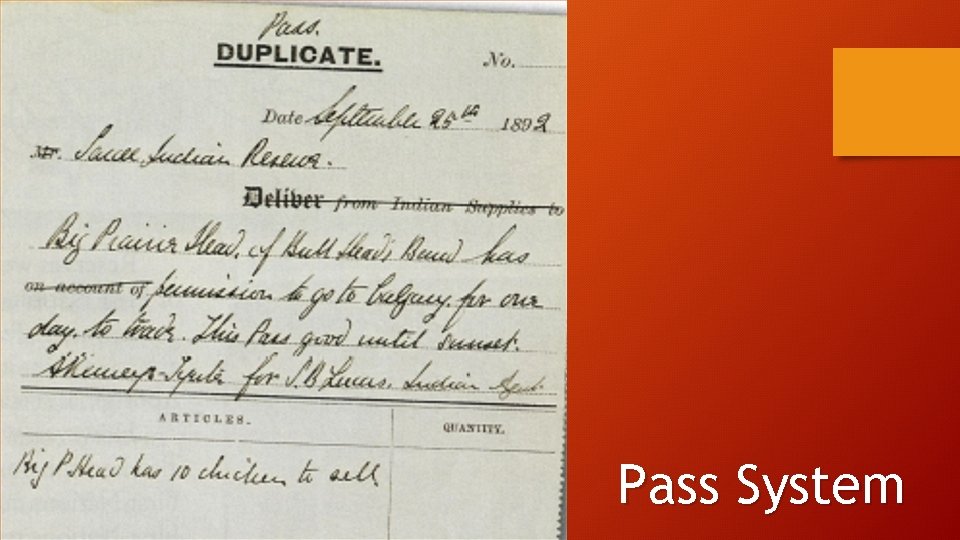
Pass System
In what ways do you think the pass system affected the lives of First Nations people? What long-term consequences might the pass system have had?
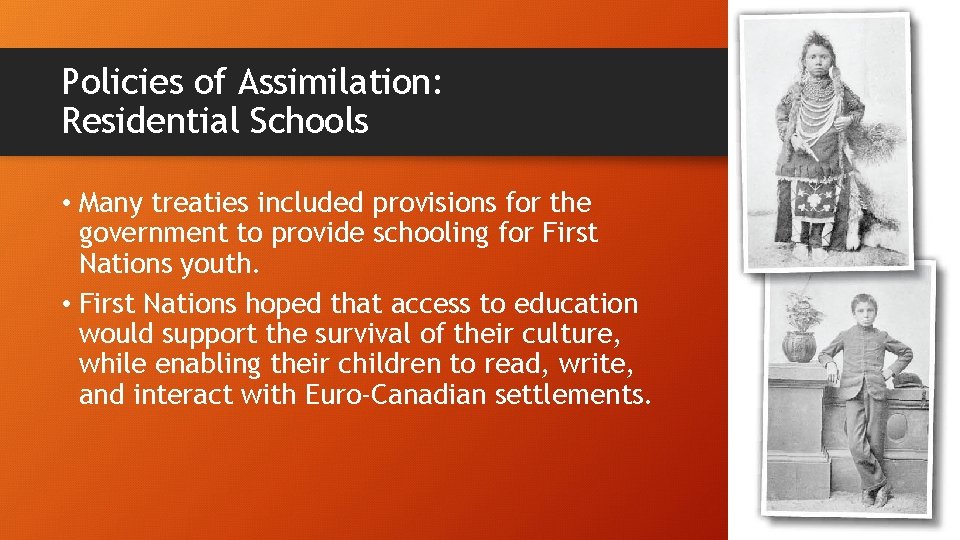
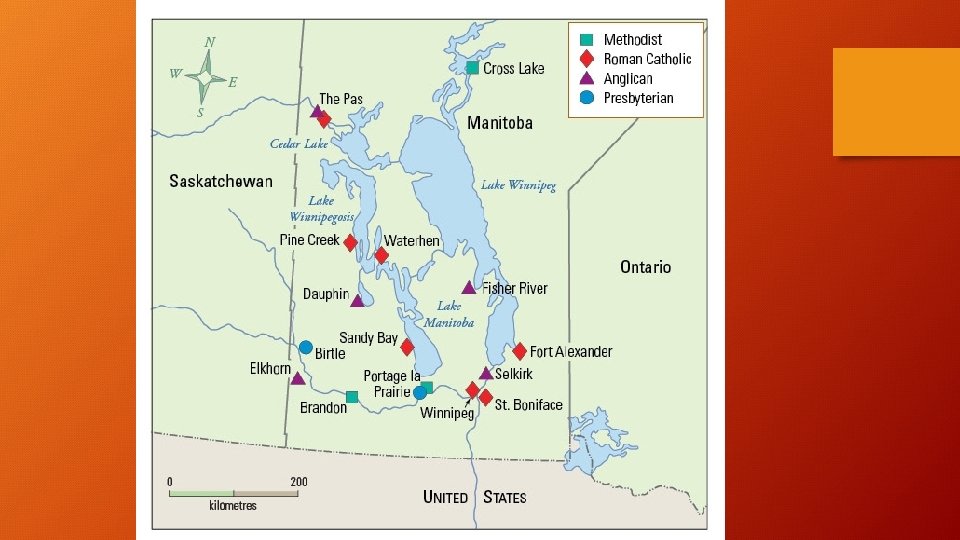
Policies of Assimilation: Residential Schools • Many treaties included provisions for the government to provide schooling for First Nations youth. • First Nations hoped that access to education would support the survival of their culture, while enabling their children to read, write, and interact with Euro-Canadian settlements.
• The Canadian government, however, had different ideas about the purpose of educating First Nations youth. • Even as early as 1847, Egerton llyerson, the chief superintendent of education for Upper Canada, stated, "The education of Indians consists not merely of training the mind but of weaning from the habits and feelings of their ancestors and the acquirements of the language, arts, and customs of a civilized life. "
• In 1920, an amendment to the Indian Act made it compulsory for First Nations youth to attend residential schools. • In the schools, children were separated from their siblings, given European-style clothing, and allowed to speak in English only. • If First Nations youth were caught speaking their traditional language or talking to family members, they were punished. • By discouraging First Nations languages, educators hoped that the oral stories providing the foundation of First Nations cultures would die.
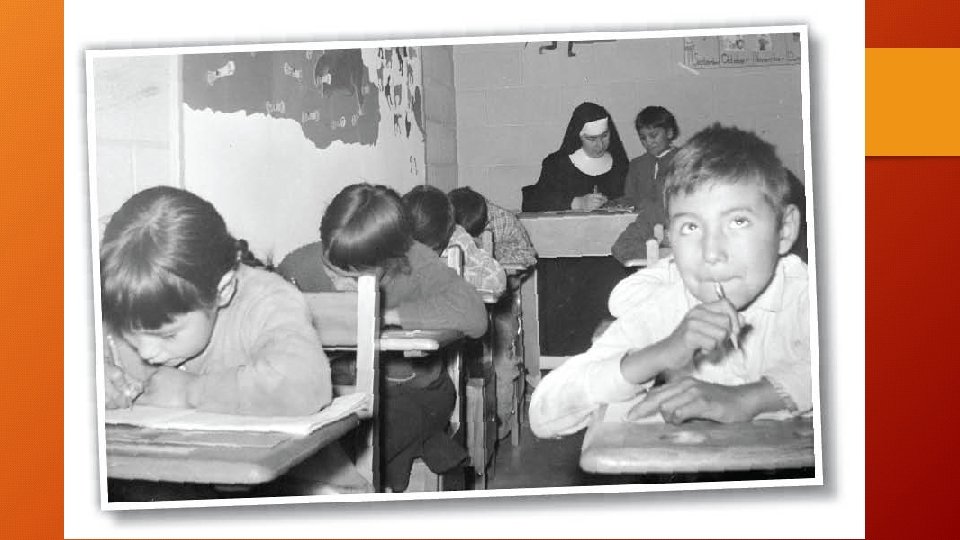
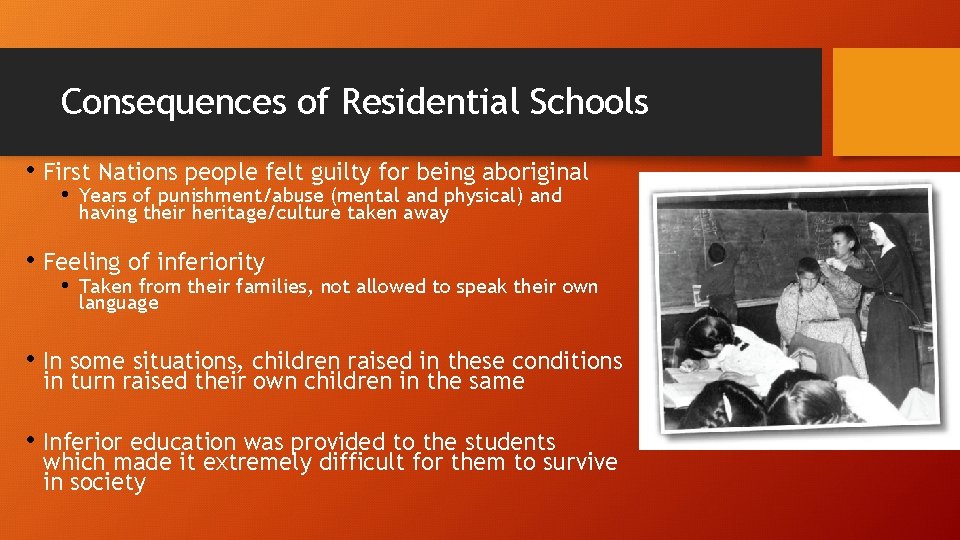
Consequences of Residential Schools • First Nations people felt guilty for being aboriginal • Years of punishment/abuse (mental and physical) and having their heritage/culture taken away • Feeling of inferiority • Taken from their families, not allowed to speak their own language • In some situations, children raised in these conditions in turn raised their own children in the same • Inferior education was provided to the students which made it extremely difficult for them to survive in society
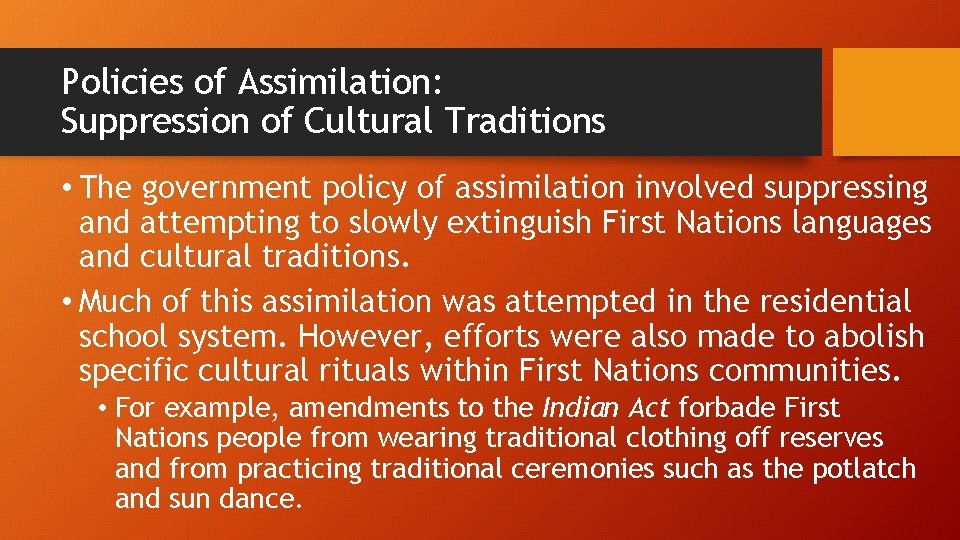
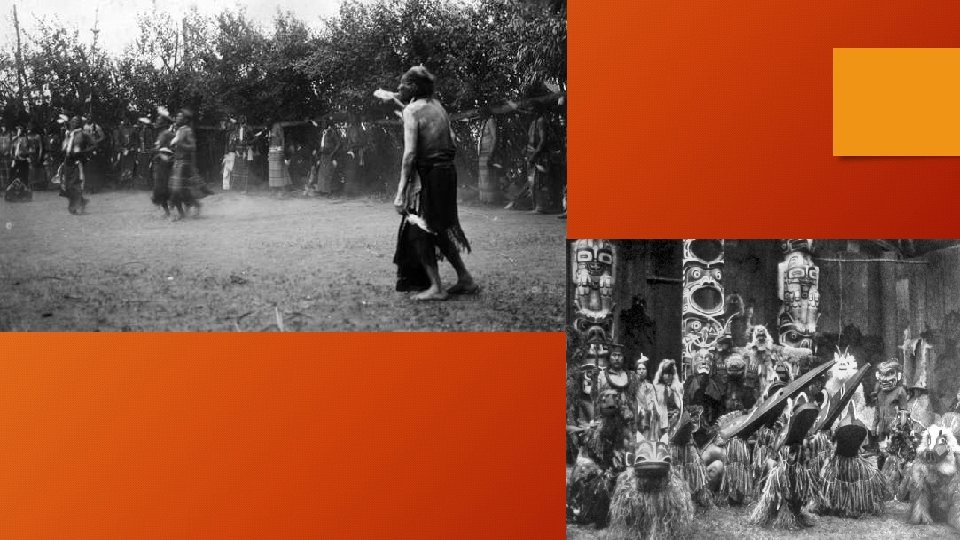
Policies of Assimilation: Suppression of Cultural Traditions • The government policy of assimilation involved suppressing and attempting to slowly extinguish First Nations languages and cultural traditions. • Much of this assimilation was attempted in the residential school system. However, efforts were also made to abolish specific cultural rituals within First Nations communities. • For example, amendments to the Indian Act forbade First Nations people from wearing traditional clothing off reserves and from practicing traditional ceremonies such as the potlatch and sun dance.
Policies of Assimilation: Enfranchisement • Until 1951, the Indian Act defined a person as "an individual other than an Indian. " • To become a "person" as defined by the act, First Nations people had to enfranchise, giving up their status under the Indian Act. • The Canadian government believed that the offer of enfranchisement would encourage First Nations people to give up their Indian status.
• Most First Nations people refused to give up their status and First Nations identity voluntarily. • Between 1859 and 1920, only about 250 First Nations people became enfranchised. That number increased after 1920, when the government allowed First Nations people living off reserves to vote if they accepted enfranchisement. • However, the idea of enfranchisement was not often looked upon as a viable option by the majority of First Nations people.
Policies of Assimilation: Aboriginal Participation in World War I • Despite the sacrifices they made to fight for Canada in the First World War, the Canadian government excluded First Nations, Metis, and Inuit veterans from any of the post-war programs they established for other soldiers. • For example, First Nations veterans did not qualify to receive farmland as other First World War veterans did. • In addition, many First Nations veterans could not return to live on their reserves because they had been forced to give up their Indian status when they enlisted. • The hardships many veterans faced upon their return to Canada forced some men to become politically active and fight for better rights for First Nations people in Canada.
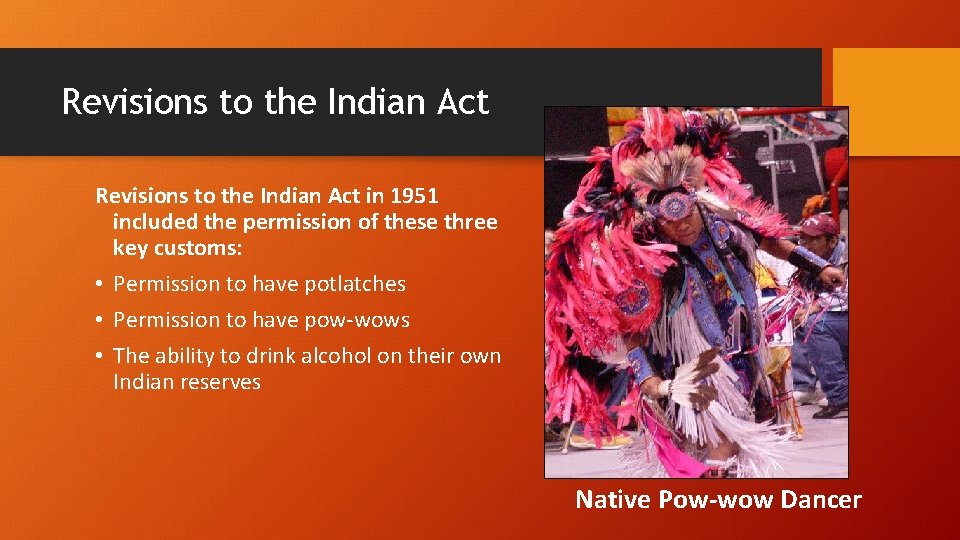
Revisions to the Indian Act in 1951 included the permission of these three key customs: • Permission to have potlatches • Permission to have pow-wows • The ability to drink alcohol on their own Indian reserves Native Pow-wow Dancer
“ We must all be equal under the laws. . . aboriginal rights, this really means saying “we were here before you. . . we want you to re-open this question. . . ” And our answer. . . Is no. If we think of restoring aboriginal rights to the Indians, well what about the French who were defeated at the Plains of Abraham? Shouldn’t we restore rights to them? And the Acadians? And the Japanese Canadians? . . . I can only say as President Kennedy said. . . We will be just in our time. This is all we can do. ” — Pierre Trudeau
“ Generations of Indians have grown up behind a buckskin curtain of indifference, ignorance and, all too often, plain bigotry. Now, at a time when our fellow Canadians consider the promise of the Just Society, once more the Indians of Canada are betrayed by a programme which offers nothing better than cultural genocide. ” -Harold Cardinal
“ If we are to be part of the Canadian mosaic, then we want to be colourful red tiles, taking our place where red is both needed and appreciated. ” — Harold Cardinal
- Slides: 47