
Aboriginal health wellbeing safety evaluation framework OPEN Symposium
Aboriginal health, wellbeing & safety evaluation framework OPEN Symposium 18 th October 2019
Introduction • Project to deliver an Aboriginal-led Aboriginal health, wellbeing & safety evaluation framework for: - Family violence - Health - Wellbeing and - Child safety • Relates to conference theme of building evidence base for Aboriginal programs & services to improve outcomes for Aboriginal children and families
Introduction Project deliverables • an overarching evaluation framework • Literature review on cultural determinants of health • individual monitoring, evaluation and accountability plans (MEA’s) & • an implementation toolkit for: • Dhelk Dja: Safe Our Way – Strong Culture, Strong Peoples, Strong Families • Korin Balit Djak: Aboriginal health wellbeing and safety strategic plan 2017 -2027 • Balit Murrup: Aboriginal social and emotional wellbeing framework 2017 -2027 • Wungurilwil Gapgapduir: Aboriginal Children and Families Agreement.
Background • DHHS tender seeking Aboriginal-led project team • VACCA has partnered with University of Melbourne • Aboriginal people told the department more work needed to ensure Aboriginal people leading evaluation and monitoring of Aboriginal health, wellbeing and safety programs across Victoria. • Key priorities in the plans strongly point to the need for an evaluation framework, including: - Aboriginal-defined measures of progress relating to Aboriginal health, wellbeing and safety - strengthening evaluation capacity in Aboriginal health, wellbeing and safety - Aboriginal-led and informed evaluation, innovation, and evidence gathering
Purpose • Recognise and act on Aboriginal knowledge, expertise and strengths • Monitor and measure impact of four key strategies • Embed cultural factors into mainstream services’ evaluative practice • Strengthen evaluative capability across the sector • Build Aboriginal-defined evidence of what works in Aboriginal HW&S • Better outcomes for Aboriginal Victorians
Innovation Framework acknowledges Aboriginal expertise and cultural knowledge as a legitimate source of truth that is integral for providing evidence of Victorian Aboriginal health, wellbeing & safety
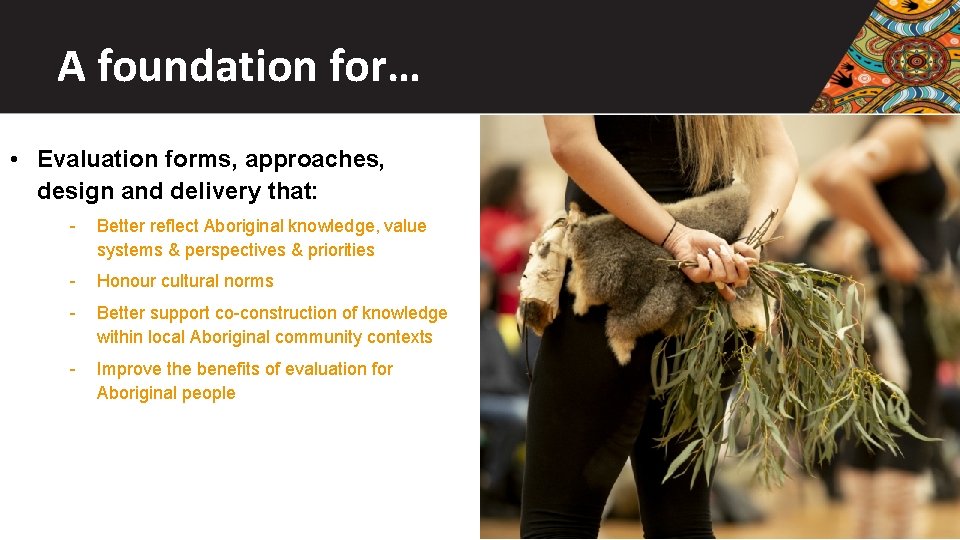
A foundation for… • Evaluation forms, approaches, design and delivery that: - Better reflect Aboriginal knowledge, value systems & perspectives & priorities - Honour cultural norms - Better support co-construction of knowledge within local Aboriginal community contexts - Improve the benefits of evaluation for Aboriginal people
The consultation process • Formation of & consultation with expert Aboriginal Advisory Group • Consultations with governance groups for strategies • Targeted consultations with ACCOs & peaks • Opportunistic consultations e. g. DHHS Aboriginal Staff Network • Targeted interviews with key Aboriginal and non-Aboriginal informants
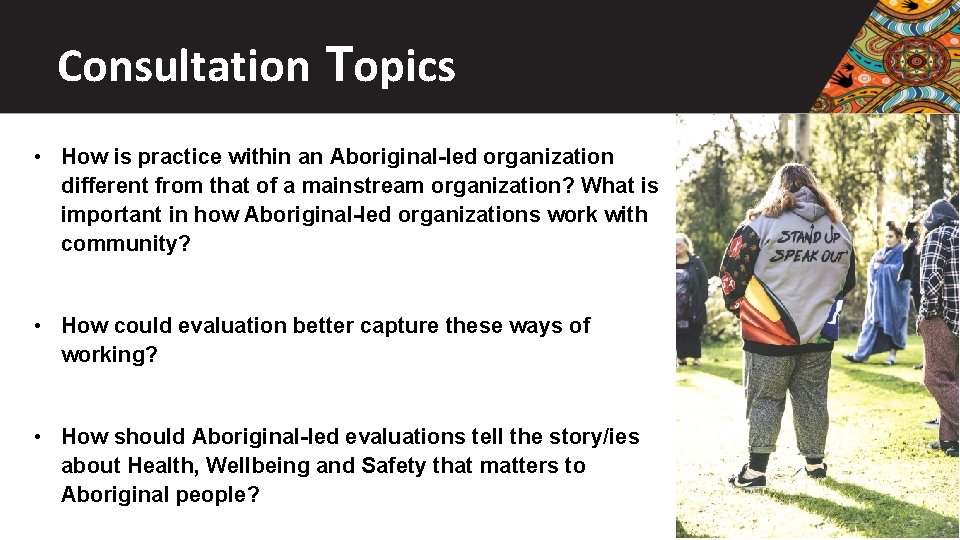
Consultation Topics • How is practice within an Aboriginal-led organization different from that of a mainstream organization? What is important in how Aboriginal-led organizations work with community? • How could evaluation better capture these ways of working? • How should Aboriginal-led evaluations tell the story/ies about Health, Wellbeing and Safety that matters to Aboriginal people?
Consultation Topics • Thinking about priorities in the 4 plans, what would success look like from an Aboriginal perspective? How would we know if this was achieved or if we were tracking well toward achieving it? • What would be helpful in building evaluation capacity of your organisation? What is needed to support strengthened evaluation?
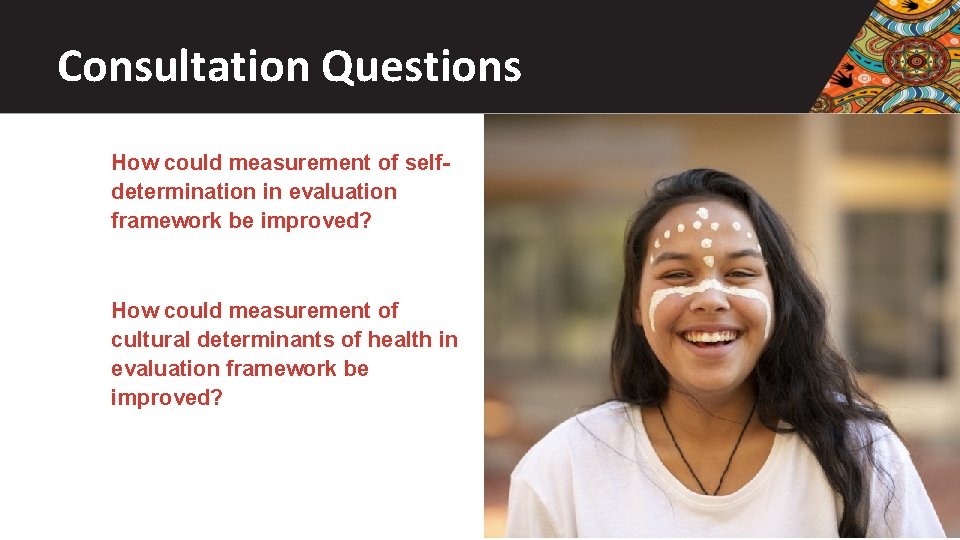
Consultation Questions How could measurement of selfdetermination in evaluation framework be improved? How could measurement of cultural determinants of health in evaluation framework be improved?
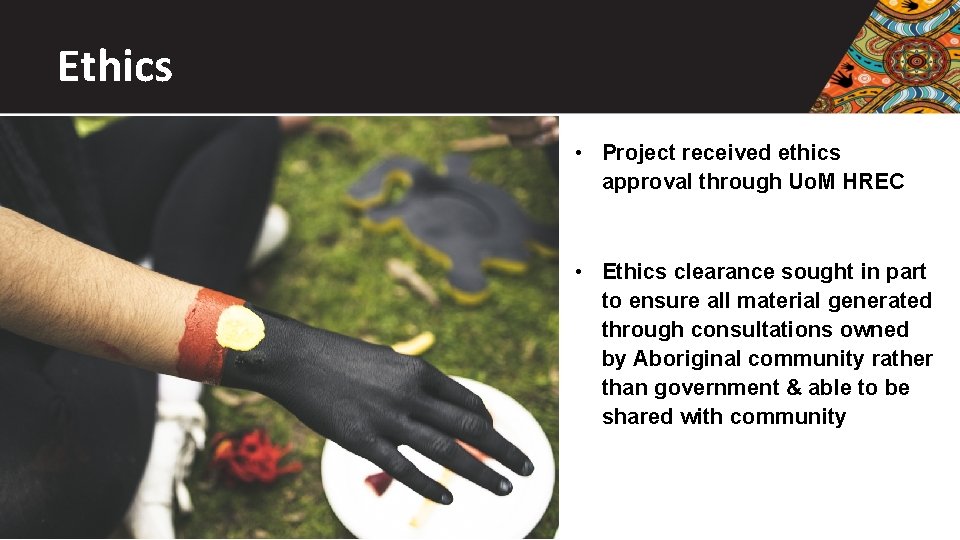
Ethics • Project received ethics approval through Uo. M HREC • Ethics clearance sought in part to ensure all material generated through consultations owned by Aboriginal community rather than government & able to be shared with community
Methodology • Conducted a literature review • Thematically analysed consultation data to identify: - Indicators against components of each strategy - Aboriginal-defined indicators of ‘success’ across six key themes: o o o Governance & leadership Cultural safety System and service reform Workforce Individuals, families & communities Data & knowledge
Six Key Themes: The work we need to do Governance & Leadership Aboriginal led governance and leadership of policy, program design, implementation, monitoring and evaluation of Aboriginal health, wellbeing and safety across the breadth of the service system. Cultural Safety Aboriginal cultural identity is respected and understood to be integral to health, wellbeing and safety. System and Service Reform Aboriginal Victorians have access to integrated, culturally responsive health, wellbeing and safety services in Aboriginal organisations (or where required from mainstream services across the continuum from prevention to tertiary services. Workforce A skilled and expanded Aboriginal workforce is present in service delivery, management and leadership roles across the Victorian service system. Individuals, Families & Communities Improved physical, social and emotional wellbeing and safety across the diversity of Aboriginal people. Data & Knowledge Aboriginal led capture and sharing of knowledge, learning, data and evidence to drive service investment and to inform practice and innovation.
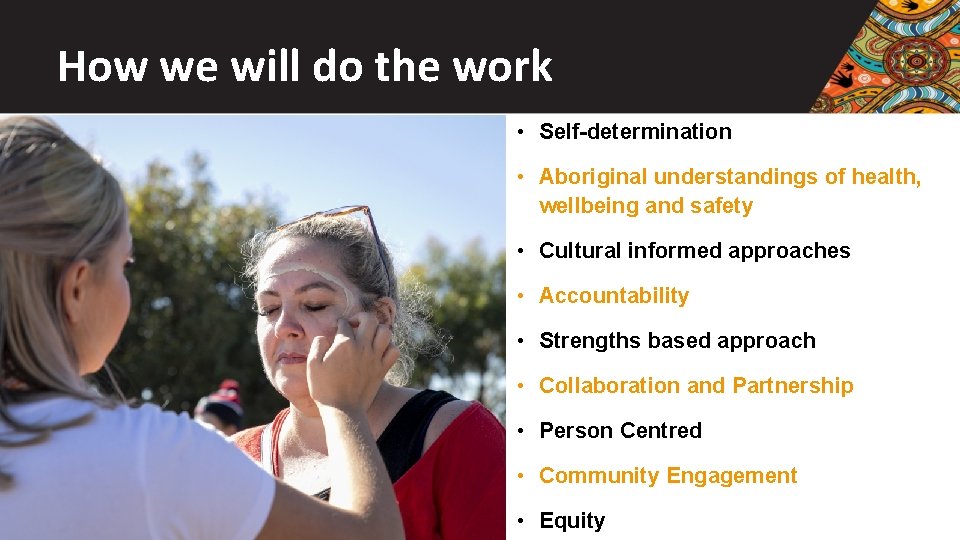
How we will do the work • Self-determination • Aboriginal understandings of health, wellbeing and safety • Cultural informed approaches • Accountability • Strengths based approach • Collaboration and Partnership • Person Centred • Community Engagement • Equity
Phase Two • Draft products (overall framework, MEAs) initially tested with Aboriginal community sector representatives. Feedback: - Need for a more manageable number of indicators - Need for strategies to better articulate their intended short, medium and long term outcomes • Theory of Change (aka program logic or pathway of change) for each strategy - a more transparent, logical basis for helping governance groups select “headline” indicators that best measure these outcomes - will result in a Framework that provides clear direction for department to achieve outcomes Victorian Aboriginal community has prioritised

Questions
More Information… Gabrielle Johnson Professor Margaret Kelaher Project Coordinator- Consultations, VACCA Uo. M Lead Investigator (03) 9287 8800 gabriellej@vacca. org (03) 8344 0648 mkelaher@unimelb. edu. au Amanda Jones Amanda Allen-Toland Project Manager, VACCA Project Manager, DHHS Aboriginal Strategy and Oversight Branch Strategy and Planning Division (03) 9287 8800 amandaj@vacca. org 0428 446 258 Amanda. Allen-Toland@dhhs. vic. gov. au
- Slides: 18