
Abolition of Slave Trade and Slavery in Latin

Abolition of Slave Trade and Slavery in Latin America Mainland Spanish America (from independent Mexico to Argentina), 1810 s 1860 s Cuba (Spanish colonies) 1860 s-1880 s Brazil (independent), 1850 s-1880 s
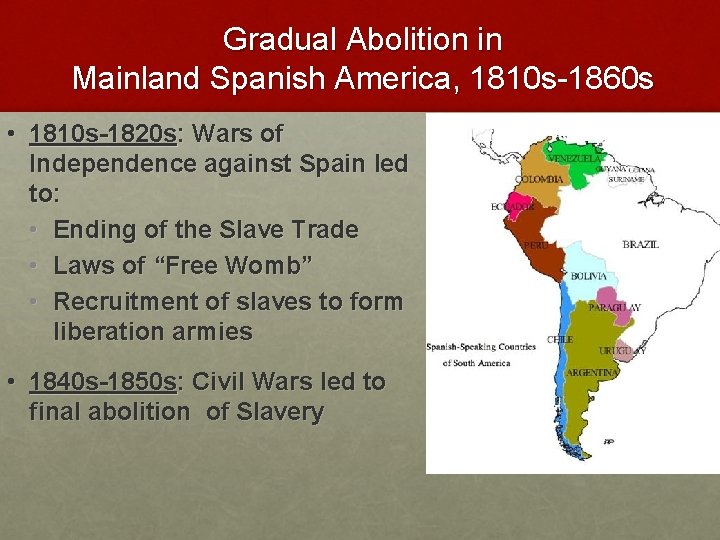
Gradual Abolition in Mainland Spanish America, 1810 s-1860 s • 1810 s-1820 s: Wars of Independence against Spain led to: • Ending of the Slave Trade • Laws of “Free Womb” • Recruitment of slaves to form liberation armies • 1840 s-1850 s: Civil Wars led to final abolition of Slavery
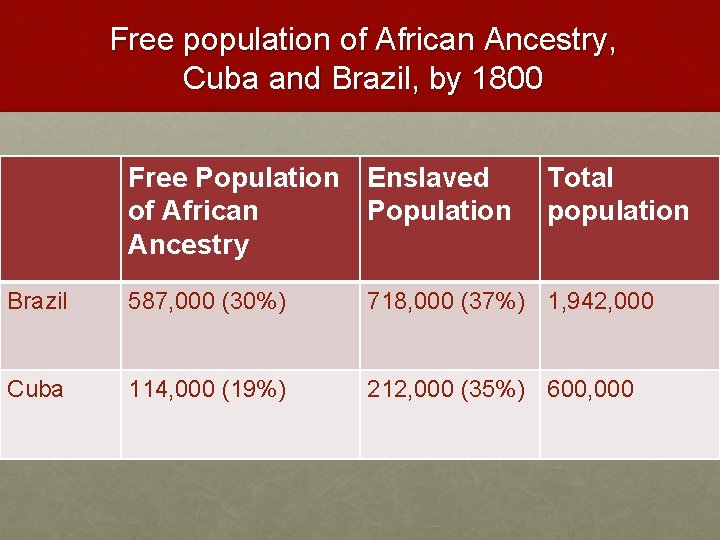
Free population of African Ancestry, Cuba and Brazil, by 1800 Free Population Enslaved of African Population Ancestry Total population Brazil 587, 000 (30%) 718, 000 (37%) 1, 942, 000 Cuba 114, 000 (19%) 212, 000 (35%) 600, 000
Ending of the slave Trade: Brazil, 1850 • Treaty with Britain against slave trade in 1826 to end traffic by 1830 • British Navy attacked slave trade vessels anchored in Brazilian ports (1849) • Brazilian government needed British support for their own war in the region
Ending of the slave Trade: Cuba, 1866 • US influence: Ending of US Civil War in 1865 • Both Britain and the US would enforce anti-slave trade policies more strictly than before on Cuba • Continuation of the Spanish-Cuban traffic would encourage foreign intervention in Cuba
War and Abolition of Slavery in Cuba • 1870 Moret Law: Newborns from slave mother would be free. Issued during first war of independence (18681878) • 1880 Apprenticeship or Patronato system • Scheduled to end slavery by 1888, but patrocinados (apprentices) shortened the period of apprenticeship to 1886. • Colonial state did not compensate masters, but the labor of the remaining slaves paid for their emancipation. • • • Established the ability to self purchase at a lower price. Adult slaves perceived a stipend. Established quotas: each former master had to liberate one in four patrocinados by 1885 and one in
British Consul-General Dunlop in Havana, Cuba, 1871 The Cuban planters quite recognize now the probability, almost certainty, of a coming abolition of slavery. They make here no organized public objection to its eventual arrival; but they demand time, and an immigration of labour hands under Government sanction and aid, and also a series of years of preparation of a very gradual description. “How not to do it!” is their môt d’ordre
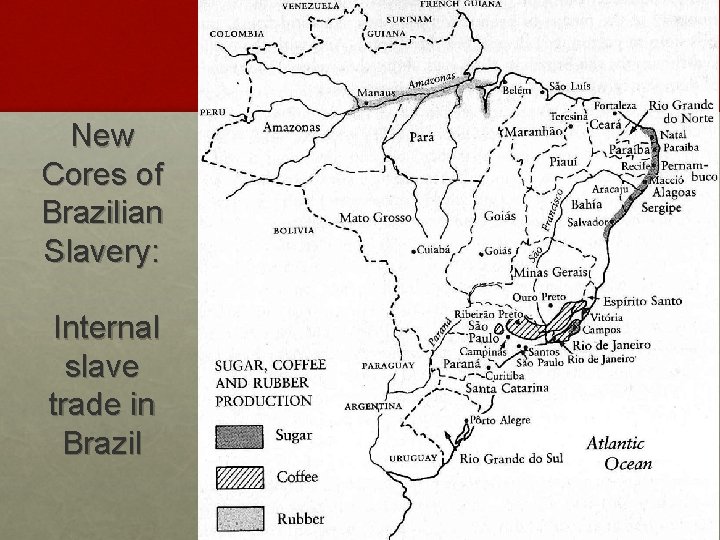
New Cores of Brazilian Slavery: Internal slave trade in Brazil

Abolition of Slavery in Brazil • 1871: Rio Branco Law, newborns from slave mother be freed. • No other measure against slavery up to 1885, when slaves older than 65 years were liberated. • Decrease of slave population by individual emancipation and running away: • 1. 7 million slaves by 1864, 700. 000 slaves by 1887. • 1888: Abolition of slavery pushed by civil disobedience of slavery: police did not return runaway slaves. • Princess Isabel of Brazil issue Abolition law
- Slides: 9