
Abnormality Definitions 1 Deviation from Social Norms 2
Abnormality Definitions: 1. Deviation from Social Norms 2. Failure to Function Adequately 3. Deviation from Ideal Mental Health 4. Statistical Infrequency
Card sort Use the A 4 introduction sheets on your desk to sort the 10 characteristics into the relevant definition. You must read the definition before you can work them out.
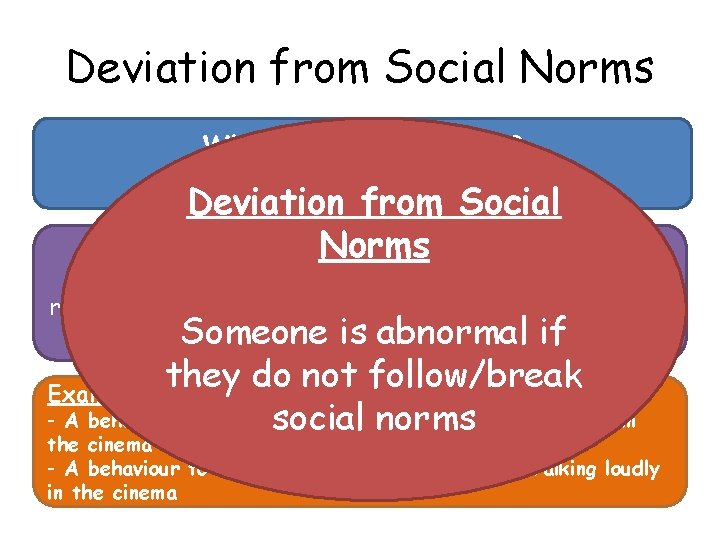
Deviation from Social Norms What are social norms? What are the 2 types? Deviation from Social Norms Social norms are expected and accepted ways of behaving in a given situation, they allow for the regulation of normal social behaviour. All societies have Someone is abnormal if expectations of how people should behave/think they do not follow/break Examples: - A behaviour to suggest you are norms ‘normal’ e. g. Being quiet in social the cinema - A behaviour to suggest you are ‘abnormal’ e. g. Talking loudly in the cinema
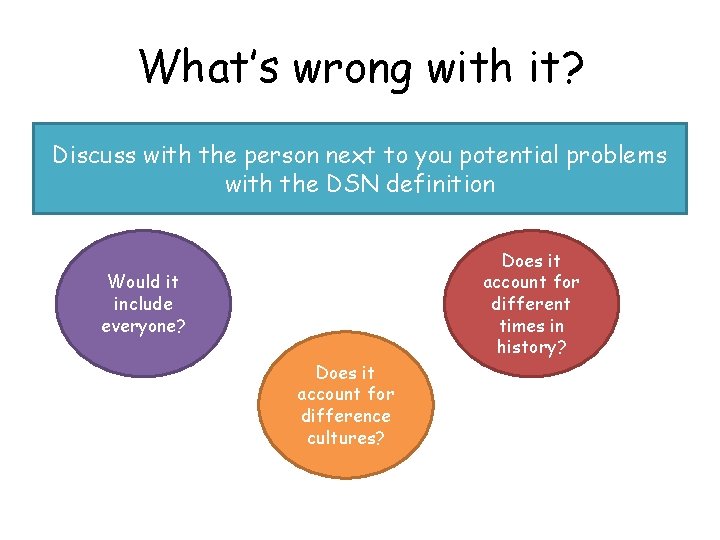
What’s wrong with it? Discuss with the person next to you potential problems with the DSN definition Does it account for different times in history? Would it include everyone? Does it account for difference cultures?
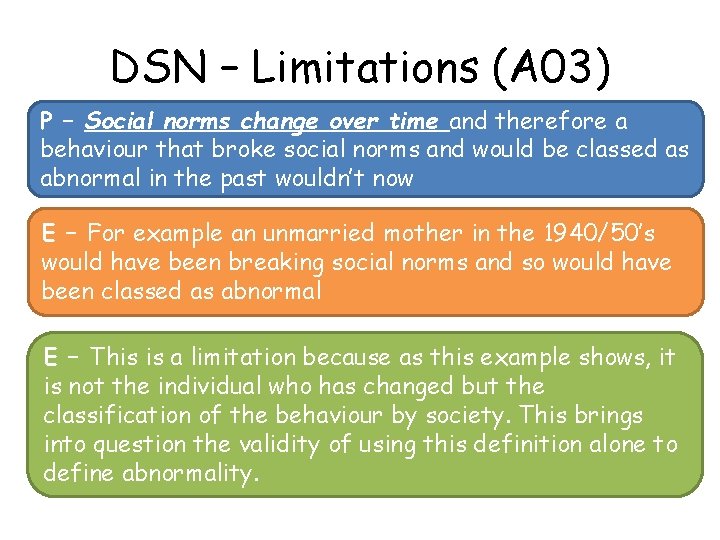
DSN – Limitations (A 03) P – Social norms change over time and therefore a behaviour that broke social norms and would be classed as abnormal in the past wouldn’t now E – For example an unmarried mother in the 1940/50’s would have been breaking social norms and so would have been classed as abnormal E – This is a limitation because as this example shows, it is not the individual who has changed but the classification of the behaviour by society. This brings into question the validity of using this definition alone to define abnormality.
Differences in Social Norms HSBC Advert: Cultural Norms • https: //www. youtube. com/watch? v=6_ WAmt 3 c. Mdk
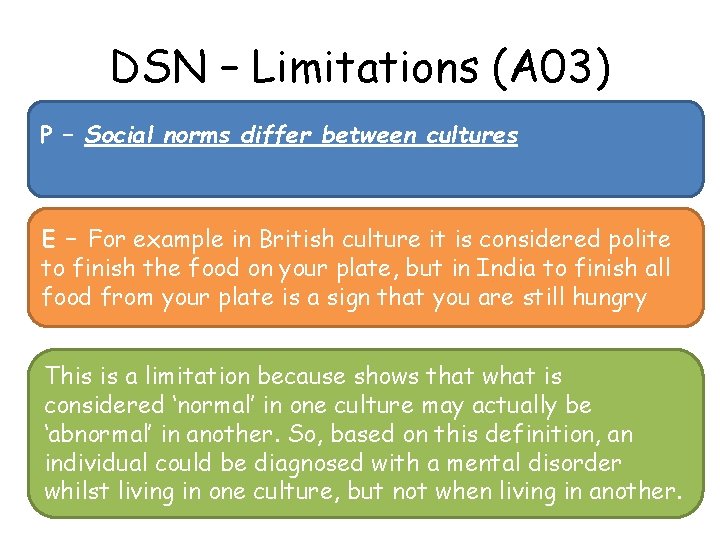
DSN – Limitations (A 03) P – Social norms differ between cultures E – For example in British culture it is considered polite to finish the food on your plate, but in India to finish all food from your plate is a sign that you are still hungry This is a limitation because shows that what is considered ‘normal’ in one culture may actually be ‘abnormal’ in another. So, based on this definition, an individual could be diagnosed with a mental disorder whilst living in one culture, but not when living in another.
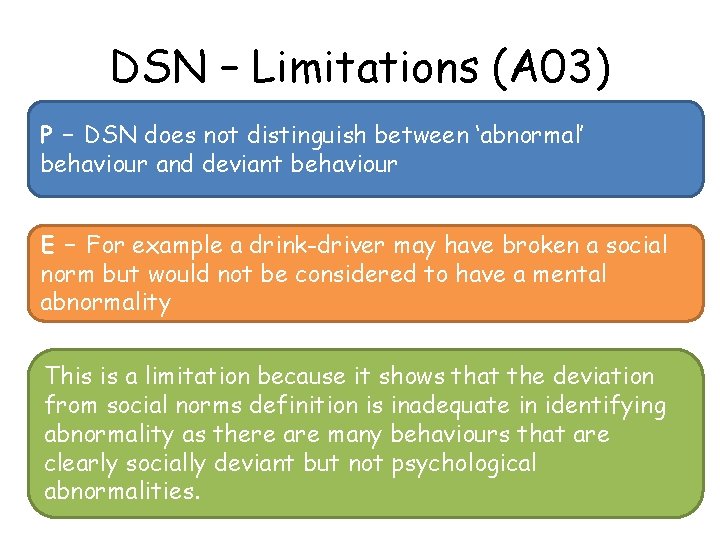
DSN – Limitations (A 03) P – DSN does not distinguish between ‘abnormal’ behaviour and deviant behaviour E – For example a drink-driver may have broken a social norm but would not be considered to have a mental abnormality This is a limitation because it shows that the deviation from social norms definition is inadequate in identifying abnormality as there are many behaviours that are clearly socially deviant but not psychological abnormalities.
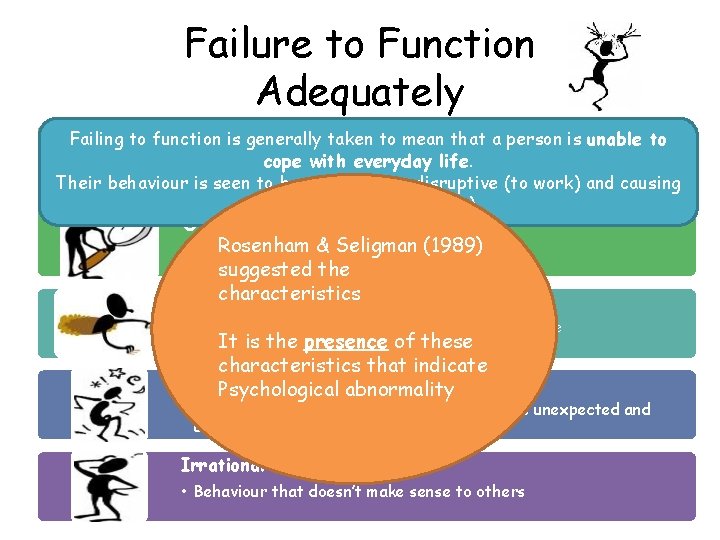
Failure to Function Adequately Failing to function is generally taken to mean that a person is unable to Personal Distress with everyday life. • Sufferingcope Psychological distress Their behaviour is seen to be maladaptive, disruptive (to work) and causing distress (self and others) Observer Distress Rosenham & Seligman • Causes discomfort to others (1989) suggested the characteristics Maladaptive Behaviour • Behaviour interferes with ability to cope with normal life It is the presence of these • Maladaptive or dysfunctional characteristics that indicate Unpredictable Behaviour Psychological abnormality • Behaviour that doesn’t fit the situation, or is unexpected and uncontrolled Irrational Behaviour • Behaviour that doesn’t make sense to others
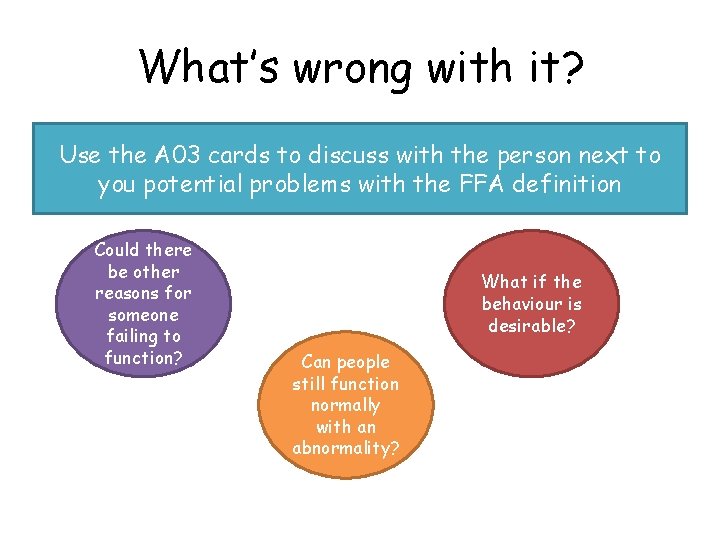
What’s wrong with it? Use the A 03 cards to discuss with the person next to you potential problems with the FFA definition Could there be other reasons for someone failing to function? What if the behaviour is desirable? Can people still function normally with an abnormality?
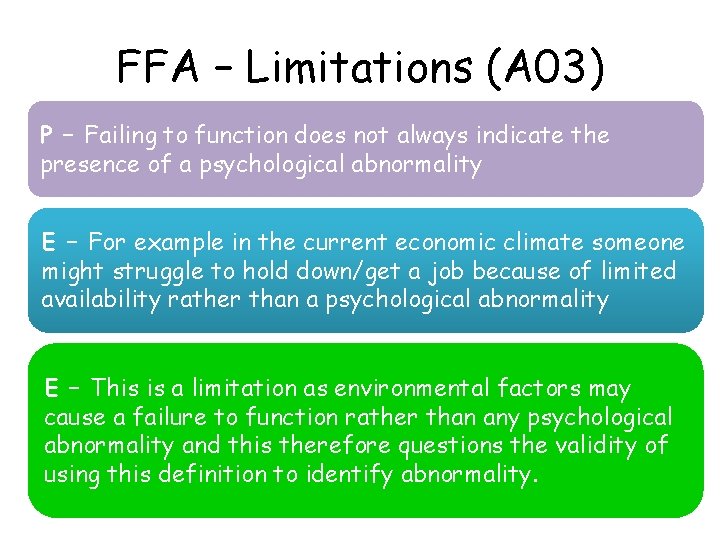
FFA – Limitations (A 03) P – Failing to function does not always indicate the presence of a psychological abnormality E – For example in the current economic climate someone might struggle to hold down/get a job because of limited availability rather than a psychological abnormality E – This is a limitation as environmental factors may cause a failure to function rather than any psychological abnormality and this therefore questions the validity of using this definition to identify abnormality.
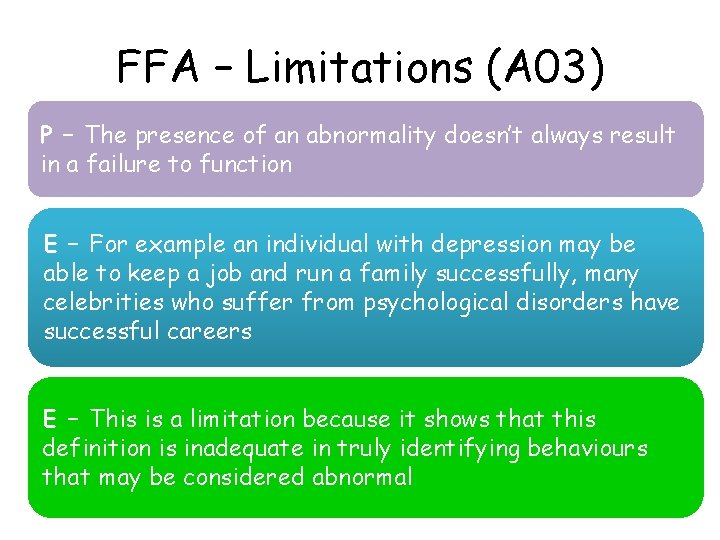
FFA – Limitations (A 03) P – The presence of an abnormality doesn’t always result in a failure to function E – For example an individual with depression may be able to keep a job and run a family successfully, many celebrities who suffer from psychological disorders have successful careers E – This is a limitation because it shows that this definition is inadequate in truly identifying behaviours that may be considered abnormal
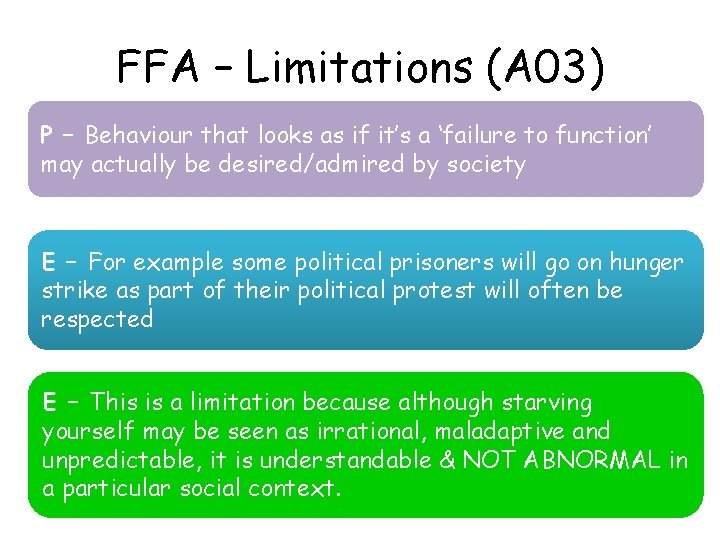
FFA – Limitations (A 03) P – Behaviour that looks as if it’s a ‘failure to function’ may actually be desired/admired by society E – For example some political prisoners will go on hunger strike as part of their political protest will often be respected E – This is a limitation because although starving yourself may be seen as irrational, maladaptive and unpredictable, it is understandable & NOT ABNORMAL in a particular social context.
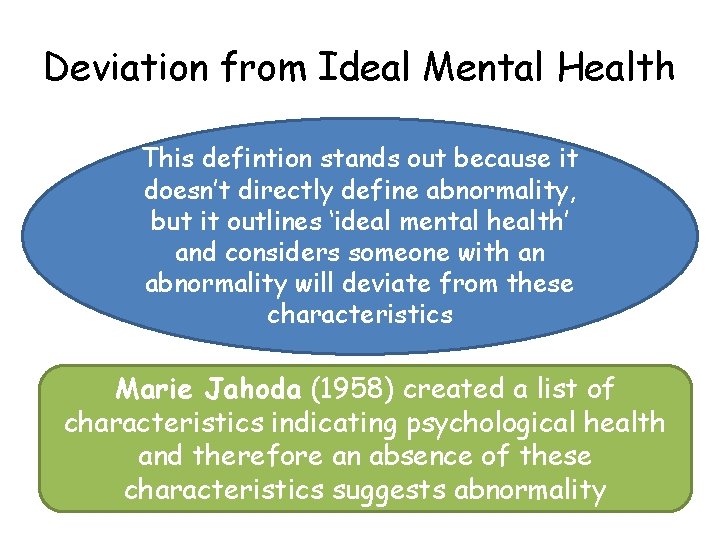
Deviation from Ideal Mental Health This defintion stands out because it doesn’t directly define abnormality, but it outlines ‘ideal mental health’ and considers someone with an abnormality will deviate from these characteristics Marie Jahoda (1958) created a list of characteristics indicating psychological health and therefore an absence of these characteristics suggests abnormality
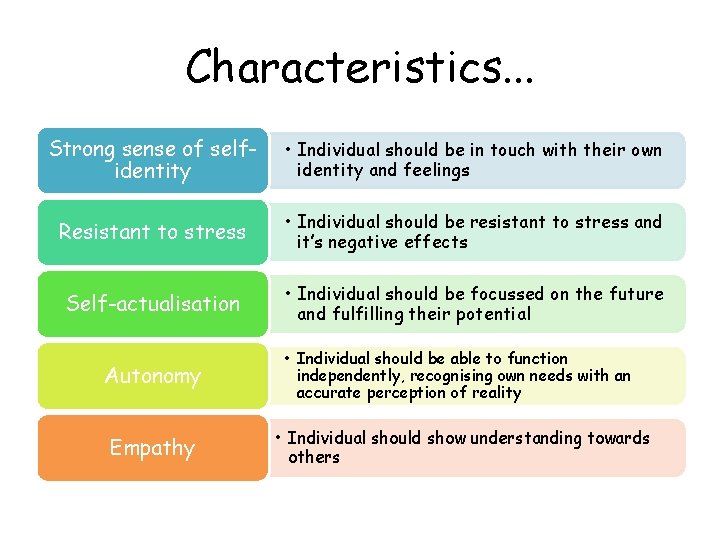
Characteristics. . . Strong sense of selfidentity • Individual should be in touch with their own identity and feelings Resistant to stress • Individual should be resistant to stress and it’s negative effects Self-actualisation • Individual should be focussed on the future and fulfilling their potential Autonomy • Individual should be able to function independently, recognising own needs with an accurate perception of reality Empathy • Individual should show understanding towards others
What’s wrong with it? Use the A 03 cards to discuss with the person next to you potential problems with the FFA definition Can you easily decide what ‘normal’ is? Anything else? Can anyone realistically fulfil all of the criteria?
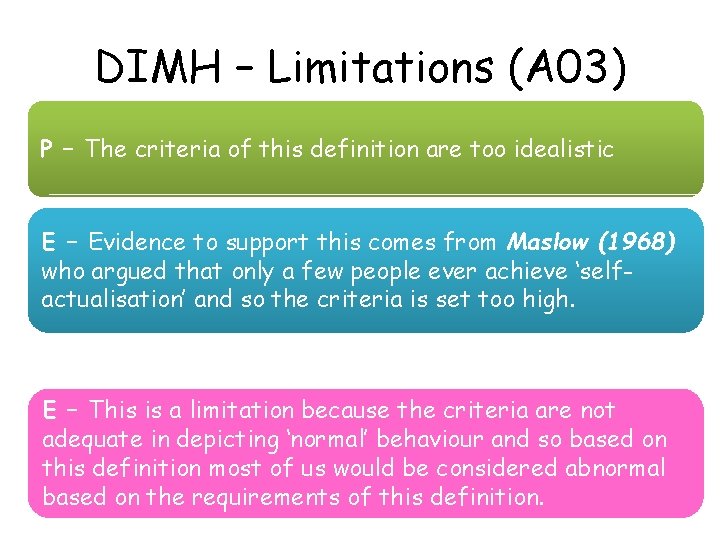
DIMH – Limitations (A 03) P – The criteria of this definition are too idealistic E – Evidence to support this comes from Maslow (1968) who argued that only a few people ever achieve ‘selfactualisation’ and so the criteria is set too high. E – This is a limitation because the criteria are not adequate in depicting ‘normal’ behaviour and so based on this definition most of us would be considered abnormal based on the requirements of this definition.
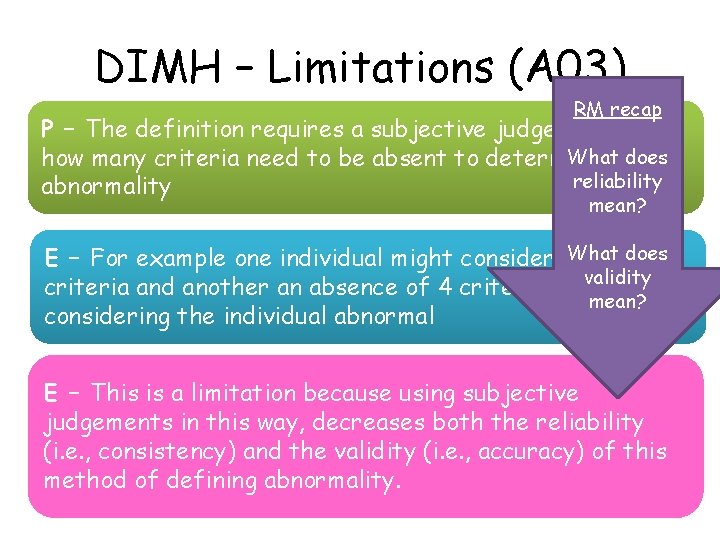
DIMH – Limitations (A 03) RM recap P – The definition requires a subjective judgement on What does how many criteria need to be absent to determine reliability abnormality mean? E – For example one individual might consider a. What lackdoes of 2 validity criteria and another an absence of 4 criteria before mean? considering the individual abnormal E – This is a limitation because using subjective judgements in this way, decreases both the reliability (i. e. , consistency) and the validity (i. e. , accuracy) of this method of defining abnormality.
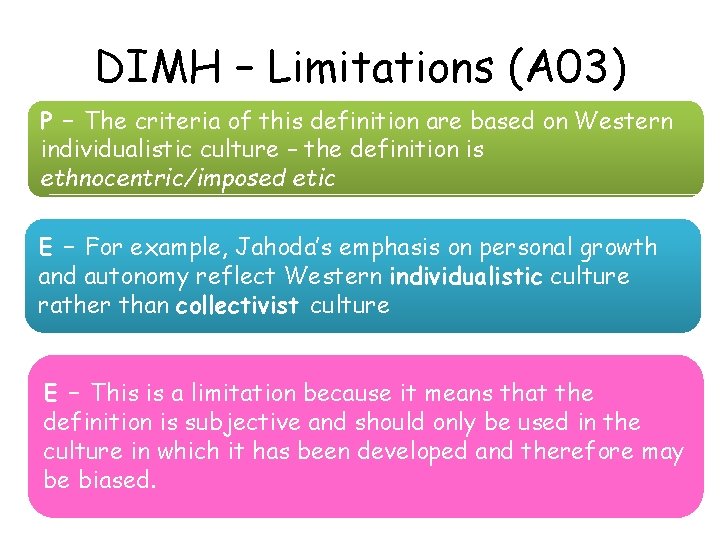
DIMH – Limitations (A 03) P – The criteria of this definition are based on Western individualistic culture – the definition is ethnocentric/imposed etic E – For example, Jahoda’s emphasis on personal growth and autonomy reflect Western individualistic culture rather than collectivist culture E – This is a limitation because it means that the definition is subjective and should only be used in the culture in which it has been developed and therefore may be biased.
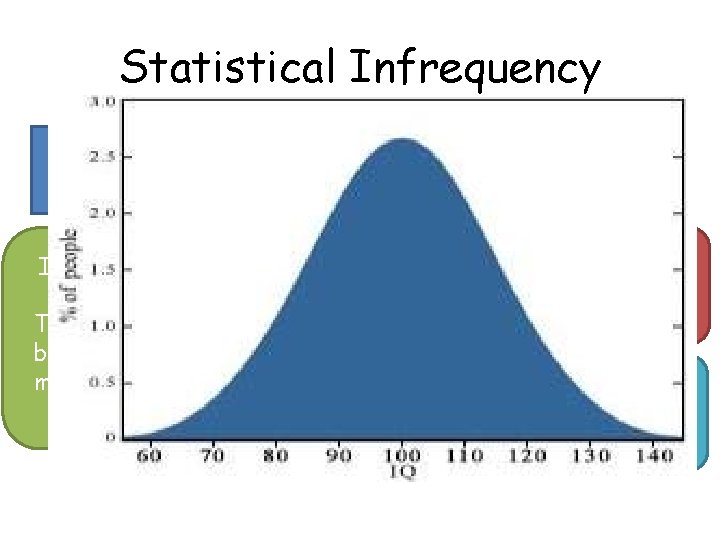
Statistical Infrequency Any behaviour that deviates from the ‘average’ is considered abnormal Idea behind this is – The less frequently a behaviour occurs, the more likely it is to be abnormal Quantity over quality - the majority of people are normal with the minority of people being abnormal The judgement of whether the behaviour is statistically frequent of infrequent is based on the mathematical principal of the normal distribution.
What’s wrong with it? Discuss with the person next to you potential problems with the DSN definition Does it provide some ‘cut off’ guideline? Can you apply it to all cultures? Does it account for desirable behaviours?
SI – Limitations (A 03) P – A strength of the Statistical Infrequency definition of abnormality is that offers the prospect of clear guidelines for identifying behaviours as normal and abnormal. E – For example, the definition introduces an element of objectivity into the process of defining abnormality so that different mental health care workers can all view the same kind of behaviour in the same kind of way. This is a strength because it offers a more scientific way of measuring abnormality, reducing subjectivity and therefore leading to a more accurate way of defining abnormality.
SI – Limitations (A 03) P – A criticism of this definition is that it suggests that anyone who differs from the ‘average’ is technically abnormal. E – For example, it doesn’t take into account the desirability of behaviours, highly intelligent people are statistically rare and are thus, according to this definition, abnormal. This is a weakness as just because somebody falls outside of the statistically common area of the distribution curve, it doesn’t necessary mean that they are able. Therefore, suggesting that the statistical infrequency definition is not always accurate in defining abnormality.
SI – Limitations (A 03) P – A weakness of this definition is that it can be criticised as being ethnocentric. E – For example, cultures differ in terms of what they consider normal behaviour. It would be very unusual for someone in Great Britain to take an extended rest period during the working day; however, in other cultures this is very common. This is a weakness because the definition cannot be applied/generalised to every culture and therefore in using this definition it may lead to some individuals being inaccurately defined as being abnormal.
- Slides: 24