
Abnormal Puerperiu and Postnatal Care Purperium Definition It
Abnormal Puerperiu and Postnatal Care
Purperium Definition: It is period about 6 8 weeks following delivery during which the changes produced by pregnancy.
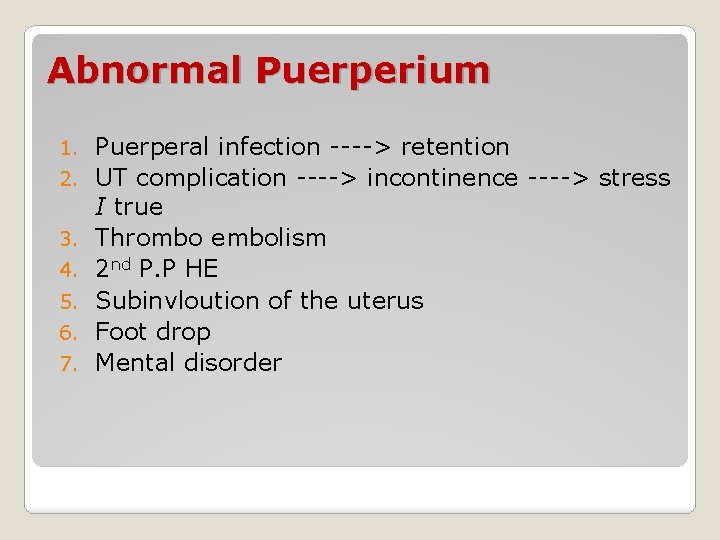
Abnormal Puerperium 1. 2. 3. 4. 5. 6. 7. Puerperal infection > retention UT complication > incontinence > stress I true Thrombo embolism 2 nd P. P HE Subinvloution of the uterus Foot drop Mental disorder
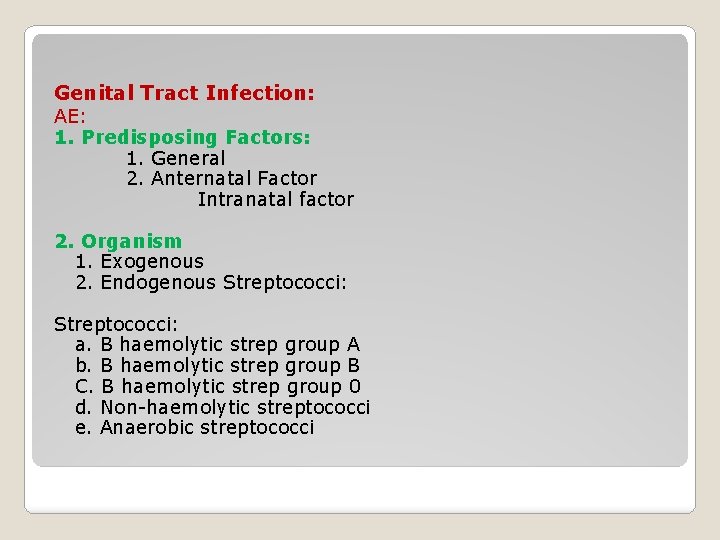
Genital Tract Infection: AE: 1. Predisposing Factors: 1. General 2. Anternatal Factor Intranatal factor 2. Organism 1. Exogenous 2. Endogenous Streptococci: a. B haemolytic strep group A b. B haemolytic strep group B C. B haemolytic strep group 0 d. Non haemolytic streptococci e. Anaerobic streptococci
Staph: Staph aureus Anaerobic staph Bacilli: G negative aerobic bacilli E coli, Klebsiella G negative anaerobic bacillus > bacteroids Gm positive anaerobic bacilli
ROUTE OF INFECTION: Primary Sites: placental site, wound and laceration, clots and pluc. tissue Secondary Sites: pelvic cellulitis, thrombophlebitis, pelvic peritonitis, generalized peritonitis, septicaemia, and septic shock COMPLICATIONS: Spread of infection Renal failure Death Secondary infertility Sheehan
CLINICAL PICTURE depends on site of infection INVESTIGATIONS: History Examination Special investigations
TREATMENT: Prophylaxis: Antenatal, intranatal case, postnatal Active Treatment: 1. General treatment 2. Medical treatment 3. TTT of complication > rest > diet > fluid > antipyretic > analgesics > antibiotics
Puerperal Pyrexia Definition: A rise of temperature above 3 So. C occurring in first 3 weeks of puerperium persistent at least 2 H hours on recurring within this period.
AE: Puerperal sepsis Breast infection Urinary infection Episiotomy infection Wound infection Other types of infection as respiratory infection, malaria, gluteal abscess, typhoid
INCIDENCE: Infection, haemorrhage, hypertension, disorder remain the most causes of death.
Primary Puerperal Sepsis Definition: Genital tract infection after delivery. It is the commonest cause for puerperal infection. The causative organism 1. Anaerobic streptococci 2. Group A haemolytic streptococci 3. Staphylococci causing suppurative and pus 4. E. coli and non haemolytic streptococci 5. Specific organism as cl. welchii and tetani
Mode of infection 1. Exogenous infection > attendant 2. Endogenous: organism already present in genital tract 3. Autogenous: organism transmitted to genital tract from other parts of body
SITES OF INFECTION A) Primary Sites: 1. The placental site 2. Laceration of cervix, vagina or perineum 3. Dead tissue retained in the uterus as placental remnant or blood clot B) Secondary Sites: > ext. from primary site 1. Parametritis 2. Salpingo oophoritis 3. Pelvic thrombophlebitis 4. Pelvic and generalized peritonitis C) Generalized Spread: Septicaemia or pyrexia
PREDISPOSING FACTORS 1. Introduction of bacteria 2. Anaemia 3. Prolonged or instrumental delivery PRM
PATHOLOGY 1. Uterus > Uterus puerperal endometritis localized type septic puerperal endometritis generalized type 2. Infected laceration > greenish yellowish 3. The parametrium . pelvic cellulitis from: direct lymphatic: cervix, vaginal vault 4. The tubes and ovaries > acute salpingo oophoritis 5. The peritoneum > through lymphatic by direct 6. Pelvic veins > pelvic thrombophlebitis
CLINICAL PICTURE I. Uterine Infection: a. In the mild type > onset 4 days after delivery b. In the severe type > onset 2 3 days or even one day after delivery, increased temperature and pulse, headache and malaria, UT tender, involuted and lochia scanty.
II. Infected Laceration: Mild pyrexia, local discomfort, tenderness, oedema and congestion III. Parametritis: At 10 days after delivery with increased temp and pulse, vague abdominal pain, backache, U/E = tender mass extending from UT to 1 st pelvic wall on one or both sides. * SOFTENING > parametric abscess
IV. Salpingo-oophoritis: Fever, rigor, vomiting, lower abdominal pain, tenderness at rigidity V. Peritonitis: a. Pelvic peritonitis > as complication of salpingitis b. Generalized peritonitis > rigor, fever, t pulse
VI. Septicaemia: > occurred about the third and fourth day after delivery secondary to UT infection VII. Thrombophlebitis: Secondary to UT infection 7 10 days after delivery
Investigation A. History Pre existing infection before labour TB, UTI Anaemia, toxaemia and diabetes Difficult labour on spontaneous Instrumental used or any complication Catheterization Onset of pyrexia Sore throat, busy mict. B. General Examination: 1. Pulse, temp, BP 2. Anaemia or jaundice 3. Tonsillitis 4. Breast, heart and chest 5. LL > thrombophlebitis
c. Abdominal Examination: 1. Tenderness in abdomen, int, loin 2. Rigidity 3. Height, fundus and any abdominal mass D. Vaginal Examination: 1. Lochia 2. Laceration 3. Bi manual examination size and mobility, uterus 4. Speculum examination to see cervix + vagina
E. Laboratory Investigations: 1. Swab from the upper vagina or cervix 2. Catheter specimen of urine for culture 3. Full blood picture Hb, RBCs and leucocytes 4. Widal test, x ray chest, blood film for malaria
PROPHYLAXIS PUERPERAL SEPSIS A. Antenatal: 1. Diet, vitamin + mineral 2. Treat disease as anaemia, toxaemia or diabetes 3. Treat vaginal discharge B. Intrapartum 1. Proper delivery 2. Strict asepsis > patient > instrument > attendant 3. In prophylactic, antibiotic c. Postnatal: 1. Aseptic precaution 2. Early isolation of suspected cases
TREATMENT OF SEPSIS I. General Treatment: 1. Isolation of patient 2. Light diet 3. Correct anaemia 4. Relieved pain by analgesics 5. Give mild laxative II. Antibiotic: 1. Vaginal swab and give correct antibiotic
III. Promotion of Drainage: 1. Sensitivity position 2. Ergometra 3. Removal of suture 4. Drainage of pelvic abscess 5. Gentle of any piece of placenta IV. General Peritonitis: 1. Heavy dose, antibiotic IV _ Ryle tube + IV fluid V. Septic Thrombophlebitis: 1. Antibiotics 2. Anticoagulant 3. Immobilization of limb
Postnatal Care AIMS: 1. Detection of any abnormality that from pregnancy and labour. 2. Follow up of complication in pregnancy. 3. Advice regarding breast feeding, diet, hygiene 4. Advice regarding contraception.
The Gynaecological Conditions Which May Be Found Are: 1. Perineal Laceration: Not repaired within 24 hours > need operation 3 6 months 2. Vesico-Vaginal Fistula: * Fix catheter for 10 15 h + antibiotic after 3 6 months > fistula may heal if small or may need operation
3. Prolapse + 8. 1. : * Pelvic floor exercises if condition persist > operation, 3 6 months. 4. RVF of uterus No symptoms > no treatment There is symptom > correct ut manually > insert Hodge pessaries 4 6 weeks 5. Cervical Erosion: * No treatment before 3 months * Persists cauterized 6. Sub-Involution Ergometrium + antibiotic
THE CAUSES OF SUB-INVOLUTION 1. Retained placental segment 2. Infection 3. RVF > congestion 4. Over distension of uterus as twins and hydramnios 5. Fibroid 6. Non suckling 7. Bad general condition and anaemia in case of antepartum and postpartum hemorrhage
- Slides: 30