
Abnormal Psychology What is a psychological disorder A
Abnormal Psychology
What is a psychological disorder? �A psychological disorder must meet 3 criteria: Psychological dysfunction within an individual Cause distress or impairment in functioning Have a response that is not typical or culturally expected

1. Psychological Dysfunction �Psychological dysfunction refers to a breakdown in the cognitive, emotional, or behavioral functioning of a person �Must know the context of the situation and the person �The line between normal and abnormal dysfunction can be difficult �Most disorders are on a continuum

2. Personal Distress �The behavior must cause extreme distress to the individual �However, distress and suffering is a part of human existence �Some disorders require a lack of distress to be diagnosed!
3. Atypical or Not Culturally Expected �Behavior may be abnormal because it deviates from the accepted average �However, many artists deviate from the average! �Behavior may be abnormal if it violates social norms, but it depends how your society defines normal. Different cultures believe in different things. �Behavior may be abnormal if it is out of the person’s control.
Accepted Definition �A psychological dysfunction is behavioral, emotional, or cognitive dysfunctions that are unexpected in their cultural context and associated with personal distress or substantial impairment in functioning.
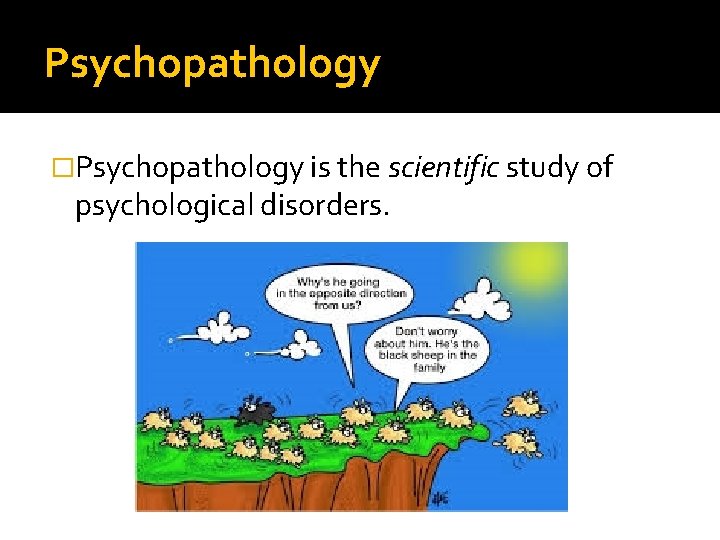
Psychopathology �Psychopathology is the scientific study of psychological disorders.
Question �Three weeks ago, Jane, a 35 -year-old business executive, stopped showering, refused to leave her apartment, and started watching television talk shows. Threats of being fired have failed to bring Jane back to reality, and she continues to spend her days staring blankly at the television screen. Which of the 3 definitions of abnormality apply to Jane’s situation?
Question �Miguel recently began feeling sad and lonely. Although still able to function at work and fulfill other responsibilities, he finds himself feeling down much of the time and he worries about what is happening to him. Which of the 3 definitions of abnormality apply to him?
Psychopathology �Requires several professionals: Clinical psychologists Counselling psychologists Psychiatric social workers Psychiatric nurses Marriage and family therapists Mental health practioners
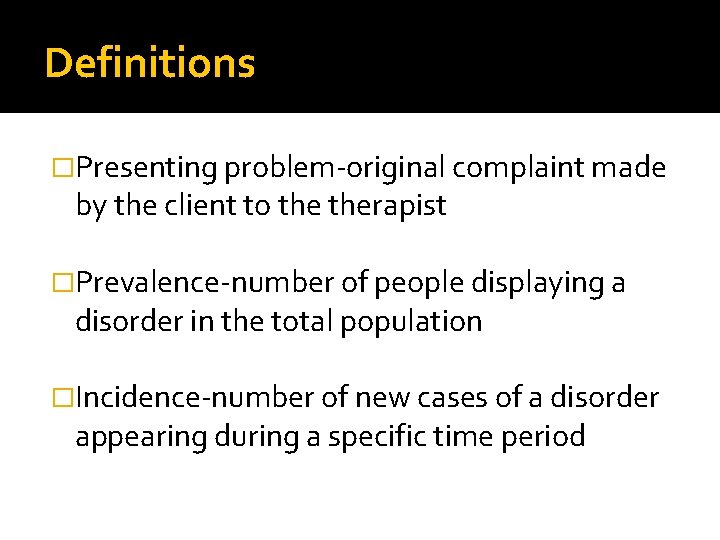
Definitions �Presenting problem-original complaint made by the client to therapist �Prevalence-number of people displaying a disorder in the total population �Incidence-number of new cases of a disorder appearing during a specific time period
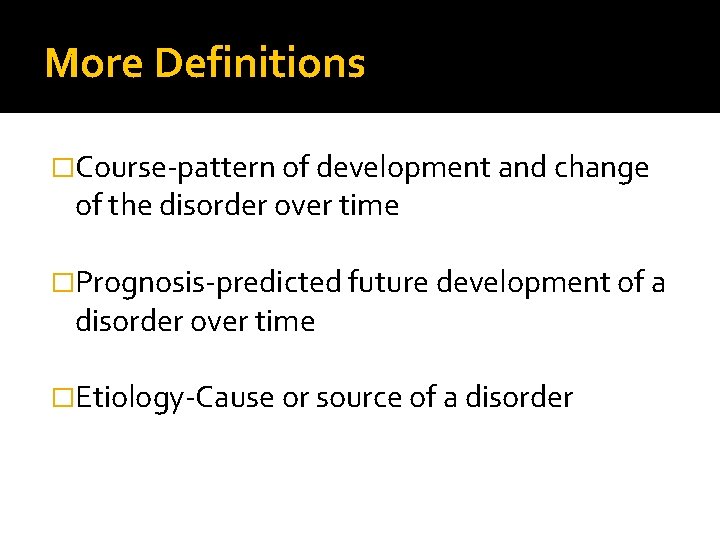
More Definitions �Course-pattern of development and change of the disorder over time �Prognosis-predicted future development of a disorder over time �Etiology-Cause or source of a disorder
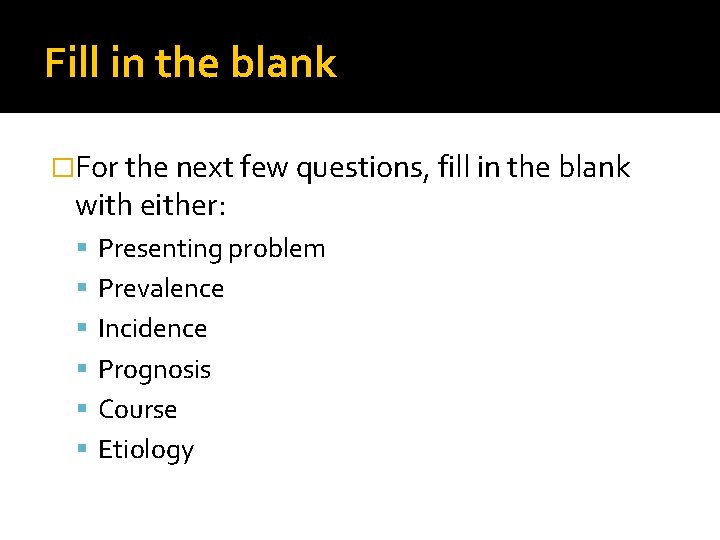
Fill in the blank �For the next few questions, fill in the blank with either: Presenting problem Prevalence Incidence Prognosis Course Etiology
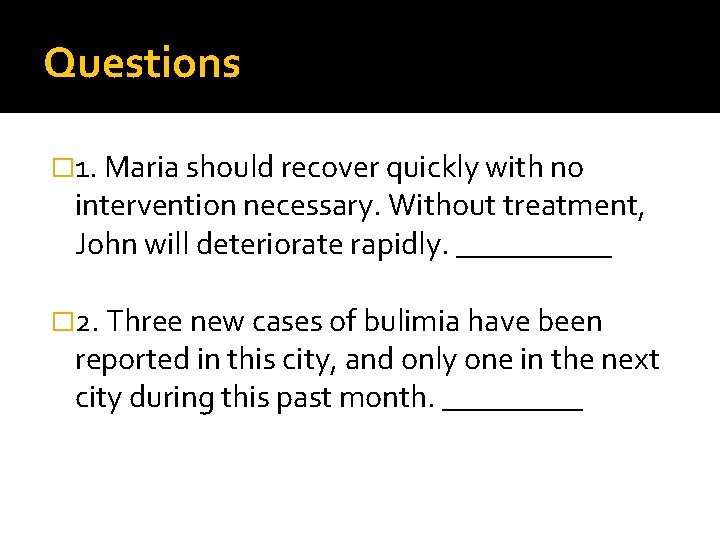
Questions � 1. Maria should recover quickly with no intervention necessary. Without treatment, John will deteriorate rapidly. _____ � 2. Three new cases of bulimia have been reported in this city, and only one in the next city during this past month. _____
Questions � 3. Elizabeth visited the campus mental health center because of her increasing feelings of guilt and anxiety. ______ � 4. Biological, psychological, and social influences all contribute to a variety of disorders. ______
Questions � 5. The pattern a disorder follows can be chronic, time limited, or episodic. _____ �On a side note, what is the difference between chronic and episodic? � 6. How many people in the population as a whole suffer from OCD? _____
Next class. . . � PSYCHOPATHOLOGY IN HISTORICAL CONTEXT Throughout history, many societies have held quite different views of the problems that we consider to be mental disorders. The search for explanations of the causes of abnormal behavior dates to ancient times, as do conflicting opinions about the etiology of mental disorders. Ancient records attribute abnormal behaviour to the disfavor of the gods or the mischief of demons. Models for Studying Psychopathology 1. Supernatural Model 2. Biological Model 3. The Psychological Model What purpose do these Models serve? These models try to explain the cause of individual abnormal behavior. Each model represents its own individual interpretation of psychopathology and recommends its individual treatment procedures.

Homework �Read 1 of the 3 historical models for psychopathology Supernatural (blue chip) Biological (red chip) Psychological (white chip) �This article will be a word document posted under Abnormal Psychology Class Summary tab at www. aberdeenhallcunningham. weebly. com
- Slides: 18