
Abnormal Psychology Fourteenth Edition Ann M Kring Sheri
Abnormal Psychology Fourteenth Edition Ann M. Kring & Sheri L. Johnson Chapter 1 Introduction and Historical Review
Chapter Outline • • • Psychological Disorders and Stigmas Defining Psychological Disorder History of Psychopathology The Evolution of Contemporary Thought The Mental Health Professions Copyright © 2018 John Wiley & Sons, Inc. 2
Defining Stigma • Psychology o The field concerned with the nature, development, and treatment of psychological disorders • Stigma Destructive beliefs and attitudes held by a society that are ascribed to groups considered different in some way o Psychological disorders remain the most stigmatized condition in the 21 st century o Copyright © 2018 John Wiley & Sons, Inc. 3
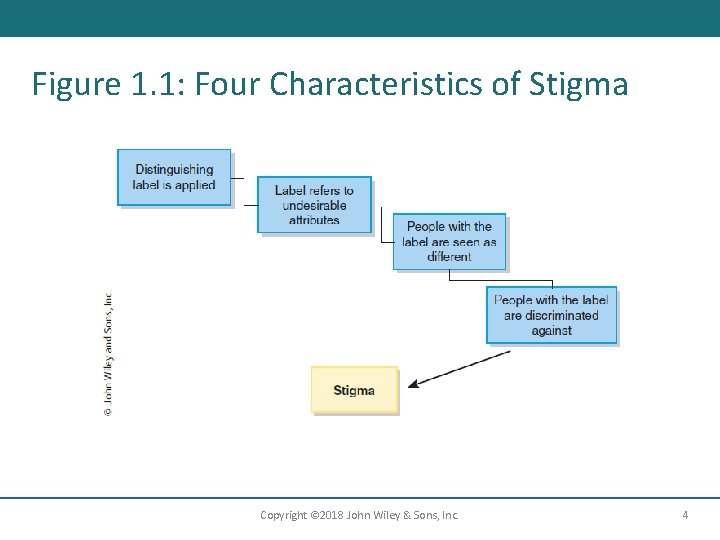
Figure 1. 1: Four Characteristics of Stigma Copyright © 2018 John Wiley & Sons, Inc. 4
Ending Stigma • People’s knowledge has increased, but stigma has not decreased • Social Media o Websites and blogs serve as a medium to share personal stories, raise awareness, and increase social connectedness • Public figures speaking about their experiences with mental illness may help to reduce stigma Copyright © 2018 John Wiley & Sons, Inc. 5
Defining Psychological Disorders: DSM-5 • The disorder occurs within the individual • It involves clinically significant difficulties in thinking, feeling, or behaving • It usually involves personal distress of some sort • It involves dysfunction in psychological, developmental, and/or neurobiological processes that support mental functioning • It is not a culturally specific reaction to an event • It is not primarily a result of social deviance or conflict with society Copyright © 2018 John Wiley & Sons, Inc. 6
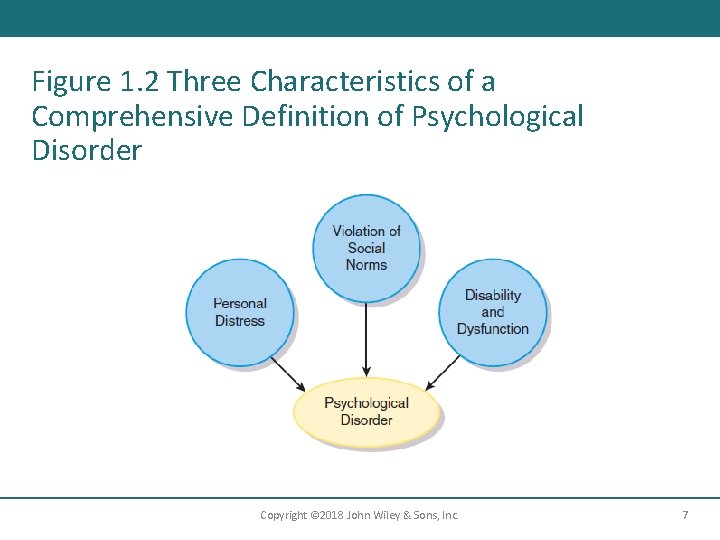
Figure 1. 2 Three Characteristics of a Comprehensive Definition of Psychological Disorder Copyright © 2018 John Wiley & Sons, Inc. 7
Personal Distress • A person’s behavior causes significant distress o Examples of distress: • Difficulty paying attention • Emotional pain and suffering • Not all psychological disorders cause distress o E. g. , Antisocial personality disorder • An individual may violate the law without guilt, remorse, or anxiety • Not all behaviors that causes distress are disordered o E. g. , Distress of hunger due to religious fasting Copyright © 2018 John Wiley & Sons, Inc. 8
Disability and Dysfunction • Disability o Impairment in an important area (e. g. , work, relationships) o o Not all psychological disorders involve disability Not all disabilities are considered to be psychological disorders • Chronic substance abuse resulting in job loss • Rejection by peers due to social anxiety • Dysfunction Developmental, psychological, and/or biological systems are not working as they should (impairment) o These systems are interrelated o Copyright © 2018 John Wiley & Sons, Inc. 9
Violation of Social Norms • Social norms are widely held standards o o Beliefs and attitudes used to make judgments about behaviors Behaviors that violate social norms may be classified as disordered • Repetitive rituals performed by people with obsessivecompulsive disorder • Talking to nonexistent voices that some people with schizophrenia experience • Too broad and too narrow of a definition o o Criminals violate social norms (too broad) Highly anxious people typically do not violate social norms (too narrow) • Social norms vary across cultures and ethnic groups Copyright © 2018 John Wiley & Sons, Inc. 10
History of Psychopathology • Supernatural explanations o Displeasure of the gods or possession by demons • Treatment: Exorcism—Ritualistic casting out of evil spirits • Early biological explanations: Hippocrates (5 th Century BC) Mental disturbances have natural causes (brain pathology) o Three categories of mental disorders: o • Mania, melancholia, & phrenitis (brain fever) o Healthy brain functioning depended on balance of four humors: • Blood, black bile, yellow bile, & phlegm o Treatment: Physicians restored natural balance (e. g. , tranquility, sobriety, care in choosing food) Copyright © 2018 John Wiley & Sons, Inc. 11
Dark Ages • Dark Ages (2 nd century AD) o Christian monasteries replaced physicians as healers • Return to the belief of supernatural causes • Treatments: Cared and prayed for by monks o Touched with relics o Drank potions in the waning phase of the moon o Copyright © 2018 John Wiley & Sons, Inc. 12
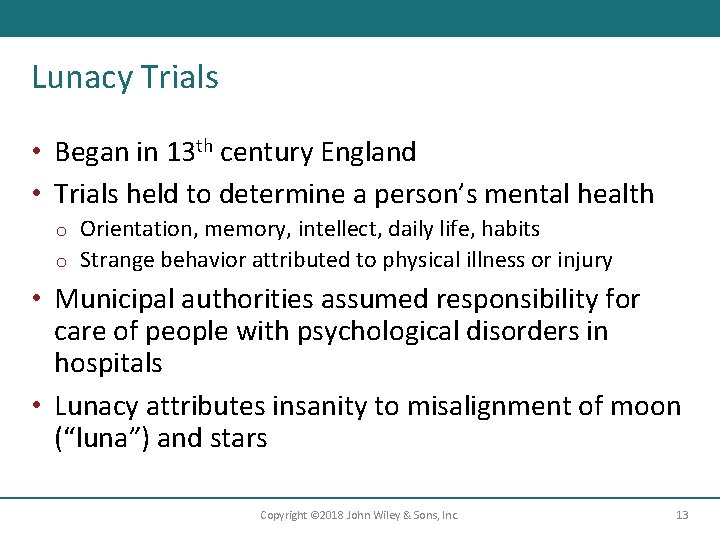
Lunacy Trials • Began in 13 th century England • Trials held to determine a person’s mental health Orientation, memory, intellect, daily life, habits o Strange behavior attributed to physical illness or injury o • Municipal authorities assumed responsibility for care of people with psychological disorders in hospitals • Lunacy attributes insanity to misalignment of moon (“luna”) and stars Copyright © 2018 John Wiley & Sons, Inc. 13
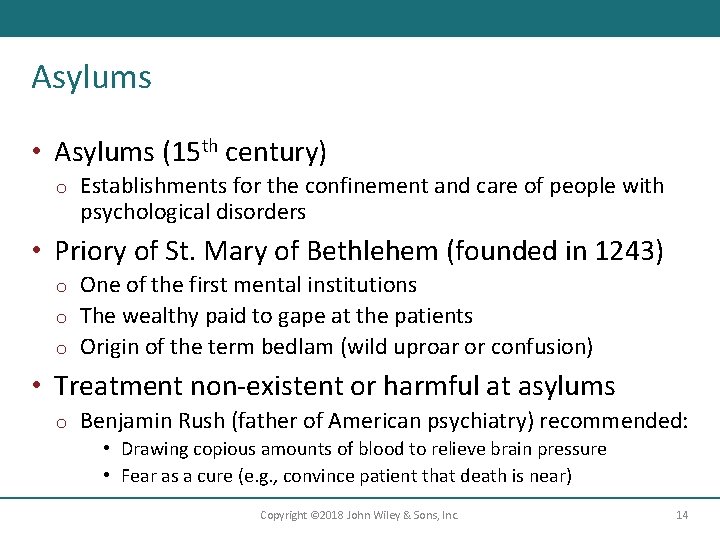
Asylums • Asylums (15 th century) o Establishments for the confinement and care of people with psychological disorders • Priory of St. Mary of Bethlehem (founded in 1243) One of the first mental institutions o The wealthy paid to gape at the patients o Origin of the term bedlam (wild uproar or confusion) o • Treatment non-existent or harmful at asylums o Benjamin Rush (father of American psychiatry) recommended: • Drawing copious amounts of blood to relieve brain pressure • Fear as a cure (e. g. , convince patient that death is near) Copyright © 2018 John Wiley & Sons, Inc. 14
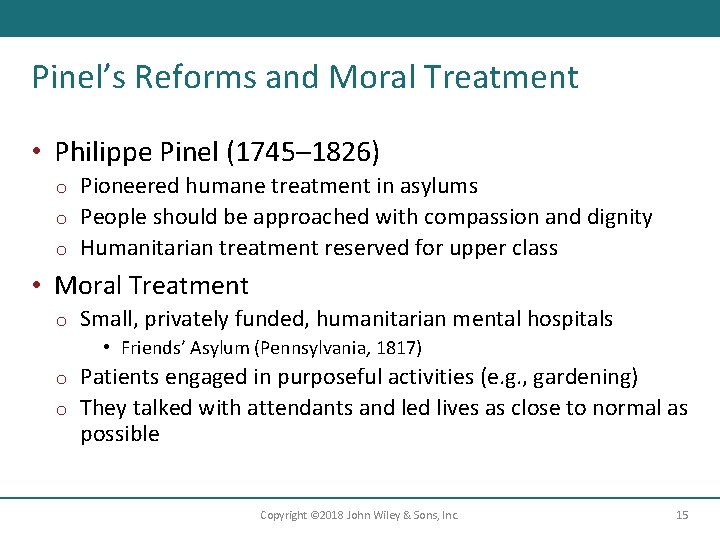
Pinel’s Reforms and Moral Treatment • Philippe Pinel (1745– 1826) Pioneered humane treatment in asylums o People should be approached with compassion and dignity o Humanitarian treatment reserved for upper class o • Moral Treatment o Small, privately funded, humanitarian mental hospitals • Friends’ Asylum (Pennsylvania, 1817) Patients engaged in purposeful activities (e. g. , gardening) o They talked with attendants and led lives as close to normal as possible o Copyright © 2018 John Wiley & Sons, Inc. 15
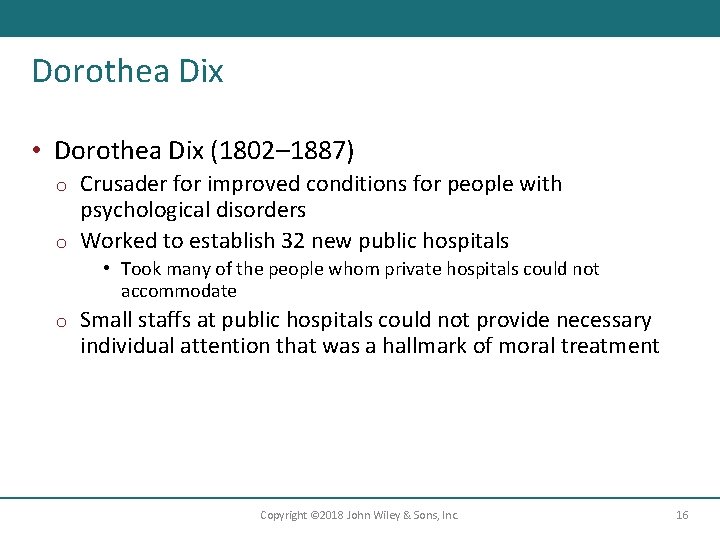
Dorothea Dix • Dorothea Dix (1802– 1887) Crusader for improved conditions for people with psychological disorders o Worked to establish 32 new public hospitals o • Took many of the people whom private hospitals could not accommodate o Small staffs at public hospitals could not provide necessary individual attention that was a hallmark of moral treatment Copyright © 2018 John Wiley & Sons, Inc. 16
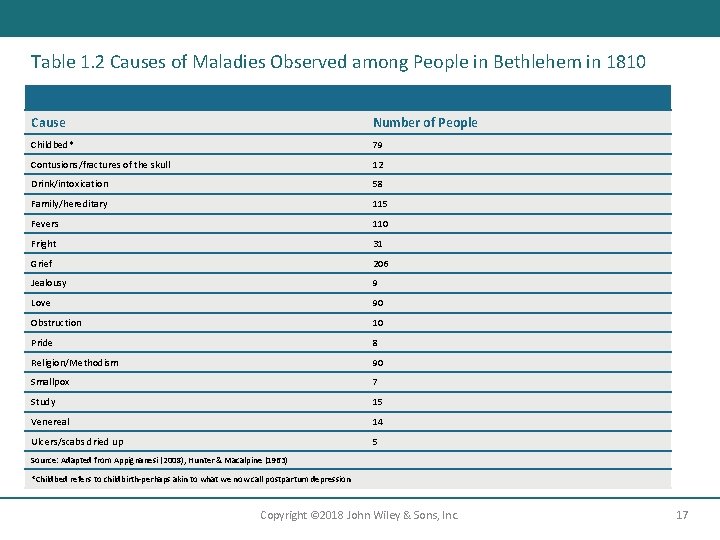
Table 1. 2 Causes of Maladies Observed among People in Bethlehem in 1810 Cause Number of People Childbed* 79 Contusions/fractures of the skull 12 Drink/intoxication 58 Family/hereditary 115 Fevers 110 Fright 31 Grief 206 Jealousy 9 Love 90 Obstruction 10 Pride 8 Religion/Methodism 90 Smallpox 7 Study 15 Venereal 14 Ulcers/scabs dried up 5 Source: Adapted from Appignanesi (2008), Hunter & Macalpine (1963) *Childbed refers to childbirth-perhaps akin to what we now call postpartum depression Copyright © 2018 John Wiley & Sons, Inc. 17
Biological Origins • General paresis and syphilis Deterioration of mental and physical abilities, and progressive paralysis (general paresis) o Some people with general paresis also had syphilis o In 1905, biological cause of syphilis found: o • Causal link between infection, damage to the brain, and psychopathology o Biological causes of psychopathology gained credibility Copyright © 2018 John Wiley & Sons, Inc. 18
Genetics • Galton’s (1822– 1911) Originator of genetic research with twins o Work lead to notion that mental illness can be inherited o Nature (genetics) and nurture (environment) o Eugenics o • Promotion of enforced sterilization to eliminate undesirable characteristics from the population • Many state laws required people with psychological disorders to be sterilized Copyright © 2018 John Wiley & Sons, Inc. 19
Biological Treatments • Insulin-coma therapy o Sakel (1930 s) • Electroconvulsive therapy (ECT) Cerletti and Bini (1938) o Induce epileptic seizures with electric shock o • Prefrontal lobotomy o Moniz (1935) o Destroys tracts connecting frontal lobes to other areas of brain Often used to control violent behaviors o Led to listlessness, apathy, and loss of cognitive abilities o Copyright © 2018 John Wiley & Sons, Inc. 20
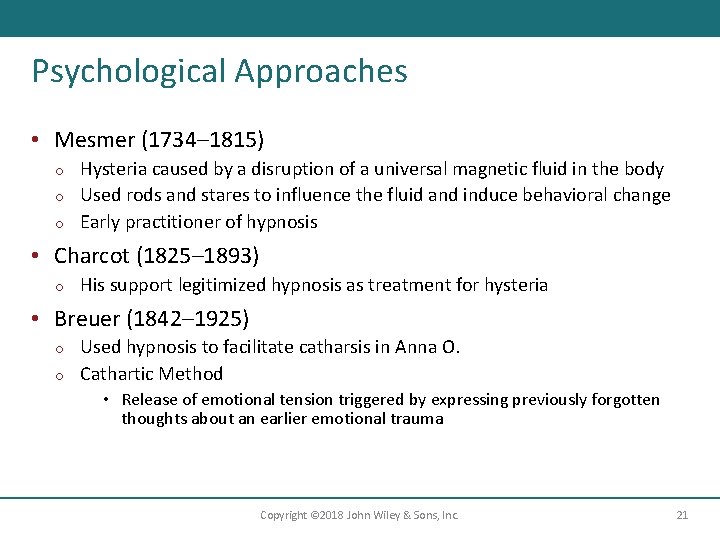
Psychological Approaches • Mesmer (1734– 1815) Hysteria caused by a disruption of a universal magnetic fluid in the body o Used rods and stares to influence the fluid and induce behavioral change o Early practitioner of hypnosis o • Charcot (1825– 1893) o His support legitimized hypnosis as treatment for hysteria • Breuer (1842– 1925) Used hypnosis to facilitate catharsis in Anna O. o Cathartic Method o • Release of emotional tension triggered by expressing previously forgotten thoughts about an earlier emotional trauma Copyright © 2018 John Wiley & Sons, Inc. 21
Freud • Psychoanalytic theory Psychopathology results from unconscious conflicts o Mind is divided into three principle parts: Id, ego, superego o Id, ego, and superego continually in conflict • Conflict generates anxiety o Defense mechanism o • Strategy used by ego to protect itself from anxiety Copyright © 2018 John Wiley & Sons, Inc. 22
Freuds Structures of the Mind • Id o o Present at birth Biological and unconscious Seeks Immediate gratification When id is not satisfied, tension is produced and id drives a person to get rid of tension (e. g. , eat when hungry) • Ego o o Primarily conscious Mediates between demands of reality and id’s demands for immediate gratification • Superego o o A person’s conscience Develops as we incorporate parental and society values Copyright © 2018 John Wiley & Sons, Inc. 23
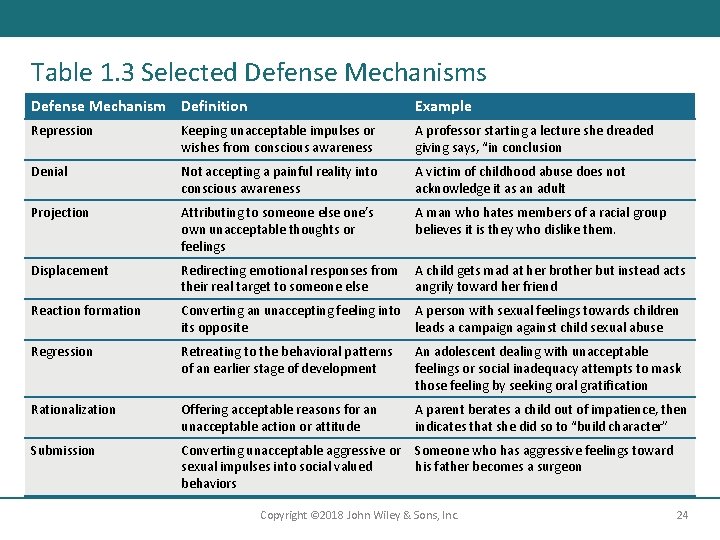
Table 1. 3 Selected Defense Mechanisms Defense Mechanism Definition Example Repression Keeping unacceptable impulses or wishes from conscious awareness A professor starting a lecture she dreaded giving says, “in conclusion Denial Not accepting a painful reality into conscious awareness A victim of childhood abuse does not acknowledge it as an adult Projection Attributing to someone else one’s own unacceptable thoughts or feelings A man who hates members of a racial group believes it is they who dislike them. Displacement Redirecting emotional responses from their real target to someone else A child gets mad at her brother but instead acts angrily toward her friend Reaction formation Converting an unaccepting feeling into its opposite A person with sexual feelings towards children leads a campaign against child sexual abuse Regression Retreating to the behavioral patterns of an earlier stage of development An adolescent dealing with unacceptable feelings or social inadequacy attempts to mask those feeling by seeking oral gratification Rationalization Offering acceptable reasons for an unacceptable action or attitude A parent berates a child out of impatience, then indicates that she did so to “build character” Submission Converting unacceptable aggressive or sexual impulses into social valued behaviors Someone who has aggressive feelings toward his father becomes a surgeon Copyright © 2018 John Wiley & Sons, Inc. 24
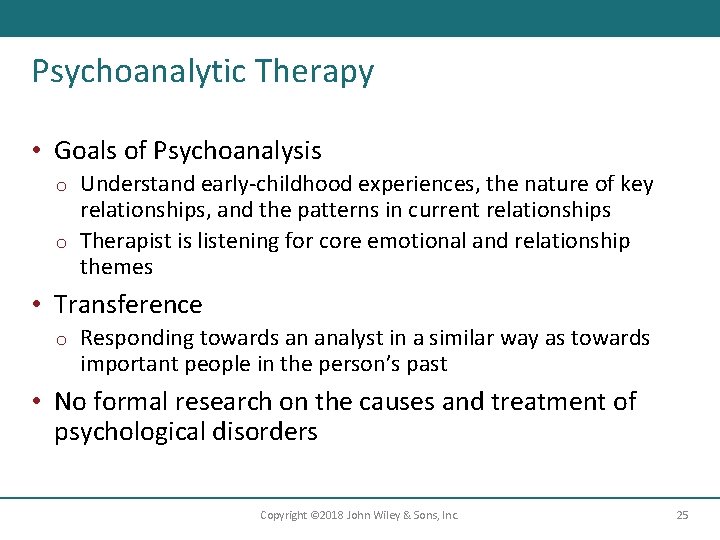
Psychoanalytic Therapy • Goals of Psychoanalysis Understand early-childhood experiences, the nature of key relationships, and the patterns in current relationships o Therapist is listening for core emotional and relationship themes o • Transference o Responding towards an analyst in a similar way as towards important people in the person’s past • No formal research on the causes and treatment of psychological disorders Copyright © 2018 John Wiley & Sons, Inc. 25
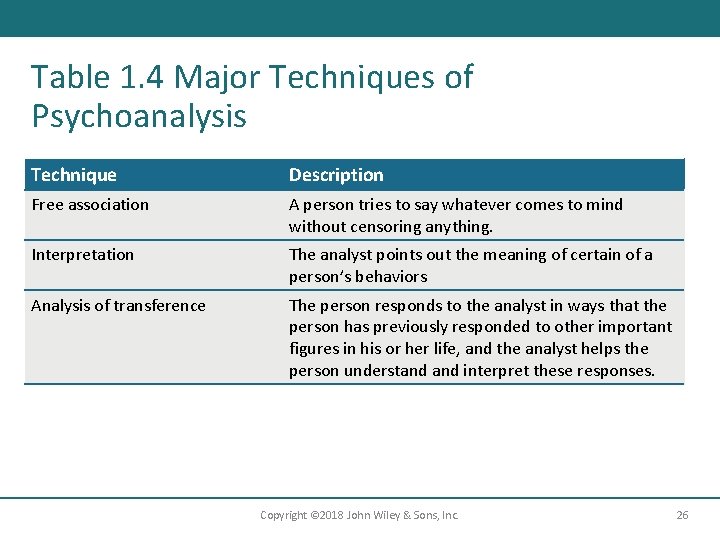
Table 1. 4 Major Techniques of Psychoanalysis Technique Description Free association A person tries to say whatever comes to mind without censoring anything. Interpretation The analyst points out the meaning of certain of a person’s behaviors Analysis of transference The person responds to the analyst in ways that the person has previously responded to other important figures in his or her life, and the analyst helps the person understand interpret these responses. Copyright © 2018 John Wiley & Sons, Inc. 26
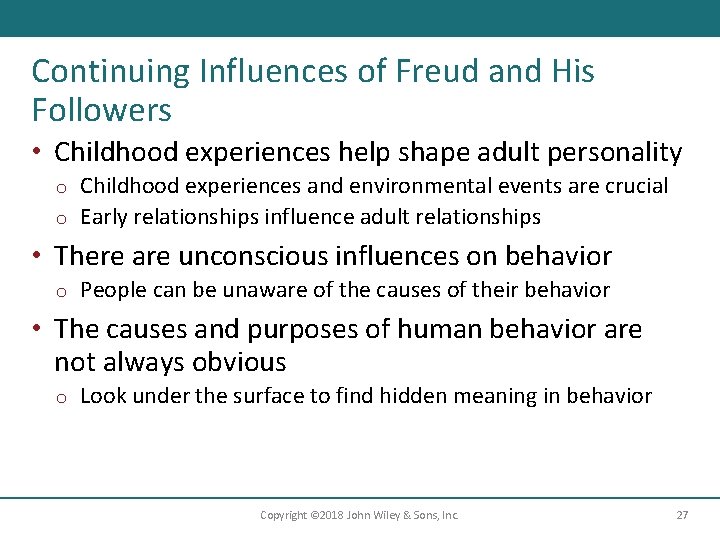
Continuing Influences of Freud and His Followers • Childhood experiences help shape adult personality Childhood experiences and environmental events are crucial o Early relationships influence adult relationships o • There are unconscious influences on behavior o People can be unaware of the causes of their behavior • The causes and purposes of human behavior are not always obvious o Look under the surface to find hidden meaning in behavior Copyright © 2018 John Wiley & Sons, Inc. 27
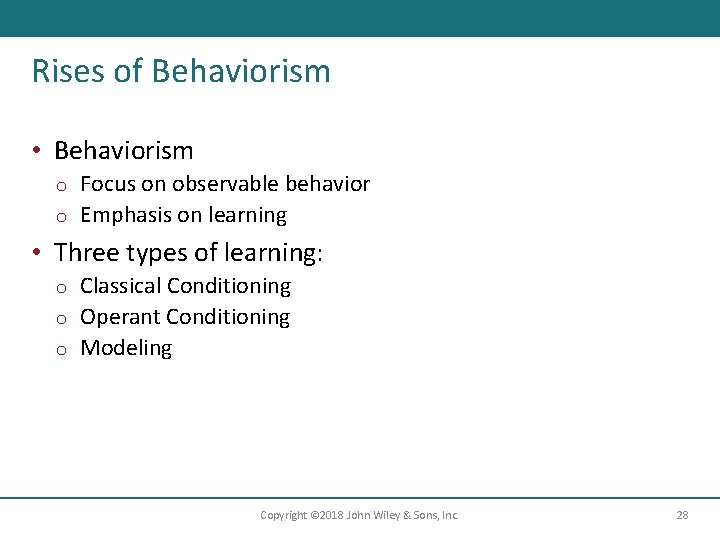
Rises of Behaviorism • Behaviorism Focus on observable behavior o Emphasis on learning o • Three types of learning: Classical Conditioning o Operant Conditioning o Modeling o Copyright © 2018 John Wiley & Sons, Inc. 28
Classical Conditioning (1 of 2) • Pavlov (1849– 1936) • Unconditioned Stimulus (UCS) o Meat powder (automatically elicits salivation) • Unconditioned Response (UCR) o Salivation (automatic response to meat powder) • Meat powder (UCS) is preceded several times by a neutral stimulus o Ringing of bell (does not automatically elicit salivation) Copyright © 2018 John Wiley & Sons, Inc. 29
Classical Conditioning (2 of 2) • After pairing the ringing of the bell and the UCS, the bell now automatically elicits salivation • Conditioned Stimulus (CS) o Ringing of the bell • Conditioned Response (CR) o Salivation (automatic response to bell) • Extinction o CS (bell) not followed by UCS (meat powder) causes gradual disappearance of CR (salivation) Copyright © 2018 John Wiley & Sons, Inc. 30
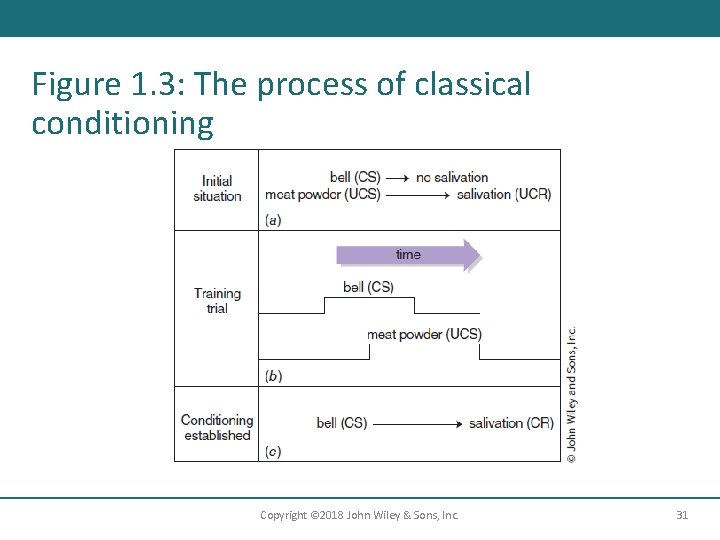
Figure 1. 3: The process of classical conditioning Copyright © 2018 John Wiley & Sons, Inc. 31
Additional Classical Conditioning Example • Watson & Rayner (1920) o Little Albert and the white rat experiment • UCS – Loud Noise • UCR – Fear o When little Albert reached for the white rat, the experimenter made a loud noise • CS – White rat • CR – Fear at sight of white rat • Suggests a relationship between classical conditioning and development of phobia Copyright © 2018 John Wiley & Sons, Inc. 32
Operant Conditioning • E. Thorndike (1874– 1949) Learning through consequences o Law of Effect o • Behavior that is followed by satisfying consequences will be repeated; behavior that is followed by unpleasant consequences will be discouraged • B. F. Skinner (1904– 1990) o Principle of Reinforcement • Positive reinforcement • Presentation of a pleasant event strengthens a response • Negative reinforcement • Removal of an aversive event strengthens a response Copyright © 2018 John Wiley & Sons, Inc. 33
Modeling • Learning by watching and imitating others’ behaviors o Can occur without reinforcement • Modeling can increase or decrease diverse kinds of behavior o Sharing, aggression, fear, etc. • Bandura & Menlove (1968) o Modeling reduced children’s fear of dogs Copyright © 2018 John Wiley & Sons, Inc. 34
Behavior Therapy • Systematic Desensitization Used to treat phobias and anxiety o Combines deep muscle relaxation and gradual exposure to the feared condition or object o Starts with minimal anxiety producing condition and gradually progresses to most feared o • Intermittent Reinforcement o Rewarding a behavior only occasionally is more effective than continuous schedules of reinforcement Copyright © 2018 John Wiley & Sons, Inc. 35
Importance of Cognition • How we think, or appraise, a situation influences our feelings and behaviors • Cognitive Therapy How people construe themselves and the world is a major determinant of psychological disorders o Focus on becoming more aware of maladaptive thoughts o Changing cognitions to change feelings, behaviors, symptoms o • Beck’s Cognitive Therapy • Ellis’ Rational-Emotive Behavior Therapy Self-statements reflect unspoken assumptions (irrational beliefs) o Eliminate self-defeating beliefs o Copyright © 2018 John Wiley & Sons, Inc. 36
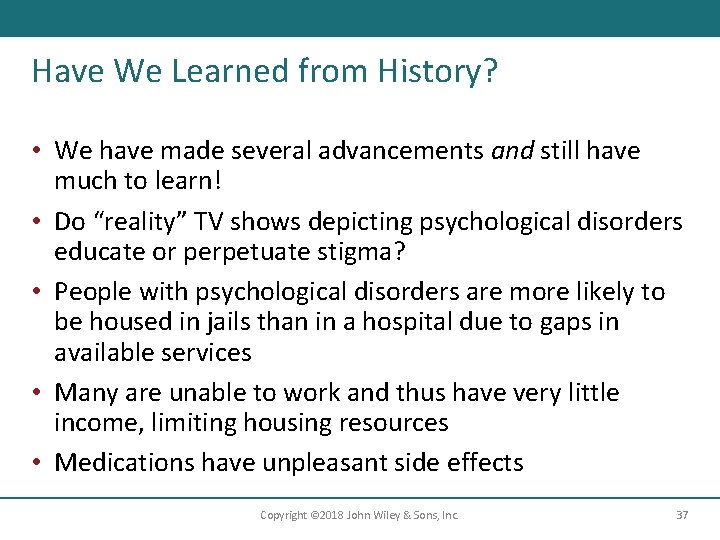
Have We Learned from History? • We have made several advancements and still have much to learn! • Do “reality” TV shows depicting psychological disorders educate or perpetuate stigma? • People with psychological disorders are more likely to be housed in jails than in a hospital due to gaps in available services • Many are unable to work and thus have very little income, limiting housing resources • Medications have unpleasant side effects Copyright © 2018 John Wiley & Sons, Inc. 37
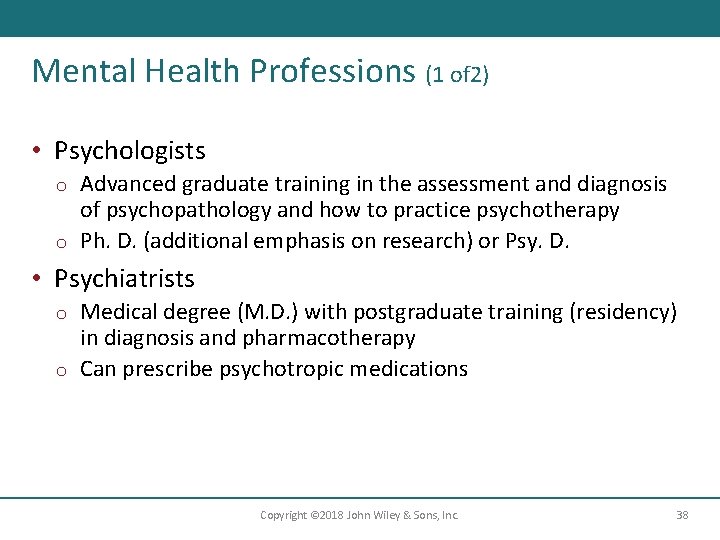
Mental Health Professions (1 of 2) • Psychologists Advanced graduate training in the assessment and diagnosis of psychopathology and how to practice psychotherapy o Ph. D. (additional emphasis on research) or Psy. D. o • Psychiatrists Medical degree (M. D. ) with postgraduate training (residency) in diagnosis and pharmacotherapy o Can prescribe psychotropic medications o Copyright © 2018 John Wiley & Sons, Inc. 38
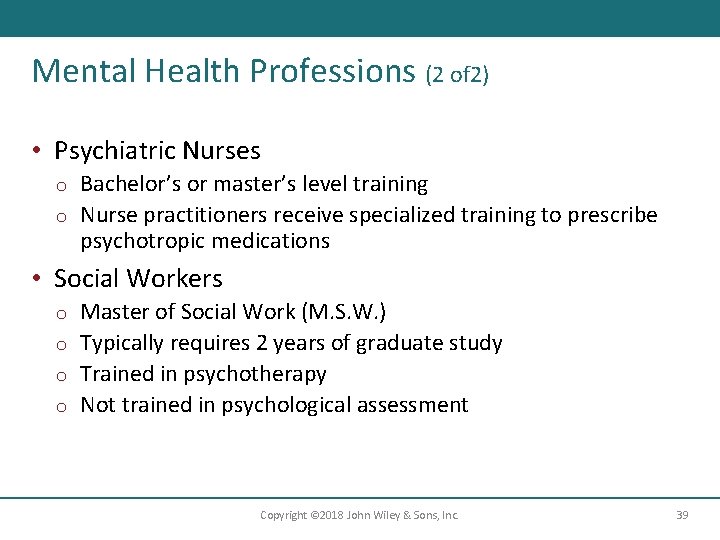
Mental Health Professions (2 of 2) • Psychiatric Nurses Bachelor’s or master’s level training o Nurse practitioners receive specialized training to prescribe psychotropic medications o • Social Workers Master of Social Work (M. S. W. ) o Typically requires 2 years of graduate study o Trained in psychotherapy o Not trained in psychological assessment o Copyright © 2018 John Wiley & Sons, Inc. 39
Copyright © 2018 John Wiley & Sons, Inc. All rights reserved. Reproduction or translation of this work beyond that permitted in Section 117 of the 1976 United States Act without the express written permission of the copyright owner is unlawful. Request for further information should be addressed to the Permissions Department, John Wiley & Sons, Inc. The purchaser may make back-up copies for his/her own use only and not for distribution or resale. The Publisher assumes no responsibility for errors, omissions, or damages, caused by the use of these programs or from the use of the information contained herein. Copyright © 2018 John Wiley & Sons, Inc. 40
- Slides: 40