
Abnormal behavior Introduction to Psychological Disorders Defining psychological

Abnormal behavior
Introduction to Psychological Disorders

Defining psychological disorders – Psychological disorder: syndrome marked by a clinically significant disturbance in an individual’s cognition, emotion regulation, or behavior. – Disturbed or dysfunctional , behaviors are maladaptive (they interfere with normal, day to day life) – Definitions for disturbances have varied throughout the years – Homosexuality (December 10, 1973)
Understanding psychological disorders – Olden days…THE DEVIL, caged within bars like animals, “therapies”, beating, burning, castration, pulling teeth, removing lengths of intestines, cauterizing the clitoris, or giving transfusions of animal blood
The medical model – Reformers: Philippe Pinel – Madness is not a demon possession but a sickness of the mind caused by severe stresses and inhumane conditions – “moral treatment”… unchaining people, talking to them, activity, clean air and sunshine – Medical Model- concept that diseases, in this case psychological disorders, have physical causes that can be diagnosed, treated, and in most cases, cured, often through treatment in a hospital
Bio-psychosocial approach – All behavior, normal and disordered, arises from the interaction of nature (genetic and physiological factors) and nurture (past and present experiences) – Sickness, but also environmental factors (person’s current interpretation of event, or the person’s bad habits and social skills may also be factors
Cultural disorders – Cultures differ in their levels and produce different methods of coping – Anorexia and bulimia have occurred mainly in Western culture – Amok- Malaysia- a sudden outburst of behavior – Susto- Latin America- a condition marked by severe anxiety, restlessness, and a fear of black magic – Taijin-kyofusho- Japan- social anxiety about one’s appearance combined with a readiness to blush and a fear of contact – Koro- fear of penis shrinkage and retraction into the body, accompanied by panic and fear of dying – **Beserker- (Norse) blindly flying into a rage
Hikikimori – phenomenon of reclusive adolescents or adults who withdraw from social life, often seeking extreme degrees of isolation and confinement. – Isolation for a period exceeding 6 months – https: //www. youtube. com/watch? v=dr 5 y 1 i. P 9 Tf. U
Biological Influences: evolution, individual genes, brain structure, and chemistry Psychological Influences: stress, trauma, learned helplessness, moodrelated perceptions and memories Social-Cultural influences: roles, expectations, definitions of normality and disorder
Classifying Psychological Disorders – DSM-5 - the American Psychiatric Association’s Diagnostic and Statistical Manual of Mental Disorders (Fifth Edition) –widely used for classifying psychological disorders – Diagnostic classification aims not only to describe a disorder but also to predict its future course, imply appropriate treatment, and stimulate research into its causes

Labeling psychological disorders – Labels create perceptions that guide our perceptions and our interpretations – David Rosenhan (1973) biasing power of labels – https: //www. youtube. com/watch? v=j 6 bm. Z 8 c. VB 4 o Langer- interviews Page- stigmatizing power of labels (jobs, rent, etc) People express greater sympathy for people who have disorders that are atypical (depression for men/alcoholism for women)
Rates of Psychological disorders – U. S. National Institute of Mental Health estimates that 26% of adult Americans suffer from a diagnosable mental disorder – Highest mental disorder om 20 countries – US comes out on top – Immigrants to the US average better mental health than non-immigrants – (immigrant paradox)
Anxiety disorders, obsessive -compulsive disorder, and post-traumatic stress disorder (that’s a mouthful)
Anxiety disorders – Psychological disorders characterized by distressing, persistent anxiety or maladaptive behaviors that reduce anxiety – Generalized anxiety disorder – Panic disorder – Phobias
Generalized anxiety disorder – An anxiety disorder in which a person is continually tense, apprehensive, and in a state of autonomic nervous system arousal – Marked by pathological worry – Lasts more than 6 months – 2/3 are women – Jittery, sleep deprived, twitching, trembling, perspiration, fidgeting, and concentration issues – Difficult to pinpoint a source of its cause – Often accompanied by depressed mood, even high blood pressure
Panic disorder – Like an anxiety tornado- panic strikes suddenly, wrecks havoc, and disappears – 1/75 people – Panic-attacks- minutes-long episode of intense fear that something horrible is about to happen. Heart palpitations, shortness of breath, choking sensations, trembling, or dizziness typically accompany the panic
Phobias – Anxiety disorders in which an irrational fear causes the person to avoid some object, activity, or situation (some can manage, others are incapacitated) – Specific phobias (bugs, alligators, dogs, blood, heights, enclosed spaces) – (classical conditioning)
Social anxiety disorder – Shyness to an extreme – Intense fear of social situations, leading to the avoidance of such (formerly social phobia) – Intense fear of being scrutinized by others, avoid things like speaking up and parties
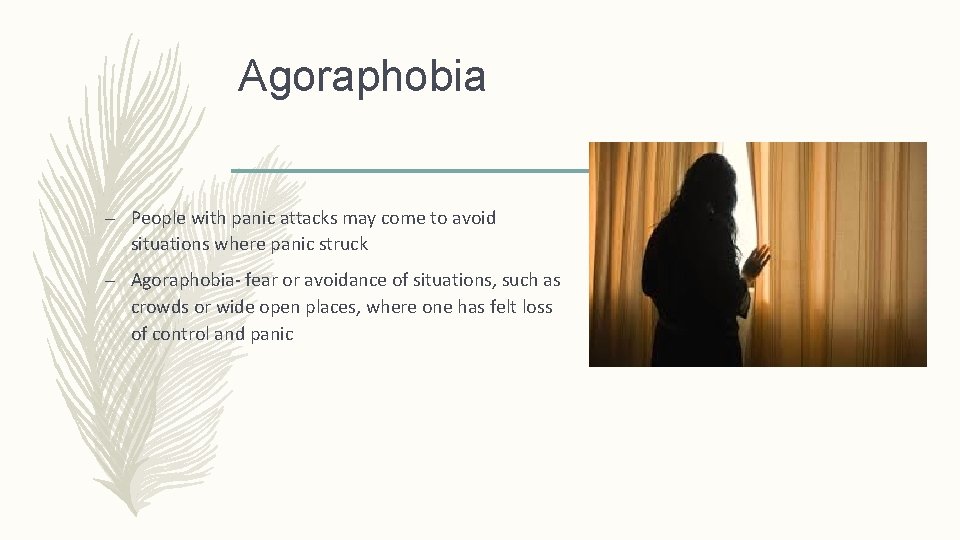
Agoraphobia – People with panic attacks may come to avoid situations where panic struck – Agoraphobia- fear or avoidance of situations, such as crowds or wide open places, where one has felt loss of control and panic
- Slides: 20