
Abnormal and Deviant Behavior Nicole Duranceaux Ph D
Abnormal and Deviant Behavior Nicole Duranceaux, Ph. D. Albuquerque Police Department Behavioral Sciences Division (505) 764 -1600 Cell: (505) 417 -6407 nebberhart@yahoo. com 1
Law Enforcement Involvement You see abnormal & deviant individuals regularly n Thus, it is important to understand: n n n Types Reasons 2

What is Abnormal Behavior? n n ‘Away from the norm’ Deviation from social norms n n n Culture Time Period Context Status ‘Abnormal’ does not necessarily mean ‘bad, ’ undesirable, or harmful 3
Elements of Abnormal Behavior Suffering Key is context n People who are abnormal may not suffer: Personality Disorder n People who are suffering may not be abnormal: Grief n 4
Elements of Abnormal Behavior Maladaptiveness n Adaptation n n Change in behavior or capabilities in response to new/changing environment Normal Failure to adapt is likely abnormal n Impairs well-being of the person or society n 5

Elements of Abnormal Behavior n n Irrationality & Incomprehensibility Behavior that seems illogical, irrational, incomprehensible For example n n Bulimia Phobias Repetitive behavior Thought disorder—absurd, bizarre, no basis in reality 6
Elements of Abnormal Behavior n n Unpredictability & Loss of Control We expect predictability, consistency, and control Violent, unpredictable behaviors considered abnormal. Healthy people can give up control when necessary, often in predictable way Rigidity with control or lack thereof likely abnormal 7
Elements of Abnormal Behavior n Unconventionality & Vividness Convention always changing n n Often difficult to identify abnormality purely based on this Vividness n n n May be determined by rarity Rare and undesirable, ‘bad’ Rare and desirable, ‘gift’ or ‘genius’ 8
Elements of Abnormal Behavior Observer Discomfort n People who n n Overly ingratiating Dependent Violate written/unwritten rules of society Often functional for the person 9
Elements of Abnormal Behavior Violation of Moral and Ideal Standards n Culturally bound n Way people SHOULD behave n n Work, pay bills, be honest, loyal, etc Usually a continuum: n Abnormal to be ‘too’ shy, aggressive, ambitious, unambitious, etc 10
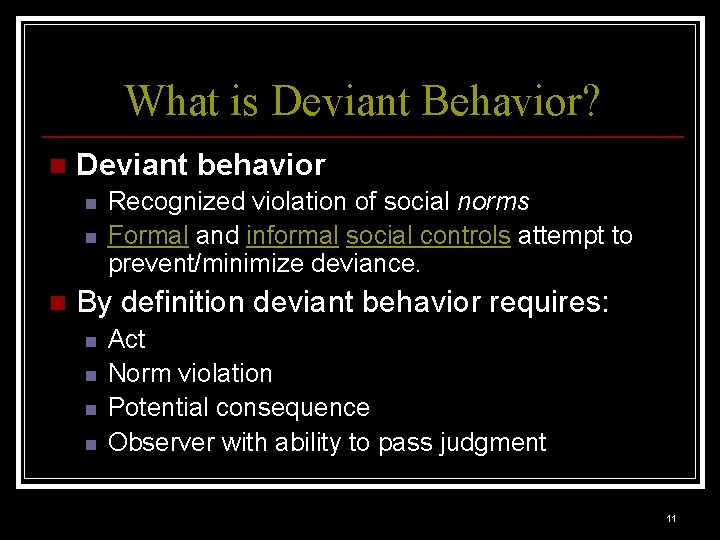
What is Deviant Behavior? n Deviant behavior n n n Recognized violation of social norms Formal and informal social controls attempt to prevent/minimize deviance. By definition deviant behavior requires: n n Act Norm violation Potential consequence Observer with ability to pass judgment 11
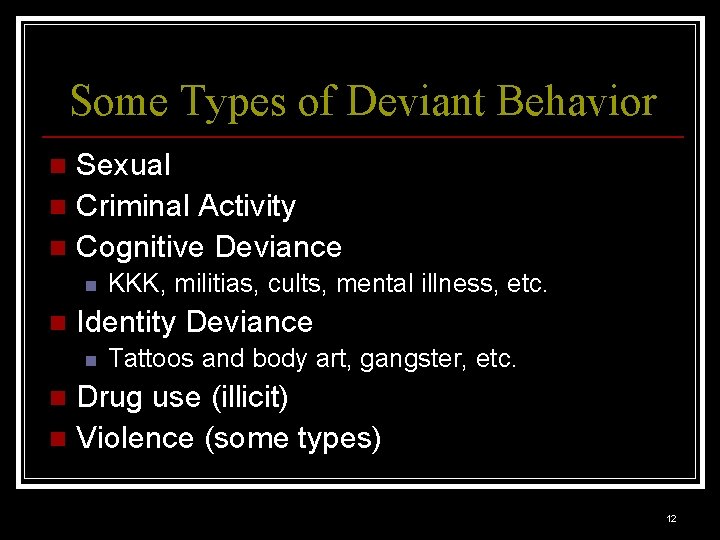
Some Types of Deviant Behavior Sexual n Criminal Activity n Cognitive Deviance n n n KKK, militias, cults, mental illness, etc. Identity Deviance n Tattoos and body art, gangster, etc. Drug use (illicit) n Violence (some types) n 12
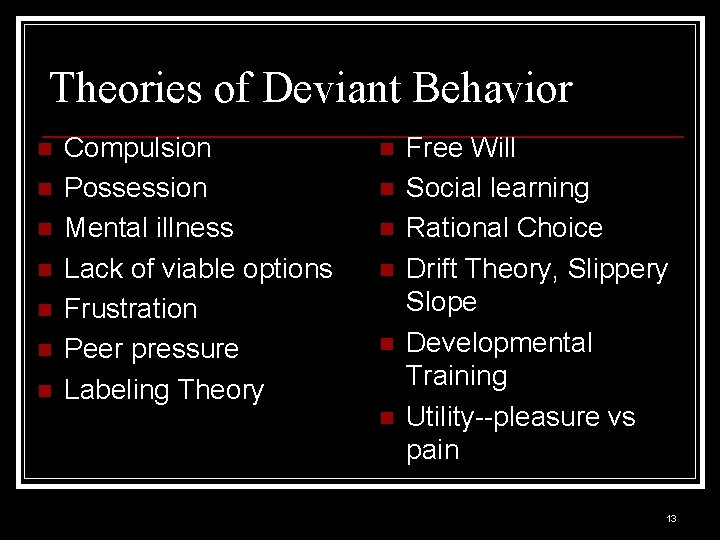
Theories of Deviant Behavior n n n n Compulsion Possession Mental illness Lack of viable options Frustration Peer pressure Labeling Theory n n n Free Will Social learning Rational Choice Drift Theory, Slippery Slope Developmental Training Utility--pleasure vs pain 13
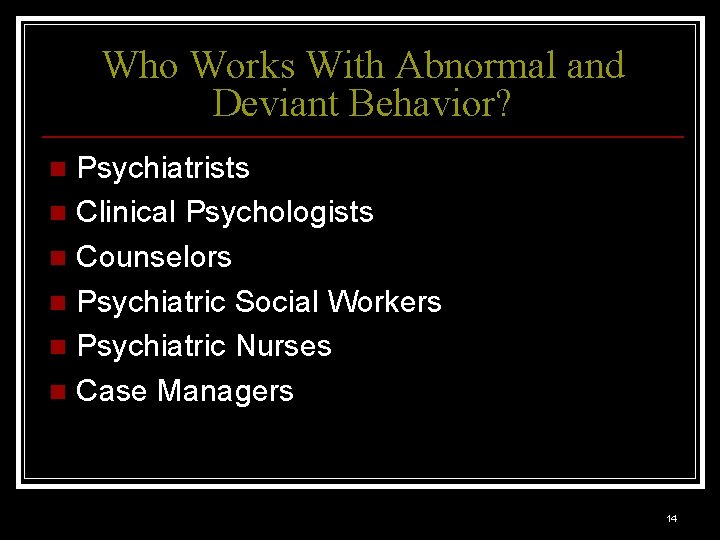
Who Works With Abnormal and Deviant Behavior? Psychiatrists n Clinical Psychologists n Counselors n Psychiatric Social Workers n Psychiatric Nurses n Case Managers n 14
Who Works With Abnormal and Deviant Behavior? POLICE OFFICERS 15
Law Enforcement & Deviant Behavior n Law enforcement involvement likely when: n n Discomfort of others Danger to society Danger to officers Others’ (over)reactions to abnormal or deviant behavior 16
Keys for Law Enforcement Expect the unexpected: Approach with caution n Anticipate abnormalities in behavior n Deviance is not necessarily a threat, but it often can be n Range of harm n Be strategic in your interventions n 17
- Slides: 17