
Abdominal Pain I Upper Abdominal pains EMC SDMH
Abdominal Pain I – Upper Abdominal pains EMC SDMH 2015
Objectives • Understand the nature of visceral abdominal pain and radiation patterns • Be able to develop differentials for pain affecting Epigastrium, Right upper, Left upper quadrants and Flanks • To briefly review the nature and management of Biliary disorders • Briefly review Pancreatitis • Briefly review ED approach to dyspepsia • Briefly review Aortic aneurysm rupture
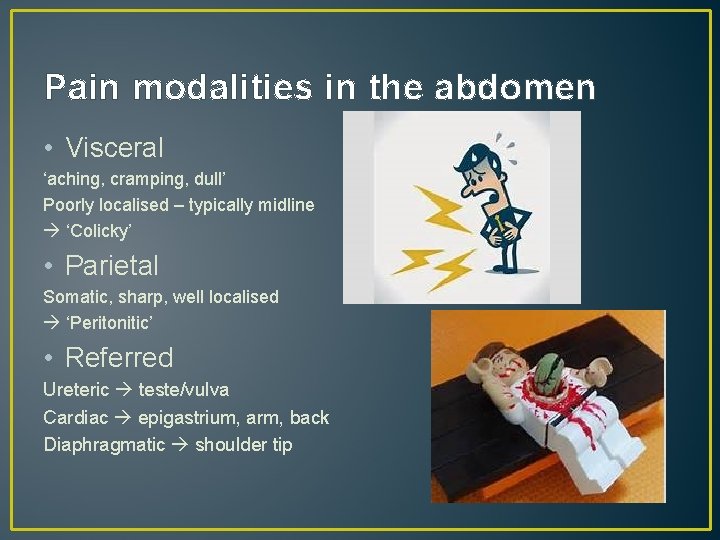
Pain modalities in the abdomen • Visceral ‘aching, cramping, dull’ Poorly localised – typically midline ‘Colicky’ • Parietal Somatic, sharp, well localised ‘Peritonitic’ • Referred Ureteric teste/vulva Cardiac epigastrium, arm, back Diaphragmatic shoulder tip
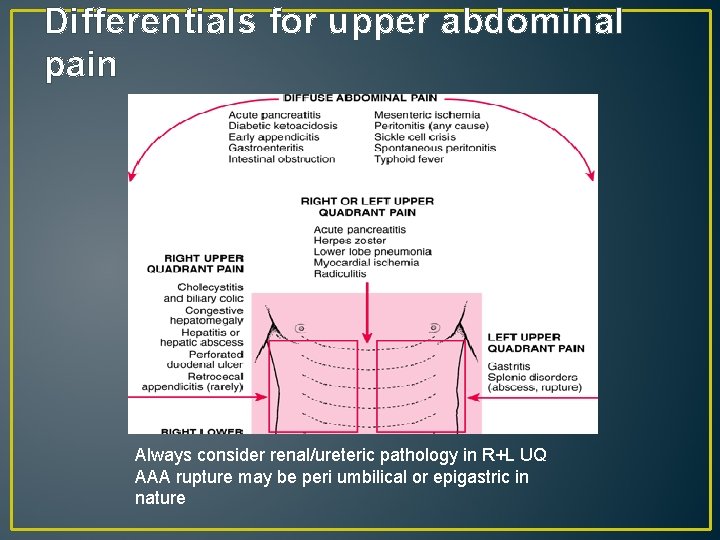
Differentials for upper abdominal pain Always consider renal/ureteric pathology in R+L UQ AAA rupture may be peri umbilical or epigastric in nature
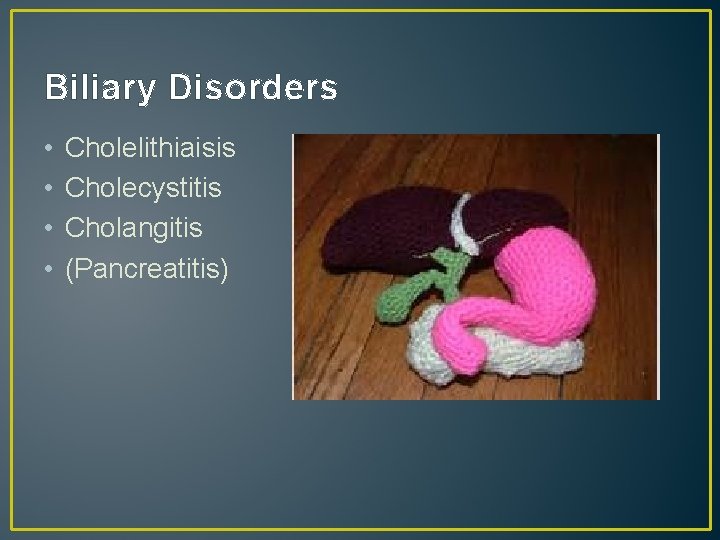
Biliary Disorders • • Cholelithiaisis Cholecystitis Cholangitis (Pancreatitis)
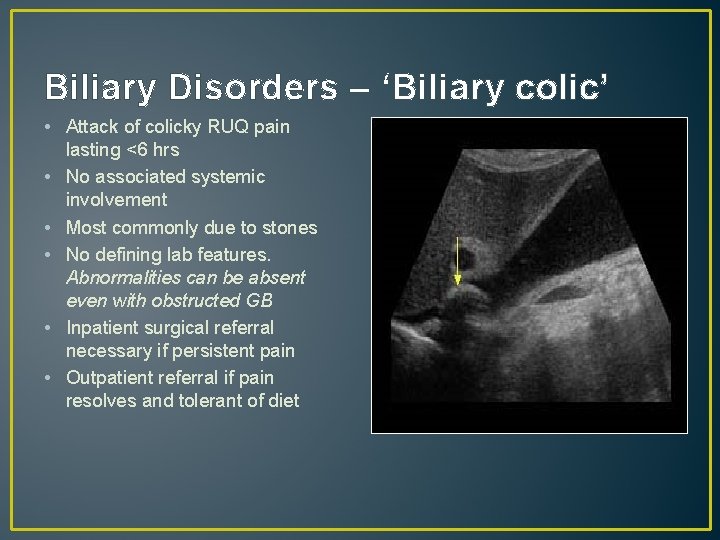
Biliary Disorders – ‘Biliary colic’ • Attack of colicky RUQ pain lasting <6 hrs • No associated systemic involvement • Most commonly due to stones • No defining lab features. Abnormalities can be absent even with obstructed GB • Inpatient surgical referral necessary if persistent pain • Outpatient referral if pain resolves and tolerant of diet
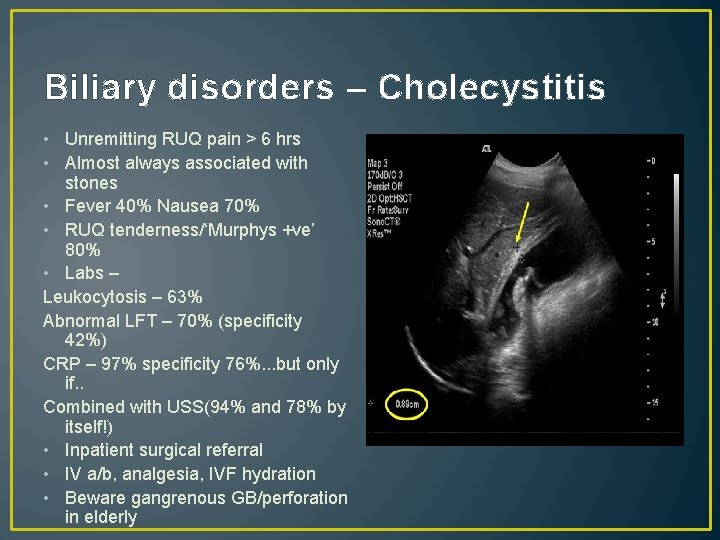
Biliary disorders – Cholecystitis • Unremitting RUQ pain > 6 hrs • Almost always associated with stones • Fever 40% Nausea 70% • RUQ tenderness/‘Murphys +ve’ 80% • Labs – Leukocytosis – 63% Abnormal LFT – 70% (specificity 42%) CRP – 97% specificity 76%. . . but only if. . Combined with USS(94% and 78% by itself!) • Inpatient surgical referral • IV a/b, analgesia, IVF hydration • Beware gangrenous GB/perforation in elderly
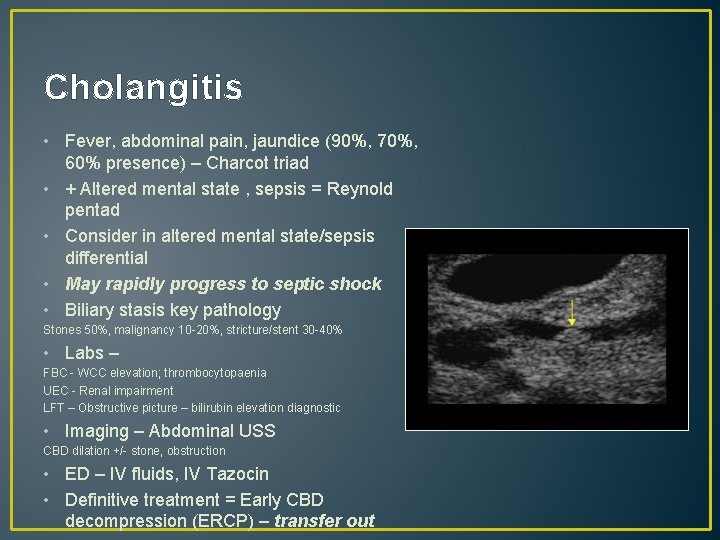
Cholangitis • Fever, abdominal pain, jaundice (90%, 70%, 60% presence) – Charcot triad • + Altered mental state , sepsis = Reynold pentad • Consider in altered mental state/sepsis differential • May rapidly progress to septic shock • Biliary stasis key pathology Stones 50%, malignancy 10 -20%, stricture/stent 30 -40% • Labs – FBC - WCC elevation; thrombocytopaenia UEC - Renal impairment LFT – Obstructive picture – bilirubin elevation diagnostic • Imaging – Abdominal USS CBD dilation +/- stone, obstruction • ED – IV fluids, IV Tazocin • Definitive treatment = Early CBD decompression (ERCP) – transfer out
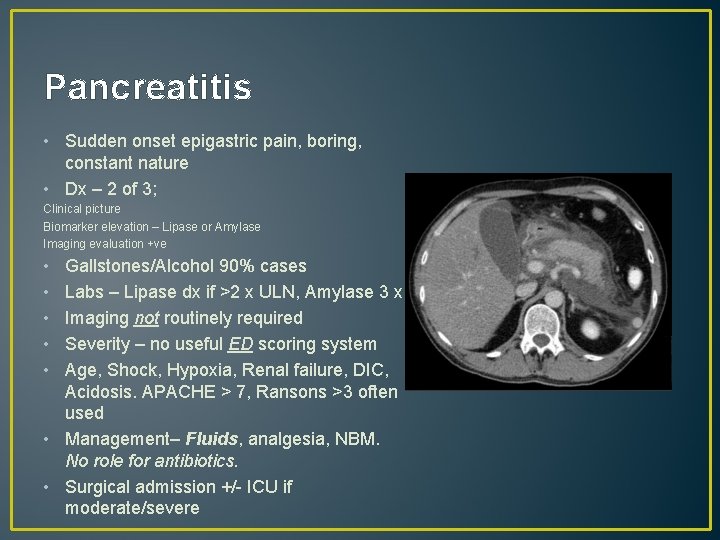
Pancreatitis • Sudden onset epigastric pain, boring, constant nature • Dx – 2 of 3; Clinical picture Biomarker elevation – Lipase or Amylase Imaging evaluation +ve • • • Gallstones/Alcohol 90% cases Labs – Lipase dx if >2 x ULN, Amylase 3 x Imaging not routinely required Severity – no useful ED scoring system Age, Shock, Hypoxia, Renal failure, DIC, Acidosis. APACHE > 7, Ransons >3 often used • Management– Fluids, analgesia, NBM. No role for antibiotics. • Surgical admission +/- ICU if moderate/severe
Dyspepsia + Reflux • Epigastric burning, dull ache, colicky pain or fullness. Associated with nausea +/- vomiting Avoid accepting ‘heartburn’ ‘indigestion’ as patient descriptions • Usually few ‘hard’ physical signs; beware abnormal vital signs • Aim to exclude serious differentials Biliary pathology Pancreatitis Myocardial ischaemia Small bowel obstruction Perforation AAA • No specifically useful labs or imaging for ‘rule-in’ • Clinical diagnosis and therefore higher risk. Dyspepsia – 10 -20% PU; 10 -20% gastritis; 50 -60% nil endoscopic findings Dyspepsia with Reflux – 33% esophagitis at endoscopy (but 80% response rate to therapy) • ED management – Analgesia/Antacids. Trial PPI +/- H 2 Antagonist • Discharge for outpatient GP follow up for empirical treatment or ‘test and treat’ approach once symptomatically controlled
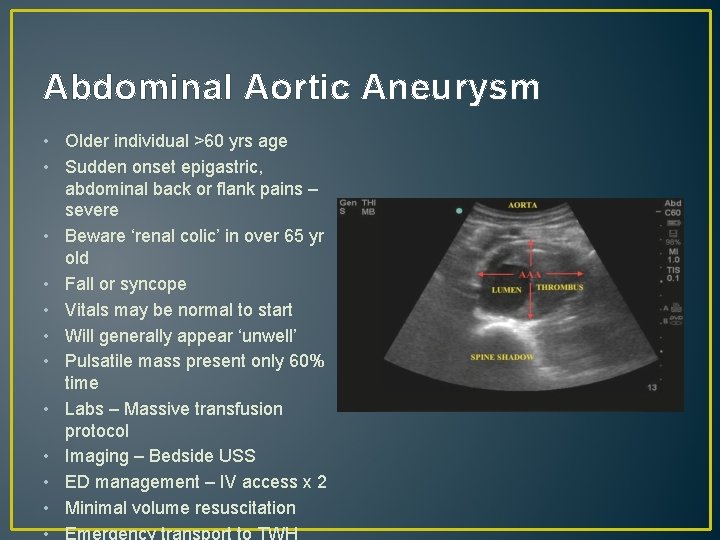
Abdominal Aortic Aneurysm • Older individual >60 yrs age • Sudden onset epigastric, abdominal back or flank pains – severe • Beware ‘renal colic’ in over 65 yr old • Fall or syncope • Vitals may be normal to start • Will generally appear ‘unwell’ • Pulsatile mass present only 60% time • Labs – Massive transfusion protocol • Imaging – Bedside USS • ED management – IV access x 2 • Minimal volume resuscitation

Questions?
Summary • Consider pain character to decide if pain is visceral or parietal • Localise to quadrant to narrow diagnosis, but be aware of variation • Be aware of ability to be led astray by labs in RUQ pathology – get an USS (bedside) • Keep cholangitis in mind in your septic screen; appreciate it’s ability to deteriorate • Don’t get too concerned about pancreatitis scores in ED; if marked clinical or biochemical abnormality consider ICU • Dyspepsia is challenging! Be careful not to label too early. • AAA at SDMH requires rapid diagnosis and emergency transport
- Slides: 13