
Abdomen GI system RT 91 Pathology Spring 2013
Abdomen & GI system RT 91 - Pathology Spring 2013 1
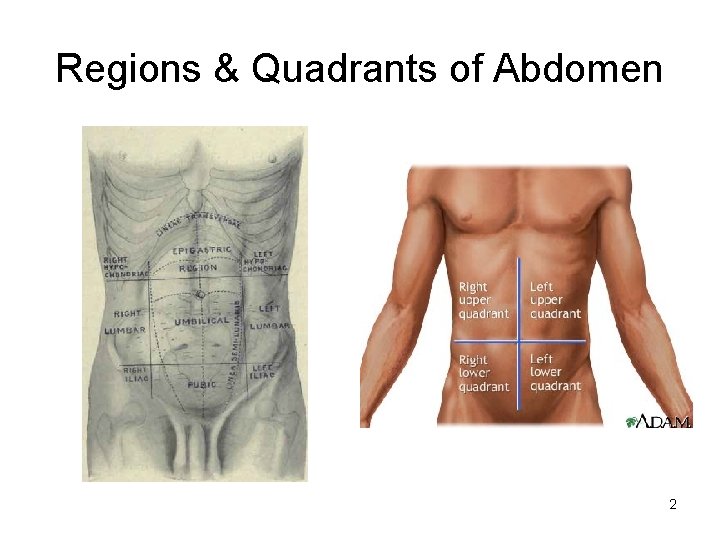
Regions & Quadrants of Abdomen 2
Contents of Abdominal Cavity 1. Digestive system – Stomach and Intestines 2. Hepatobiliary System – Liver, gallbladder, & pancreas 3. Urinary system – Kidneys, ureters and bladder 4. Circulatory system – spleen 3
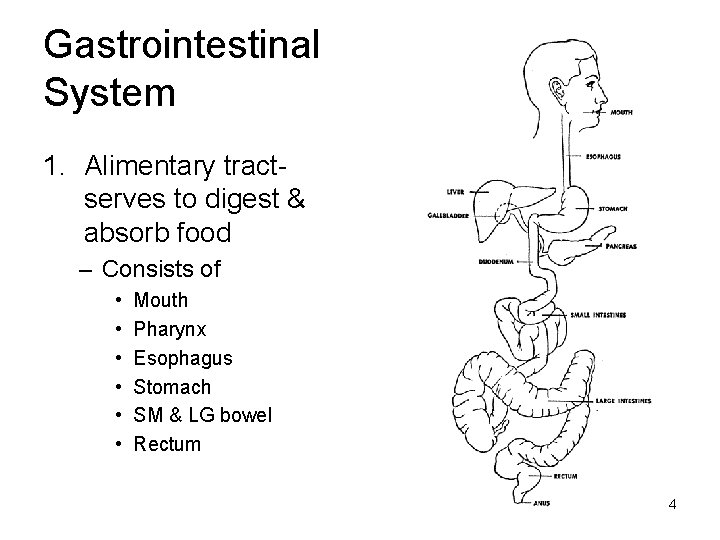
Gastrointestinal System 1. Alimentary tractserves to digest & absorb food – Consists of • • • Mouth Pharynx Esophagus Stomach SM & LG bowel Rectum 4
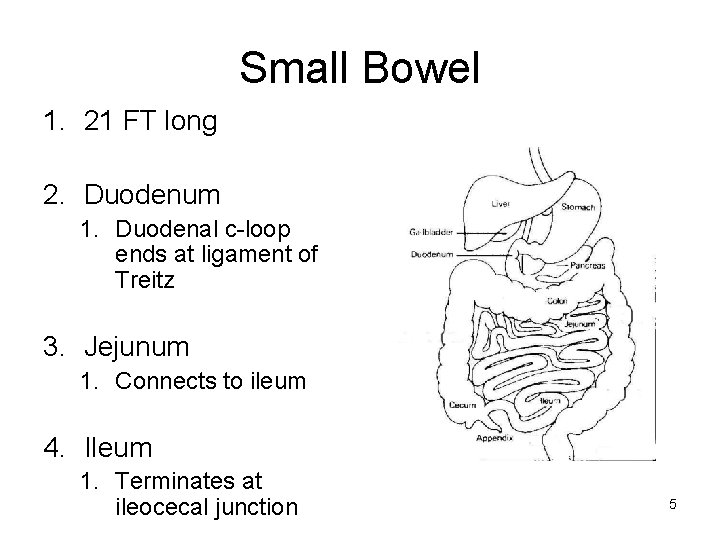
Small Bowel 1. 21 FT long 2. Duodenum 1. Duodenal c-loop ends at ligament of Treitz 3. Jejunum 1. Connects to ileum 4. Ileum 1. Terminates at ileocecal junction 5
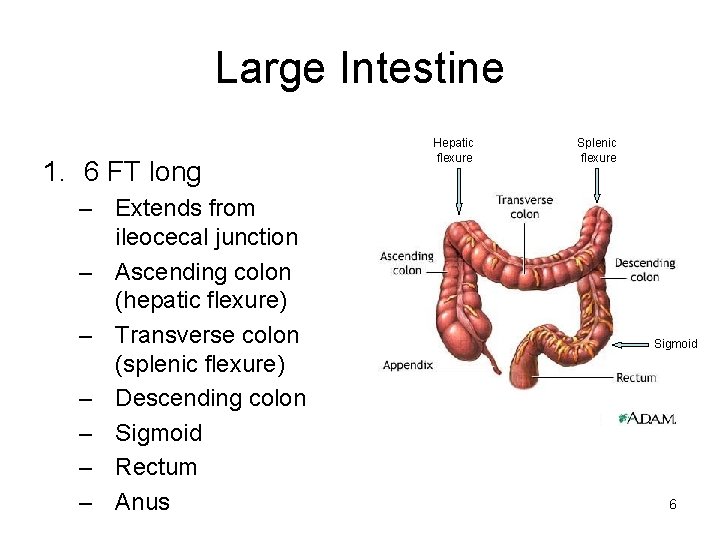
Large Intestine 1. 6 FT long – Extends from ileocecal junction – Ascending colon (hepatic flexure) – Transverse colon (splenic flexure) – Descending colon – Sigmoid – Rectum – Anus Hepatic flexure Splenic flexure Sigmoid 6
Congenital and Hereditary Anomalies 7
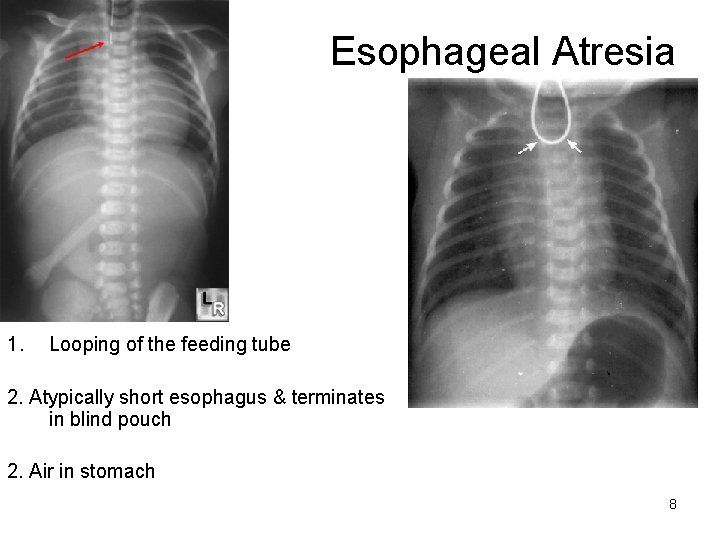
Esophageal Atresia 1. Looping of the feeding tube 2. Atypically short esophagus & terminates in blind pouch 2. Air in stomach 8
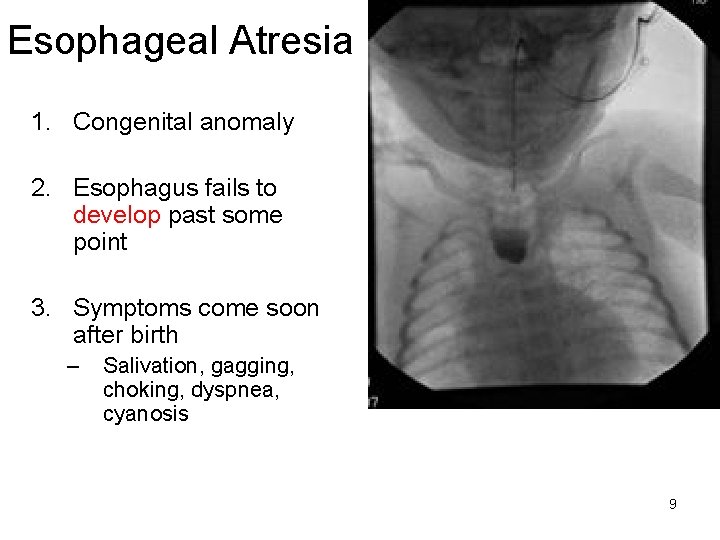
Esophageal Atresia 1. Congenital anomaly 2. Esophagus fails to develop past some point 3. Symptoms come soon after birth – Salivation, gagging, choking, dyspnea, cyanosis 9
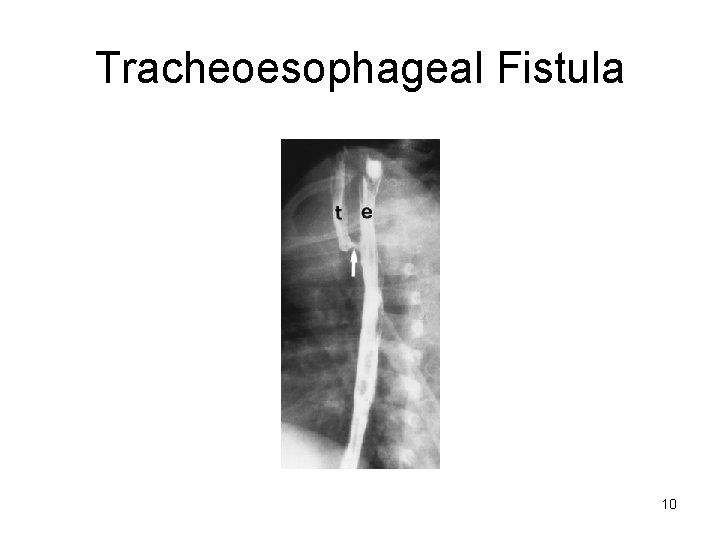
Tracheoesophageal Fistula 10
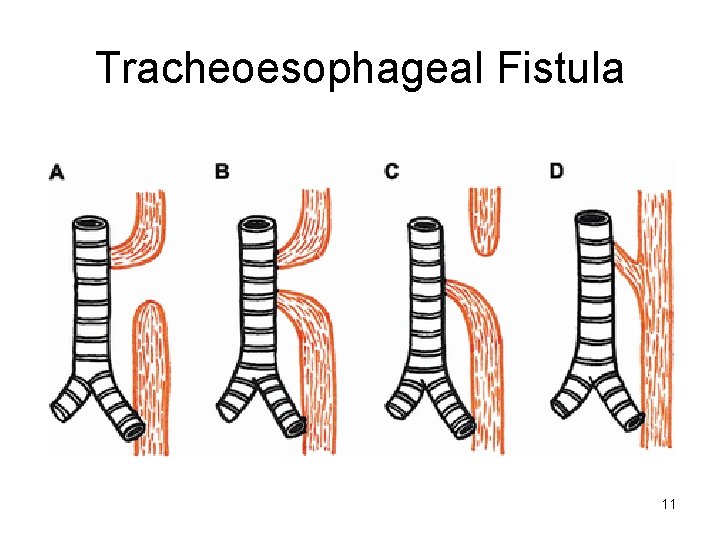
Tracheoesophageal Fistula 11
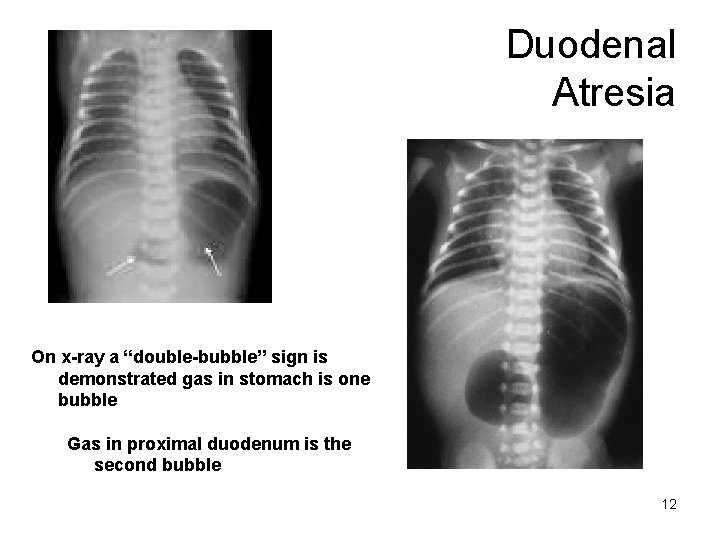
Duodenal Atresia On x-ray a “double-bubble” sign is demonstrated gas in stomach is one bubble Gas in proximal duodenum is the second bubble 12
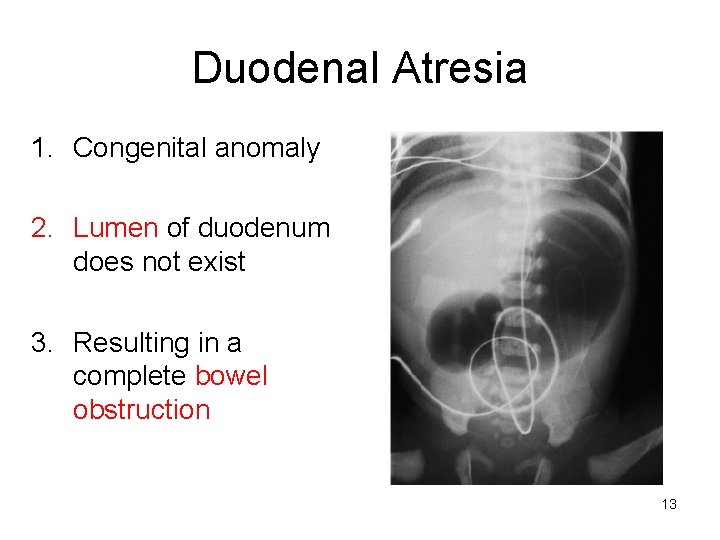
Duodenal Atresia 1. Congenital anomaly 2. Lumen of duodenum does not exist 3. Resulting in a complete bowel obstruction 13

Colonic Atresia 14

Colonic Atresia 1. Congenital failure of development of the distal rectum & anus 2. Frequent complication includes fistula formation to the genitourinary system 3. Must be repaired surgically 15
Hypertrophic Pyloric Stenosis 16
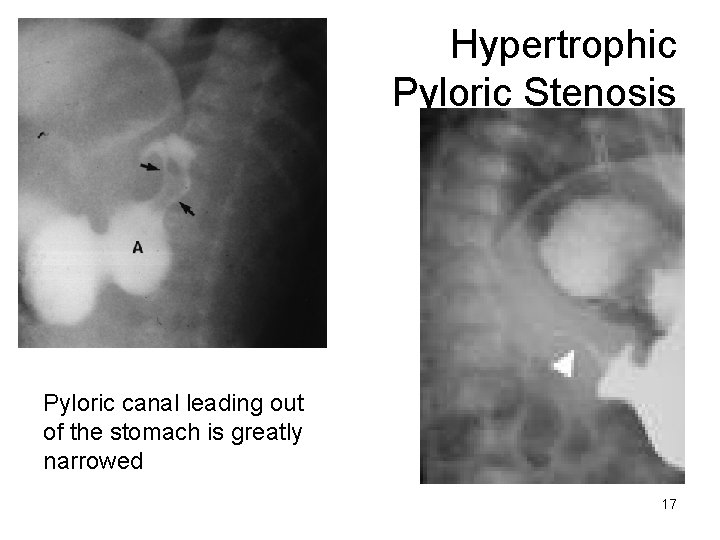
Hypertrophic Pyloric Stenosis Pyloric canal leading out of the stomach is greatly narrowed 17
Hypertrophic Pyloric Stenosis 18
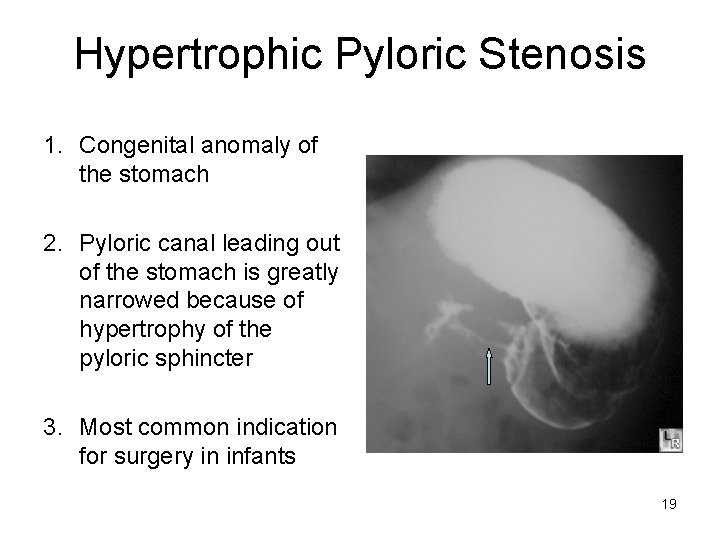
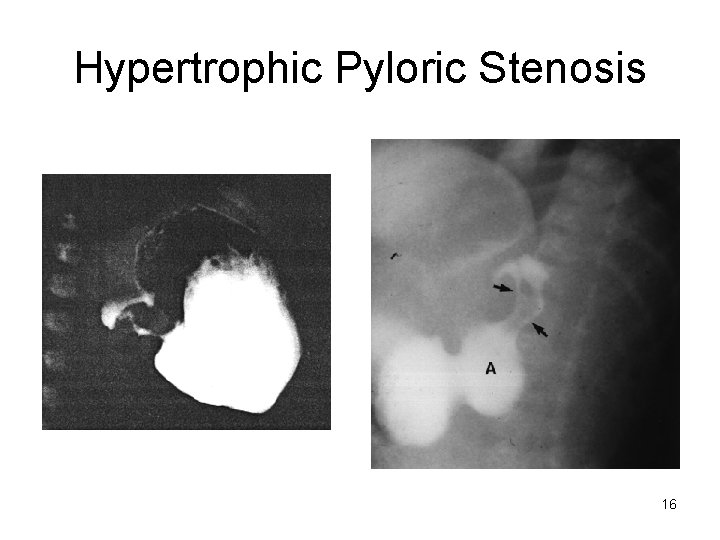
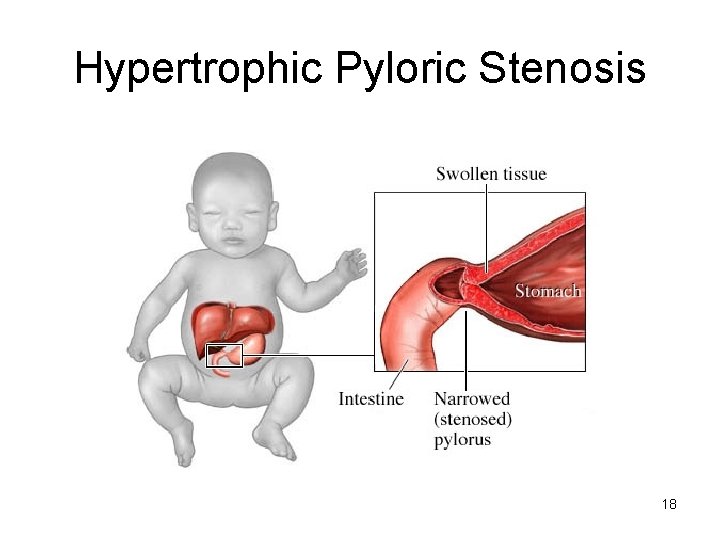
Hypertrophic Pyloric Stenosis 1. Congenital anomaly of the stomach 2. Pyloric canal leading out of the stomach is greatly narrowed because of hypertrophy of the pyloric sphincter 3. Most common indication for surgery in infants 19
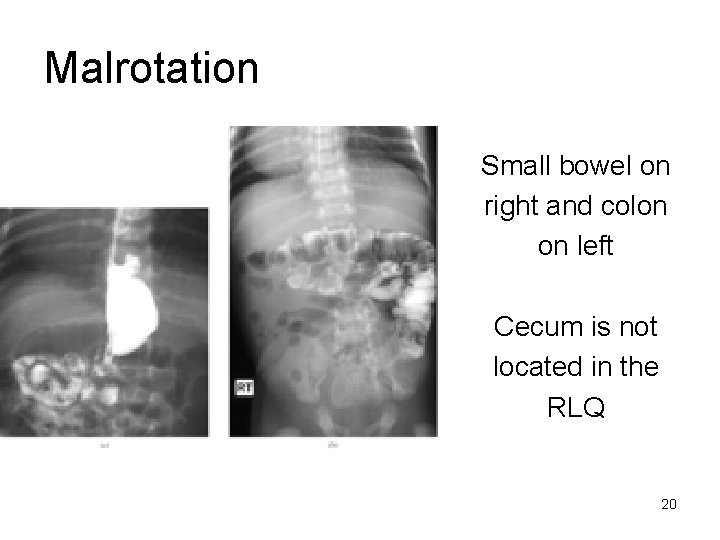
Malrotation Small bowel on right and colon on left Cecum is not located in the RLQ 20
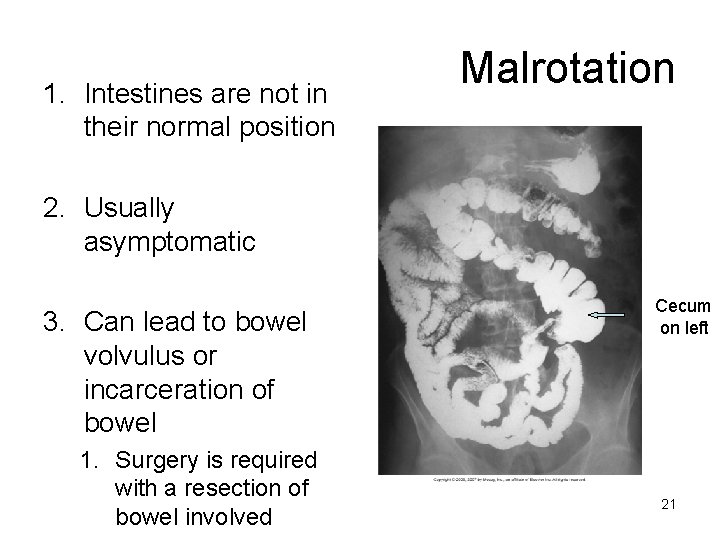
1. Intestines are not in their normal position Malrotation 2. Usually asymptomatic 3. Can lead to bowel volvulus or incarceration of bowel 1. Surgery is required with a resection of bowel involved Cecum on left 21
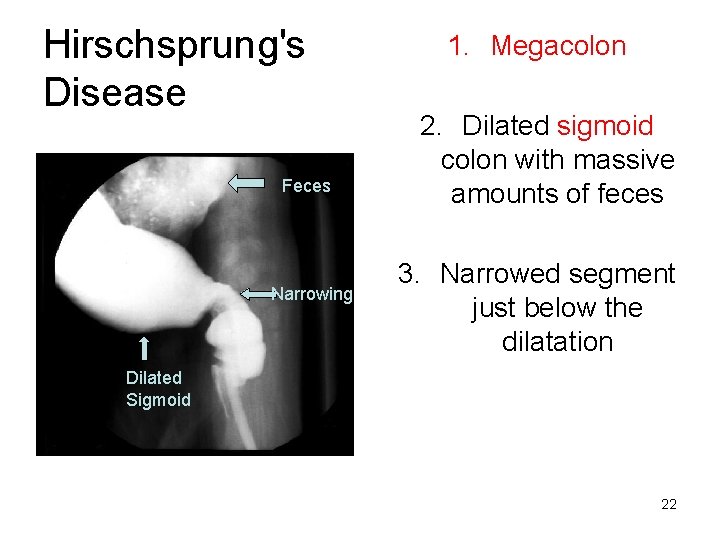
Hirschsprung's Disease Feces Narrowing 1. Megacolon 2. Dilated sigmoid colon with massive amounts of feces 3. Narrowed segment just below the dilatation Dilated Sigmoid 22
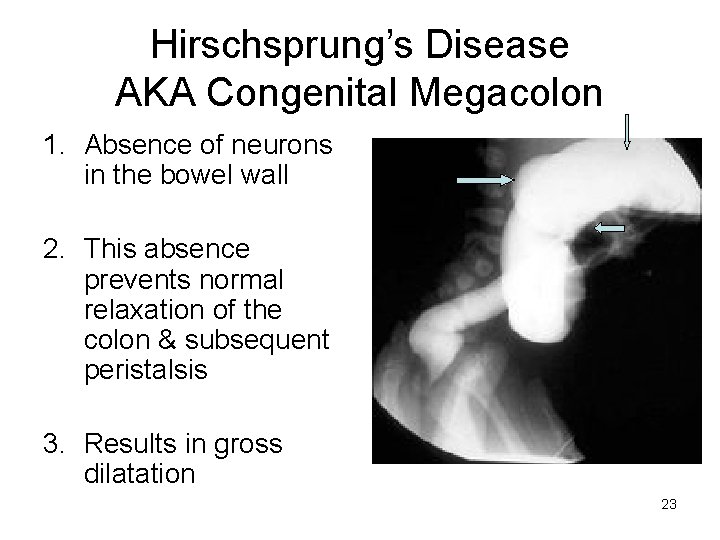
Hirschsprung’s Disease AKA Congenital Megacolon 1. Absence of neurons in the bowel wall 2. This absence prevents normal relaxation of the colon & subsequent peristalsis 3. Results in gross dilatation 23
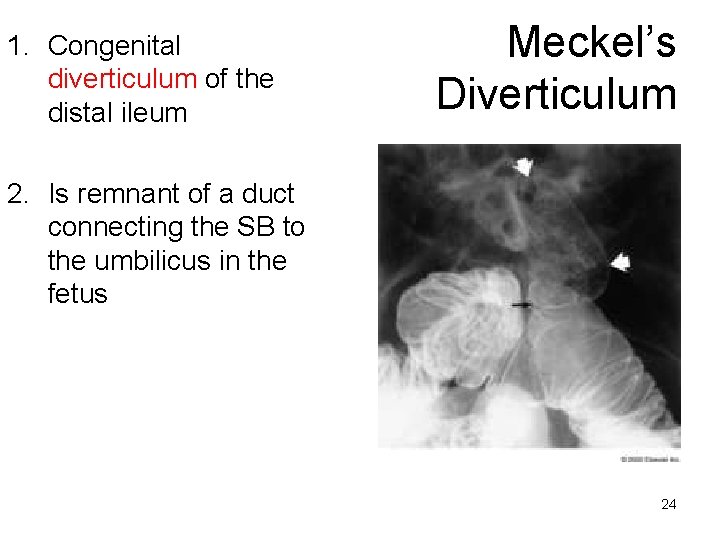
1. Congenital diverticulum of the distal ileum Meckel’s Diverticulum 2. Is remnant of a duct connecting the SB to the umbilicus in the fetus 24
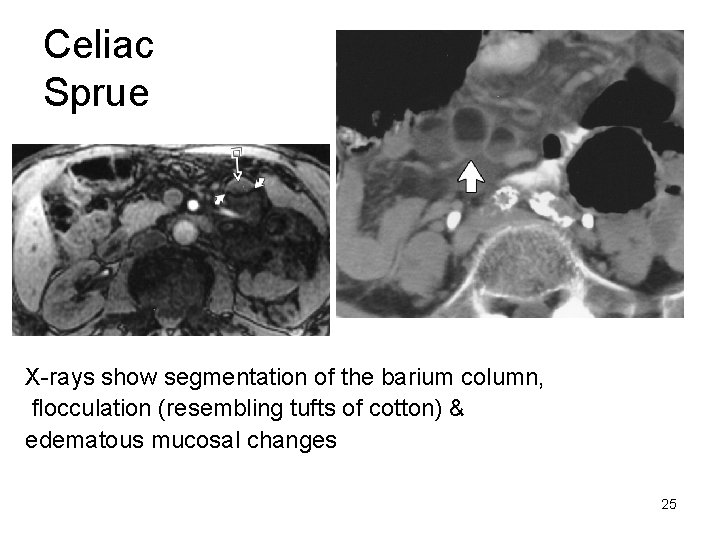
Celiac Sprue X-rays show segmentation of the barium column, flocculation (resembling tufts of cotton) & edematous mucosal changes 25
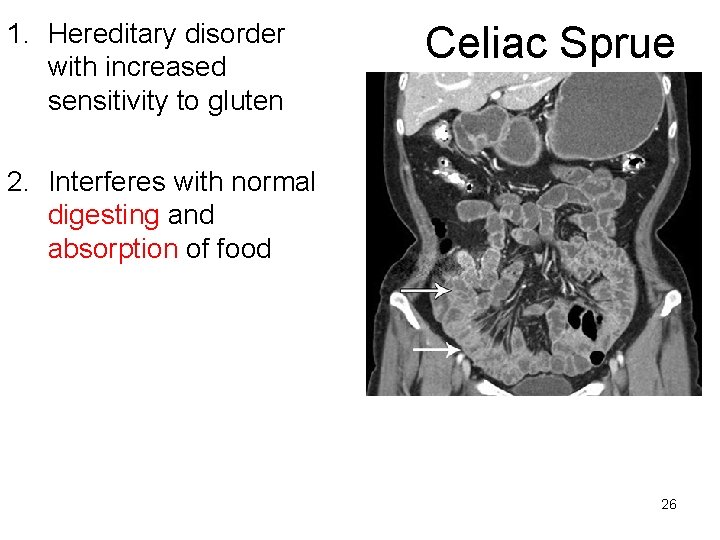
1. Hereditary disorder with increased sensitivity to gluten Celiac Sprue 2. Interferes with normal digesting and absorption of food 26
Inflammatory Disease 27
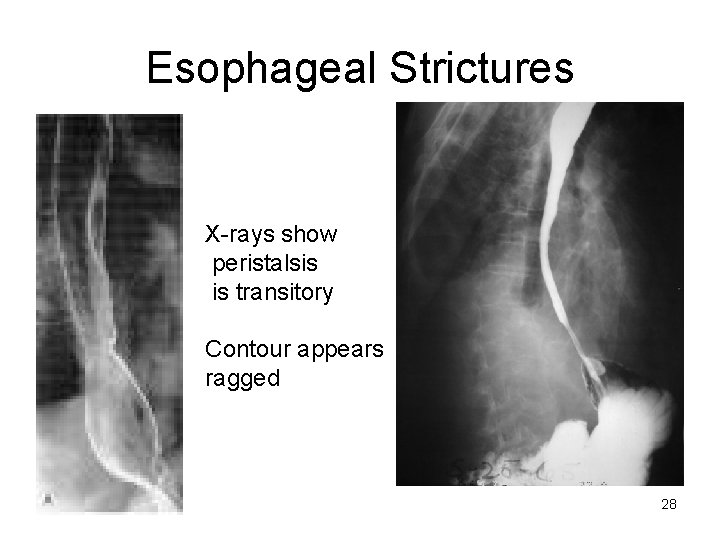
Esophageal Strictures X-rays show peristalsis is transitory Contour appears ragged 28
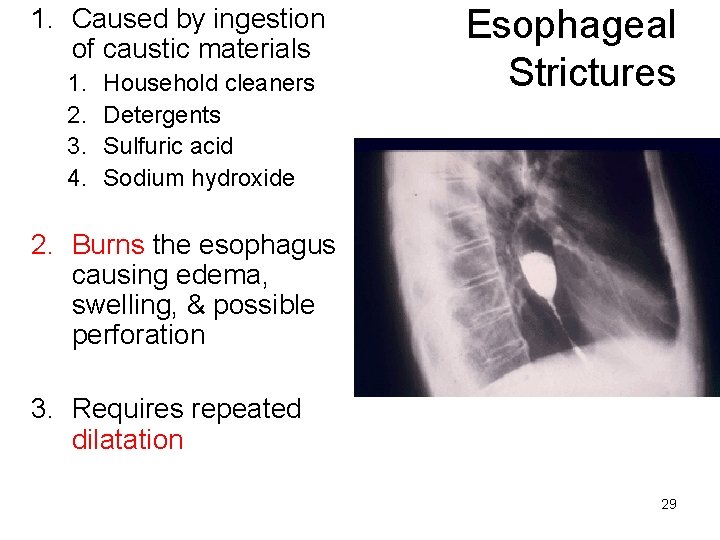
1. Caused by ingestion of caustic materials 1. 2. 3. 4. Household cleaners Detergents Sulfuric acid Sodium hydroxide Esophageal Strictures 2. Burns the esophagus causing edema, swelling, & possible perforation 3. Requires repeated dilatation 29
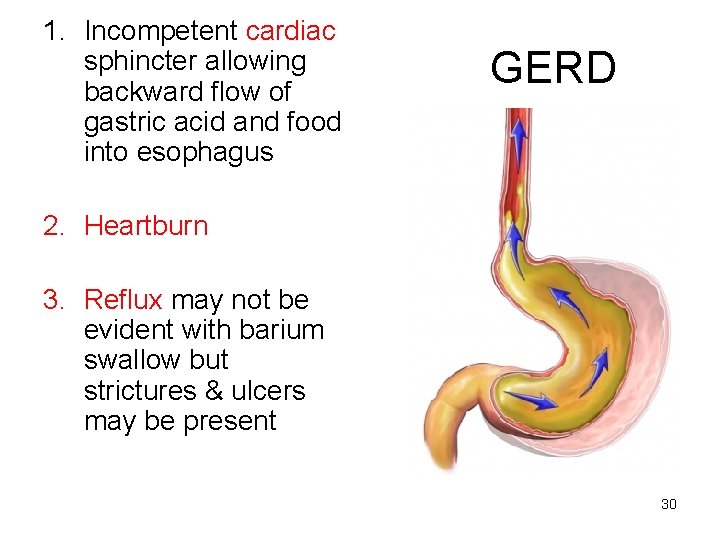
1. Incompetent cardiac sphincter allowing backward flow of gastric acid and food into esophagus GERD 2. Heartburn 3. Reflux may not be evident with barium swallow but strictures & ulcers may be present 30
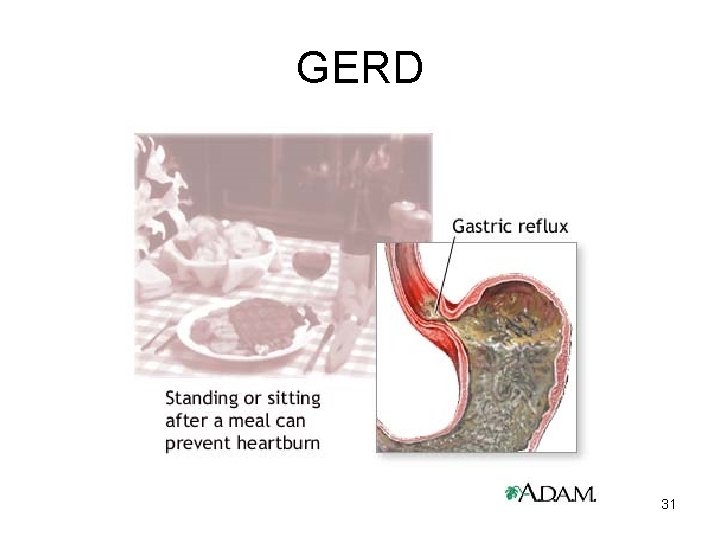
GERD 31
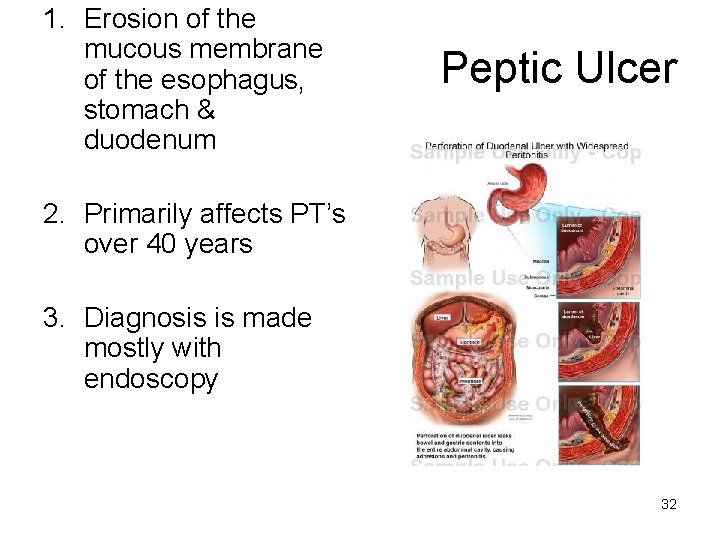
1. Erosion of the mucous membrane of the esophagus, stomach & duodenum Peptic Ulcer 2. Primarily affects PT’s over 40 years 3. Diagnosis is made mostly with endoscopy 32
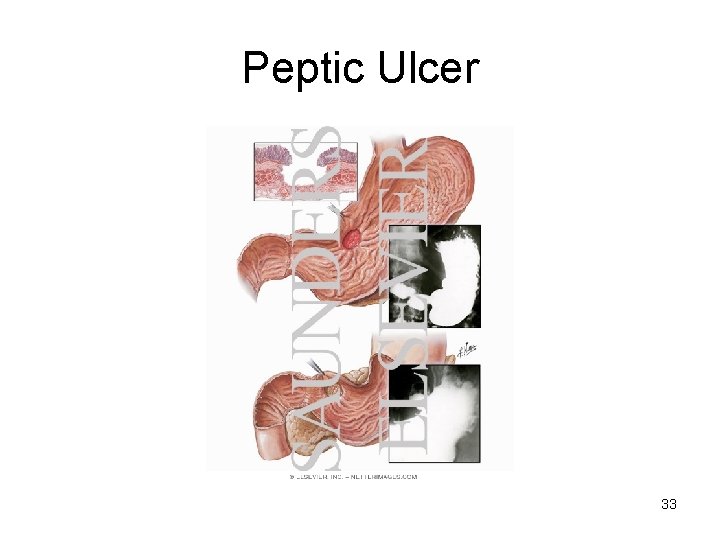
Peptic Ulcer 33
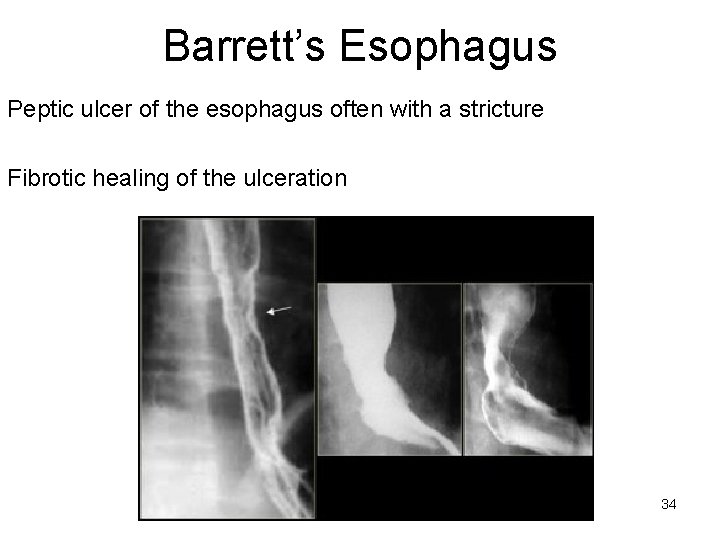
Barrett’s Esophagus Peptic ulcer of the esophagus often with a stricture Fibrotic healing of the ulceration 34
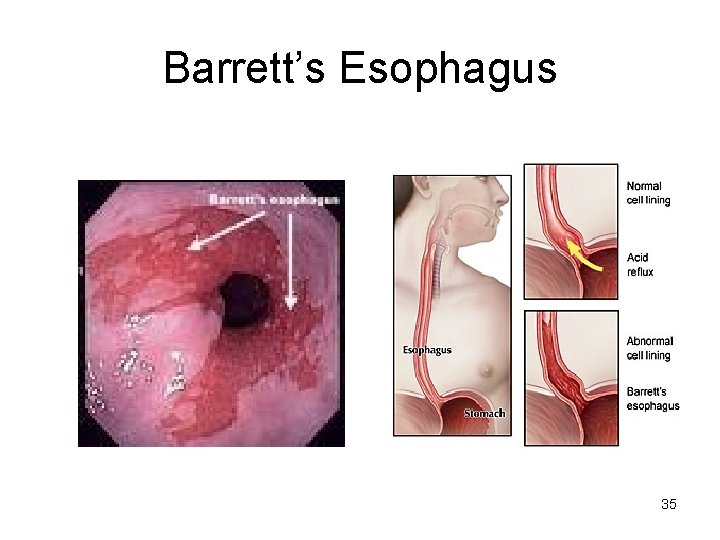
Barrett’s Esophagus 35
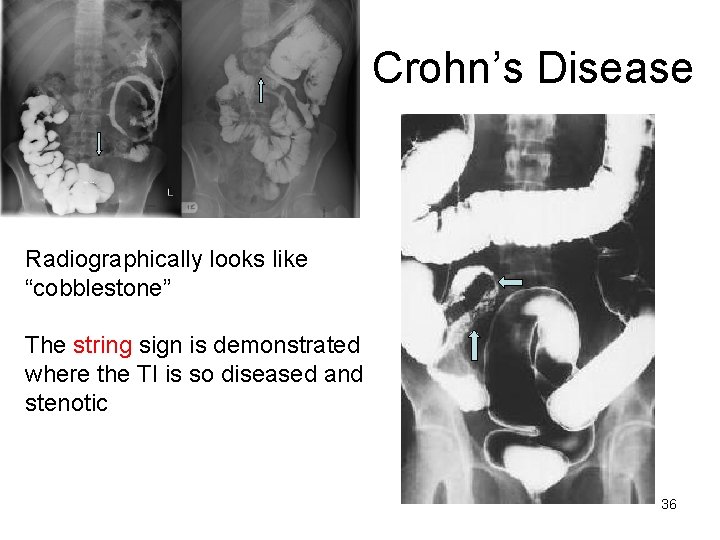
Crohn’s Disease Radiographically looks like “cobblestone” The string sign is demonstrated where the TI is so diseased and stenotic 36
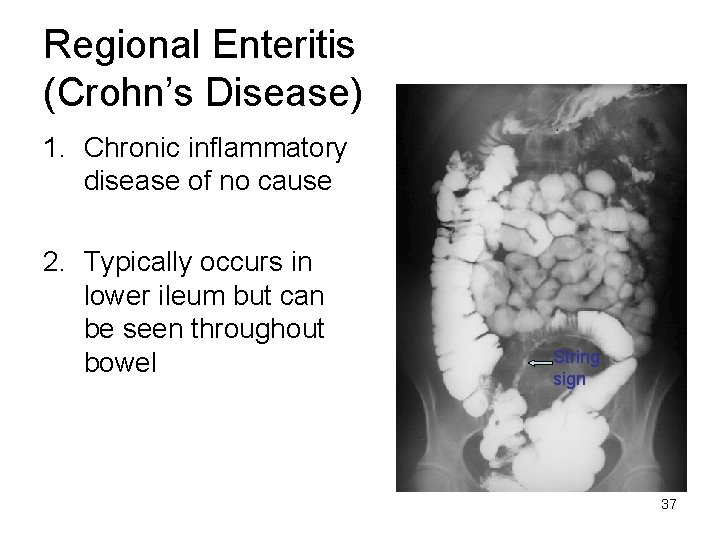
Regional Enteritis (Crohn’s Disease) 1. Chronic inflammatory disease of no cause 2. Typically occurs in lower ileum but can be seen throughout bowel String sign 37
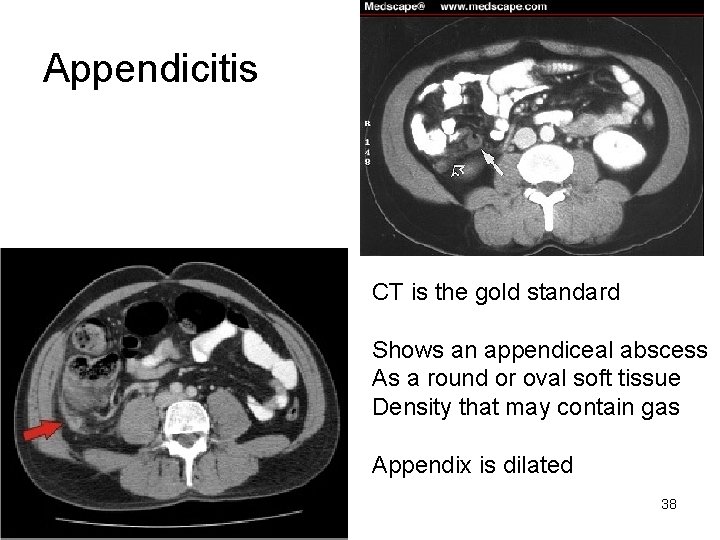
Appendicitis CT is the gold standard Shows an appendiceal abscess As a round or oval soft tissue Density that may contain gas Appendix is dilated 38
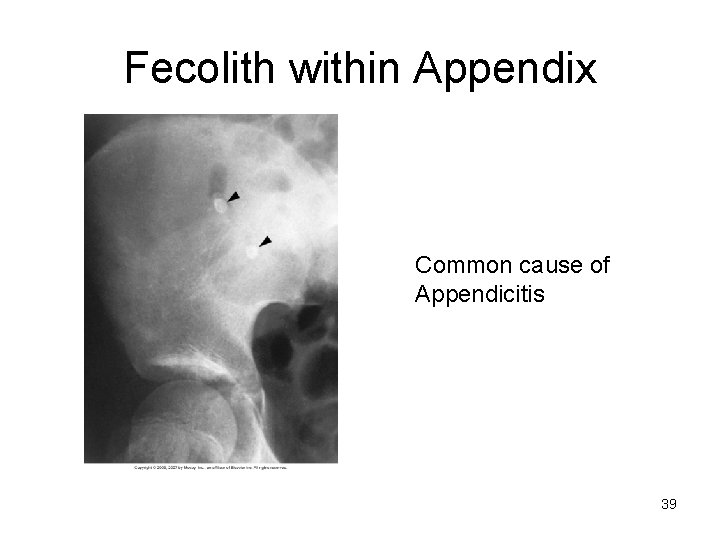
Fecolith within Appendix Common cause of Appendicitis 39
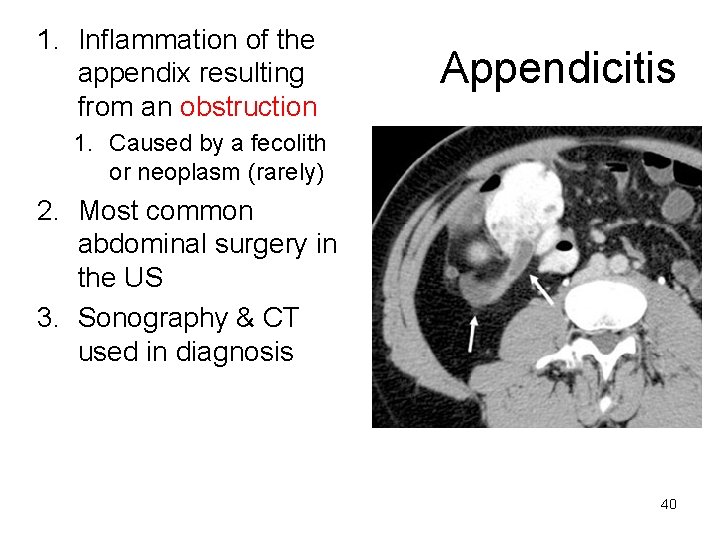
1. Inflammation of the appendix resulting from an obstruction Appendicitis 1. Caused by a fecolith or neoplasm (rarely) 2. Most common abdominal surgery in the US 3. Sonography & CT used in diagnosis 40
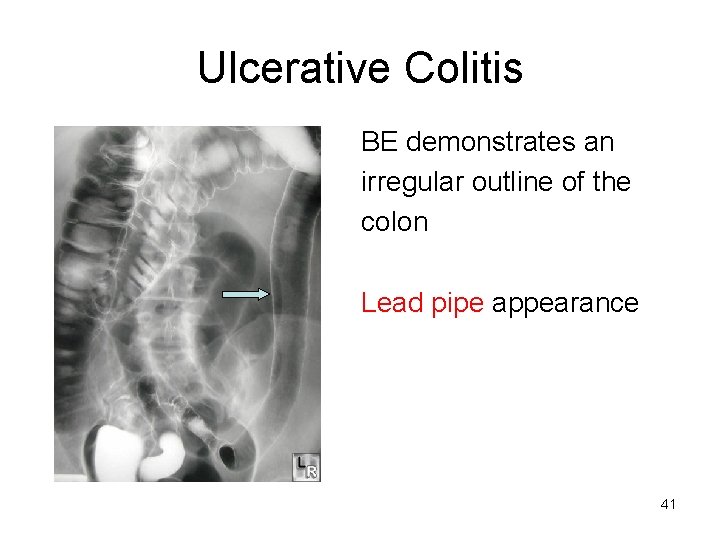
Ulcerative Colitis BE demonstrates an irregular outline of the colon Lead pipe appearance 41
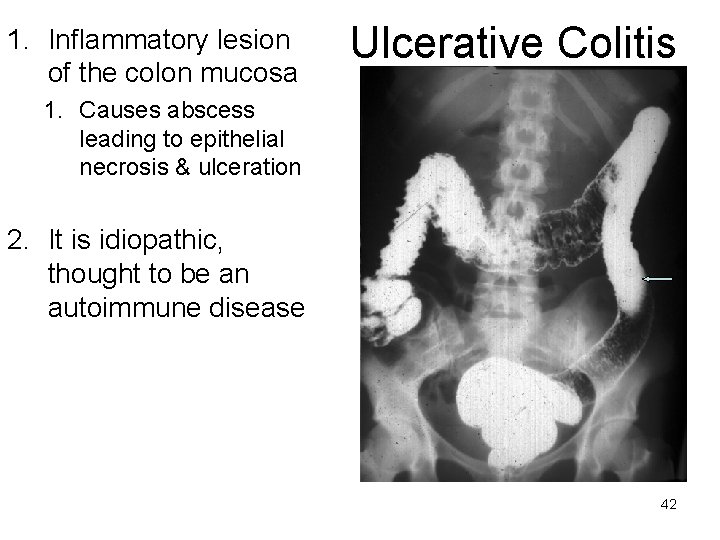
1. Inflammatory lesion of the colon mucosa Ulcerative Colitis 1. Causes abscess leading to epithelial necrosis & ulceration 2. It is idiopathic, thought to be an autoimmune disease 42
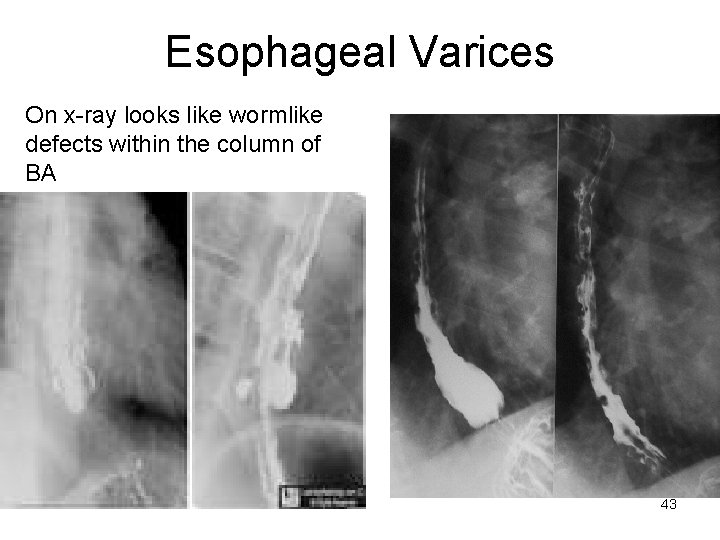
Esophageal Varices On x-ray looks like wormlike defects within the column of BA 43
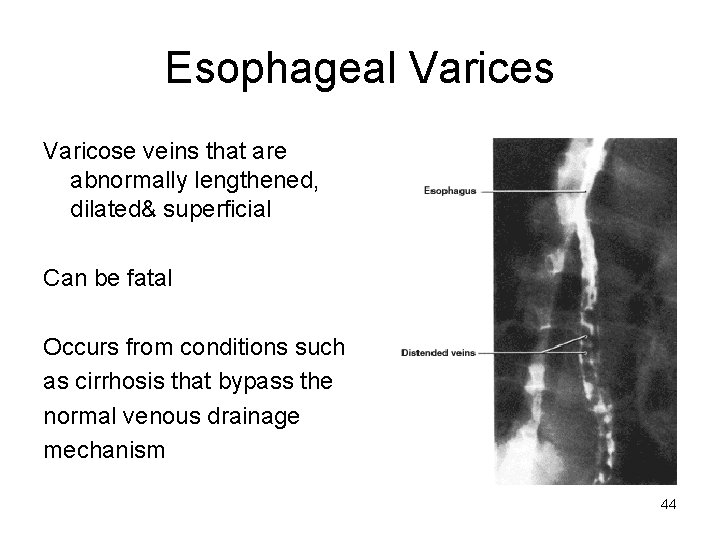
Esophageal Varices Varicose veins that are abnormally lengthened, dilated& superficial Can be fatal Occurs from conditions such as cirrhosis that bypass the normal venous drainage mechanism 44
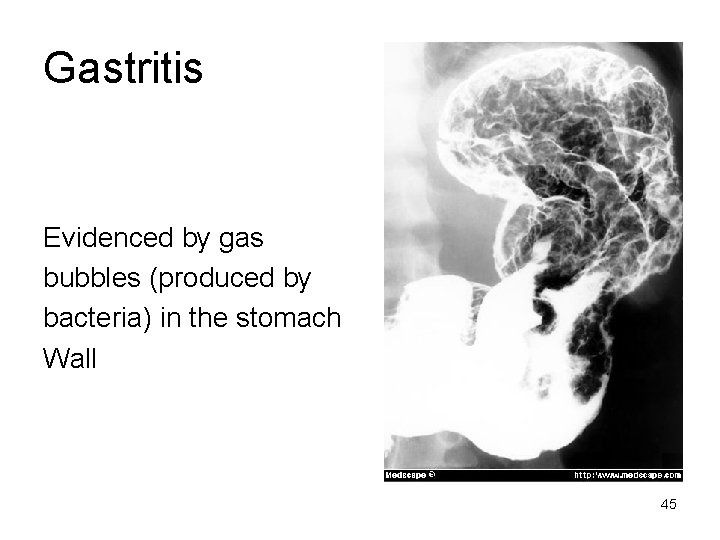
Gastritis Evidenced by gas bubbles (produced by bacteria) in the stomach Wall 45
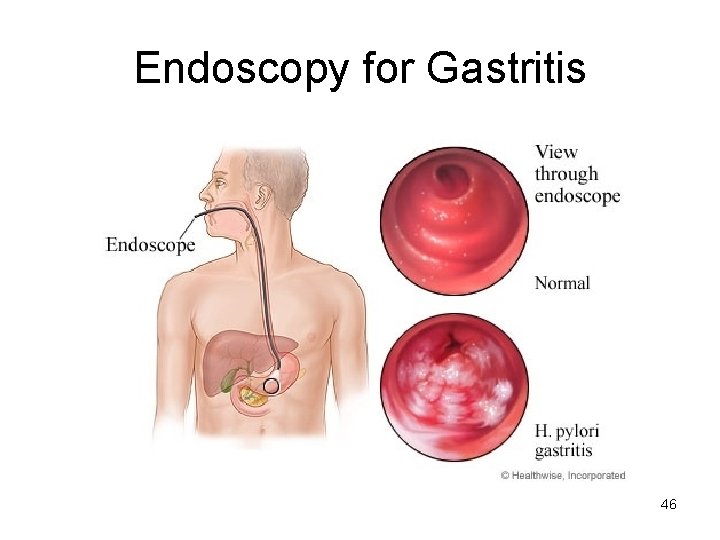
Endoscopy for Gastritis 46
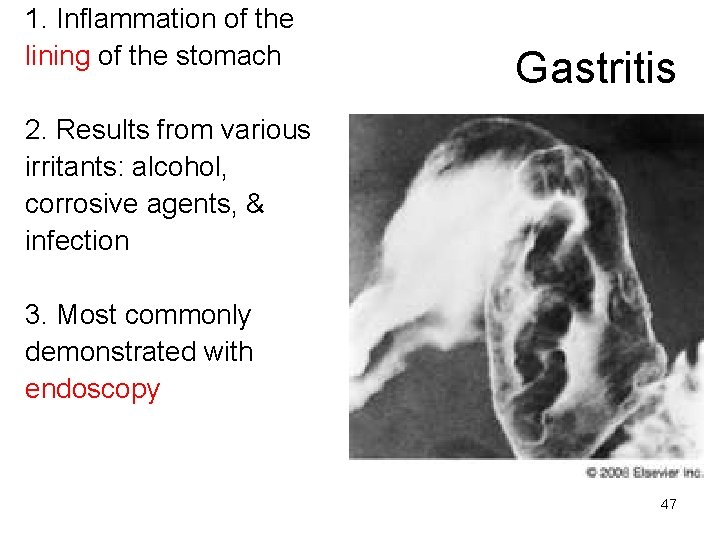
1. Inflammation of the lining of the stomach Gastritis 2. Results from various irritants: alcohol, corrosive agents, & infection 3. Most commonly demonstrated with endoscopy 47
Degenerative Diseases 48
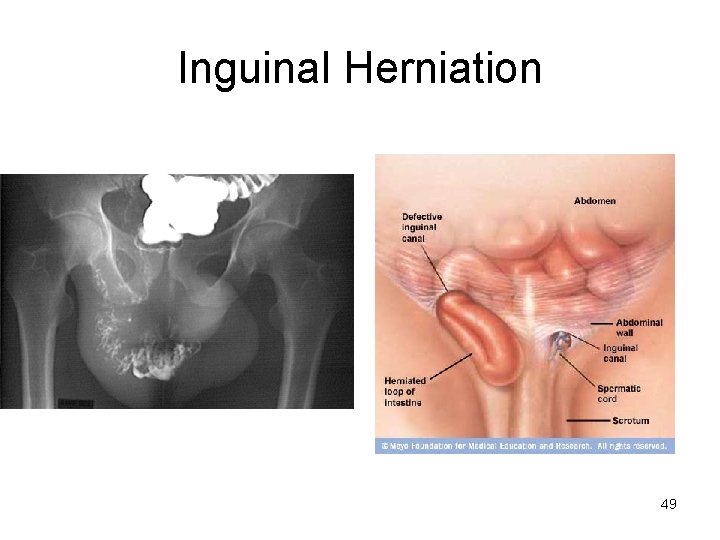
Inguinal Herniation 49
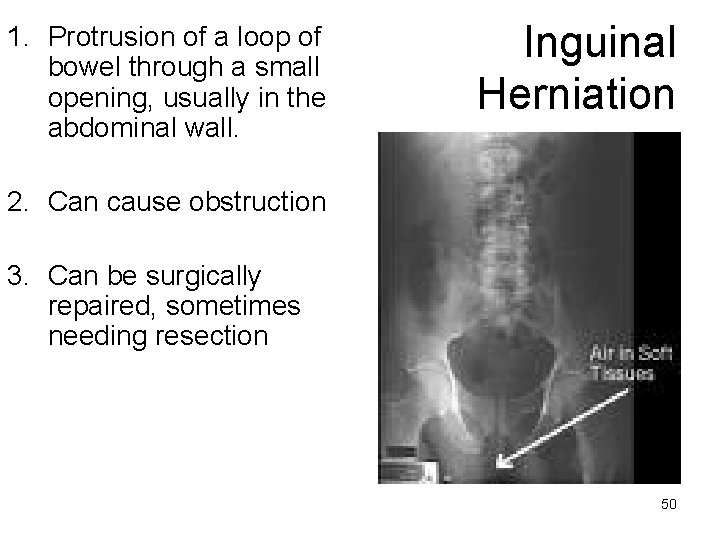
1. Protrusion of a loop of bowel through a small opening, usually in the abdominal wall. Inguinal Herniation 2. Can cause obstruction 3. Can be surgically repaired, sometimes needing resection 50
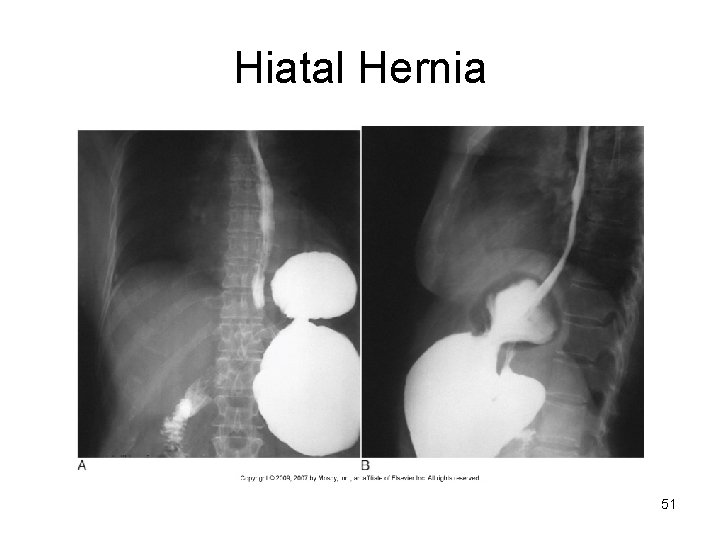
Hiatal Hernia 51
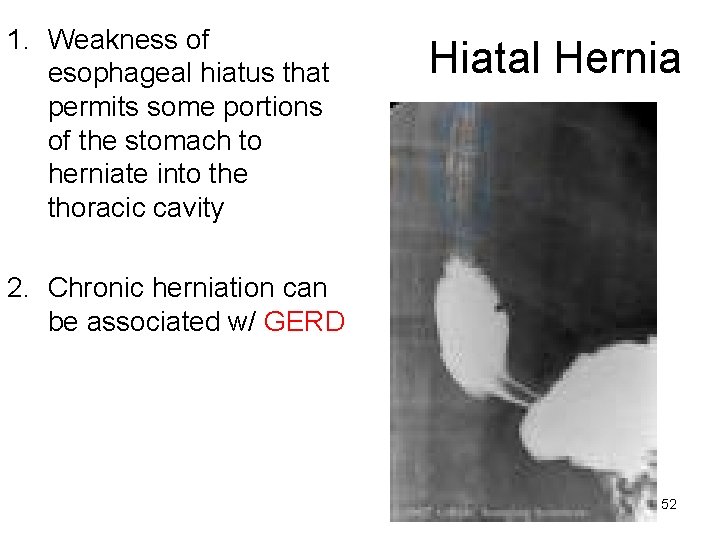
1. Weakness of esophageal hiatus that permits some portions of the stomach to herniate into the thoracic cavity Hiatal Hernia 2. Chronic herniation can be associated w/ GERD 52
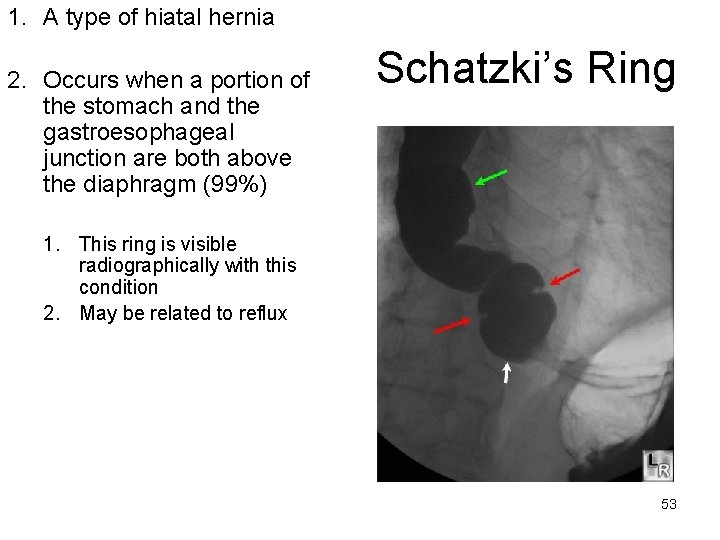
1. A type of hiatal hernia 2. Occurs when a portion of the stomach and the gastroesophageal junction are both above the diaphragm (99%) Schatzki’s Ring 1. This ring is visible radiographically with this condition 2. May be related to reflux 53
Bowel Obstructions 54
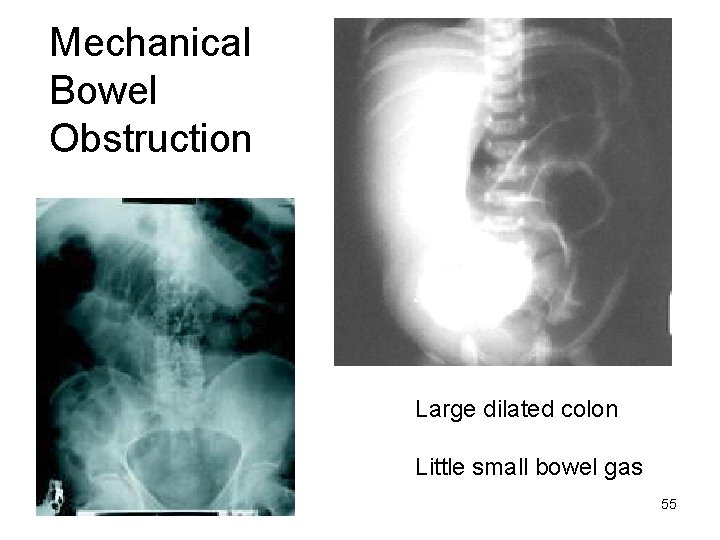
Mechanical Bowel Obstruction Large dilated colon Little small bowel gas 55
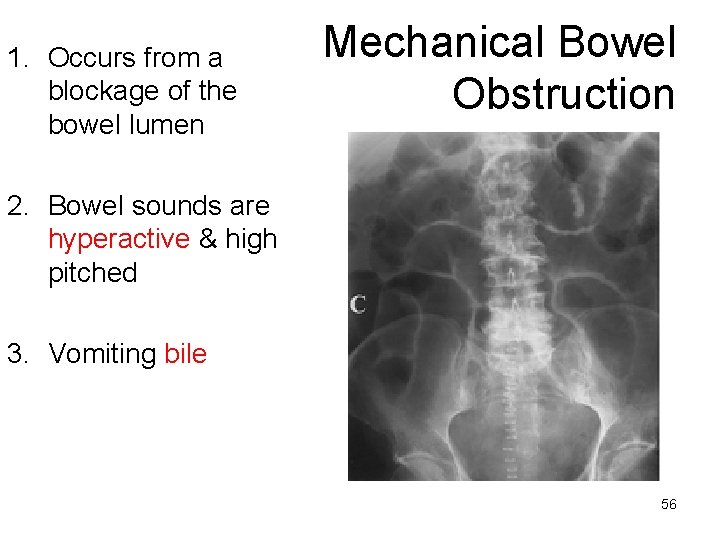
1. Occurs from a blockage of the bowel lumen Mechanical Bowel Obstruction 2. Bowel sounds are hyperactive & high pitched 3. Vomiting bile 56
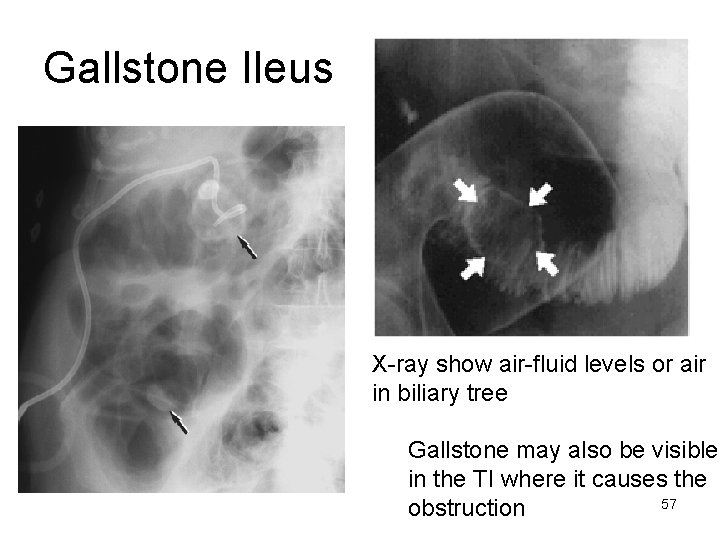
Gallstone Ileus X-ray show air-fluid levels or air in biliary tree Gallstone may also be visible in the TI where it causes the 57 obstruction
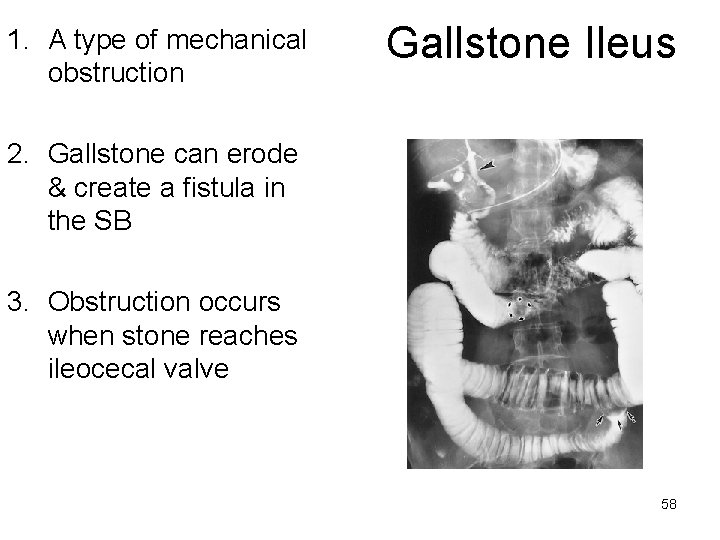
1. A type of mechanical obstruction Gallstone Ileus 2. Gallstone can erode & create a fistula in the SB 3. Obstruction occurs when stone reaches ileocecal valve 58
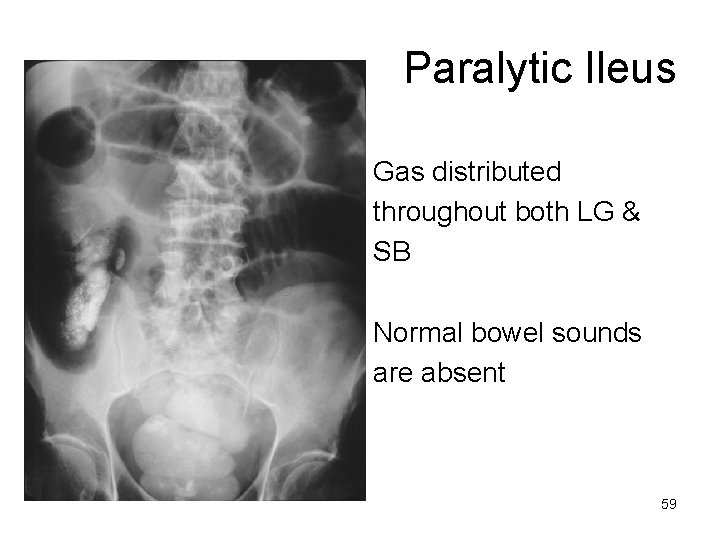
Paralytic Ileus Gas distributed throughout both LG & SB Normal bowel sounds are absent 59
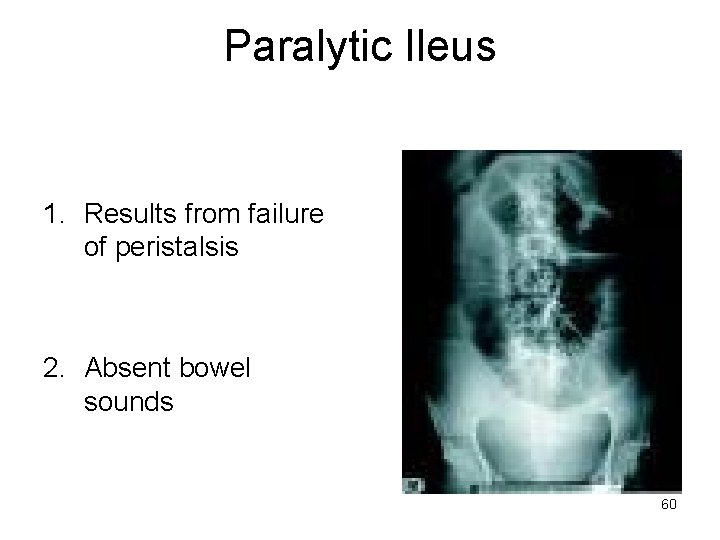
Paralytic Ileus 1. Results from failure of peristalsis 2. Absent bowel sounds 60
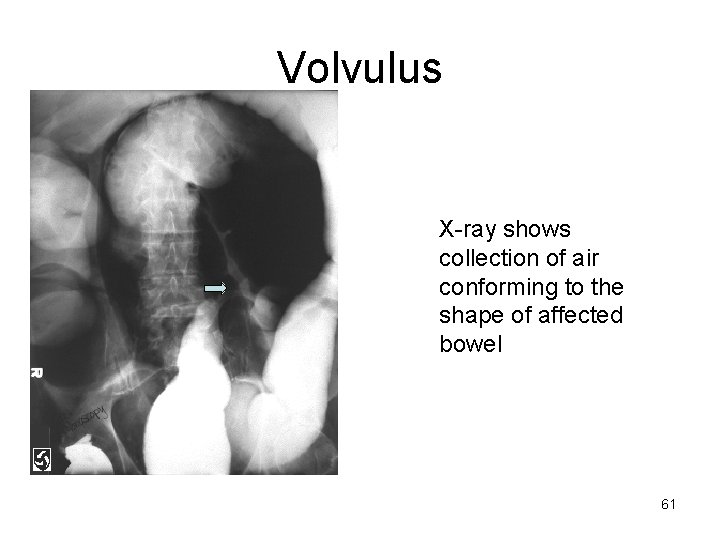
Volvulus X-ray shows collection of air conforming to the shape of affected bowel 61
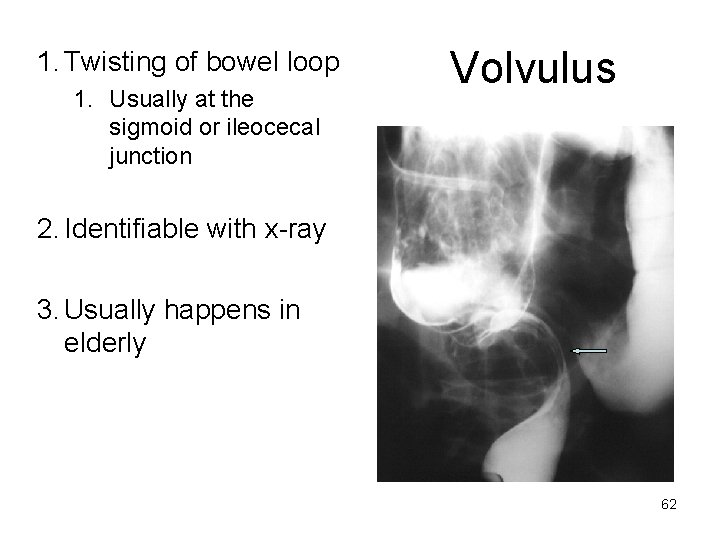
1. Twisting of bowel loop 1. Usually at the sigmoid or ileocecal junction Volvulus 2. Identifiable with x-ray 3. Usually happens in elderly 62
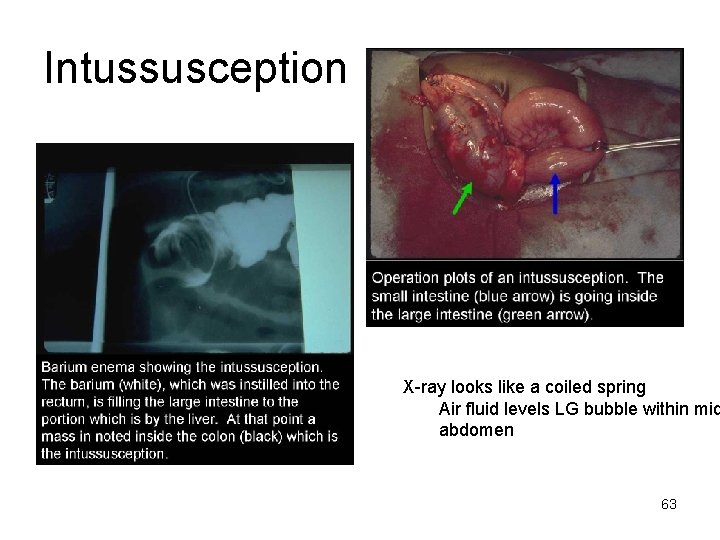
Intussusception X-ray looks like a coiled spring Air fluid levels LG bubble within mid abdomen 63
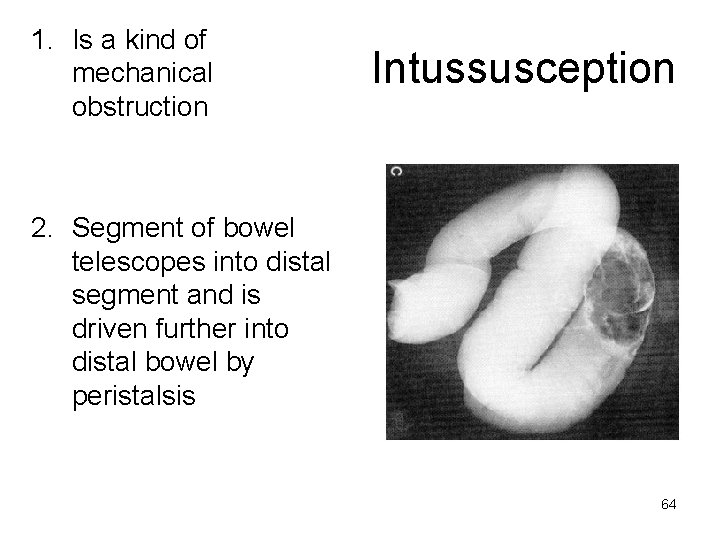
1. Is a kind of mechanical obstruction Intussusception 2. Segment of bowel telescopes into distal segment and is driven further into distal bowel by peristalsis 64
Neurogenic Diseases 65
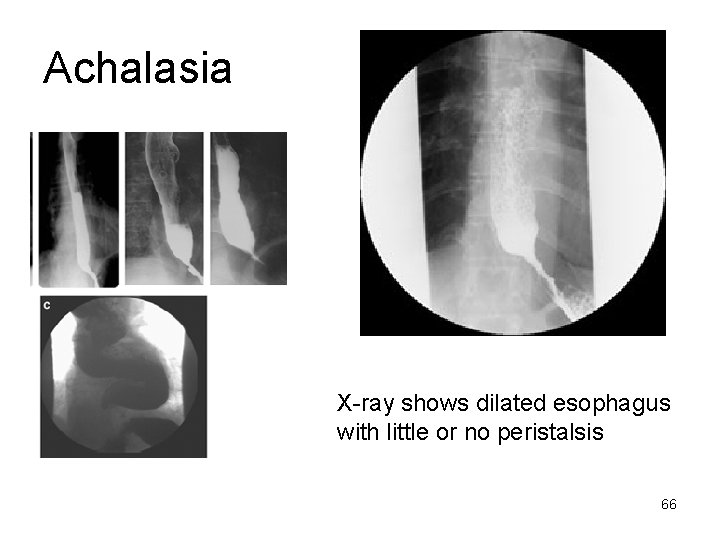
Achalasia X-ray shows dilated esophagus with little or no peristalsis 66
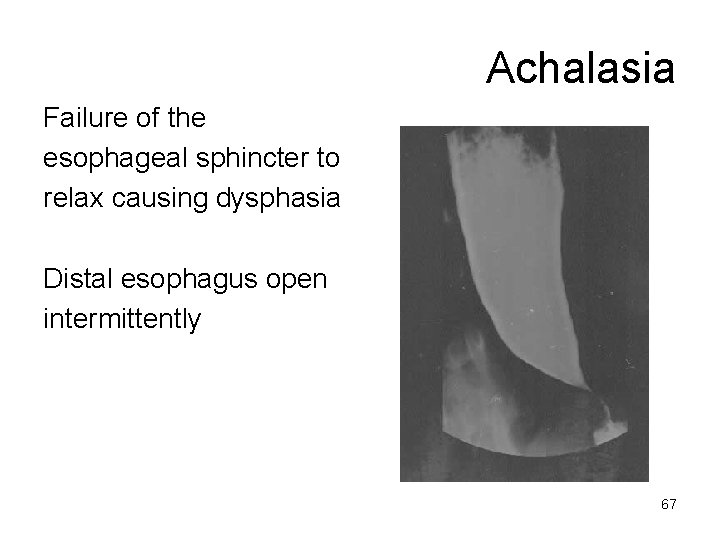
Achalasia Failure of the esophageal sphincter to relax causing dysphasia Distal esophagus open intermittently 67
Diverticular Diseases 68
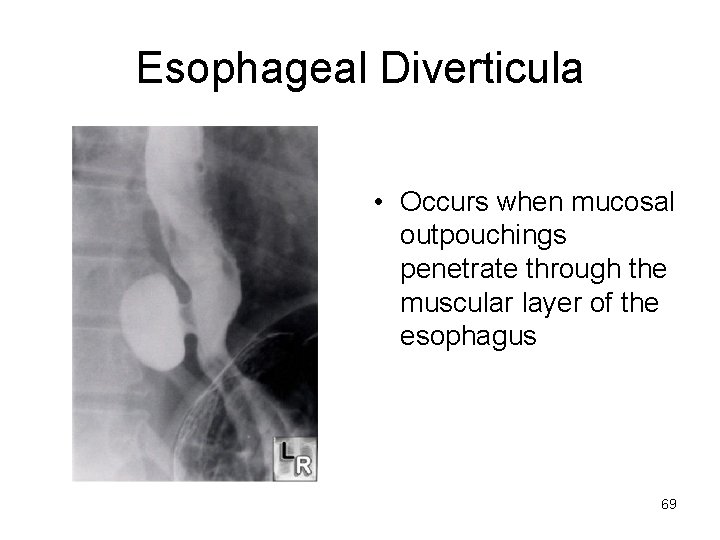
Esophageal Diverticula • Occurs when mucosal outpouchings penetrate through the muscular layer of the esophagus 69
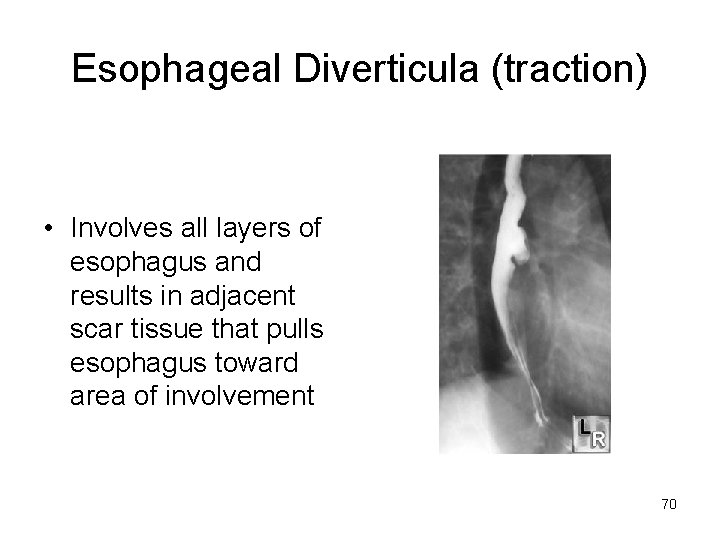
Esophageal Diverticula (traction) • Involves all layers of esophagus and results in adjacent scar tissue that pulls esophagus toward area of involvement 70
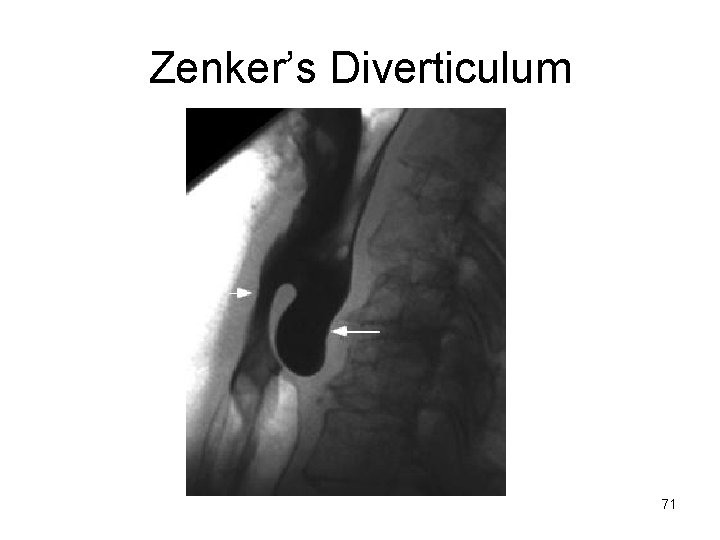
Zenker’s Diverticulum 71
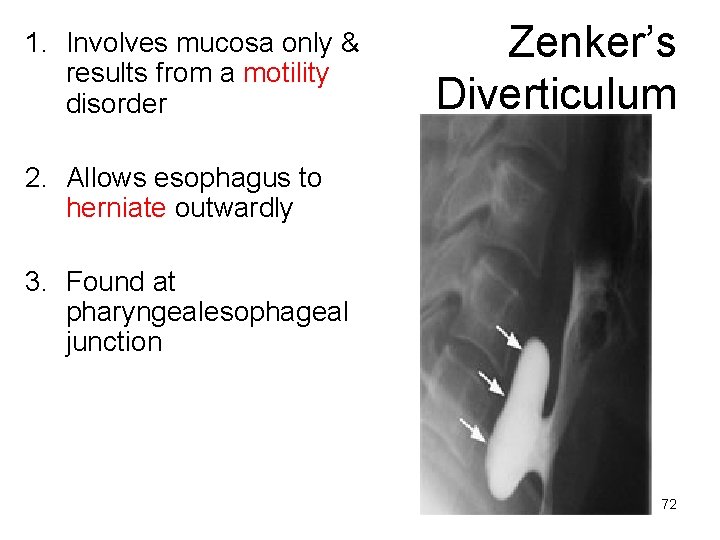
1. Involves mucosa only & results from a motility disorder Zenker’s Diverticulum 2. Allows esophagus to herniate outwardly 3. Found at pharyngealesophageal junction 72
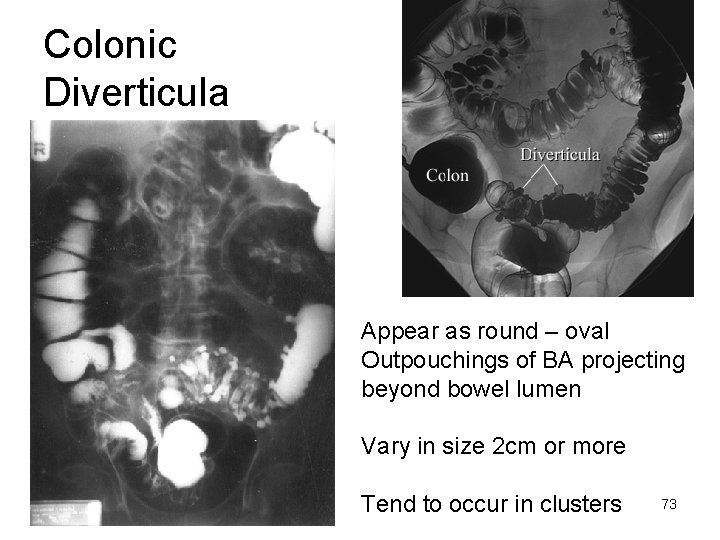
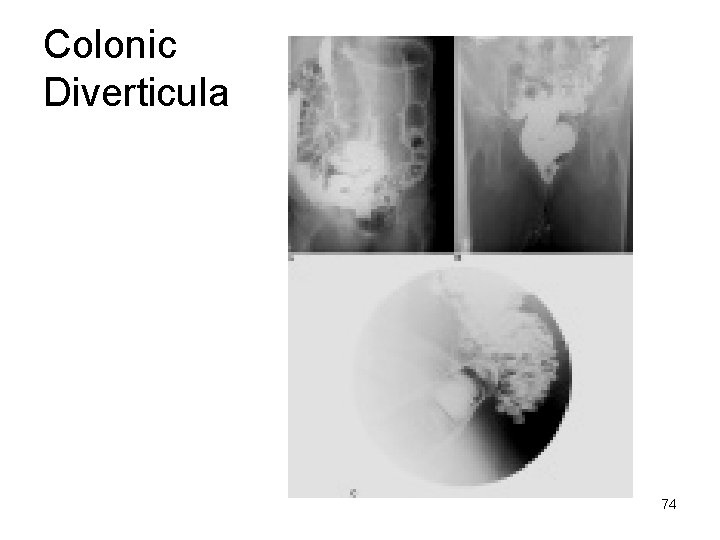
Colonic Diverticula Appear as round – oval Outpouchings of BA projecting beyond bowel lumen Vary in size 2 cm or more Tend to occur in clusters 73
Colonic Diverticula 74
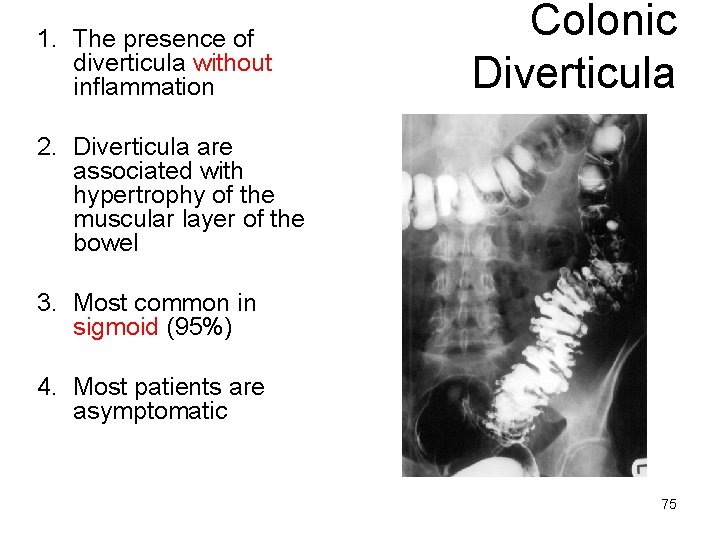
1. The presence of diverticula without inflammation Colonic Diverticula 2. Diverticula are associated with hypertrophy of the muscular layer of the bowel 3. Most common in sigmoid (95%) 4. Most patients are asymptomatic 75
Diverticulitis 1. Inflammation of the diverticulum 2. Exacerbated by feces lodging in the diverticulum 3. Signs and symptoms: fever, LLQ pain, tenderness and increased WBC count 4. BA shows diverticulum 5. Treatment centers on reduction of inflammation and infection 76
Neoplastic Diseases 77
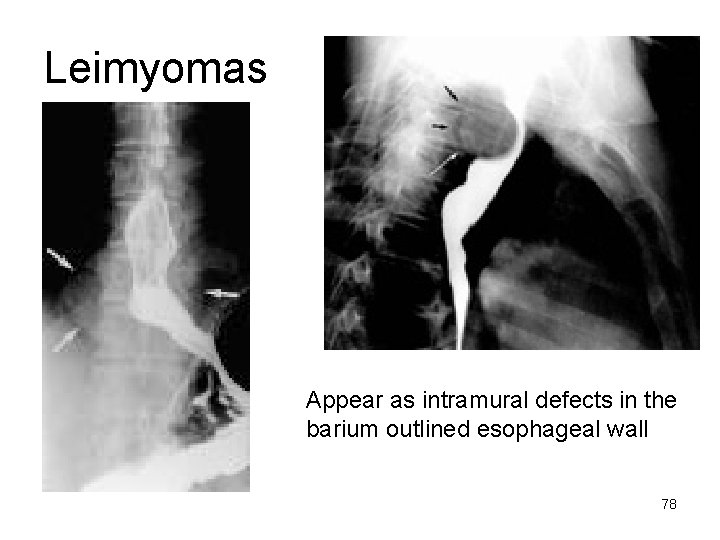
Leimyomas Appear as intramural defects in the barium outlined esophageal wall 78
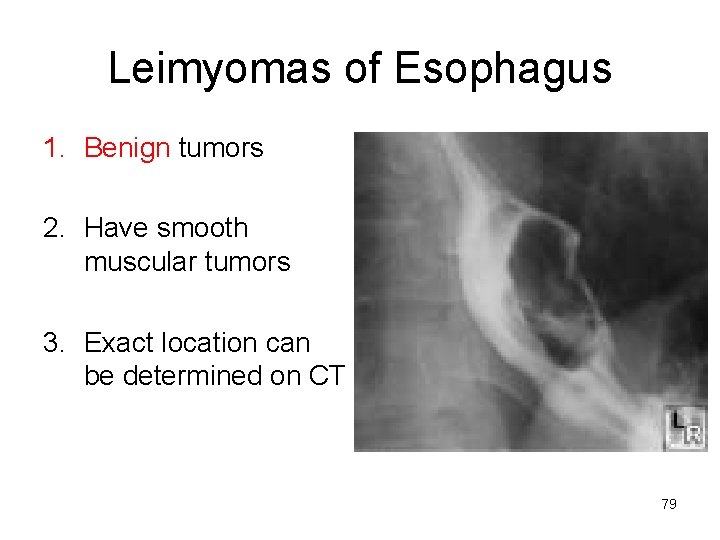
Leimyomas of Esophagus 1. Benign tumors 2. Have smooth muscular tumors 3. Exact location can be determined on CT 79
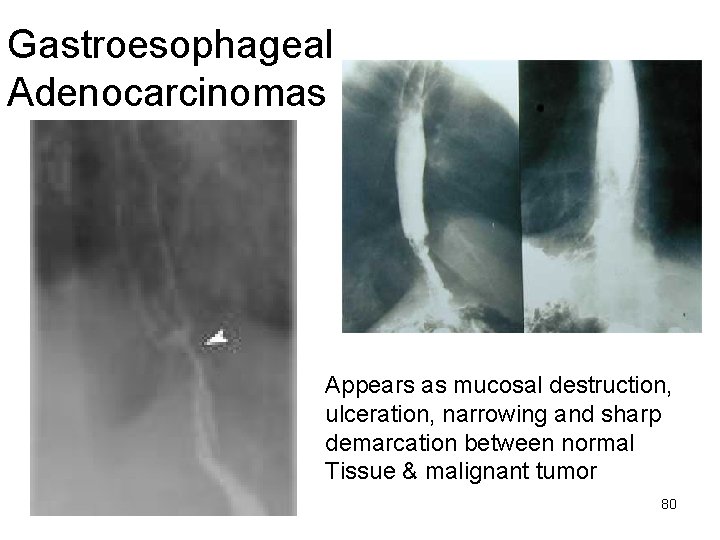
Gastroesophageal Adenocarcinomas Appears as mucosal destruction, ulceration, narrowing and sharp demarcation between normal Tissue & malignant tumor 80
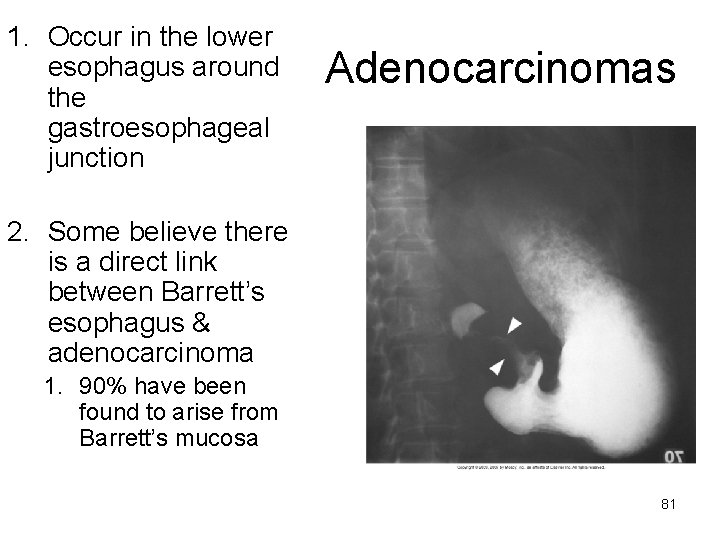
1. Occur in the lower esophagus around the gastroesophageal junction Adenocarcinomas 2. Some believe there is a direct link between Barrett’s esophagus & adenocarcinoma 1. 90% have been found to arise from Barrett’s mucosa 81
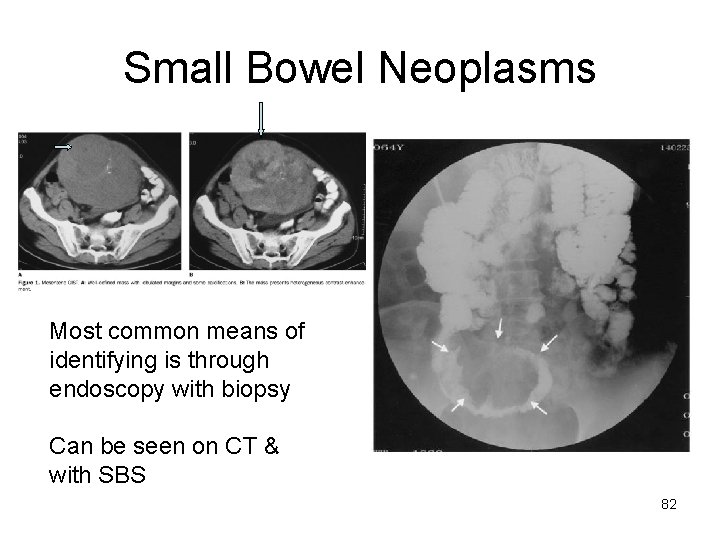
Small Bowel Neoplasms Most common means of identifying is through endoscopy with biopsy Can be seen on CT & with SBS 82
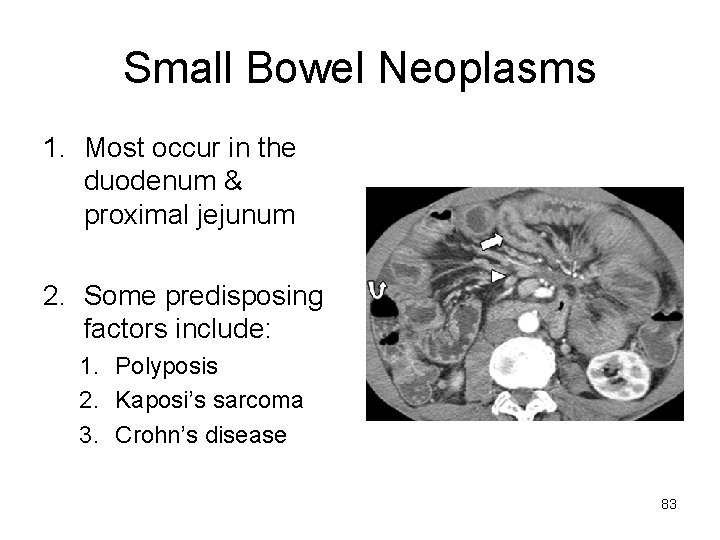
Small Bowel Neoplasms 1. Most occur in the duodenum & proximal jejunum 2. Some predisposing factors include: 1. Polyposis 2. Kaposi’s sarcoma 3. Crohn’s disease 83
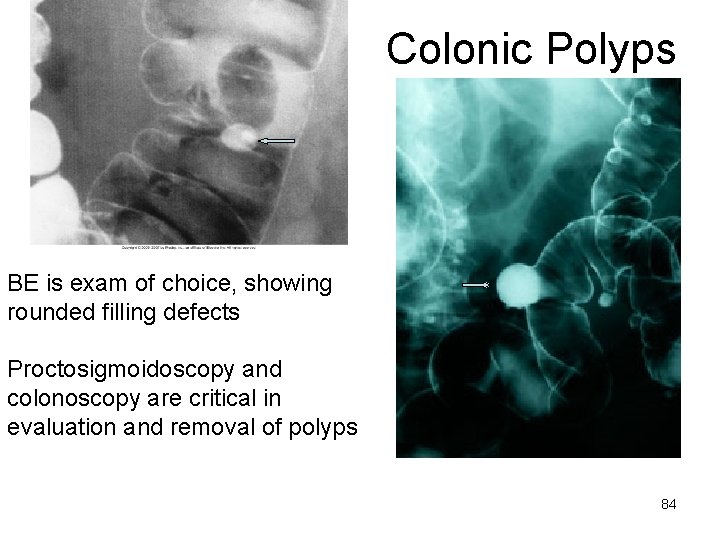
Colonic Polyps BE is exam of choice, showing rounded filling defects Proctosigmoidoscopy and colonoscopy are critical in evaluation and removal of polyps 84
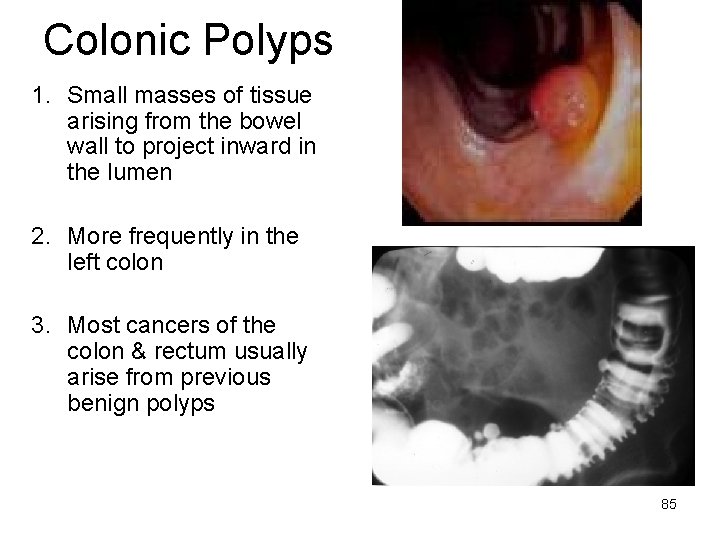
Colonic Polyps 1. Small masses of tissue arising from the bowel wall to project inward in the lumen 2. More frequently in the left colon 3. Most cancers of the colon & rectum usually arise from previous benign polyps 85
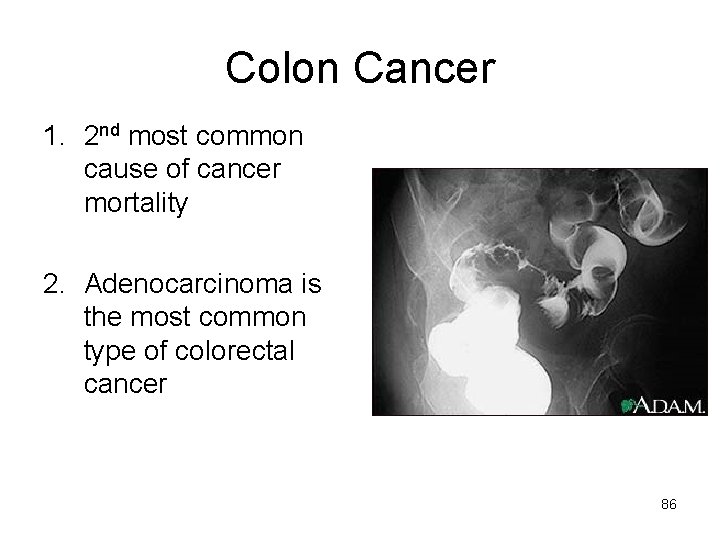
Colon Cancer 1. 2 nd most common cause of cancer mortality 2. Adenocarcinoma is the most common type of colorectal cancer 86
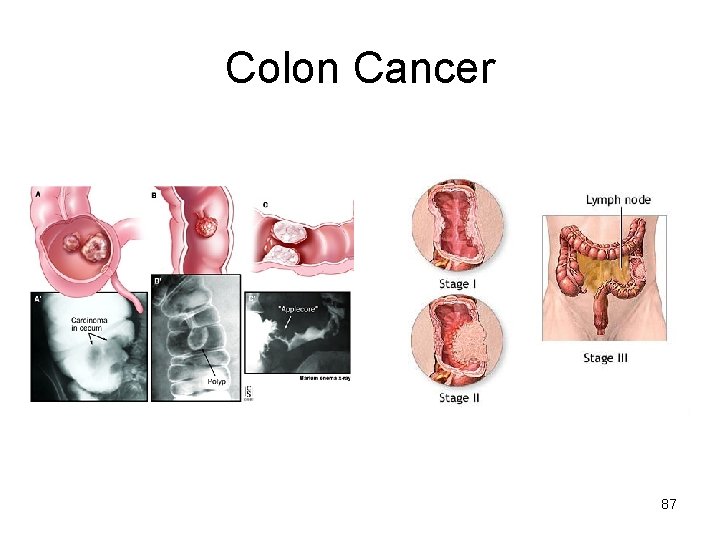
Colon Cancer 87
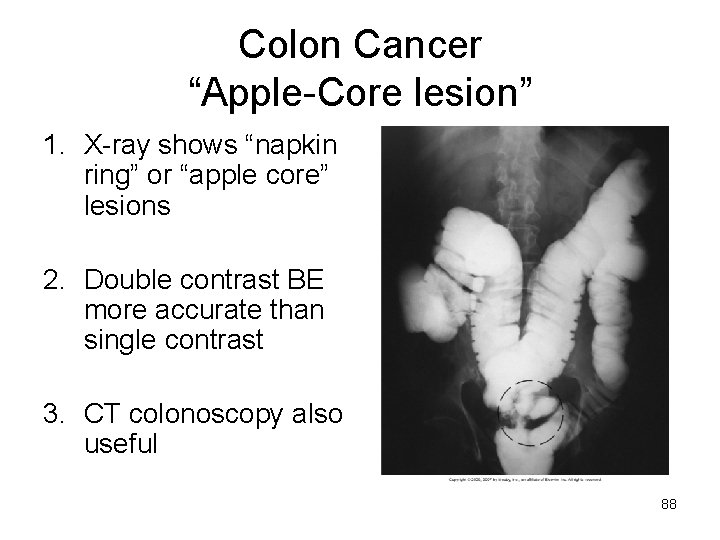
Colon Cancer “Apple-Core lesion” 1. X-ray shows “napkin ring” or “apple core” lesions 2. Double contrast BE more accurate than single contrast 3. CT colonoscopy also useful 88
CT of Abdomen & GI 1. Clearly demonstrates abdominal organs that are normally not apparent on x-ray w/o contrast 2. Recommended for bowel obstruction diagnosis 3. Virtual colonoscopy can be done to see areas not seen during a regular colonoscopy 89
MRI imaging of Abdomen & GI 1. Still limited due to bowel motion 2. Useful in demonstrating retroperitoneal masses impinging on GI system 3. Can differentiate between pathology & normal tissue 90
US imaging of Abdomen & GI 1. Not useful in imaging of the GI system 2. Extensively used to image the retroperitoneum because of the flexibility of angling the transducer 3. With this modality it is possible to image behind the bowel & assess for abnormalities 91
Nuclear Medicine imaging for Abdomen & GI 1. Useful is detecting: 1. 2. 3. 4. GI bleeds Gastric emptying time Presence of H. Pylori Infection from gastric ulcers 2. PET has been known to demonstrate 20% of esophageal cancer undetected by CT 92
Endoscopic Procedures 1. Fiberoptic tube device to look inside hollow organs or cavities 2. Upper endoscopy can see esophagus, stomach, duodenum & proximal jejunum 3. Colonoscopy to the terminal ileum 4. Small bowel is still out of reach 5. Capsule endoscopy is a camera pill that is swallowed and takes pictures of the GI tract 1. Drawbacks include inability to biopsy area and locate pathology 2. Insurance reimbursement 6. Also used for several therapeutic applications 1. 2. 3. 4. Biopsies Stent placement Polyp removal Stone removal 93
- Slides: 93